
MELU-321 · Lesson 11 of 12 · 18 min
Renewal and continuing education
▶ Video coming soon A video version of this lesson is on the way.
Hal kept his master card in his wallet for more than thirty years, and in all that time he let it lapse only once, in 2002, when the renewal reminder went to an old address and he did not notice until a general contractor asked for a copy of a current card. The reinstatement took weeks and an extra fee, and he spent them letting his journeymen sign nothing and running every job through another master he knew. "Nobody talks about renewal on exam day," he told Angela after she passed. "But you will renew this license ten times if you are lucky, and every one of those is a deadline you cannot miss."
This lesson covers how a Virginia master electrician keeps the tradesman license in force. It explains the three-year renewal cycle, the continuing education requirement and how hours are counted when a person holds more than one designation, how to choose an approved provider and course, how completion is reported through provider rosters, what happens when a license expires, how the individual license and the firm's contractor license renew on different schedules, and a simple system for tracking it all.
The renewal cycle
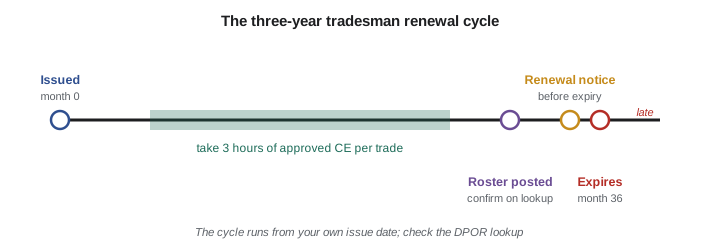
Virginia tradesman licenses, including the master electrician license, renew every three years. The cycle runs from the date the license was issued rather than from a single statewide date, so every license holder must check the expiration date on his or her own card and in DPOR's license lookup. DPOR sends a renewal notice before expiration, but the Board's position is that failure to receive a notice does not excuse a late renewal, which is why keeping DPOR's address record current matters. Hal's 2002 lapse came from an address change he had never reported.
Renewal requires completing the required continuing education within the current three-year period, then submitting the renewal and fee, usually online. The renewal fee is set by the Board's regulations and changes from time to time, so it should be checked on DPOR's fee schedule rather than memorized. A licensee who does not renew on time cannot perform work that requires the license until it is renewed or reinstated, and the firm that relies on the licensee as its qualified individual may find its own license at risk.
How many hours
According to DPOR's tradesman continuing education information, holders of journeyman or master designations in the electrical trade must complete three hours of Board-approved continuing education during each three-year renewal period. The same three hours apply to plumbing and HVAC designations, and gas fitting designations require one hour. The hours are counted per trade: a person who holds both an electrical and a plumbing designation needs three hours for each, six hours in total. A person who holds both a master and a journeyman designation in the same trade needs only one course for that trade.
The electrical course is expected to address the code, and in practice most approved electrical courses cover changes in the edition of the NEC adopted through the Uniform Statewide Building Code. That is useful in two ways. It meets the requirement, and it keeps the master current on the rules that the building officials described in Lesson 6 will apply on inspection. When the 2021 USBC took effect in January 2024 with the 2020 NEC, approved providers across the state updated their courses, and a master who renewed in 2024 or 2025 usually learned the new edition's changes in the required class.
| Designations held | Hours per three-year cycle (summary) |
|---|---|
| Master electrician only | 3 hours |
| Master and journeyman electrician | 3 hours (one course for the trade) |
| Master electrician and master plumber | 6 hours (3 per trade) |
| Master electrician and a gas fitter designation | 4 hours (3 plus 1) |
# Tradesman continuing education hours per three-year cycle (study aid)
HOURS = {"ELE": 3, "PLB": 3, "HVAC": 3, "GAS": 1}

def hours_needed(designations):
    trades = set()
    for d in designations:
        trade = d.split()[-1]          # "Master ELE" -> "ELE"
        if trade in ("GFC", "LPG", "NGF"):
            trade = "GAS"              # one approved gas course covers all three
        trades.add(trade)
    return sum(HOURS[t] for t in trades)

people = {
    "Angela": ["Master ELE"],
    "Hal": ["Master ELE", "Journeyman ELE"],
    "Marcus": ["Journeyman ELE", "Journeyman PLB"],
    "Rosa": ["Master ELE", "Master LPG", "Master NGF"],
}
for name, ds in people.items():
print(f"{name}: {', '.join(ds)} -> {hours_needed(ds)} hours")Angela: Master ELE -> 3 hours Hal: Master ELE, Journeyman ELE -> 3 hours Marcus: Journeyman ELE, Journeyman PLB -> 6 hours Rosa: Master ELE, Master LPG, Master NGF -> 4 hours
The study aid shows the counting rules at work. Hal's two electrical designations need one three-hour course. Marcus holds two trades and needs six hours. Rosa needs three hours for electrical and one hour for gas, because one approved gas course covers all of the gas designations she holds.
Approved providers and courses
Only Board-approved courses from approved providers count. DPOR publishes a list of approved tradesman continuing education providers, which includes Virginia community colleges, joint apprenticeship training committees, trade associations and a number of national online providers. Some providers are approved only for certain trades, and not every course a provider offers is approved, so a master should confirm that the specific course is approved for the electrical trade before paying for it. Courses are offered in classrooms, by correspondence and online, and a course approved in another state does not count in Virginia unless it is also approved here.
Angela took her first renewal course at Virginia Western Community College in Roanoke, which offers tradesman renewal classes, and encouraged Mill Mountain's journeymen to take theirs together in the shop's training room when the college offered an on-site session. The group format had a side benefit: the crews discussed how the code changes would affect the company's typical installations, and Angela turned the discussion into a one-page summary for the field.
Rosters, records and proof
Approved providers report completion to DPOR electronically by submitting rosters, which are then posted to each licensee's record. Licensees are not required to submit proof of completion themselves, but DPOR strongly encourages them to keep their certificates in case the Board asks for them. Roster posting can take about two weeks, and the Board cannot confirm completion until the record posts, so a master who takes the course in the last week before expiration risks a renewal that cannot be processed in time. Registering with the provider under the exact name shown on the tradesman license avoids roster records that fail to match.
Mill Mountain kept a simple record for every licensed person: license number, designations, expiration date, the course taken in the current cycle, the provider, the completion date, the date the roster posted and a scanned certificate. Denise checked DPOR's lookup a few weeks after each course to confirm that the hours had posted, and followed up with the provider when they had not.
Expiration and reinstatement
A license that is not renewed by its expiration date expires. DPOR's procedures allow a short period after expiration in which a license can be renewed with a late fee and, after that, require reinstatement, which involves an application, a higher fee and Board staff review. A license that has been expired for a long time may require the person to meet the requirements for a new license again. During any period of expiration, the person may not perform or supervise work that requires the license. The specific periods and fees are set in the Board's regulations, so check them on DPOR's site rather than relying on a number remembered from someone else's experience.
Expiration also has consequences beyond the individual. If the master is the firm's qualified individual for ELE, the firm no longer has a qualified individual for that classification while the license is expired. Permits, inspections and contracts that depend on the master's license can be delayed, and customers or general contractors who check DPOR's records may stop the work. Hal's 2002 lapse cost Mill Mountain two delayed inspections and an uncomfortable conversation with a general contractor.
The individual license and the firm license
The tradesman license and the firm's contractor license are separate credentials with separate renewal cycles. The contractor license, discussed in Lesson 8, renews on its own schedule, with its own fee and, for some firms, its own continuing education requirements for certain people. A master who also serves as a firm's designated employee or member of responsible management should track both. The renewal of one does not renew the other, and a lapse in either can stop the firm from working.
Getting value from the required hours
Three hours every three years is a modest requirement, and many masters treat it as a box to check. The better masters treat it as the minimum. The NEC changes on a three-year cycle, Virginia adopts new editions through the USBC on its own schedule, and manufacturers introduce new equipment, from energy storage systems to electric vehicle supply equipment, faster than any short course can cover. A master who reads the significant changes in each new edition, attends the occasional inspector association meeting and asks the local building official about common corrections stays ahead of problems that would otherwise show up as failed inspections.
Angela built a short learning plan for herself and the company. Each year she picked one topic that the company's work was moving toward, such as large photovoltaic systems or health care facility wiring, and took a longer course or read the relevant parts of the code in depth. She also asked each journeyman preparing for the master exam to present one code change at a monthly safety meeting. The required three hours fit inside that plan without any special effort, and the company's inspection results improved.
A renewal calendar
Because every tradesman license renews on its own date, a firm with several licensed people faces renewals scattered across the year. Mill Mountain's calendar listed each person's expiration date, a reminder date six months ahead for the continuing education course, a reminder ninety days ahead to confirm that the roster had posted, and a reminder sixty days ahead to submit the renewal. The same calendar carried the firm's contractor license, its insurance policies and its local business license renewals, so that one person reviewed every deadline once a month.
The calendar also handled the people who were working toward licenses. When Marcus sat for the master exam, Denise added his expected issue date and a placeholder renewal three years later, and when Eli finished his apprenticeship and earned his journeyman card, his first renewal went on the calendar the same week. Nobody at Mill Mountain had to remember a renewal date, which was exactly the point. Hal's one lapse in more than thirty years had come from relying on memory and the mail, and the calendar was his way of making sure it never happened to anyone else in the company.
Worked problem
Planning a renewal
Angela's master license was issued on February 27, 2026. She also earns a journeyman plumber license in 2027. When does her master license expire, and how many hours of continuing education will she need for her next electrical renewal?
Show solution
- Tradesman licenses renew every three years from issue, so the master license expires in February 2029; she should confirm the exact date on her record.
- She needs three hours of approved electrical continuing education within the cycle.
- Her plumbing license has its own cycle and needs its own three hours, which do not count toward the electrical requirement.
- She should take the electrical course by late 2028 so that the roster posts well before expiration.
Answer: The master license expires in February 2029; she needs three approved electrical hours, completed early enough for the roster to post.
Common mistakes
MistakeAssuming tradesman licenses renew every two years.
InsteadVirginia tradesman licenses renew every three years; check your own expiration date.
MistakeTaking one three-hour course for two different trades.
InsteadHours are counted per trade; two trades need three hours each.
MistakeTaking the course the week before expiration.
InsteadRoster posting takes about two weeks; finish early.
MistakeAssuming the firm's renewal covers the individual license.
InsteadThe contractor license and the tradesman license renew separately.
Summary and key terms
- Virginia tradesman licenses renew every three years from the issue date.
- Master and journeyman electricians need three hours of approved continuing education per cycle.
- Hours are counted per trade; one course covers both master and journeyman in the same trade.
- Approved providers submit rosters to DPOR; keep your certificate and confirm posting.
- Expired licenses cannot be used, and the firm loses that qualified individual until renewal or reinstatement.
- Renewal cycle
- The three-year period between renewals of a tradesman license.
- Approved provider
- An organization the Board has approved to offer tradesman continuing education.
- Roster
- The provider's electronic report of course completions submitted to DPOR.
- Reinstatement
- The process to restore a license after the late-renewal period has passed.
- Designation
- A trade and level on a tradesman license, such as master electrician.
Practice problems
Work each problem on paper first, then reveal the answer to check.
How often does a Virginia master electrician license renew?
Show answer
Every three years.
How many hours does a person holding master ELE and journeyman ELE need?
Show answer
Three hours; one course covers both in the same trade.
Who reports course completion to DPOR?
Show answer
The approved provider, by submitting a roster.
Lesson quiz · 5 questions
Score 60% or more to complete this lesson.
Create a free account to save your progress, take quizzes and earn a certificate.