
MELU-321 · Lesson 4 of 12 · 18 min
The exam format and the references allowed
▶ Video coming soon A video version of this lesson is on the way.
Angela's approval notice arrived on a Thursday, and that evening she downloaded the PSI candidate information bulletin and read it cover to cover at the kitchen table. The section on the electrician examinations was short, but every line mattered. It told her how many questions there would be, how long she would have, what score she needed, and which books she could carry into the room. It also told her what she could not bring, and that list was as important as the first. "Open book," Hal said when she showed him, "doesn't mean easy. It means they expect you to know where everything is."
This lesson explains the format of the Virginia master electrician examination, the content it covers, the references PSI allows and the rules for preparing them, how open-book exams are scored and paced, and how to use the score report. The figures in this lesson come from the PSI bulletin for the Board for Contractors that was current in 2024, supplemented by what exam preparation providers reported in 2026. Because the bulletin is revised from time to time, the bulletin current on the day you test is the only authority.
Format and scoring
According to the 2024 bulletin, the Virginia master electrician examination has 90 questions with a time limit of 270 minutes, four and a half hours, and a candidate needs 63 correct answers to pass, which works out to seventy correct out of every hundred. For comparison, the journeyman electrician exam had 70 questions in 210 minutes with 49 correct needed. All questions are multiple choice, and PSI may include a small number of unscored pretest questions that count against your time but not your score. The bulletin says that all of the Board's tradesman examinations are open book.
The exam is scored against the total. There is no separate passing mark for each section in the electrician exams as described in the 2024 bulletin, so a candidate who is strong on calculations can make up for a few misses on regulations questions, and the reverse. Results are typically reported at the end of the session, with a pass or fail and, for a failing candidate, a diagnostic breakdown by content area. Never assume a question is unscored; treat every question as if it counts.
| Item | Master electrician | Journeyman electrician |
|---|---|---|
| Questions | 90 | 70 |
| Time allowed | 270 minutes | 210 minutes |
| Correct answers needed | 63 | 49 |
| Exam fee (2024 bulletin) | 125 dollars | 100 dollars |
| Format | Open book, multiple choice | Open book, multiple choice |
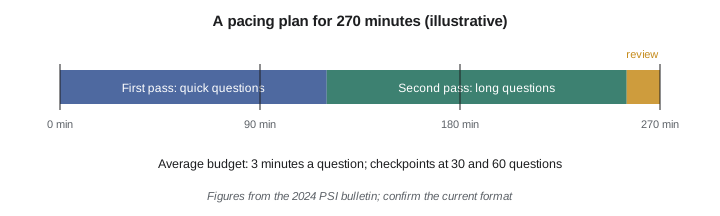
Pacing matters on a long open-book exam. At 270 minutes for 90 questions, the average budget is three minutes a question. That sounds generous until you meet a question that requires a calculation, two table lookups and a check of an exception. A sound plan is to work the whole exam in two passes: answer every question you can do quickly in the first pass, flag the long ones, and return to them in the second pass with the time you have banked.
# Pacing plan for a 90-question, 270-minute exam (study aid)
questions, minutes = 90, 270
per_q = minutes / questions
print(f"Average budget: {per_q:.1f} minutes per question")

# Plan: first pass on quick items, banked time for long items
quick, long_items = 60, 30
quick_budget = 2.0
first_pass = quick * quick_budget
remaining = minutes - first_pass - 15   # keep 15 minutes to review flags and answer sheet
print(f"First pass: {quick} quick questions in about {first_pass:.0f} minutes")
print(f"Second pass: {long_items} long questions share {remaining:.0f} minutes, about {remaining / long_items:.1f} each")Average budget: 3.0 minutes per question First pass: 60 quick questions in about 120 minutes Second pass: 30 long questions share 135 minutes, about 4.5 each
What the exam covers
The bulletin's content outline for the electrician exams lists the broad areas tested, with the number of questions in each. Expect questions spread across general knowledge and definitions, services and service equipment, feeders and branch circuits, wiring methods and materials, grounding and bonding, overcurrent protection, motors and controls, transformers, special occupancies and equipment, calculations of many kinds, and Virginia laws and regulations governing tradesmen. The master exam goes deeper than the journeyman exam into design-level calculations such as service and feeder sizing, demand factors, motor feeders and transformer protection, which is why the core courses in this series spend so much time on them.
The regulations portion deserves real attention. Candidates who are strong in the trade often treat the regulations questions as easy points and then lose them by guessing. Questions may ask about license renewal periods, continuing education, supervision, standards of conduct, what must be reported to the Board, and the roles of licensees. Lessons 7 and 11 of this course cover the parts of 18VAC50-30 that are most likely to appear. The regulations booklet is one of the allowed references, so a well-tabbed copy turns these questions into quick lookups.
The references allowed
The 2024 bulletin listed the same references for the journeyman and master electrician exams: the National Electrical Code (NFPA 70), the American Electricians' Handbook (sixteenth edition, Croft, Hartwell and Summers), and the Board's Individual License and Certification Regulations. The NEC edition listed in that 2024 bulletin was the 2017 edition, and it stated that code questions are based only on the edition listed. Exam preparation providers reported in 2026 that the electrician exams had moved to the 2020 NEC, matching the edition adopted through the 2021 USBC, and some lists also included NFPA 70E. These differences are exactly why you must check the current bulletin before buying books.
The edition question is not a small one. Article numbers, section numbers and requirements change between editions, and an answer that is right under one edition can be wrong under another. If the bulletin lists the 2020 NEC, study and tab the 2020 NEC, even if your jurisdiction's day-to-day work is under the same edition and even if a newer edition has been published nationally. Angela bought a fresh copy of the edition the bulletin listed rather than using the dog-eared copy from the Mill Mountain truck, which turned out to be an older edition.
Rules for preparing your books
PSI's rules on references are strict, and candidates are turned away from the room for breaking them. Under the 2024 bulletin, candidates must bring their own references; nothing is provided at the site. Study guides are not permitted. Loose or unbound pages are not allowed, and references downloaded and printed must be spiral bound, hole-punched and placed in a binder, or stapled in the left-hand corner. References may be highlighted, underlined and indexed in advance, but must not contain handwritten notes, and only permanent tabs are allowed, not removable sticky notes.
These rules shape how you tab. Permanent adhesive tabs, labeled before the exam with article or chapter titles, are allowed; writing formulas or answers in the margins is not. Highlighting key words in a table heading is allowed; jotting a note next to it is not. Proctors check references before the exam, and a book with prohibited notes may be removed from the room, leaving the candidate without it for the whole session. When in doubt, ask PSI before exam day rather than at the check-in desk.
A tabbing plan
Good tabs are the difference between a two-minute lookup and a ten-minute one. Most successful candidates tab the NEC by chapter and then by the articles they use most: definitions in Article 100, the general requirements in Article 110, branch circuits, feeders and load calculations, services, overcurrent protection, grounding and bonding, the wiring method articles, conductors and their tables, boxes and fittings, motors, air-conditioning equipment, transformers, and the special occupancy articles most often tested. The Chapter 9 tables and the annexes that hold conduit fill and example calculations deserve their own tabs, because calculation questions send you to them again and again.
Tab the other references too. In the American Electricians' Handbook, tab the sections on formulas, motor data, transformer connections and conductor properties, which can save time on questions that ask about practice rather than code. In the regulations booklet, tab definitions, the qualification section, renewal and continuing education, and the standards of practice and conduct. Angela color-coded her tabs, one color for each reference, and placed them at different heights so she could find a book's tabs by feel. She then spent three evenings doing nothing but timed lookups, adjusting tabs whenever a lookup took too long.
Calculators and the testing room
Calculation questions are a large share of the master exam, so the calculator rules matter. PSI bulletins generally allow a silent, non-programmable, non-printing calculator and prohibit devices with text storage, communication functions or alphabetic keyboards; phones and smart watches are never allowed. Read the current bulletin's exact wording and practice with the same calculator you will bring, including its square root key and memory functions, which you will use for three-phase and voltage drop calculations. A candidate who learns a new calculator on exam day loses minutes on every calculation.
Expect a formal check-in. Staff confirm your identification, inspect your references, and assign a seat; personal items go into a locker or stay outside. Breaks may be allowed, but the exam clock usually keeps running. Scratch paper or an erasable board is typically provided and collected at the end. Arrive early enough that check-in delays do not eat into your nerves, and bring a sweater, because testing rooms are often cold. Small comforts matter on a four-and-a-half-hour exam.
Reading the score report
A candidate who passes needs nothing more than the pass notice. A candidate who fails receives something more valuable than it feels like at the time: a breakdown of performance by content area. Read it the way you would read a load calculation, looking for the biggest numbers first. If one area is far below the others, that area deserves most of your study time before a retake. If every area is a little low, the problem is more often pacing or lookup speed than knowledge, and timed practice is the cure.
Hal liked to tell the story of his own first attempt in 1991, when he failed by three questions. His report showed that he had done well on calculations and poorly on regulations and on the special occupancy articles, both of which he had barely studied because he thought they were common sense. He spent a month tabbing and reading the regulations and the special occupancy chapter, and passed comfortably on his second try. "The report told me exactly where I'd been lazy," he said. Angela wrote that line on the inside cover of her notebook, where notes were allowed.
Common mistakes
MistakeBringing the edition of the NEC you use at work rather than the one in the bulletin.
InsteadBuy and tab the edition the current bulletin lists; code questions are based only on that edition.
MistakeWriting formulas in the margins of the NEC.
InsteadHighlighting, underlining and permanent tabs are allowed; handwritten notes are not.
MistakeSkipping the regulations booklet.
InsteadBring and tab it; regulations questions become quick lookups.
MistakeSpending ten minutes on the first hard question.
InsteadUse two passes and flag long questions so quick points are banked first.
Worked problem
Building a pacing budget
On a practice exam, Angela finds that 25 of 90 questions need a calculation or several lookups, and she averages six minutes on those. The rest take her about two minutes each. Does her pace fit within 270 minutes with 15 minutes held back for review?
Show solution
- Quick questions: 65 questions at 2 minutes each is 130 minutes.
- Long questions: 25 questions at 6 minutes each is 150 minutes.
- Total working time is 280 minutes, plus 15 minutes of review makes 295 minutes.
- That exceeds 270 minutes by 25 minutes, so she must speed up her lookups or her calculations.
Answer: No. She is about 25 minutes over and needs faster lookups, which is what tabbing practice is for.
Summary and key terms
- The 2024 bulletin described the master exam as 90 questions in 270 minutes, with 63 correct needed to pass.
- All Board tradesman exams are open book; you bring your own references.
- References listed: the NEC (edition per the current bulletin), the American Electricians' Handbook and the Board's individual license regulations.
- Highlighting, underlining and permanent tabs are allowed; handwritten notes, loose pages and study guides are not.
- Pace with two passes and use the score report to target study if a retake is needed.
- Open book
- An exam in which candidates may use listed references during the test.
- Pretest question
- An unscored question included to evaluate it for future use.
- Permanent tab
- An adhesive index tab that cannot be removed and repositioned; the only kind allowed.
- Content outline
- The bulletin's list of subject areas and the number of questions in each.
- Two-pass method
- Answering quick questions first and returning to flagged long questions.
Practice problems
Work each problem on paper first, then reveal the answer to check.
How many minutes per question does the master exam allow on average, using the 2024 figures?
Show answer
Three minutes (270 minutes divided by 90 questions).
May a candidate bring a commercial study guide with practice questions?
Show answer
No. Study guides are not permitted under the bulletin's rules.
Which document decides the NEC edition used for exam questions?
Show answer
The current PSI candidate information bulletin.
Lesson quiz · 5 questions
Score 60% or more to complete this lesson.
Create a free account to save your progress, take quizzes and earn a certificate.