
MELU-321 · Lesson 12 of 12 · 25 min
Practice exam review and test-day strategy
▶ Video coming soon A video version of this lesson is on the way.
Two Saturdays before her exam, Angela sat alone in Mill Mountain's conference room with her tabbed code book, the American Electricians' Handbook, a printed copy of the Board's tradesman regulations, a calculator, a kitchen timer and a practice set of ninety questions. Hal had insisted on one full session under exam conditions. "Four and a half hours with those books is a different animal from an hour after work," he said. When the timer went off, she had answered eighty-four questions and guessed on the last six. That result shaped her final two weeks more than anything else in her preparation. This lesson pulls the course together: a twelve-week plan, the calculations and Virginia topics most worth reviewing, worked practice questions, how to review a practice session, and a plan for exam day.
A twelve-week plan
Most candidates who pass on the first attempt follow some version of the same plan. They spend the first weeks getting the right editions of the references and tabbing them, the middle weeks working through the technical content and calculations, a short block on the Virginia regulations and the business and legal topics in this course, and the last weeks on timed practice and weak areas. Angela's plan, built with Hal, gave the most time to the code and calculations, but it protected time for the Board's regulations, because questions about licensing rules are short, direct and easy to lose through carelessness.
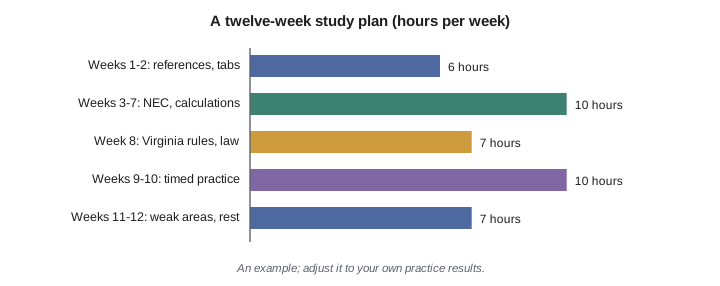
| Weeks | Focus | Output |
|---|---|---|
| 1-2 | Confirm editions on the bulletin; get and tab the NEC, handbook and regulations | Tabbed books and a lookup log |
| 3-7 | NEC: services, feeders, grounding and bonding, wiring methods, motors, transformers, special occupancies | Calculation notebook and timed lookups |
| 8 | Board regulations, USBC structure, permits, liens, safety and workers' compensation | Summary sheets by topic (for study, not the exam room) |
| 9-10 | Full timed practice sessions | Scores by content area |
| 11-12 | Weak areas, final tab adjustments, rest before exam day | Confidence and a test-day plan |
Technical review: the calculations that keep coming back
Across the content outline, the same calculations appear again and again: Ohm's law and power, single-phase and three-phase current, voltage drop, conductor sizing with ambient temperature correction and adjustment for more than three current-carrying conductors, motor branch circuits, transformer current and protection, box and conduit fill, and dwelling and commercial load calculations. The master electrician core courses covered each one in detail. In the last weeks, the goal is speed and accuracy: knowing which formula applies, which article or table to open, and how to check an answer for reasonableness before moving on.
# Quick practice: transformer and three-phase current (illustrative values)
import math
kva = 112.5
for volts in (208, 480):
    amps = kva * 1000 / (math.sqrt(3) * volts)
    print(f"{kva} kVA at {volts} V three-phase: {amps:.1f} A")

# Single-phase voltage drop (illustrative: 2-wire, K = 12.9 for copper)
load_amps, length_ft, cmil, volts = 32, 120, 10380, 240
vd = 2 * 12.9 * load_amps * length_ft / cmil
print(f"Voltage drop: {vd:.2f} V, or {vd / volts * 100:.1f} in every 100 volts")112.5 kVA at 208 V three-phase: 312.3 A 112.5 kVA at 480 V three-phase: 135.3 A Voltage drop: 9.54 V, or 4.0 in every 100 volts
The first result, about 312 amperes on the 208-volt side of a 112.5 kVA transformer and about 135 amperes on the 480-volt side, is worth remembering, because it lets you check transformer questions quickly. The voltage drop example uses the common approximate formula with a constant for copper and an illustrative conductor area; on the exam, take conductor properties from the references and use the method the question asks for. The answer, a little under 10 volts on a 240-volt circuit, is about four volts in every hundred, a result that should prompt a check of whether the question wants a larger conductor.
Virginia review
The Virginia-specific questions draw on the Board's tradesman regulations and on the structure covered in this course. The topics most worth a final review are the licensing routes and experience rules, the duties of a master and the limits on journeymen and apprentices, what a license allows and when it must be shown, how the USBC adopts the NEC and who enforces it, permits and inspections, and the renewal and continuing education rules. The business topics, including contractor classes, liens and workers' compensation, are useful in practice and may appear on contractor exams even when they are not on the master exam outline, so check the current bulletin for what is tested.
| Topic | Main reference | Virginia points from this course |
|---|---|---|
| Eligibility and routes | Tradesman regulations | Experience and training combinations; out-of-state routes |
| Application and exam | PSI bulletin; DPOR forms | Fees, approval, booking, retakes, 63 of 90 to pass (2024) |
| Codes | USBC; NEC | 2021 USBC with the 2020 NEC, effective January 18, 2024 |
| Permits and inspections | USBC Part I | Local building officials, plan review, Technical Review Board |
| Duties | Tradesman regulations | Supervision, conduct, reporting |
| Renewal | Tradesman regulations; DPOR CE page | Three-year cycle; three hours per trade |
# Quick practice: Virginia administrative numbers from this course (2024-2026 sources)
questions, minutes, to_pass = 90, 270, 63
print("Minutes per question:", minutes / questions)
print("Share needed to pass:", round(to_pass / questions * 100), "in every 100")

renewal_years, ce_hours = 3, 3
print("Electrical CE hours per year of the cycle:", round(ce_hours / renewal_years, 1))

designations = {"ELE": 3, "PLB": 3}
print("Hours for a master electrician who is also a master plumber:", sum(designations.values()))Minutes per question: 3.0 Share needed to pass: 70 in every 100 Electrical CE hours per year of the cycle: 1.0 Hours for a master electrician who is also a master plumber: 6
Worked practice questions
Worked problem
Supervision
A master electrician sends a second-year apprentice alone to replace a damaged receptacle in an occupied office while she works across town. Is this consistent with the supervision rules covered in Lesson 7?
Show solution
- Apprentices must work under the supervision of a licensed journeyman or master.
- Sending an apprentice alone, with no licensed person directing the work, is not supervision.
- The master should send a licensed electrician with the apprentice or reschedule the work.
Answer: No; the apprentice needs a licensed journeyman or master supervising the work.
Worked problem
Code edition
A permit was issued in March 2024 for a new building in a Virginia county. Which NEC edition generally applies through the USBC, and who decides questions about it on the job?
Show solution
- The 2021 USBC took effect January 18, 2024, and it references the 2020 NEC.
- The local building official enforces the USBC and interprets it on the job.
- Appeals of the official's decisions go first to the local board of building code appeals, then to the State Technical Review Board.
Answer: The 2020 NEC through the 2021 USBC, enforced by the local building official.
Worked problem
Continuing education
A licensee holds master electrician and journeyman electrician designations. How many hours of continuing education does the next renewal require?
Show solution
- Electrical designations require three hours per three-year cycle.
- Master and journeyman designations in the same trade need only one course.
- No other trade is held.
Answer: Three hours from an approved provider, completed early enough for the roster to post.
Worked problem
Reading the ask
A question describes a 50-ampere continuous load and asks for the minimum rating of the overcurrent device, not the conductor size. A candidate sizes the conductor and picks that answer. What went wrong?
Show solution
- The question asked for the overcurrent device rating.
- For a continuous load, the device generally must be rated above the continuous load by the factor the code requires; confirm the rule in the NEC.
- The candidate solved a related question instead of the one asked.
Answer: Underline what the question asks for before starting; here it was the device rating, not the conductor.
Reviewing a practice session
A practice session is only as useful as the review that follows it. Angela scored 61 out of 90 on her first full session, two short of the passing mark, and her first reaction was to study everything again. Hal asked her to sort the misses instead. She had lost seven questions on grounding and bonding, five on motors, four on load calculations, three on the Board's regulations and the rest scattered. Only nine of her misses came from not knowing the material. The rest came from slow lookups, misread questions, arithmetic slips and the six questions she never reached.
| Cause of miss | What it looks like | Fix |
|---|---|---|
| Did not know it | No idea where to look | Study the topic, then retest it within a week |
| Slow lookup | Found the answer but ran out of time | Add or move tabs; practice timed lookups |
| Misread the question | Answered a different question than the one asked | Underline the ask; restate it before calculating |
| Arithmetic slip | Right method, wrong number | Write each step; check the result for reasonableness |
| Did not reach it | Ran out of time | Set checkpoints and flag slow questions |
Keep a running log of every miss with its cause, the reference and the page where the answer lives, and the time it took. Over several sessions the log shows patterns: an article that always takes too long, a kind of question you misread, a formula you keep inverting. Those patterns are where the final weeks of study pay off most. Angela's second full session, a week later, came in at 70 out of 90, and almost all of the gain came from faster lookups and finishing every question rather than from new knowledge.
# Practice session tracker (illustrative scores)
sessions = [("Session 1", 61, 84), ("Session 2", 70, 90), ("Session 3", 74, 90)]
passing = 63
for name, correct, answered in sessions:
    status = "above" if correct >= passing else "below"
print(f"{name}: {correct}/90 correct, {answered}/90 answered, {status} the passing mark by {abs(correct - passing)}")Session 1: 61/90 correct, 84/90 answered, below the passing mark by 2 Session 2: 70/90 correct, 90/90 answered, above the passing mark by 7 Session 3: 74/90 correct, 90/90 answered, above the passing mark by 11
Using the references efficiently
The candidates who use the references well treat them like tools on a truck: each has a place, and the hand goes to it without searching. Check the current PSI bulletin for its rules on tabs, highlighting and notes before preparing the books, because books that do not meet them can be refused at check-in. Angela used one tab color for NEC chapters, another for the tables she used most, a third for the handbook and a fourth for the Board's regulations. She kept the number of tabs manageable, because a book with too many tabs is as slow as a book with none.
Learn the indexes too. Many questions are answered fastest by going to the index with a key word, then to the article, then to the section. For the regulations, know the parts that cover entry requirements, standards of conduct and renewal. For the handbook, know where the formulas and tables for calculations are. Every minute saved on a lookup is a minute available for a long calculation later in the exam.
Exam day
Prepare the night before: books in a bag, identification that matches the name on the PSI registration, a permitted calculator with fresh batteries, the testing center address in your phone and an early alarm. Sleep matters more than a last evening of cramming. Arrive early, check in calmly and let the staff inspect the books. Use the tutorial to learn the screen. In the first minute, write down your checkpoints, such as 30 questions by the 90-minute mark and 60 by 180 minutes, then work steadily, flag slow questions and leave the last fifteen minutes for the flagged ones. Answer every question, because a blank is certainly wrong and a guess may not be.
Fatigue is the enemy late in a four-and-a-half-hour exam. Angela's practice sessions taught her that her accuracy dropped in the last hour, so she planned a short pause every hour to stretch her hands, look away from the screen and reset. She also brought a simple rule from her practice log: change an answer only when the references give a specific reason, never on a feeling.
After the exam
Angela walked out of the testing center in Roanoke with a passing result. She called Hal from the parking lot, and Denise began the paperwork that afternoon: the license record, the change form that added Angela as a qualified individual for ELE, the permit portal accounts with the local building departments and the update to the company's insurance and bid documents. Marcus asked Angela to sign off on his experience record, and Kenny asked whether she would help him study.
If you do not pass on the first try, read the score report by content area, adjust the plan and schedule the retake as the bulletin allows. Many good masters passed on their second attempt. What matters is the plan you follow afterward and the honesty of your review.
Common mistakes
MistakeDoing practice questions without a timer.
InsteadPractice under exam conditions, including at least one full session of 90 questions in 270 minutes.
MistakeStudying with the wrong code edition.
InsteadConfirm the editions on the current PSI bulletin before buying and tabbing books.
MistakeLeaving flagged questions until there is no time left.
InsteadSet checkpoints and reserve the last minutes for review.
MistakeCramming the night before.
InsteadPack the night before, sleep well and arrive early.
Summary and key terms
- Follow a plan: references and tabs, technical content, Virginia regulations, timed practice, then weak areas.
- Practice the recurring calculations until they are fast: currents, voltage drop, conductor sizing, motors, transformers, fill and load calculations.
- Review the Virginia points: routes, application, exam format, the USBC and NEC edition, permits, duties and renewal.
- Sort practice misses by cause and fix lookups and reading habits.
- On exam day, set checkpoints, flag slow questions, answer everything and rest your eyes each hour.
- Timed practice
- Practice questions answered under exam time limits with the references.
- Lookup log
- A record of where answers were found and how long each lookup took.
- Checkpoint
- A planned number of questions to have answered by a given time.
- Flagging
- Marking a question to return to later in the exam.
- Score report
- The exam result showing performance by content area.
Practice problems
Work each problem on paper first, then reveal the answer to check.
What is the three-phase current of a 75 kVA transformer at 480 volts, to the nearest ampere?
Show answer
75,000 / (1.732 x 480) = about 90 amperes.
Using the 2024 figures, how many minutes per question does the exam allow on average?
Show answer
Three minutes.
What should you do with a question that will take more than five minutes?
Show answer
Flag it, move on and return to it in the review time.
Lesson quiz · 5 questions
Score 60% or more to complete this lesson.
Create a free account to save your progress, take quizzes and earn a certificate.