
MELU-321 · Lesson 7 of 12 · 18 min
Duties and responsibilities of the Master Electrician License holder
▶ Video coming soon A video version of this lesson is on the way.
The week before Angela's exam, Hal took her to lunch at a diner on Williamson Road and talked about something the books barely mention. "Passing gets you the card," he said. "The card gets you responsibilities. When this company lists you as its qualified individual, every electrical job we do is partly yours. When you sign a permit application, you're telling the building official that somebody qualified is responsible for that work. When a journeyman or an apprentice works under you, you're answering for how they're supervised. And the Board expects you to keep your own record clean, renew on time and report what you're supposed to report."
This lesson covers those responsibilities. It explains what a master electrician may do that a journeyman may not, the qualified individual role and what it requires of the firm and the master, supervision of journeymen, apprentices and helpers, the standards of practice and conduct in the Board's regulations, the grounds for discipline and how DPOR investigates complaints, and the reporting duties that apply to licensees. Questions on these topics are a regular part of the regulations portion of the master exam and an everyday part of the job.
What the master license allows
A master electrician license shows that its holder has the experience and tested knowledge to plan, lay out and supervise electrical work as well as to perform it. Both journeymen and masters may perform electrical work without direct supervision by another licensee, and both may supervise apprentices and helpers. What the master license adds is eligibility to serve as the qualified individual for a contractor's electrical classification, along with the standing that comes with the higher credential, such as signing for the electrical work on permits where a locality asks for a master's license number.
The license does not allow its holder to contract with the public. As Lesson 1 explained, contracting requires a contractor license held by a business, and the master's role is to qualify that business for electrical work. A master who wants to work for himself must form or join a firm that holds a contractor license with the ELE classification, and may then serve as that firm's qualified individual. This distinction appears often on the exam and in real life, when skilled masters start doing side jobs without realizing that their individual license does not cover contracting.
The qualified individual
Under the contractor regulations, every classification and specialty on a firm's license must be supported by a qualified individual who meets the Board's experience and competency requirements for that classification, and DPOR's licensing information states that, for the electrical classification, the qualified individual must hold a current master tradesman license in that classification. The same information sets general experience levels for qualified individuals: five years of experience in the classification for a Class A firm and three years for a Class B firm, with a lower requirement for Class C. A master electrician who meets the experience requirement for the firm's class can serve.
The firm must keep a qualified individual for each classification at all times. If the qualified individual leaves, dies or loses the license, the firm must notify the Board and replace the qualified individual within the time the regulations allow, and it may not keep contracting for electrical work beyond that time without one. A qualified individual should be a real part of the firm. The regulations require the qualified individual to be a full-time employee or a member of responsible management of the firm, so a master electrician cannot lend his license to a company where he does not actually work. Lending a license in that way is a classic disciplinary violation for both the master and the firm.
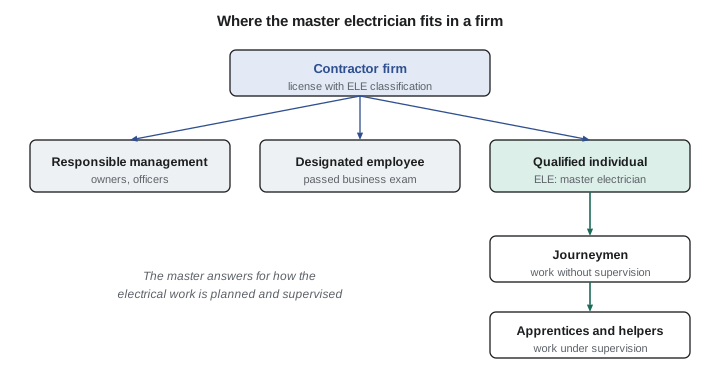
| Role | Who fills it | What the Board expects |
|---|---|---|
| Responsible management | Owners and officers | Run the firm; one completes pre-license education (Class C) |
| Designated employee | A full-time employee or member of management (Class A and B) | Passed the contractor business exam; completes pre-license education |
| Qualified individual (ELE) | A master electrician employed full time or in management | Meets experience for the class; supports the classification |
| Journeyman electrician | Licensed individual | Performs work; supervises apprentices and helpers |
| Apprentice or helper | Trainee | Works under the supervision of a licensed tradesman |
Supervision
Supervision is the heart of a master's daily responsibility. Apprentices and helpers may perform electrical work only under the supervision of a licensed journeyman or master, and the regulations and the USBC both speak to how that supervision works. A licensed person who supervises is responsible for seeing that the work meets the code, which means being close enough to direct and check it, not simply being on the payroll somewhere in the state. Registered apprenticeship programs set their own ratios and rules for on-the-job supervision, and employers must follow them.
At Mill Mountain, Angela's crews usually included one or two journeymen, an apprentice and sometimes a helper. Her approach was simple: every apprentice was assigned to a named journeyman for the day, every new task was demonstrated before the apprentice did it alone, and every piece of work an apprentice did was checked before it was covered. Eli Frazier, the second-year apprentice, liked to joke that he had more people checking his work than anyone else in the company. Angela's answer was that he would be glad of it the first time an inspector looked closely at a job he had wired.
# Crew supervision check (simplified study aid; follow your program's actual rules)
crews = {
    "Valley View dental office": {"masters": 1, "journeymen": 1, "apprentices": 2, "helpers": 0},
    "Hollins apartments": {"masters": 0, "journeymen": 2, "apprentices": 2, "helpers": 1},
    "Salem warehouse service": {"masters": 0, "journeymen": 0, "apprentices": 1, "helpers": 1},
}
for job, c in crews.items():
    licensed = c["masters"] + c["journeymen"]
    trainees = c["apprentices"] + c["helpers"]
    if licensed == 0 and trainees > 0:
        status = "PROBLEM: trainees with no licensed tradesman on site"
    else:
        status = f"{licensed} licensed tradesman(s) supervising {trainees} trainee(s)"
print(f"{job}: {status}")Valley View dental office: 2 licensed tradesman(s) supervising 2 trainee(s) Hollins apartments: 2 licensed tradesman(s) supervising 3 trainee(s) Salem warehouse service: PROBLEM: trainees with no licensed tradesman on site
The study aid flags the obvious problem, a crew of an apprentice and a helper with no licensed tradesman. Real supervision rules are more detailed, and registered apprenticeship standards may set specific ratios. The point for the exam and the job is the same: trainees work under licensed supervision, and the licensed person is responsible for what they do.
Standards of practice and conduct
The Board's regulations list standards of practice and conduct for licensees. They include complying with the USBC and other applicable codes, obtaining required permits and inspections, not misrepresenting one's license or qualifications, not aiding unlicensed activity, cooperating with Board investigations, keeping DPOR informed of address and name changes, and reporting certain events, such as criminal convictions, within the time the regulations set. Negligence or incompetence in the practice of the trade, and misconduct such as fraud, are grounds for discipline. Contractor firms have their own parallel list, covering contracts, advertising, financial responsibility and abandonment of work.
Some of these standards trip up good electricians. Allowing another firm to use your name as qualified individual when you do not work there is aiding unlicensed contracting. Pulling a permit for work you will not supervise misrepresents who is responsible. Failing to report a conviction within the required time is a violation even if the conviction itself would not have affected your license. Not responding to a DPOR investigator's request is a separate violation. Hal's advice was blunt: when DPOR sends you a letter, answer it, on time and in full, even if you think the complaint behind it is nonsense.
Complaints, investigations and discipline
Anyone can file a complaint with DPOR: a customer, a building official, a competitor or another licensee. DPOR reviews the complaint, may investigate by interviewing the people involved and collecting records, and refers matters that appear to involve violations to the Board's process. Many cases are resolved by consent order, an agreement in which the licensee accepts a sanction such as a fine or required education. Cases that are not settled can go to an informal fact-finding conference and then to a Board decision, with rights of appeal. Sanctions range from fines and required continuing education to probation, suspension and revocation of the license.
Discipline against a master electrician can affect the firm too. If the master's license is suspended or revoked, the master cannot serve as qualified individual, and the firm must replace him or lose the electrical classification. Some violations may also expose the firm to discipline under the contractor regulations. For that reason, firms that rely on a single master take a real risk, and many medium-sized firms, like Mill Mountain after Angela's exam, keep two masters on staff so that the firm is never without a qualified individual.
Reporting duties and record keeping
A licensee's duties to the Board continue between renewals. The regulations require licensees to notify DPOR of changes of name and address within a set time, to report certain criminal convictions and disciplinary actions taken by other jurisdictions, and to respond to Board inquiries. Contractor firms must report changes in their qualified individuals, designated employee, responsible management and business form. The exact deadlines are in the regulations, and the regulations booklet in the exam is the place to look them up. Keep copies of every notice you send to DPOR and the date you sent it, because the burden of showing a timely report rests on you.
Records matter on the job as well. Keep permits, inspection approvals, correction notices and their resolutions, supervision assignments and training records for apprentices. If a complaint arrives two years after a job, those records are what show that the work was permitted, inspected and supervised. Angela started keeping a simple job file for every project she signed for, with the permit, the inspection record and a list of the crew who worked on it. When an apartment owner complained about a tripping circuit a year later, the file showed exactly what had been installed and inspected, and the complaint ended with a service call instead of a dispute.
Worked problem
Spotting a violation
A small firm in Lynchburg asks Angela to be listed as its qualified individual for the ELE classification while she keeps working full time at Mill Mountain. They offer a monthly fee and say she would never need to visit their jobs. What is wrong with the offer?
Show solution
- The regulations expect the qualified individual to be a full-time employee or a member of responsible management of the firm.
- Angela would be lending her license to a firm where she does not work and does not supervise the electrical work.
- That would aid the firm in contracting for electrical work without a real qualified individual.
- Both Angela and the firm would risk discipline by the Board.
Answer: It is license lending: she would not be a real part of the firm, which violates the standards for both her and the firm.
Common mistakes
MistakeBelieving a master license lets you contract with the public in your own name.
InsteadContracting requires a firm with a contractor license; the master qualifies the firm.
MistakeServing as qualified individual for a firm where you do not work.
InsteadThe qualified individual must be a full-time employee or in responsible management; lending a license is a violation.
MistakeTreating supervision as a paperwork matter.
InsteadTrainees must work under real supervision, and the licensed tradesman answers for their work.
MistakeIgnoring a DPOR letter about a complaint you think is baseless.
InsteadRespond fully and on time; failing to cooperate is a separate violation.
Summary and key terms
- Journeymen and masters may perform work without direct supervision; masters may also serve as qualified individual for ELE.
- A master license does not authorize contracting; that requires a firm license.
- The qualified individual must meet the class experience level and be a full-time employee or member of responsible management.
- Apprentices and helpers work under licensed supervision, and the supervisor answers for their work.
- The Board's standards cover code compliance, permits, honesty, cooperation and reporting; violations lead to fines, suspension or revocation.
- Qualified individual
- The person who supports a classification on a firm's license; for ELE, a master electrician.
- License lending
- Allowing a firm to use your license where you do not actually work or supervise.
- Consent order
- An agreement resolving a disciplinary case with an agreed sanction.
- Informal fact-finding conference
- A proceeding in which the Board's representative hears a disputed disciplinary case.
- Supervision
- Directing and checking the work of apprentices and helpers so that it meets the code.
Practice problems
Work each problem on paper first, then reveal the answer to check.
May a master electrician work as a sole proprietor contracting for service upgrades without a contractor license?
Show answer
No. A contractor license with the ELE classification is required to contract for the work.
What must a firm do if its only electrical qualified individual quits?
Show answer
Notify the Board and replace the qualified individual within the time allowed, or stop contracting for electrical work.
Name two sanctions the Board may impose.
Show answer
For example, a fine and required continuing education; others include probation, suspension and revocation.
Lesson quiz · 5 questions
Score 60% or more to complete this lesson.
Create a free account to save your progress, take quizzes and earn a certificate.