
MELU-321 · Lesson 10 of 12 · 18 min
Workplace safety law and OSHA for electrical contractors
▶ Video coming soon A video version of this lesson is on the way.
The worst day of Hal's career came in 2009, when a second-year apprentice on a Mill Mountain crew took a shock while pulling wire into a panel that a customer's maintenance worker had re-energized without telling anyone. The apprentice recovered after a night in the hospital at Carilion Roanoke Memorial, but the investigation that followed changed how the company worked. Hal rewrote the lockout procedure, bought locks for every electrician and made the energized-work rules part of every job briefing. "A master license means you are the one who decides how the work is done," he told Angela. "That includes deciding that nobody gets hurt."
This lesson covers the safety and insurance obligations of a Virginia electrical contractor and the master electrician who runs its work. It explains Virginia Occupational Safety and Health, the state plan that enforces workplace safety in Virginia, the federal construction and electrical standards it adopts, electrical safety work practices under NFPA 70E, lockout and tagout, the employer's written programs and training, inspections and citations, and the Virginia workers' compensation system, including who must carry coverage, posting and reporting duties and what happens after an injury.
VOSH, the Virginia state plan
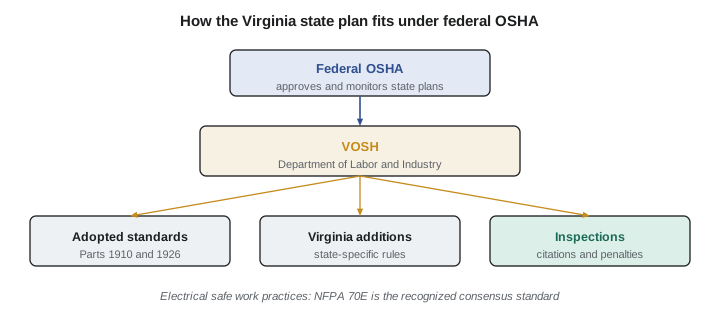
Virginia is one of the states that runs its own occupational safety and health program under a plan approved by federal OSHA. The program, called Virginia Occupational Safety and Health or VOSH, is part of the Virginia Department of Labor and Industry, and it covers most private employers and public employers in the state. A state plan must be at least as effective as federal OSHA, and VOSH generally adopts the federal standards, including the general industry standards in Part 1910 and the construction standards in Part 1926, while adding some Virginia-specific rules. For a Virginia electrical contractor, VOSH, not federal OSHA, is usually the agency that inspects job sites and issues citations.
The construction standards most relevant to electrical work include the electrical subpart of Part 1926, which covers wiring design, ground-fault protection for temporary power, and safety-related work practices, along with the rules for ladders, scaffolds, fall protection, trenching and excavation, and hazard communication. On many job sites, electricians are injured less often by electricity than by falls from ladders and lifts, so a complete safety program covers all of these hazards, not just shock and arc flash.
Electrical safety work practices
NFPA 70E, the standard for electrical safety in the workplace, is the main reference for safe work on or near electrical equipment. It is a consensus standard rather than a law, but safety agencies treat it as evidence of recognized practice, and most commercial and industrial customers require contractors to follow it. Its central principle is that equipment should be put into an electrically safe work condition before work begins, by identifying sources, disconnecting them, verifying visible breaks where possible, applying locks and tags, testing for absence of voltage and grounding where needed. Energized work is permitted only when de-energizing creates a greater hazard or is not feasible, and then only with a justification, an energized work permit where required, a shock and arc flash risk assessment and appropriate protective equipment.
A master electrician's role in this system is practical. The master decides how each job will be done, plans the outages, assigns qualified workers, makes sure the crew has the right meters and protective equipment, and refuses customer pressure to do work energized when it can be shut down. On the job that injured the apprentice, the failure was not in the wiring but in control of energy: the crew had opened a breaker but had not locked it, and the customer's worker closed it. Under Hal's rewritten procedure, every worker placed a personal lock, and no one removed another worker's lock.
| Step | Purpose |
|---|---|
| Identify all sources | Finds every way the equipment can be energized |
| Disconnect and verify the break | Separates the equipment from its sources |
| Apply locks and tags | Prevents re-energizing while work is done |
| Test for absence of voltage | Confirms the equipment is actually de-energized |
| Ground where needed | Controls induced or stored energy |
# Crew lockout tally (study aid): no restart until every personal lock is removed
crew = {"Angela": True, "Marcus": True, "Eli": False, "Rosa": True}
missing = [name for name, locked in crew.items() if not locked]
print("Personal locks applied:", sum(crew.values()), "of", len(crew))
if missing:
    print("Stop: no work until locks are applied by", ", ".join(missing))
else:
print("All personal locks applied; test for absence of voltage next")Personal locks applied: 3 of 4 Stop: no work until locks are applied by Eli
Programs, training and inspections
VOSH expects employers to have written programs where the standards require them, such as a hazard communication program, a lockout and tagout program for general industry work and, where applicable, respiratory protection and other programs. Employers must train workers on the hazards of their work, and electrical workers must be trained in the safety-related work practices that apply to their jobs, with records showing who was trained and when. Job briefings at the start of each task, covering hazards, procedures, energy sources and protective equipment, are one of the most effective habits a crew can have and are required by the electrical safety standards in many situations.
VOSH inspections can result from a complaint, a referral, a serious injury or fatality, or a program of targeted inspections. After an inspection, VOSH may issue citations with proposed penalties, which the employer can contest within the time stated in the citation. Employers must report fatalities and serious injuries, such as in-patient hospitalizations, amputations and losses of an eye, to VOSH within short periods set by the regulations, and they must keep injury and illness records if they are not exempt. Mill Mountain posted the required VOSH workplace poster in its shop and kept copies of its programs and training records in each job trailer.
Workers' compensation in Virginia
Virginia's workers' compensation system is administered by the Virginia Workers' Compensation Commission. Under the Virginia Workers' Compensation Act, employers that regularly have more than two employees in the state, counting full-time and part-time workers, must carry workers' compensation insurance or qualify as self-insured. The coverage pays medical costs and a portion of lost wages for employees injured on the job, and in exchange the employer is generally protected from being sued by the employee for the injury. Employers that are required to carry coverage and fail to do so face civil penalties and other consequences.
Contractors face an additional twist. Under Virginia's statutory employer rules, a general contractor or owner may be treated as the employer of a subcontractor's workers if the subcontractor is uninsured, so general contractors routinely require certificates of insurance before subcontractors start work. A small electrical firm with only one or two employees may not be required by the statute to carry coverage, but its customers may require it anyway, and many local building departments ask about workers' compensation when issuing permits. Insurance requirements in contracts should be checked before bidding, since coverage costs are part of the price.
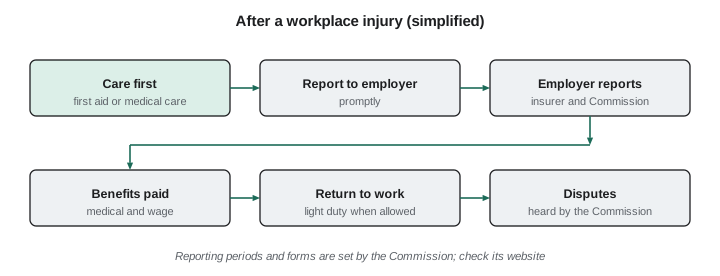
When an employee is injured, the employee should report the injury to the employer promptly, and the employer must report it to its insurer and file the employer's first report of accident with the Commission within the period the rules set when the injury causes lost time beyond a short threshold or meets other reporting criteria. Employers must also post the Commission's workplace poster, known as Form 1 or the employee notice of coverage, where employees can see it. Disputes about a claim go to the Commission, which holds hearings and decides them. The details of filing periods and forms change, so the Commission's website is the place to confirm them.
Temporary power and the job site
Electrical contractors often install and maintain temporary power for the whole job site, which makes them responsible for a hazard that affects every trade. The construction standards require ground-fault protection for receptacles used by workers on construction sites, either through ground-fault circuit interrupters or, where permitted, an assured equipment grounding conductor program, and the wiring code has its own rules for temporary installations. Cords and tools must be inspected, damaged cords removed from service, and temporary wiring protected from damage by vehicles, doors and other trades.
On the Hollins apartment project, Angela assigned one journeyman each week to walk the temporary power system, test every ground-fault device with its test button and a plug-in tester, and record the results on a log posted at the main temporary panel. When a framing crew's extension cord was found spliced with electrical tape, the cord was cut and removed that morning and the general contractor's superintendent was told. That kind of routine is easy to skip on a busy job, and it is exactly what an inspector looks for after an incident.
After an injury: care, claims and return to work
The first priority after any injury is care. Mill Mountain's crews carried a card listing the nearest urgent care centers and hospitals for each job, and every foreman knew how to reach the office and the insurer's claim line. Once the injured worker is cared for, the foreman preserves the scene if the injury is serious, gathers names of witnesses and writes a short factual account while details are fresh. The office then reports the claim to the insurer and makes any required reports to VOSH and the Commission within their deadlines.
Virginia's workers' compensation rules give employers a role in medical care, including providing a panel of physicians from which the injured employee may choose in many situations, and they set rules for wage benefits based on the employee's average weekly wage. A good return-to-work program, which offers injured workers light-duty tasks such as material handling in the shop, plan takeoffs or tool-room work when their doctors allow, shortens claims, keeps experienced workers connected to the company and holds down the experience modification rate. Angela made the light-duty list part of the company's written safety program so that foremen did not have to invent tasks when an injured worker came back.
Investigation should lead to change. After every recordable injury and every serious near miss, Mill Mountain held a short review asking what happened, why the controls in place did not prevent it and what would be done differently. The answers went into the next month's safety meeting, and the most useful ones became part of the company's job briefing checklist. The 2009 shock produced the personal-lock rule; a 2015 ladder fall produced a rule that crews use platform ladders for overhead work in panel rooms.
Safety as a business advantage
Safety records affect a contractor's business directly. Insurers base workers' compensation premiums partly on an experience modification rate, a number that compares a firm's claims history to the average for its industry, so a firm with fewer injuries pays less. Many owners and general contractors screen subcontractors by their experience modification rate and injury rates before inviting them to bid. Mill Mountain's rate rose after the 2009 injury and took three years to come back down, which cost the company more in premiums and lost bids than the new locks, training and meters had cost.
Worked problem
Counting employees for coverage
Kenny's new firm, Cho Electric LLC, has two full-time electricians and one part-time helper who works about 15 hours a week year-round. Must the firm carry workers' compensation insurance under the Virginia statute?
Show solution
- The statute counts employees who regularly work in the business, full-time and part-time.
- Two full-time electricians plus one regular part-time helper makes three employees.
- Three is more than two, so the firm is regularly employing more than two employees.
- The firm must carry workers' compensation insurance or qualify as self-insured, and post the required notice.
Answer: Yes. With three regular employees, the firm must carry coverage and post the Commission's notice.
Common mistakes
MistakeAssuming federal OSHA inspects Virginia job sites.
InsteadVirginia runs a state plan; VOSH usually inspects private and public employers in the state.
MistakeOpening a breaker without locking it.
InsteadApply personal locks and tags, then test for absence of voltage.
MistakeLeaving part-time workers out of the employee count.
InsteadRegular part-time workers count toward the more-than-two-employees threshold.
MistakeTreating NFPA 70E as optional because it is not a statute.
InsteadSafety agencies and customers treat it as recognized practice; follow it.
Summary and key terms
- Virginia runs a state occupational safety and health plan, VOSH, within the Department of Labor and Industry.
- VOSH generally adopts federal Part 1910 and Part 1926 standards, with Virginia additions.
- NFPA 70E centers on establishing an electrically safe work condition before work begins.
- Employers with more than two regular employees must carry workers' compensation insurance.
- Post the required VOSH and Commission notices, report serious injuries and keep training records.
- VOSH
- Virginia Occupational Safety and Health, the state plan enforcing workplace safety.
- Electrically safe work condition
- A state in which equipment is disconnected, locked, tested and grounded as needed.
- Lockout and tagout
- Applying locks and tags to energy-isolating devices to prevent re-energizing.
- Statutory employer
- A contractor or owner treated as the employer of an uninsured subcontractor's workers.
- Experience modification rate
- A factor comparing a firm's claims history to its industry's average.
Practice problems
Work each problem on paper first, then reveal the answer to check.
Which agency usually inspects a private Virginia job site for safety?
Show answer
VOSH, within the Virginia Department of Labor and Industry.
What is the first goal of NFPA 70E work practices?
Show answer
Putting equipment into an electrically safe work condition before work.
Which agency administers Virginia workers' compensation?
Show answer
The Virginia Workers' Compensation Commission.
Lesson quiz · 5 questions
Score 60% or more to complete this lesson.
Create a free account to save your progress, take quizzes and earn a certificate.