
MELU-321 · Lesson 6 of 12 · 18 min
Permits, inspections and the inspection authority
▶ Video coming soon A video version of this lesson is on the way.
Denise had a whiteboard in the Mill Mountain office with a column for every locality the company worked in: Roanoke City, Roanoke County, Salem, Vinton, Botetourt County, Bedford County and Franklin County. Under each name she kept the permit portal address, the inspection request cutoff time, the phone number of the permit desk and notes about each department's habits. "Same code everywhere," she told Angela, "different front door at every building department." The whiteboard was her answer to that problem, and Angela, who would soon be signing permit applications as a master electrician, needed to understand everything on it.
This lesson covers how electrical permits and inspections work under the USBC. It explains the role of the local building official, when a permit is required and what work is exempt, who may apply for an electrical permit, the inspection sequence for typical jobs, what happens when work fails inspection, certificates of occupancy, and how third-party inspectors and the state fit in. It also covers the practical habits that keep a contractor in good standing with the building departments it depends on.
The building official
Every Virginia locality that enforces the USBC has a building official, the person responsible for administering and enforcing the code within that jurisdiction. The building official is appointed by the local government and must meet qualifications and training requirements set at the state level, including certification through DHCD's programs. Under the building official work plans reviewers and inspectors, including electrical inspectors who also hold certifications. Small counties may have one or two inspectors who handle every trade; large cities have specialized electrical inspection staff. In Virginia the building official, not a separate state electrical inspector, is the authority having jurisdiction for most electrical work.
The building official's powers are broad. The official issues permits, approves plans, conducts or delegates inspections, issues notices of violation and stop-work orders, and issues certificates of occupancy. The official may also approve modifications, alternatives that meet the intent of the code when strict compliance is impractical, and the USBC sets out the procedure for requesting them. Contractors who understand that the building official has this authority, and who treat the department as a partner rather than an obstacle, tend to have far fewer problems on their jobs.
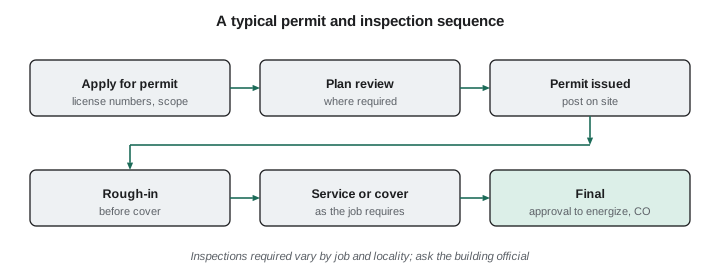
When a permit is required
Under the USBC, a permit is generally required before installing, altering or repairing electrical systems, with a limited list of exemptions for minor work. The exemptions, set in the USBC administrative provisions, typically cover things like replacing receptacles, switches and lighting fixtures with like items, or repairs that do not change the system, though the exact list and its conditions must be checked in the current code. When in doubt, ask the building department; a permit costs far less than having to open finished walls for an inspection later. Work that requires a permit and is done without one can be ordered exposed for inspection or removed.
Permits are issued to the person responsible for the work. For electrical work done by a contractor, the permit application identifies the licensed contractor and its license number, and localities check DPOR's records. Many localities also require the name of the master or journeyman responsible for the work. Homeowners may obtain permits for some work on their own single-family dwellings under conditions set by the USBC and local practice, but a homeowner permit does not let an unlicensed person do work for hire. Denise's whiteboard noted which localities required the master's license number on the application and which only asked for the contractor license.
| Step | Who acts | Typical content |
|---|---|---|
| Permit application | Contractor | Scope, address, contractor license number, often the responsible tradesman |
| Plan review (where required) | Building department | Drawings, load calculations, panel schedules |
| Permit issued | Building department | Permit card posted on the job |
| Rough-in inspection | Inspector | Boxes, cables and raceways before cover |
| Service inspection | Inspector | Service equipment, grounding electrode system, bonding |
| Final inspection | Inspector | Devices, labeling, working space, completed equipment |
| Approval to energize or certificate of occupancy | Building official and utility | Release to the utility; occupancy where required |
Plan review
Commercial projects and many larger residential projects require plans to be submitted and approved before a permit is issued. For electrical work, plan review usually looks at the service size and load calculations, the one-line diagram, panel schedules, fault current and equipment ratings, emergency systems and the layout of required circuits. Plans for many commercial buildings must be sealed by a licensed professional engineer, while some smaller projects can be submitted by the contractor. The plan reviewer's comments must be answered before the permit is issued, and they often state the code edition the project is reviewed under, which settles questions like the one Marcus raised in Lesson 5.
Plan review takes time, and the time varies by locality and season. Mill Mountain built plan review time into every commercial schedule and told customers about it up front. When the Valley View dental office plans came back with comments about available fault current and the rating of the new panelboards, Angela worked with the engineer to answer them, and the revised plans were approved in a week. A contractor who starts work before a permit is issued risks a stop-work order and, worse, a reputation with the department that follows the company to every future job.
Inspections
Inspections follow the stages of the work. A rough-in inspection checks boxes, cables, raceways and conductors before walls and ceilings are covered. A service inspection checks the service equipment, the grounding electrode system and bonding before the utility connects. Some jobs require an underground or slab inspection before concrete is poured over conduits, or a separate inspection for fire alarm or other systems. The final inspection checks the finished installation: devices, covers, labeling, working space, equipment ratings and anything left open from earlier inspections. The inspector records approvals on the permit card or in the locality's online system.
Inspection requests have deadlines and procedures that vary by locality, which is exactly what Denise's whiteboard tracked. Some departments take requests online until a cutoff time for next-day inspections; others need a phone call. The job must be ready when the inspector arrives: accessible, with the permit card posted and the approved plans on site. An inspector who arrives to find the work unfinished may record a failed inspection and charge a reinspection fee. Angela made it a rule that her crews would never call for an inspection until she or a journeyman had walked the job with a checklist.
# Inspection readiness checklist (study aid)
checklist = {
    "Permit card posted and visible": True,
    "Approved plans on site": True,
    "All boxes and raceways accessible (no cover yet)": True,
    "Grounding electrode conductor connections exposed for viewing": False,
    "Panel directory and labels in place (final only)": False,
}
stage = "rough-in"
not_ready = [item for item, ok in checklist.items() if not ok and "final only" not in item]
if not_ready:
    print(f"Do not call for the {stage} inspection yet. Fix:")
    for item in not_ready:
        print("  -", item)
else:
print(f"Ready to request the {stage} inspection")Do not call for the rough-in inspection yet. Fix: - Grounding electrode conductor connections exposed for viewing
Failed inspections and corrections
When work fails, the inspector issues a correction notice or notice of violation listing the problems and the code sections involved. The contractor corrects the work and requests a reinspection, usually paying a fee. If the contractor disagrees with a correction, the first step is a respectful conversation with the inspector, asking which code section applies and why. If that does not resolve it, the contractor can ask to speak with the building official, and if the disagreement remains, the appeal path described in Lesson 5 is available. Most disagreements end at the first conversation when the contractor comes prepared with the code section and a clear explanation.
Repeated failures have consequences beyond the fees. Building officials notice which contractors fail often, and a contractor with a poor record may find inspectors looking harder at every job. Serious or repeated violations can also be reported to DPOR, which can investigate the licensees involved. For a master electrician who serves as a firm's qualified individual, a pattern of failed inspections is a professional problem, not just an annoyance, because it reflects on the supervision the master is expected to provide.
Certificates of occupancy and utilities
For new buildings and many changes of occupancy, the building official issues a certificate of occupancy after all required inspections pass. Occupying the building before that certificate is issued violates the USBC. For electrical work in existing buildings, the final inspection approval is usually the last step, and for service work the building department releases the job to the utility so that power can be connected. In the Roanoke Valley, Appalachian Power handles most service connections, and its own rules for meter bases, service drops and metering must be met alongside the code. Utility requirements are separate from the USBC and the inspector does not enforce them, but a service that does not meet them will not be connected.
Third-party inspection is possible in some situations. The USBC allows building officials to accept inspections or reports from qualified third parties under conditions they set, which some localities use for large projects or when staff are stretched. DHCD's State Building Codes Office oversees certain programs directly, such as industrialized buildings, and supports localities with training and technical assistance. For most electrical contractors, though, the local building official is the authority that matters every day.
Habits that keep a contractor in good standing
Good relationships with building departments are built job by job. Pull permits for everything that needs one, even small jobs where the temptation to skip the paperwork is strongest. Keep the permit card and approved plans on site, and keep them clean. Call inspections only when the work is ready, and be on site or reachable when the inspector arrives. Answer correction notices quickly and completely, and close out permits with a final inspection rather than leaving them open when a customer stops paying or the job winds down. Open permits follow a contractor, and some departments will not issue new permits to a contractor with a pile of expired ones.
Denise kept a monthly report of every open permit at Mill Mountain, sorted by age, and Hal reviewed it with her at the first management meeting of each month. Any permit open more than ninety days without an inspection got a phone call to the customer and, if needed, a call to the building department to arrange a final or to withdraw the permit properly. When Angela became a master electrician and began signing permit applications, the report became hers to watch. "Your name is on these now," Hal told her. "The inspectors will remember it."
Worked problem
Handling a correction
At the rough-in inspection for an apartment building in Salem, the inspector writes a correction for box fill in three kitchen boxes and asks for arc-fault protection on a circuit Angela believes is exempt. What steps should she take?
Show solution
- She corrects the box fill, which is a clear calculation she can check against the NEC tables.
- On the arc-fault item, she reads the applicable section in the edition in force and any Virginia amendment, and prepares her reasoning.
- She asks the inspector politely which section the correction relies on and explains her reading.
- If they still disagree, she raises it with the building official, and only then considers the appeal path.
Answer: Fix what is clearly wrong, discuss the disputed item with the code section in hand, and escalate only if needed.
Common mistakes
MistakeStarting work before the permit is issued.
InsteadWait for the permit; early starts risk stop-work orders and damage relationships with the department.
MistakeCalling for inspection before the work is ready.
InsteadWalk the job with a checklist first; failed inspections cost fees and credibility.
MistakeAssuming the inspector enforces utility metering rules.
InsteadUtility requirements are separate and must be met for connection.
MistakeTreating a homeowner permit as a way for an unlicensed person to work for hire.
InsteadHomeowner permits cover owners doing their own work under the USBC's conditions.
Summary and key terms
- The local building official administers and enforces the USBC, including electrical work.
- Permits are generally required for electrical installation, alteration and repair, with limited exemptions in the USBC.
- Plan review applies to commercial and larger projects; comments often state the code edition used.
- Inspections follow the work: rough-in, service and final, with others as needed.
- Corrections are resolved with the inspector, then the building official, then the appeals process.
- Building official
- The local officer responsible for administering and enforcing the USBC.
- Permit
- Authorization from the building department to perform regulated work.
- Rough-in inspection
- Inspection of wiring before it is concealed.
- Certificate of occupancy
- The building official's approval to occupy a building after required inspections.
- Modification
- An approved alternative to a code requirement where strict compliance is impractical.
Practice problems
Work each problem on paper first, then reveal the answer to check.
Who is the authority having jurisdiction for most electrical work in Virginia?
Show answer
The local building official enforcing the USBC.
A contractor disagrees with an inspector's correction. What is the first step?
Show answer
Ask which code section applies and discuss it respectfully with the inspector.
Does the electrical inspector enforce Appalachian Power's meter base requirements?
Show answer
No. Utility requirements are separate, though they must be met for connection.
Lesson quiz · 5 questions
Score 60% or more to complete this lesson.
Create a free account to save your progress, take quizzes and earn a certificate.