
MELU-321 · Lesson 5 of 12 · 18 min
The NEC as adopted in Virginia and state amendments
▶ Video coming soon A video version of this lesson is on the way.
On a job site walk-through at a dental office on Valley View Boulevard, Marcus Reid asked Angela a question that comes up on every Virginia project sooner or later. "Which code are we actually on?" The architect's drawings cited one edition of the NEC, an old specification section from a previous project cited another, and the inspector's correction notice on a different job referred to the Virginia Construction Code. Angela had the answer because she had been studying it. In Virginia, nobody adopts the NEC directly. It comes in by reference through the Virginia Uniform Statewide Building Code, and the edition that applies is the one the USBC currently references.
This lesson explains how that works. It covers the structure of the USBC and its parts, how DHCD and the Board of Housing and Community Development adopt new editions on a three-year cycle, which NEC edition applies under the 2021 USBC that took effect on January 18, 2024, the status of the 2024 code cycle, how localities enforce but generally do not amend the statewide code, how existing buildings are treated, and how a contractor confirms the edition before quoting a code rule to a customer or an inspector.
A statewide code
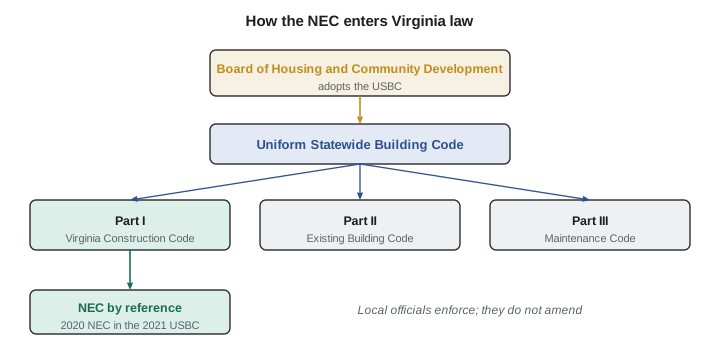
Virginia is one of the states with a truly statewide building code. The Uniform Statewide Building Code is adopted by the Board of Housing and Community Development, a citizen board supported by DHCD, under authority given in Title 36 of the Code of Virginia. It applies throughout the Commonwealth, and local governments enforce it rather than adopting their own building codes. The idea is uniformity: a contractor working in Roanoke, Fairfax and Virginia Beach faces the same code requirements, enforced by different local building officials. That uniformity is one of the reasons Virginia contractors can work across the state without learning a new code in every county.
The USBC is organized in parts. Part I, the Virginia Construction Code, governs new construction, additions and changes of occupancy. Part II, the Virginia Existing Building Code, governs work in existing buildings, such as alterations and repairs. Part III, the Virginia Maintenance Code, governs the maintenance of existing buildings and is enforced at the option of the locality. Each part adopts national model codes by reference, with Virginia changes, and the Virginia Construction Code brings in the NEC for electrical work. When an inspector cites a section of the Virginia Construction Code in an electrical correction, he or she is usually pointing to the administrative provisions that make the NEC enforceable.
The three-year cycle
DHCD runs a code development cycle that tracks the three-year publication schedule of the national model codes. During each cycle, staff and stakeholder workgroups review the new national editions and proposed Virginia changes, the Board considers them through the regulatory process, and the new USBC is published with an effective date. Because the regulatory process takes time, Virginia's effective dates lag the national publication dates. The 2021 codes took effect on January 18, 2024, and DHCD notes that mandatory code change training for code officials accompanied the change.
Under the 2021 USBC, the NEC edition in force is the 2020 NEC, as NEMA's state code alert and DHCD's materials reflect. The 2024 code development cycle was under way in 2026, with stakeholder workgroups and memos posted on DHCD's site, but no effective date for the next USBC had been announced at the time this course was written. When the next USBC takes effect, it will reference a newer NEC edition, and there may be a transition period during which projects designed under the old code can proceed. Watch DHCD's announcements and your local building department's notices for the exact dates.
| Cycle | Effective date | NEC edition referenced |
|---|---|---|
| 2018 USBC | Earlier cycle (now superseded) | 2017 NEC |
| 2021 USBC | January 18, 2024 | 2020 NEC |
| 2024 USBC | Not set at the time of writing | Newer edition; check DHCD |
# Which USBC (and NEC edition) applies to a permit date? (simplified study aid)
from datetime import date
cycles = [
    (date(2024, 1, 18), "2021 USBC", "2020 NEC"),
]
def edition_for(permit_date):
    current = ("2018 USBC", "2017 NEC")
    for start, usbc, nec in cycles:
        if permit_date >= start:
            current = (usbc, nec)
    return current

for d in [date(2023, 11, 2), date(2024, 3, 15), date(2026, 10, 19)]:
    usbc, nec = edition_for(d)
print(f"Permit applied {d}: {usbc} -> {nec}")Permit applied 2023-11-02: 2018 USBC -> 2017 NEC Permit applied 2024-03-15: 2021 USBC -> 2020 NEC Permit applied 2026-10-19: 2021 USBC -> 2020 NEC
The study aid treats the application date as the trigger, which is the usual approach, but it leaves out the transition rules that often let a project designed under the previous code proceed for a time after a new code takes effect. Real decisions about which code applies to a particular project belong to the building official, and the permit or plan review comments usually state the code edition the project is reviewed under.
Virginia changes to the NEC
The Virginia Construction Code adopts the NEC with a limited set of Virginia changes, and over the years those changes have addressed topics where Virginia stakeholders wanted a different balance than the national edition, for example certain ground-fault and arc-fault requirements in dwellings or administrative matters like the qualifications for inspections. The specific changes vary from cycle to cycle and are published in the Virginia Construction Code itself, so they are not repeated here. When a requirement in the national NEC seems to be missing or different on a Virginia job, the first place to look is the Virginia Construction Code's chapter on electrical systems and its amendments to the NEC.
For the exam, remember the distinction. The PSI exam tests the NEC edition listed in the bulletin and the Board's regulations; it does not ask you to know every Virginia amendment to the NEC unless the bulletin's content outline includes Virginia code provisions. On the job, Virginia amendments matter a great deal, and an inspector will enforce them. Angela kept a single sheet in her truck listing the Virginia changes that mattered most for Mill Mountain's work under the current cycle, and she updated it whenever DHCD published a new edition.
Local enforcement, not local amendment
Because the USBC is statewide, localities generally may not adopt their own amendments to its technical requirements. A county cannot decide on its own to require arc-fault protection in places the USBC does not, or to waive a requirement the USBC imposes. What localities do control is enforcement: they appoint the building official, set permit fees within the law, schedule inspections, and decide how to staff their departments. Some administrative matters, such as the local enforcement of the Maintenance Code, are left to local choice. This structure is different from states where each city adopts and amends the NEC, and it simplifies life for contractors who work in many localities.
Disputes about what the code requires follow a defined path. A contractor or owner who disagrees with a building official's decision may appeal to the local board of building code appeals, and from there to the State Building Code Technical Review Board, a state body that hears appeals and issues interpretations of the USBC. Its decisions and interpretations are useful references when a code question is unsettled. Hal had taken one appeal to the local board in thirty years, over the interpretation of a working-space rule in a mechanical room, and he advised Angela to treat an appeal as a last resort after a respectful conversation with the inspector and the building official.
Existing buildings
Much of an electrical contractor's work happens in existing buildings, and Part II of the USBC, the Virginia Existing Building Code, governs alterations, repairs and changes of occupancy. The general principle is that new work must comply with the current code, while existing work that is not being altered may usually remain as long as it is not unsafe. A panel replacement at a 1950s bungalow on Grandin Road, for example, requires the new equipment and the work done to meet current requirements, but it does not usually require rewiring the whole house. The Existing Building Code spells out when more extensive upgrades are triggered, and the building official applies it.
Changes of occupancy deserve special care. When a building changes use, for example when a retail space becomes a restaurant, the new occupancy may trigger requirements for the whole space. Mill Mountain's project converting a former shoe store on Brambleton Avenue into a restaurant needed a new service, emergency lighting and kitchen circuits that the old use never required, and the plan review comments made clear which code provisions applied. Pricing that job without understanding the change of occupancy would have cost the company thousands of dollars.
Other codes that touch electrical work
The NEC is not the only code an electrical contractor meets on a Virginia job. The Virginia Construction Code also brings in the national residential code for one- and two-family dwellings, and the building, fire protection and energy provisions all contain requirements that affect electrical work: fire alarm and emergency lighting rules, smoke alarm power requirements in dwellings, exit sign illumination, and energy code limits on lighting power and controls in commercial buildings. The Statewide Fire Prevention Code, adopted by the same board, governs the ongoing maintenance of fire protection systems and hazards in existing buildings and is enforced by fire officials.
These overlaps matter in practice. On the Brambleton Avenue restaurant conversion, the energy code's lighting control requirements, the building code's emergency lighting rules and the fire code's requirements for the kitchen hood suppression interlock all landed on Mill Mountain's scope, even though none of them came from the NEC itself. Angela learned to read the full plan review comments, not just the electrical section, because a requirement in another code could change what she needed to buy and install. The exam focuses on the NEC and the regulations, but a working master electrician has to know where to look in all of these.
Worked problem
Confirming the edition
In October 2026 a customer asks Angela to price a service upgrade for a new commercial tenant, and the engineer's drawings cite an NEC edition newer than the 2020 NEC. The local permit has not yet been applied for. How should Angela determine which edition applies?
Show solution
- She checks DHCD's code pages for the USBC currently in effect and any announced effective date for the next cycle.
- Under the 2021 USBC, in effect since January 18, 2024, the referenced edition is the 2020 NEC.
- If no newer USBC is in effect when the permit is applied for, the 2020 NEC applies, and she raises the discrepancy with the engineer.
- She confirms with the building official at plan review, which normally states the code edition used.
Answer: Confirm the USBC in effect on DHCD's site and with the building official; under the 2021 USBC that is the 2020 NEC.
Common mistakes
MistakeAssuming the newest national NEC edition applies in Virginia once it is published.
InsteadThe NEC applies only as referenced by the USBC in effect; check DHCD for the current edition.
MistakeExpecting each county to have its own electrical amendments.
InsteadThe USBC is statewide; localities enforce it but generally do not amend its technical requirements.
MistakeStudying the edition used on the job instead of the one in the PSI bulletin.
InsteadThe exam follows the bulletin's edition; jobs follow the USBC's edition.
MistakeTreating every alteration as requiring the whole building to be brought up to current code.
InsteadPart II, the Existing Building Code, governs how much must be upgraded.
Summary and key terms
- The NEC applies in Virginia through the USBC, adopted by the Board of Housing and Community Development with DHCD's support.
- The USBC has three parts: the Construction Code, the Existing Building Code and the Maintenance Code.
- The 2021 USBC took effect January 18, 2024, and references the 2020 NEC; the 2024 cycle had no effective date at the time of writing.
- Localities enforce the statewide code but generally may not amend its technical requirements.
- Appeals go to the local board of building code appeals and then the State Building Code Technical Review Board.
- USBC
- The Virginia Uniform Statewide Building Code, the statewide code that incorporates the NEC.
- Virginia Construction Code
- Part I of the USBC, governing new construction and bringing in the NEC.
- Virginia Existing Building Code
- Part II of the USBC, governing work in existing buildings.
- Code development cycle
- DHCD's three-year process for adopting new national editions with Virginia changes.
- Technical Review Board
- The State Building Code Technical Review Board, which hears appeals and issues USBC interpretations.
Practice problems
Work each problem on paper first, then reveal the answer to check.
Which NEC edition does the 2021 USBC reference?
Show answer
The 2020 NEC.
May a Virginia county adopt a local amendment requiring more GFCI protection than the USBC?
Show answer
Generally no; the USBC is statewide and localities enforce rather than amend it.
Where does a contractor appeal after the local board of building code appeals?
Show answer
To the State Building Code Technical Review Board.
Lesson quiz · 5 questions
Score 60% or more to complete this lesson.
Create a free account to save your progress, take quizzes and earn a certificate.