
MELU-321 · Lesson 1 of 12 · 19 min
How electrical licensing works in Virginia
▶ Video coming soon A video version of this lesson is on the way.
Harold Brennan, whom everyone in the Roanoke Valley calls Hal, opened Mill Mountain Electric in 1992 with one van, a master electrician card and a Class C contractor license. Thirty-four years later the company has twenty-two employees, a Class A license, and a steady mix of commercial fit-outs, light industrial service work, apartment projects and residential service changes across Roanoke, Salem, Vinton and Botetourt County. On a gray Monday in October, after the weekly safety talk, Hal asked his lead journeyman, Angela Torres, to stay behind. "I'm sixty-four," he said. "This company's contractor license names me as the qualified individual for the electrical classification, and I'm the designated employee who passed the business exam. When I retire, both of those jobs need somebody new. I want the first one to be you, and that starts with your master electrician card."
Angela had been in the trade for fourteen years. She started as a helper on a Salem apartment project, finished an apprenticeship through a community college program while working, earned her Virginia journeyman electrician license in 2019, and had spent the last five years running crews on commercial and industrial jobs for Mill Mountain. She had already worked through the master electrician core courses on the National Electrical Code, load calculations, grounding and bonding, motors and transformers, special occupancies, and business and law. This course takes that preparation and applies it to Virginia: who licenses electricians and contractors, how the master electrician license fits with the contractor license, how the state exam works, which edition of the NEC applies through the Virginia Uniform Statewide Building Code, how permits and inspections are handled, and the Virginia law on contracts, liens, workers' compensation, safety and renewal.
The agencies involved
Virginia regulates electricians and electrical contractors through a single board that sits inside a large state agency. The Department of Professional and Occupational Regulation, almost always called DPOR, provides the staff for dozens of licensing boards: it receives applications, collects fees, issues and renews licenses, runs the public license lookup and investigates complaints. The policy body for construction is the Board for Contractors, created under Chapter 11 of Title 54.1 of the Code of Virginia. That one board licenses contracting businesses and also, through what DPOR calls its Tradesman program, licenses individual electricians, plumbers, HVAC technicians and gas fitters.
The Board's rules are split into two sets of regulations, and it pays to keep them apart in your mind. The contractor regulations, at 18VAC50-22, govern the business license: the license classes, the roles of the people who qualify a firm, the pre-license education, financial requirements and standards of conduct for firms. The individual license and certification regulations, at 18VAC50-30, govern the tradesman licenses: journeyman and master qualifications, examinations, renewal and continuing education, and conduct for individual licensees. The master electrician license you are preparing for lives in the second set, but in practice its value comes from the role it plays in the first.
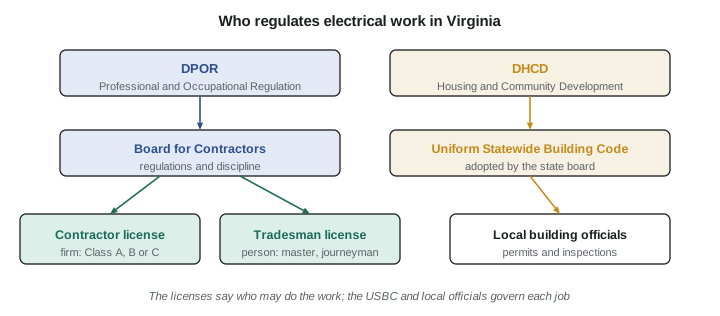
Two other bodies matter to every electrical contractor even though they issue no licenses. DHCD, through the Board of Housing and Community Development, adopts the Virginia Uniform Statewide Building Code, usually shortened to the USBC, and the USBC brings the National Electrical Code into Virginia law by reference. Local building departments, each led by a building official, enforce the USBC on every job by issuing permits and performing inspections. A Virginia license lets you work anywhere in the state, but each job is governed by the statewide code as adopted and by the local permit and inspection process in the locality where the work is done.
Two licenses, one company
The feature of Virginia's system that most surprises people moving in from other states is that there are two separate licenses that fit together. The first is the individual tradesman license. Virginia issues journeyman and master electrician licenses to people, based on experience and an examination. The second is the contractor license, issued to a business, whether that business is a sole proprietorship, a partnership, a corporation or a limited liability company. A firm that wants to contract for electrical work must hold a contractor license with the electrical classification, abbreviated ELE, in the right class for the size of its jobs.
The link between the two is a role called the qualified individual. Each classification or specialty on a contractor license must be supported by a qualified individual who meets the Board's experience and competency requirements for that classification. For the electrical classification, DPOR's licensing information says the qualified individual must hold a current master tradesman license in that classification. In plain terms, a Virginia company cannot hold the ELE classification unless a master electrician serves as its qualified individual. That is why Hal's retirement mattered so much to Mill Mountain Electric, and why Angela's master card was the first step in his succession plan.
| Question | Virginia's answer (summary) |
|---|---|
| Who licenses individual electricians? | The Board for Contractors, through DPOR's Tradesman program |
| Who licenses contracting businesses? | The same Board, under the contractor regulations (18VAC50-22) |
| What links the two? | The qualified individual; for ELE, a master electrician |
| Who adopts the electrical code? | DHCD and the Board of Housing and Community Development, through the USBC |
| Who issues permits and inspects? | Local building departments under the building official |
Journeyman, master and the people around them
Virginia's tradesman licenses come in levels. A journeyman electrician has the experience and tested knowledge to perform electrical work without direct supervision by another licensee. A master electrician has more experience, has passed a harder examination, and may serve as the qualified individual for a contractor's electrical classification. Lesson 2 sets out the exact eligibility routes, which were reorganized in regulations that took effect on April 1, 2025. Apprentices and helpers work under the supervision of licensed tradesmen, and the Board's regulations and the USBC both speak to supervision, which Lesson 7 covers.
The contractor license brings in other roles too. Every firm has members of responsible management, the owners and officers who run the business. Class A and Class B firms also name a designated employee, the person who passed the Board's contractor business examination for the firm. All Class A, B and C applicants must complete eight hours of Board-approved pre-license education, completed by a member of responsible management or, for Class A and B firms, the designated employee. Lesson 8 covers the classes, the roles and the financial requirements. At Mill Mountain, Hal held three of these roles at once, which is common in small and medium firms and is exactly what makes succession planning necessary.
Unlicensed work and why it matters
Contracting without the required license, or performing electrical work as a tradesman without the required individual license, violates Virginia law and the Board's regulations. DPOR investigates complaints, and the Board can fine licensees, suspend or revoke licenses and refer unlicensed activity for prosecution. Unlicensed contracting is also a practical disaster for the unlicensed person: Virginia courts and statutes limit the remedies of contractors who work without a required license, and a homeowner who hires an unlicensed contractor may lose access to the state's recovery fund for defrauded consumers. Local building officials will not issue permits to an unlicensed contractor, and work done without a permit can be ordered removed.
Hal had a story, as he always did. After a 2020 ice storm, a homeowner on the north side of Roanoke paid a man with a pickup truck and a magnetic sign to replace a damaged mast and meter base. No permit was pulled, the work failed when the utility came out, and the homeowner called Mill Mountain to redo the whole service. The man with the sign held neither a tradesman license nor a contractor license, and the homeowner never recovered her money. "Every one of those jobs," Hal told Angela, "costs a customer money and costs our trade a little trust."
# Which Virginia credentials does each role need? (simplified study aid)
roles = {
    "Works on a job under supervision": ["apprentice registration or helper status (employer rules)"],
    "Performs electrical work without direct supervision": ["journeyman or master electrician license"],
    "Serves as qualified individual for the ELE classification": ["master electrician license"],
    "Contracts with customers for electrical work": ["contractor license with the ELE classification"],
}
for role, needs in roles.items():
    print(f"{role}:")
    for need in needs:
print(f" needs {need}")Works on a job under supervision: needs apprentice registration or helper status (employer rules) Performs electrical work without direct supervision: needs journeyman or master electrician license Serves as qualified individual for the ELE classification: needs master electrician license Contracts with customers for electrical work: needs contractor license with the ELE classification
The study aid shows the layering. A person can be a master electrician and still not be allowed to contract with the public in his or her own name, because contracting requires the firm license. A firm can hold a contractor license but cannot add the electrical classification without a master electrician as its qualified individual. Exam questions in the regulations portion of the master exam often describe a situation in a sentence and ask which license, role or classification is missing.
Worked problem
Spotting the missing credential
Kenny Cho, an electrician with nine years of experience at Mill Mountain, wants to start a side business doing service upgrades on weekends. He has no individual license yet. His cousin owns a Class C contractor firm that holds only the home improvement specialty. Kenny proposes to do the electrical work under his cousin's firm. What is missing?
Show solution
- Kenny needs an individual electrician license to perform electrical work without supervision; with nine years of practical experience he may qualify to sit for the master exam under the 2025 regulations.
- His cousin's firm would need the electrical classification added to its contractor license before it could contract for electrical work.
- Adding the ELE classification requires a qualified individual holding a master electrician license.
- Until those pieces are in place, neither Kenny nor the firm may contract for the electrical work.
Answer: Kenny needs his own license, and the firm needs the ELE classification supported by a master electrician as qualified individual.
The rest of this course
Lesson 2 covers eligibility for the master electrician license, and Lesson 3 walks through the application, approval and booking process. Lesson 4 explains the exam format and the references allowed. Lesson 5 covers the NEC as adopted through the USBC, and Lesson 6 covers permits, inspections and the role of the building official. Lesson 7 deals with the duties of the master electrician, and Lesson 8 with contractor licensing, insurance and bonding. Lesson 9 covers contracts and Virginia's mechanics' lien law, Lesson 10 covers workplace safety under Virginia's state plan, Lesson 11 covers renewal and continuing education, and Lesson 12 pulls the course together with practice and a test-day plan.
Throughout the course you will follow Angela from the day Hal asks her to sit the exam to the day she walks out of the testing center, along with the rest of the Mill Mountain team: Denise Whitlock, who runs the office and the permit desk, Marcus Reid, a journeyman who is curious about the business side, Eli Frazier, a second-year apprentice, and Kenny Cho, who is working out which route to a license fits him. Their jobs are fictional, but the questions they face are the ones Virginia contractors face every week.
Common mistakes
MistakeThinking a master electrician license by itself allows you to contract with the public.
InsteadContracting requires a contractor license for the firm; the master license lets you perform work and serve as qualified individual.
MistakeAssuming a firm can add the electrical classification by naming any experienced employee.
InsteadFor ELE, the qualified individual must hold a master electrician license.
MistakeConfusing the code adopter with the licensing board.
InsteadDHCD adopts the USBC; the Board for Contractors licenses people and firms; local building departments enforce.
MistakeMixing up the two sets of regulations.
Instead18VAC50-22 covers contractor firms; 18VAC50-30 covers individual tradesman licenses.
Summary and key terms
- Virginia licenses electricians and electrical contractors through the Board for Contractors, staffed by DPOR.
- The tradesman regulations (18VAC50-30) cover journeyman and master electricians; the contractor regulations (18VAC50-22) cover firms.
- A firm needs a contractor license with the electrical (ELE) classification to contract for electrical work.
- For the ELE classification, the firm's qualified individual must hold a master electrician license.
- DHCD adopts the USBC, which brings in the NEC, and local building departments issue permits and inspect.
- DPOR
- The Virginia Department of Professional and Occupational Regulation, which staffs the Board for Contractors.
- Board for Contractors
- The board that licenses contracting firms and individual tradesmen in Virginia.
- Qualified individual
- The person who meets the Board's requirements for a classification or specialty on a firm's contractor license; for ELE, a master electrician.
- ELE
- The electrical classification on a Virginia contractor license.
- USBC
- The Virginia Uniform Statewide Building Code, adopted by DHCD, which incorporates the NEC.
Practice problems
Work each problem on paper first, then reveal the answer to check.
A master electrician wants to bid a small job in his own name with no firm license. Is that allowed?
Show answer
No. Contracting for the work requires a contractor license with the ELE classification; the master license alone does not authorize contracting.
Which state agency adopts the code that brings the NEC into Virginia law?
Show answer
DHCD, through the Board of Housing and Community Development, which adopts the USBC.
Name the role that links a master electrician to a firm's contractor license.
Show answer
The qualified individual for the ELE classification.
Lesson quiz · 5 questions
Score 60% or more to complete this lesson.
Create a free account to save your progress, take quizzes and earn a certificate.