
MELU-306 · Lesson 9 of 12 · 19 min
Contracts and mechanics' liens in New Mexico
▶ Video coming soon A video version of this lesson is on the way.
In the summer of 2026, Arroyo Seco Electric finished the wiring for a six-unit apartment building in Socorro. The general contractor paid the first two draws and then stopped answering calls. The final invoice of 38,400 dollars sat unpaid for weeks. Ramón had been through this before, and he walked Lucía through the questions that decide whether a subcontractor gets paid: what the contract says, whether the company protected its lien rights at the start of the job, how long it has to record a lien and what it takes to enforce one. Lucía realized that most of the answers had been decided on the first day of the job, not the last.
This lesson covers the contract and lien principles a New Mexico electrical contractor needs, based on Chapter 48, Article 2 of the New Mexico statutes, the article on mechanics' and materialmen's liens, together with the Retainage Act and the licensing act, as published in late 2026. It explains what goes into a good contract, who may claim a lien, the preliminary notice and its exemptions, the deadlines for recording and enforcing a lien, public projects, prompt payment and lien waivers. It paraphrases the statutes and does not replace a lawyer's advice on a specific claim.
The contract comes first
A lien is a remedy for an unpaid contract. The contract defines what was promised, at what price and on what terms, and it is the first thing a court or an owner will look at in a payment dispute. A good electrical subcontract states the parties and their license numbers, the scope of work by reference to drawings and specifications, the price and how changes are priced, the payment schedule and retainage, the schedule, insurance requirements, warranty terms, how disputes are resolved and what happens if the other party does not pay.
Two contract terms deserve extra attention in New Mexico. The first is the payment term: when Arroyo Seco is to be paid, and whether payment depends on the general contractor being paid by the owner. The second is the change order process. Unpriced verbal changes are the most common source of unpaid balances. Lucía adopted Ramón's rule: no change is started without at least a signed field order that describes the work, even if the price comes later.
Who may claim a lien
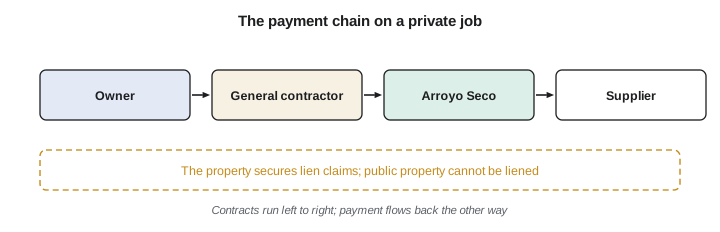
New Mexico's lien article allows people who perform labor, furnish materials or provide equipment, tools or machinery for the construction, alteration or repair of a building or improvement, as well as certain surveyors, to claim a lien on the property. An electrical contractor who contracts directly with the owner is an original contractor. A contractor who works for a general contractor is a subcontractor. Suppliers who furnish materials to either may also claim. The lien gives the claimant a security interest in the real property, which can be foreclosed if the debt is not paid.
The licensing act adds a condition. Under section 60-13-30, a contractor who was not licensed when required may not bring an action to collect compensation for that work. A lien foreclosure is an action to collect, so an unlicensed contractor is likely to lose its lien rights as well. This is one more reason to keep the license, the classification and the QP current at all times.
The preliminary notice
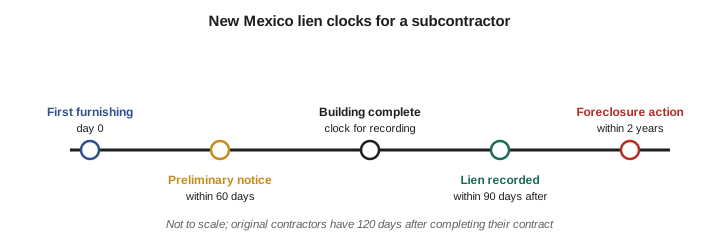
New Mexico requires a preliminary notice from some claimants. Under section 48-2-2.1, a claimant whose lien claim would be greater than 5,000 dollars, and who did not contract directly with the owner, must give a preliminary notice within 60 days after first furnishing work or materials. The notice goes to the owner or the original contractor, as the statute directs, and it identifies the property, the claimant and the party the claimant contracted with or supplied. The statute exempts claims on residential property of four or fewer units. Published summaries of the statute differ on whether a claimant who contracts directly with the original contractor is also exempt, so a subcontractor should read section 48-2-2.1 itself, and when in doubt, send the notice.
The consequence of missing the notice is a loss or reduction of lien rights. Secondary sources describing the statute say that a claimant who gives a late notice may claim a lien only for work or materials furnished in a limited period before the notice, and a claimant who gives no notice may lose the lien for the amount above the threshold. The exact effect is set in the statute and should be checked before relying on a late notice. For an electrical subcontractor on a commercial job, the safest habit is to send a preliminary notice on every job over the threshold within the first few weeks.
| Question | Rule as published in late 2026 | Source |
|---|---|---|
| Who must give a preliminary notice? | Claimants who did not contract directly with the owner, for claims over 5,000 dollars | Section 48-2-2.1 |
| When? | Within 60 days after first furnishing work or materials | Section 48-2-2.1 |
| Exemption | Residential property of four or fewer units | Section 48-2-2.1 |
| Recording deadline, original contractor | 120 days after completing the contract | Section 48-2-6 |
| Recording deadline, others | 90 days after completion of the building or improvement | Section 48-2-6 |
| Enforcement | Action filed within two years after recording | Section 48-2-10 |
Recording the lien
To claim a lien, the claimant records a verified lien statement with the county clerk of the county where the property is located. Section 48-2-6 sets the deadlines. An original contractor must record within 120 days after completing its contract. Every other claimant, including a subcontractor or supplier, must record within 90 days after completion of the building or improvement. The statement must describe the property, the amount claimed, the owner or reputed owner, the party who employed the claimant and the work done. The statute also requires a copy of the recorded lien to be served on the owner within a short time after recording.
The word completion matters. For a subcontractor, the 90 days usually run from completion of the whole building or improvement, not from the day the subcontractor left the job. That can work in the subcontractor's favor on a long project, but it can also create uncertainty about when the clock started. A careful claimant records well inside the shortest reasonable reading of the deadline.
Enforcing the lien
A recorded lien does not collect money by itself. Under section 48-2-10 the claimant must bring an action to foreclose the lien within two years after recording, or the lien is no longer enforceable. In the action, a court can order the property sold to satisfy the lien. Priority among lien claimants and other interests in the property is governed by the statute, and generally dates from the start of work on the improvement. Most lien claims are resolved by payment or settlement long before a foreclosure sale, but the two-year deadline must still be calendared.
from datetime import date, timedelta

first_furnish = date(2026, 3, 9)
completion = date(2026, 7, 24)
notice_by = first_furnish + timedelta(days=60)
record_by = completion + timedelta(days=90)
print("preliminary notice due:", notice_by)
print("lien must be recorded by:", record_by)
recorded = date(2026, 9, 18)
print("recorded on:", recorded, "| inside deadline:", recorded <= record_by)
enforce_by = date(recorded.year + 2, recorded.month, recorded.day)
print("foreclosure action due by:", enforce_by)preliminary notice due: 2026-05-08 lien must be recorded by: 2026-10-22 recorded on: 2026-09-18 | inside deadline: True foreclosure action due by: 2028-09-18
Worked problem
The Socorro apartments
Arroyo Seco is a subcontractor on a six-unit apartment building, with a claim of 38,400 dollars. It first furnished work on March 9, 2026, and the building was completed on July 24, 2026. Did it need a preliminary notice, and when must it record?
Show solution
- The claim is over 5,000 dollars, and Arroyo Seco did not contract with the owner.
- Six units is more than four, so the residential exemption does not apply.
- A preliminary notice was due within 60 days, by May 8, 2026; Teresa had sent it on March 20.
- As a subcontractor, Arroyo Seco must record within 90 days after completion, by October 22, 2026.
- Teresa recorded the lien on September 18, 2026, and the foreclosure action must be filed by September 18, 2028.
Answer: A preliminary notice was required and was sent in time; the lien was recorded inside the 90 days, and the enforcement deadline is September 18, 2028.
Public projects
Liens are not available on public property. On public works, unpaid subcontractors and suppliers rely instead on the payment bond that the prime contractor must furnish under New Mexico's public works bond statute, often called the Little Miller Act, at NMSA section 13-4-18 and following. The statute sets notice and suit requirements for claims on the bond, and those deadlines are short. A subcontractor on a school or municipal job should read the bond statute and the bond itself at the start of the job and calendar its notice deadline.
Prompt payment and retainage
New Mexico's Retainage Act, NMSA Chapter 57, Article 28, also known as the prompt payment law for construction, sets payment and retainage rules for construction contracts. As summarized in published construction law guides, owners must pay undisputed amounts within a stated number of days after receiving a payment request, and contractors and subcontractors must pay their subcontractors and suppliers within a short stated period after they themselves receive payment, with interest on late payments. The act also limits retainage practices. The exact periods and exceptions are in the act and should be checked before relying on them in a dispute.
Lien waivers
Owners and lenders often require lien waivers as a condition of each payment. A waiver given in exchange for a payment should be limited to the amount actually received and to work through a stated date. A waiver that releases all claims, or that is signed before the payment clears, can cost a contractor its lien rights for money it never received. Lucía's rule was to sign only waivers that matched the check in hand, and to keep a copy of every waiver with the invoice it covered.
Good habits for getting paid
Most payment problems are prevented by habits rather than lawsuits. Lucía's list was short. Read the payment terms before signing. Get the owner's legal name and the property description at the start of the job. Send the preliminary notice when it is required. Bill on time and in the format the contract requires. Get changes in writing. Keep daily reports and photographs. Follow up on late payments within a week. A contractor who does these things rarely needs to record a lien, and when it does, the records make the claim straightforward.
When a dispute cannot be settled
Most payment disputes end with a phone call, a meeting or a negotiated payment plan. When they do not, the contract's dispute clause controls the next step. Some contracts require mediation or arbitration before a lawsuit. Others name the court and the county where a suit must be filed. A recorded lien does not change those terms, but it adds pressure, because an owner who wants to sell or refinance the property needs the lien released. Arroyo Seco's practice was to involve the company's lawyer as soon as a lien was recorded, so that the two-year enforcement deadline and any contract procedures were handled by someone who does that work every day.
Lucía added one line to her own list after the Socorro job: if a general contractor misses a payment, call the same week and ask why, politely and in writing afterward. A short delay noticed early is usually a paperwork problem. A long silence is the warning sign that the lien clocks may soon matter.
Common mistakes
MistakeWaiting until the end of the job to think about lien rights.
InsteadThe preliminary notice is due within 60 days after first furnishing on jobs where it is required.
MistakeCounting the 90 days from the subcontractor's last day on the job.
InsteadFor subcontractors the 90 days run from completion of the building or improvement.
MistakeAssuming a lien is permanent once recorded.
InsteadAn enforcement action must be filed within two years after recording.
MistakeFiling a lien on a public school.
InsteadPublic property cannot be liened; use the payment bond under the public works bond statute.
Summary and key terms
- The contract defines what was promised; get changes in writing before starting them.
- Claimants who did not contract with the owner must give a preliminary notice within 60 days for claims over 5,000 dollars, except on residential property of four or fewer units.
- Original contractors record within 120 days after completing their contract; others within 90 days after completion of the building.
- A foreclosure action must be filed within two years after recording.
- Public projects use payment bonds, and an unlicensed contractor cannot sue to collect.
- Mechanics' lien
- A claim against real property for unpaid labor, materials or equipment furnished to improve it.
- Original contractor
- A contractor who contracts directly with the owner.
- Preliminary notice
- An early notice to the owner that a subcontractor or supplier is furnishing work or materials.
- Lien statement
- The verified document recorded with the county clerk to claim a lien.
- Lien waiver
- A document releasing lien rights, usually in exchange for payment.
Practice problems
Work each problem on paper first, then reveal the answer to check.
Within how many days after first furnishing is a preliminary notice due?
Show answer
Within 60 days.
When must a subcontractor record a lien?
Show answer
Within 90 days after completion of the building or improvement.
How long does a claimant have to bring an enforcement action?
Show answer
Two years after recording.
What protects a subcontractor on a public project?
Show answer
The payment bond under the public works bond statute.
Lesson quiz · 5 questions
Score 60% or more to complete this lesson.
Create a free account to save your progress, take quizzes and earn a certificate.