
MELU-306 · Lesson 6 of 12 · 19 min
Permits, inspections and the inspection authority
▶ Video coming soon A video version of this lesson is on the way.
In the same week, Arroyo Seco Electric started three jobs. The first was a tenant finish in a strip center on Albuquerque's west side. The second was a 400-ampere three-phase service for a hay barn and shop on a ranch outside Belen. The third was a well pump replacement and a new pump house circuit for a family in the mountains east of Mountainair. Teresa pulled the permits, and Lucía watched how she did it. The Albuquerque permit came from the city. The other two came from CID. Lucía asked why, and Teresa's answer was the subject of this lesson: it depends on who the inspection authority is for the address.
This lesson explains how inspection authority is divided between CID and local building departments in New Mexico, how to find the authority for an address, what a permit application involves, the inspection stages set in the rules, correction notices, the rule against covering work, utility connection approval, stop work orders and how Lucía handled the three jobs. It draws on the permits and inspections rules in 14.5 NMAC as published in late 2026.
Who is the inspection authority
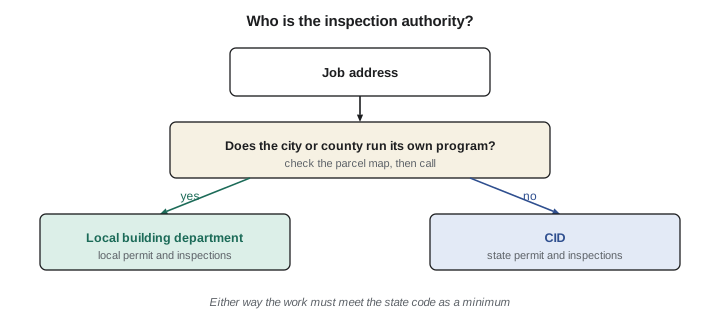
In New Mexico the authority having jurisdiction for building permits and inspections is either CID or a local government that runs its own program. Larger cities, and some counties, have building departments that issue permits and inspect electrical work within their jurisdictions. Albuquerque, Santa Fe and Las Cruces are examples of cities that run their own building safety programs. Where no local program exists, which includes much of rural New Mexico and many smaller towns, CID issues the permits and its inspectors do the inspections.
A local program is not a separate system. The licensing act makes the state codes a minimum for political subdivisions, and local inspectors are certified under the state's inspector rules in 14.6.5 NMAC. The license is the same everywhere: an EE-98 license is a state license issued by CID, and it is the license a contractor uses in every jurisdiction, while local programs issue permits and inspect. What changes from place to place is who takes the permit application, who comes to inspect and some local administrative procedures.
Finding the authority for an address
The first step for any job is to confirm the jurisdiction from the address. City limits in New Mexico can be irregular, and an address with a city's name may be in an unincorporated area. Teresa's method was to check the county assessor's parcel map, then call the city's building department if the parcel appeared to be inside city limits, and call CID's permit office if it did not. For tribal lands, she checked with the tribe and the owner first, because permitting on tribal land follows tribal and federal arrangements, not simply the state's.
| Job | Location | Inspection authority |
|---|---|---|
| Strip center tenant finish | Inside Albuquerque city limits | City of Albuquerque building safety |
| Hay barn and shop service | Unincorporated Valencia County | CID |
| Well pump and pump house circuit | Unincorporated Torrance County | CID |
The permit application
Under the permits rule, a permit is required before electrical work covered by the code is started, with exceptions listed in the rules for minor work. The permit is issued to the licensed contractor, and the application identifies the contractor by license number and classification, the property, the owner and the scope of work. For larger jobs, especially commercial work, the authority may require plans and plan review before issuing the permit. CID accepts electrical permit applications through its permitting system and publishes its fee schedule, which is based on the type and size of the work.
A permit is tied to the license and classification. Arroyo Seco can pull an electrical permit only for work within its EE-98 scope, and only while the license is active and qualified. A homeowner may, under conditions set in the rules, obtain a homeowner permit to do electrical work on their own residence, but the homeowner then takes on the responsibilities of a permittee, and the work must still be inspected.
The inspection stages
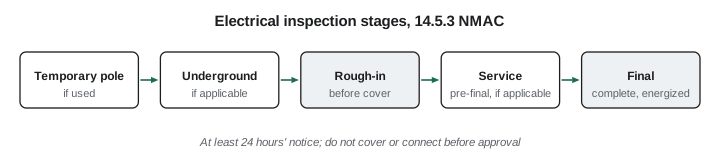
The inspections rule, 14.5.3 NMAC, lists the electrical inspection stages. They are a temporary power pole inspection where one is used, an underground or under-slab inspection where applicable, a rough-in inspection, a service or pre-final inspection where applicable and a final inspection. On residential projects the rough-in inspection is made when all wiring is installed and connections are made up; on commercial projects inspections are performed as the job requires. The final inspection is made when the electrical system is complete and energized.
Requesting an inspection
The permittee or an authorized agent must notify the authority when work is ready for inspection and give the inspector access. The rule sets a notice of at least 24 hours before the work is to be inspected. Reinspections after corrections follow the same process. Teresa scheduled inspections through the permitting system as soon as Lucía's foreman confirmed the work would be ready, and she kept the permit card posted on site so the inspector could find it.
Correction notices
If the work does not fully comply, the inspector issues a written correction notice that cites the violations and orders them corrected. The permittee must notify the authority when the corrections are complete and request a reinspection. A permittee who fails to make corrections within the time required, or within a reasonable time if none is stated, violates the rules and may face disciplinary action. Reinspection fees may apply.
Lucía's foremen treated a correction notice as a checklist. The foreman photographed each item after correcting it, wrote the date and his initials beside each line and kept the notice with the permit. When the inspector returned, the foreman walked the items in order. The practice shortened reinspections and gave Ramón a record if a question came up later.
Do not cover, do not connect
Two rules govern what happens before approval. The first is that work must remain visible until it has been inspected and approved; it may not be covered or used before approval, and no work may proceed past the next scheduled inspection without the inspector's approval. The inspector may order covered work uncovered, and a reinspection fee may apply. The second is that electrical systems may not be connected or reconnected to their energy source until the authority or inspector approves. That is the rule behind the utility release: the electric utility will not set a meter on a new service until it receives the authority's approval.
stages = ["temporary pole", "underground", "rough-in", "service", "final"]
results = {"temporary pole": "pass", "underground": "pass", "rough-in": "correction", "service": None, "final": None}
covered_ok = True
for s in stages:
    r = results[s]
    if r is None:
        print(f"{s:<15} not yet requested")
        continue
    print(f"{s:<15} {r}")
    if r == "correction":
        print("   -> fix items, notify the authority, request reinspection; do not cover the work")
        covered_ok = False
print("insulation and drywall allowed:", covered_ok)temporary pole pass underground pass rough-in correction -> fix items, notify the authority, request reinspection; do not cover the work service not yet requested final not yet requested insulation and drywall allowed: False
Stop work orders
The inspections rule allows a stop work order, issued in writing to the person doing the work and to the property owner, when there is a hazard to health or safety, when work proceeds without corrections being made, when work deviates from approved plans, when the work is being done by an unlicensed contractor or when work is done without the proper permits. Work must stop until the authority lifts the order. A stop work order is serious for a contractor, because it often comes with a referral for disciplinary action.
Certificate of occupancy
The inspections rule also says that no building may be occupied until a certificate of occupancy or an approved final inspection is issued, and that a certificate of occupancy requires all required inspections to be complete and approved. A temporary certificate may be issued in some cases for a limited period, with extensions up to a maximum stated in the rule. For the electrical contractor, the practical point is that the final electrical inspection is on the critical path for the owner's move-in date.
Worked problem
The hay barn service
The Belen hay barn needs a new 400-ampere three-phase service. The property is in unincorporated Valencia County. The rough-in inspection finds two items: a missing bonding jumper and an unsupported cable run. What happens next?
Show solution
- The inspection authority is CID, so Teresa requested the inspection through CID with at least 24 hours' notice.
- The inspector issues a written correction notice listing both items.
- The crew corrects both items, photographs them and leaves the work uncovered.
- Teresa notifies CID that the corrections are complete and requests a reinspection.
- After the service inspection and final pass, CID's approval allows the utility to connect the service.
Answer: Arroyo Seco corrects the items, requests a reinspection and cannot cover the work or energize the service until CID approves it.
The three jobs, side by side
Teresa's three permits followed the same pattern in different offices. The Albuquerque tenant finish needed plan review, a city permit and city inspections at rough-in and final. The hay barn needed a CID permit and inspections at underground, rough-in, service and final. The well pump replacement needed a CID permit and a final inspection, and Lucía confirmed with CID which inspections the pump house circuit needed. In every case the work had to meet the 2020 New Mexico Electrical Code, the permit was issued to Arroyo Seco as the licensee and the work could not be energized before approval.
Disputes with an inspector
Occasionally a contractor disagrees with an inspector's reading of the code. The professional way to handle it is to ask the inspector for the specific code section, discuss it calmly, document the conversation and, if the disagreement remains, follow the authority's process for review, which in CID's case means asking the Electrical Bureau. A contractor who argues on site, covers work in the hope the issue goes away or energizes without approval risks a stop work order and a complaint against the license.
Homeowner permits and the contractor
Homeowners sometimes ask a contractor to let them pull a homeowner permit so that the contractor can do the work cheaply. That arrangement is a trap for both. A homeowner permit is for work the homeowner does on their own residence. A licensed contractor who does the work under a homeowner's permit is working without a permit of its own, and the homeowner has signed for responsibilities they cannot meet. Lucía's answer to such requests was polite and firm: if Arroyo Seco does the work, Arroyo Seco pulls the permit.
Keeping permit records
Every permit generates records: the application, the plans, the inspection results, any correction notices and the final approval. Teresa kept them in a job folder, on paper and in the company's shared drive, for every job. The records answer questions years later, such as whether a service was inspected, which code applied or who was the QP at the time. They are also the first thing CID or a lawyer asks for in a dispute.
Lucía added one more habit. Before any crew left the shop for a new job, the foreman checked that the permit was issued, that it named Arroyo Seco and the right scope, and that the inspection authority's contact number was on the job sheet. A crew that arrives without a permit loses a day; a crew that starts without one exposes the company to a stop work order and a complaint against the license.
Common mistakes
MistakeAssuming an address with a city's name is inside city limits.
InsteadCheck the parcel map; many such addresses are in unincorporated areas where CID is the authority.
MistakeThinking each city issues its own electrical contractor license.
InsteadThe contractor license is a state license from CID; local programs issue permits and inspect.
MistakeCovering work after a correction notice and before reinspection.
InsteadWork must stay visible until it is approved.
MistakeEnergizing a service before approval.
InsteadSystems may not be connected to their energy source until the authority approves.
Summary and key terms
- The inspection authority is either a local building department with its own program or CID.
- The contractor license is a state license from CID, and local codes must meet the state minimum.
- The electrical inspection stages are temporary pole, underground, rough-in, service or pre-final and final, as applicable.
- Give at least 24 hours' notice for inspections; corrections must be completed and reinspected.
- Work may not be covered or energized before approval, and a stop work order halts work until lifted.
- Inspection authority
- The agency that issues permits and inspects for an address.
- Correction notice
- A written list of violations an inspector requires to be corrected.
- Stop work order
- A written order to stop work until the authority lifts it.
- Utility release
- The authority's approval that allows the utility to connect a service.
- Certificate of occupancy
- The document that allows a building to be occupied after all required inspections pass.
Practice problems
Work each problem on paper first, then reveal the answer to check.
Who issues permits where no local program exists?
Show answer
CID.
How much notice does the rule require before an inspection?
Show answer
At least 24 hours.
Can work be covered after a failed rough-in inspection?
Show answer
No. It must be corrected and approved first.
Name two reasons for a stop work order.
Show answer
A health or safety hazard and unlicensed contracting, among others.
Lesson quiz · 5 questions
Score 60% or more to complete this lesson.
Create a free account to save your progress, take quizzes and earn a certificate.