
MELU-306 · Lesson 4 of 12 · 19 min
The exam format and the references allowed
▶ Video coming soon A video version of this lesson is on the way.
The night before her Business and Law exam, Lucía laid out what she would carry into the test center: a NASCLA contractor's guide with permanent tabs, a bound copy of the Construction Industries Licensing Act, a bound copy of 14.6.3 NMAC, a silent calculator, two forms of identification and a printout of her confirmation. She had read the bulletin's reference rules three times. A candidate at another shop had been turned away from the testing room the year before because her code book had loose pages tucked inside it, and Lucía did not intend to repeat the mistake.
This lesson describes the format, passing score and allowed references of the Business and Law exam and the three parts of the EE-98 trade exam as published in the PSI candidate bulletin for New Mexico construction trades in late 2026. It also covers the test-center rules for references, how the parts are scored and what the content outlines emphasize. Lesson 12 turns this into a study and pacing plan.
Four scored exams
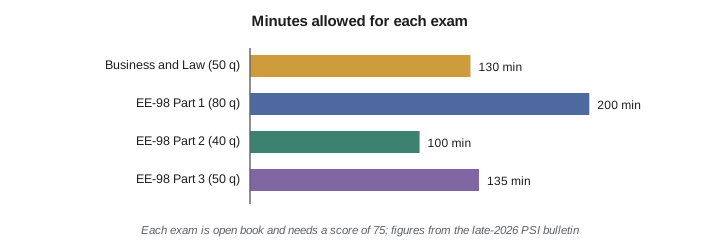
A new EE-98 qualifying party faces four scored exams: the Business and Law exam, required of all new contractor candidates unless they complete an approved course, and the three parts of the EE-98 combination exam. Each is open book, each is scored separately and each has a passing score of 75. The bulletin expresses the passing score both as a scaled 75 and as a raw number of points, which differs by exam because the exams have different numbers of questions.
| Exam | Questions | Time | Points to pass |
|---|---|---|---|
| Business and Law | 50 | 130 minutes | 38 |
| EE-98 Part 1, commercial and industrial | 80 | 200 minutes | 60 |
| EE-98 Part 2, residential | 40 | 100 minutes | 30 |
| EE-98 Part 3, specialties | 50 | 135 minutes | 38 |
The Business and Law exam
The Business and Law exam tests what a contractor needs to run a lawful, solvent business in New Mexico: licensing law, business organization, estimating and bidding, contracts, project management, accounting basics, payroll and tax obligations, insurance and bonding, lien law and safety. It has 50 questions and a time limit of 130 minutes, and a candidate needs 38 correct answers to pass. A silent, non-programmable calculator is allowed.
The bulletin lists three references for the exam. The first is the NASCLA Contractors Guide to Business, Law and Project Management, in the New Mexico edition the bulletin names. The second is the Construction Industries Licensing Act, NMSA Chapter 60, Article 13. The third is the contractor license requirements rule, 14.6.3 NMAC. A large share of the exam can be answered from the NASCLA guide, but the New Mexico-specific questions come from the Act and the rule, and they tend to be the ones candidates miss.
EE-98 Part 1: commercial and industrial
Part 1 is the longest exam: 80 questions in 200 minutes, with 60 correct answers needed to pass. It covers commercial and industrial electrical work: services and feeders, overcurrent protection, grounding and bonding, wiring methods, conductor sizing and ampacity, motors and motor controls, transformers, hazardous locations, special occupancies and equipment, and the state amendments that affect commercial work. Calculation questions, such as feeder and service load calculations, motor circuit sizing and voltage drop, make up a meaningful share.
The bulletin's references for Part 1 are the NFPA 70 National Electrical Code in the 2020 edition, or the NEC Handbook of that edition, the New Mexico Electrical Code at 14.10.4 NMAC in its 2020 version, and an older edition of the National Electrical Safety Code. The NESC applies to utility-type installations, and a few questions draw on it.
EE-98 Part 2: residential
Part 2 covers residential wiring: dwelling load calculations, branch circuits and receptacle placement, GFCI and AFCI protection, services for one- and two-family dwellings, grounding electrode systems, wiring methods common in homes and the state amendments that change residential requirements. It has 40 questions in 100 minutes, and 30 correct answers are needed. Its references are the 2020 NEC or NEC Handbook and the 2020 New Mexico Electrical Code. Because New Mexico's amendments are heaviest in residential work, a candidate who knows only the national code will find Part 2 harder than they expect.
EE-98 Part 3: specialties
Part 3 covers the specialty scopes included in EE-98: signs and outline lighting, lightning and cathodic protection, low-voltage systems such as fire alarm and communications, and water well pumps, along with related NEC articles. It has 50 questions in 135 minutes and requires 38 correct answers. Its references are the 2020 NEC or NEC Handbook and an edition of NFPA 72, the National Fire Alarm and Signaling Code, named in the bulletin. Many EE-98 candidates have little hands-on specialty experience, which makes Part 3 a common retake.
exams = [
    ("Business and Law", 50, 130, 38),
    ("Part 1 commercial/industrial", 80, 200, 60),
    ("Part 2 residential", 40, 100, 30),
    ("Part 3 specialties", 50, 135, 38),
]
print(f"{'exam':<30}{'min/question':>13}{'can miss':>10}")
for name, q, minutes, need in exams:
print(f"{name:<30}{minutes / q:>13.2f}{q - need:>10}")exam min/question can miss Business and Law 2.60 12 Part 1 commercial/industrial 2.50 20 Part 2 residential 2.50 10 Part 3 specialties 2.70 12
Every exam allows roughly two and a half minutes per question or more, which is generous for recall questions and tight for calculations that need two or three lookups. The column on the right matters as much: on Part 2 a candidate can miss only ten questions, while on Part 1 they can miss twenty.
Rules for references in the test center
Because all four exams are open book, the bulletin's rules about references matter. In general the bulletin allows bound, published references in the editions listed, and allows a candidate to highlight, underline and add permanent tabs. It does not allow loose papers, notes inserted between pages, removable sticky notes or handwritten material beyond what the bulletin permits. Proctors inspect the books before the exam starts. A book that does not meet the rules may be kept out of the room, and the candidate must test without it.
Editions matter as well. A candidate who brings the 2023 NEC to an exam that lists the 2020 NEC is using a different book from the one the questions were written to. Some of the answers will differ. Candidates should bring exactly the editions the bulletin lists, and the bulletin tells them whether a handbook edition is an acceptable alternative.
| Usually allowed | Usually not allowed |
|---|---|
| Highlighting and underlining | Loose notes or papers |
| Permanent tabs | Removable sticky notes |
| Bound, published references in the listed editions | Photocopied or printed pages added to a book |
| A silent, non-programmable calculator | Phones, smartwatches and programmable calculators |
How the parts are scored and reported
Each exam is scored on its own. A candidate who passes Parts 2 and 3 of the EE-98 exam but fails Part 1 has two passing scores on file and needs to retake only Part 1. PSI reports the result at the test center. A failing report usually shows the score and a breakdown by content area, which is the single best guide to what to study for the retake.
The passing score of 75 is the same on every exam, and 14.6.3 NMAC states it directly. Candidates sometimes hope that a strong score on one part can make up for a weak one on another. It cannot, because each part must be passed separately.
Worked problem
Reading a score report
Lucía's friend Mateo failed Part 1 with 56 correct answers. His report shows weak areas in motors and hazardous locations, and strong areas in services and grounding. What should he do?
Show solution
- He needed 60 correct answers, so he was four questions short.
- His other parts are already passed and do not need to be retaken.
- He should study motor circuits and hazardous location articles first, using timed practice.
- He may retake Part 1, but not more than twice in any 30-day period, and his passing scores on the other parts stay valid for a year.
Answer: Mateo should retake only Part 1 after targeted study of the weak areas, keeping track of the one-year validity of his other scores.
What the content outlines emphasize
The bulletin includes a content outline for each exam that shows the topics and approximately how many questions each one contributes. Candidates often skip the outline. They should not. It shows where the points are. For Part 1, for example, the outline gives significant weight to services, feeders, branch circuits and calculations, while individual topics such as hazardous locations carry a handful of questions each. For Business and Law, the outline shows how many questions come from licensing law, lien law, contracts and financial management.
Lucía made a single sheet from the outlines. For each topic she wrote the number of questions, the reference where answers are found and a self-rating from one to five. Topics with many questions and a low self-rating went to the top of her study plan. Topics with few questions and a high self-rating went to the bottom. Lesson 12 develops that sheet into a full plan.
Lucía's Business and Law exam
Lucía took the Business and Law exam on October 17. Her strategy was to answer every question she could find quickly in the NASCLA guide, flag every New Mexico-specific question and return to those with the Act and the rule open. She finished with twenty minutes to spare and passed. Her score report showed her weakest area as lien law, which she noted for the work she would do on Arroyo Seco's contracts in the spring.
How the exam is delivered
PSI delivers the New Mexico construction exams on computer at its test centers. The session begins with identity checks and an inspection of the candidate's references, followed by a short tutorial on the testing software. The software shows one question at a time, lets the candidate mark a question for review, shows the time remaining and allows a return to marked questions before the exam is submitted. Scratch paper or a writing board is provided by the center under its rules, and it is collected at the end.
The bulletin explains what happens if a candidate arrives late, forgets identification or brings a prohibited item. In general, a candidate who arrives too late or without acceptable identification is not admitted and may forfeit the fee. A candidate who is found with a prohibited item, such as a phone, may have the exam ended. Reading those paragraphs once before test day costs nothing and prevents a painful surprise.
Using two references at once
Part 1 and Part 2 questions often require the NEC and the New Mexico Electrical Code together. A question may ask for the number of outlets allowed on a dwelling branch circuit, or for the conductor size for a concrete-encased electrode, where the national code and the state amendment give different answers. Candidates who keep the rule's pages tabbed at the front of the NEC, or in a thin bound copy beside it, save a great deal of time. Lucía practiced by reading each question, deciding first whether the topic was one the state amends and only then opening the book.
A final point about calculators. The bulletin allows a silent, non-programmable calculator, and candidates should practice with the same model they will bring. A candidate who learns a new calculator on test day loses time on every calculation question, and a calculator that the center rejects as programmable leaves the candidate with none at all. Lucía bought a second unit of the same simple model as a spare.
Common mistakes
MistakeBringing the newest NEC edition instead of the edition the bulletin lists.
InsteadBring exactly the editions listed; questions are written to those editions.
MistakeLeaving sticky notes in a reference book.
InsteadRemovable notes and loose papers are not allowed; use permanent tabs.
MistakeExpecting a high score on one part to offset a low score on another.
InsteadEach part is scored and passed separately.
MistakeIgnoring the content outline.
InsteadThe outline shows where the questions are and should drive the study plan.
Summary and key terms
- All four exams are open book and require a score of 75.
- Business and Law: 50 questions in 130 minutes; NASCLA guide, the Act and 14.6.3 NMAC.
- EE-98 Part 1: 80 questions in 200 minutes; Part 2: 40 in 100; Part 3: 50 in 135.
- References are the NEC and New Mexico Electrical Code editions the bulletin lists, plus the NESC and NFPA 72 for the parts that name them.
- Bound references with highlighting, underlining and permanent tabs are generally allowed; loose notes are not.
- Open book
- An exam that allows the listed references in the testing room.
- Content outline
- The bulletin's list of topics and approximate question counts for each exam.
- NESC
- The National Electrical Safety Code, which covers utility installations.
- NFPA 72
- The National Fire Alarm and Signaling Code.
- Raw score
- The number of questions answered correctly.
Practice problems
Work each problem on paper first, then reveal the answer to check.
How many questions and minutes does EE-98 Part 1 have?
Show answer
80 questions in 200 minutes.
What references does the Business and Law exam allow?
Show answer
The NASCLA contractor's guide, the Construction Industries Licensing Act and 14.6.3 NMAC.
Which EE-98 part lists NFPA 72 as a reference?
Show answer
Part 3, specialties.
Are removable sticky notes allowed in reference books?
Show answer
No. Permanent tabs are allowed; removable notes are not.
Lesson quiz · 5 questions
Score 60% or more to complete this lesson.
Create a free account to save your progress, take quizzes and earn a certificate.