
MELU-306 · Lesson 7 of 12 · 19 min
Duties of the qualifying party
▶ Video coming soon A video version of this lesson is on the way.
Ramón Archuleta kept a folder in his desk drawer labeled simply QP. Inside were a copy of his certificate, the company's license, every letter he had ever received from CID and a page of handwritten notes titled what the QP is for. In November 2026 he handed the folder to Lucía. "The exam tests whether you know the code," he told her. "This job is about whether you keep the company honest. Your name is on every permit, whether you were on the job or not."
This lesson explains the duties and limits of a New Mexico qualifying party as set out in the Construction Industries Licensing Act and 14.6.3 NMAC in late 2026: the relationship between the QP and the licensee, supervision, the limits on qualifying more than one business, conflicts of employment, the 30-day notice when a QP leaves, what happens to work in progress, how a QP certificate can expire, signing renewals and the consequences of violations. It ends with Ramón's notes, rewritten as a checklist for Lucía.
The QP and the licensee
The licensing act and the rules treat the qualifying party as the person whose competence supports the license. The rule requires a licensed entity to employ, or be owned by, one or more qualifying parties. That requirement exists so that the QP has a real role in the business. A QP who never visits the office, never sees a job and simply lets a company use their certificate is not doing what the rules require, and the rules treat lending a certificate in that way as a violation.
The QP may perform certified work only while attached to a validly licensed entity. A QP who leaves one company cannot use the certificate to work on their own until it is attached to another license, either one they hold themselves or one held by a new employer. The certificate is personal, but its authority comes from being attached to a license.
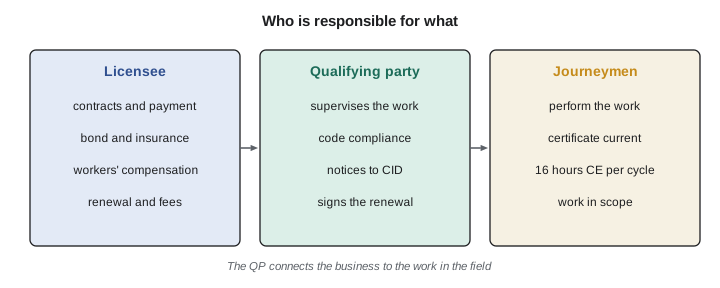
Supervision
The QP is responsible for supervising the work done under the classification they qualify. The rules do not require the QP to stand on every job site, which would be impossible for a company with several crews. They do require the QP to be able to supervise, and the rule against conflicting employment says a QP may not take employment that conflicts with their duties as qualifying party or with their ability to supervise the licensee's work. A QP who works a full-time job for an unrelated company while qualifying an electrical contractor is likely to be in breach.
In practice, supervision means systems. Lucía planned to review every permit application before it was submitted, visit every commercial job at least weekly, review every correction notice within a day and make sure each crew had a certified journeyman in charge. She also planned to keep apprentice supervision within whatever ratios the rules set and to check that every worker on an electrical crew held the right certificate or was a registered apprentice.
| Duty | Source | What it means in practice |
|---|---|---|
| Be employed by or own the licensee | 14.6.3 NMAC | A real role in the business, not a rented certificate |
| Supervise the classification's work | Act and 14.6.3 NMAC | Systems for permits, job visits, corrections and crew certification |
| Avoid conflicting employment | 14.6.3 NMAC | No other job that interferes with supervising |
| Work only while attached to a license | 14.6.3 NMAC | The certificate has authority only through a license |
| Notify CID within 30 days of leaving | 14.6.3 NMAC | Both the QP and the licensee give written notice |
| Sign the license renewal | 14.6.3 NMAC | Every current QP signs the renewal form |
Qualifying more than one business
A QP cannot freely qualify several unrelated businesses. Under 14.6.3 NMAC an individual may qualify more than one licensed entity only if the entities share common ownership of at least three-tenths, the threshold the rule states, with an exception for joint ventures. The rule prevents one person from acting as the QP for a string of companies they have no real connection to. A family with two related companies under common ownership may share a QP; two unrelated shops may not.
When a QP leaves
The rule on a QP's departure is one of the most practical in the chapter. If a licensee loses its qualifying party, both the licensee and the QP must notify CID in writing within 30 days. The notice obligation falls on both sides, so a QP who leaves cannot assume the company will report it, and a company cannot wait for the QP to do it.
If the license is canceled because it no longer has a qualifying party, the rules allow work in progress to continue for up to 120 days after the cancellation, so that customers are not left with half-finished jobs. The license cannot be used for new work in that period. The way to avoid all of this is to have a second QP attached before the first leaves, which is exactly the plan Arroyo Seco made for Lucía.
from datetime import date, timedelta

retire = date(2027, 3, 31)
notice_due = retire + timedelta(days=30)
print("Ramon's last day:", retire)
print("written notice to CID due by:", notice_due)
print("If no QP remained and the license were cancelled on", retire, ":")
print("  work in progress could continue until", retire + timedelta(days=120))
print("Plan: Lucia attached in January 2027, so the license is never without a QP.")Ramon's last day: 2027-03-31 written notice to CID due by: 2027-04-30 If no QP remained and the license were canceled on 2027-03-31 : work in progress could continue until 2027-07-29 Plan: Lucia attached in January 2027, so the license is never without a QP.
How a QP certificate can expire
A QP certificate is not permanent in itself. Under 14.6.3 NMAC a new certificate expires if it does not qualify a valid license within twelve months of the reported exam score. A certificate also expires if the holder fails to qualify a valid license for any two-year period. A QP who retires and later wants to return should check whether their certificate has expired, because a return after more than two years without qualifying a license may mean starting again with the exams.
For Lucía this means that once she has passed Part 1 in December, the twelve-month clock starts. Arroyo Seco's plan to attach her certificate in January puts her well within it.
Signing renewals and reporting changes
Every current qualifying party must sign the license renewal form. The renewal form is mailed by CID at least 30 days before the license expires. Lesson 11 covers renewal in detail, but the QP's role is simple: the renewal is one of the occasions when the QP confirms in writing that they remain the qualifying party. The licensee must also report other changes that affect the license, such as a change in the business's name, address or ownership, in the way CID's rules require.
Violations and their consequences
The licensing act gives CID the power to discipline licensees and certificate holders. Disciplinary action can range from a fine to suspension or revocation of a license or certificate, and the act lists grounds such as contracting without a license, working beyond a classification's scope, failing to comply with the codes, failing to obtain permits and violating the rules. The act also makes unlicensed contracting a criminal offense and bars an unlicensed contractor from bringing a lawsuit to collect for work that required a license. Because the QP is responsible for the classification's work, a QP's own certificate can be disciplined along with the license.
The most common violations Ramón had seen in forty years were working without a permit on small jobs, letting an uncertified helper do journeyman work, ignoring correction notices and allowing a crew to start a job outside the classification's scope. Each one can be prevented by a QP who has systems and uses them.
Worked problem
A crew outside the scope
A sales representative for a neighboring company asks whether Arroyo Seco can subcontract a 12,470-volt overhead line extension on a ranch. Lucía is the new QP. What should she answer?
Show solution
- The work is distribution at more than 5,000 volts.
- EE-98 covers wiring at 5,000 volts nominal or less and excludes EL-1 work other than trenching and ductwork.
- Arroyo Seco does not hold an EL-1 classification.
- The company may dig the trench and set the ductwork if that is part of the job, but the line work needs an EL-1 contractor.
Answer: Lucía should decline the line work, offer the trenching and ductwork if appropriate and refer the line work to an EL-1 contractor.
Ramón's notes as a checklist
Lucía rewrote Ramón's handwritten page as a checklist she could use every week. It turns the rules into habits. Ramón had kept most of it in his head for decades; Lucía wanted it written down so that the company's second QP, when there was one, could follow the same system.
| Frequency | Task |
|---|---|
| Every permit | Confirm the scope is within EE-98 and the authority is right |
| Every job start | Confirm a certified journeyman is in charge and apprentices are registered |
| Weekly | Visit each commercial job; review open correction notices |
| Monthly | Check that the bond and insurance are current and workers' compensation is in force |
| Every change | Report changes to CID as the rules require |
| Every renewal | Sign the renewal form and confirm continuing education for journeymen |
The handover
The last pages of Ramón's folder were a list of open permits, the inspectors he worked with most often and a short list of customers who expected a call from him personally. Lucía and Ramón agreed that from January to March they would sign permits together, visit jobs together and introduce Lucía to every inspector and general contractor the company worked with. By the time Ramón left, CID's records, the inspectors and the customers would all know who the QP was.
The QP and the company's owners
The QP's duties do not depend on owning the company, but they do shape the relationship with the owners. Owners make business decisions: which jobs to bid, what to charge, whom to hire. The QP is responsible for whether the electrical work meets the code and the rules. When the two conflict, for example when an owner wants to start a job before a permit is issued or to send an uncertified worker to do journeyman work, the QP must say no. Ramón told Lucía that in forty years he had said no to an owner perhaps a dozen times, and that each time it had saved the company money in the end.
Dolores and Lucía agreed on a written understanding. Lucía would have the final word on any question of code compliance, permits, scope and crew certification, and Dolores would have the final word on commercial terms. Disagreements would be discussed in person, not settled by email. The understanding is not required by the rules, but it reflects what the rules assume: that the QP has the authority to do the job.
Ramón's final advice was about records. A QP who can show what they did, the permits reviewed, the job visits made, the correction notices closed and the certificates checked, is in a strong position if CID ever asks how the work was supervised. A QP who did the same things but kept no record has only their memory. Lucía set up a simple weekly log for exactly that reason.
Common mistakes
MistakeLetting a company use a certificate without a real role in it.
InsteadThe licensee must employ or be owned by its QP, and lending a certificate is a violation.
MistakeAssuming the company will report a QP's departure.
InsteadBoth the QP and the licensee must give CID written notice within 30 days.
MistakeQualifying two unrelated businesses.
InsteadA QP may qualify more than one entity only with the required common ownership, or in a joint venture.
MistakeAssuming a certificate lasts forever.
InsteadIt expires if it does not qualify a license within twelve months of the score, or for any two-year period.
Summary and key terms
- A licensee must employ or be owned by its qualifying party, who supervises the classification's work.
- A QP may not take conflicting employment and may work only while attached to a valid license.
- Qualifying more than one entity requires the common ownership set in the rule, except for joint ventures.
- When a QP leaves, both the QP and the licensee must notify CID in writing within 30 days; work in progress may continue up to 120 days after a cancellation.
- A certificate expires if it does not qualify a license within twelve months of the score or for any two-year period.
- Licensee
- The business entity or individual that holds the contractor license.
- Attached
- Linked to a license as its qualifying party in CID's records.
- Conflicting employment
- Other work that interferes with the QP's duties or ability to supervise.
- Common ownership
- Shared ownership between entities, which the rule requires before one QP may qualify both.
- Work in progress
- Jobs already under way when a license is canceled.
Practice problems
Work each problem on paper first, then reveal the answer to check.
Within how many days must a departing QP's notice reach CID?
Show answer
Within 30 days, from both the QP and the licensee.
How long may work in progress continue after a license is canceled for lack of a QP?
Show answer
Up to 120 days.
Can a QP perform certified work while not attached to any license?
Show answer
No. The QP may perform certified work only while attached to a valid license.
Who must sign the license renewal form?
Show answer
Every current qualifying party.
Lesson quiz · 5 questions
Score 60% or more to complete this lesson.
Create a free account to save your progress, take quizzes and earn a certificate.