
MELU-306 · Lesson 3 of 12 · 19 min
Applying, approval and booking the exam
▶ Video coming soon A video version of this lesson is on the way.
On a Friday afternoon in late August 2026, Lucía and Teresa sat down with the qualifying party application packet and a calendar. Ramón's retirement date of March 31, 2027 was seven months away. Teresa's rule of thumb was that every licensing step takes longer than the instructions suggest, so she wanted the exams finished by the end of the year, leaving three months for the paperwork that follows. The question for the afternoon was how to get from a blank application to a confirmed exam seat as quickly as the rules allow.
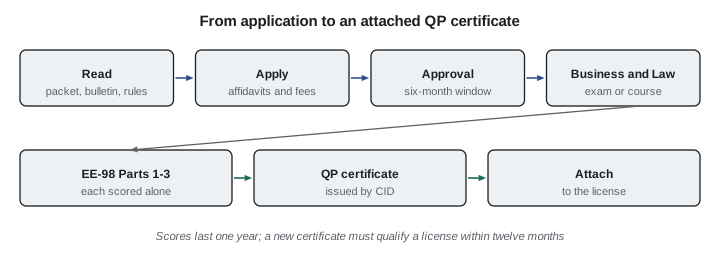
This lesson walks through the application and approval process for a New Mexico QP certificate as described in PSI's application packet and the candidate bulletin in late 2026: assembling the packet, fees and payment, approval to test, the six-month eligibility window, booking each exam, retake rules, how long scores stay valid and what happens after the exams. It ends with Lucía's timeline.
Step one: read the documents
Three documents govern the process. The QP application packet, published by PSI for CID, lists what must be submitted. The candidate bulletin for New Mexico construction trades describes each exam, the references allowed, the fees, the testing rules and the retake policy. The rules themselves, especially 14.6.3 NMAC, set the legal requirements behind both. A candidate who reads all three before filling in anything avoids most of the errors that send packets back.
The documents are dated, and they change. The application packet Teresa downloaded carried a revision date, and the bulletin had its own. If a fee or a form in one document disagrees with another, the newer document usually controls, but the safest course is to call PSI's New Mexico line and ask before sending money.
Step two: assemble the packet
The QP application asks for the candidate's identifying information, the classification sought, the experience documentation described in Lesson 2 and the fees. The experience documentation is the work experience affidavit, one per employer or affiant, signed and notarized with no blanks. The packet also asks whether the candidate has held a New Mexico certificate before and whether they have any history of disciplinary action or criminal convictions that the rules require to be disclosed.
The published application fees in the 2026 packet were a modest application fee plus a certificate fee, payable to PSI by credit card or money order. The exam fees are separate and are paid when booking each exam. The packet asks for a self-addressed, stamped envelope so that PSI can return a rejected packet. Teresa treated that envelope as a warning: if it came back, something was missing.
| Packet item | Who provides it | Notes |
|---|---|---|
| Application form | Candidate | Every question answered, signed and dated |
| Work experience affidavits | Each employer or affiant | Signed, notarized, no blanks, one per employer |
| Proof of training (optional) | Training program | Only if claiming training credit |
| Application and certificate fees | Candidate | Credit card or money order to PSI |
| Self-addressed stamped envelope | Candidate | Used to return a rejected packet |
Step three: approval to test
New Mexico uses an approval step. PSI reviews the packet for CID, and the candidate cannot book the trade exam until they are approved to test. The approval letter or email tells the candidate which exams they are eligible for. For a new QP in EE-98, that means the three-part EE-98 exam and the Business and Law exam, unless the candidate has completed an approved business and law course or already has a passing Business and Law score on file.
Approval starts a clock. The application packet states that all certification requirements must be met within six months of PSI's approval, or the application fees are forfeited, and the bulletin says that a candidate who does not test within six months of becoming eligible must reapply with the Division. A candidate should therefore apply only when they are ready to start studying in earnest and can sit the exams within that window.
Step four: book the exams
Once approved, the candidate books each exam with PSI, online or by phone, and pays the exam fee at booking. PSI delivers the New Mexico construction exams at its test centers, and the bulletin lists the locations. The EE-98 exam is booked as a combination of three parts, and the candidate may take the parts on the same day or on separate days. Each part has its own time limit, described in Lesson 4.
Teresa recommended taking the Business and Law exam first. It is the shortest exam, it uses references Lucía could study in a few weeks and passing it early removes one item from the list. She also suggested taking the EE-98 residential and specialties parts before the longer commercial and industrial part, so that Lucía would get used to the test center and the reference rules on shorter sessions.
Retakes
The bulletin's retake rules have three parts. First, a candidate must pass every part of the EE-98 combination exam, but if they fail a part, they retake only the part or parts they failed. Second, for exams that are not listed as allowing two attempts within the eligibility window, a candidate may not take the same exam more than twice in 30 days; after two failures within 30 days, they must wait 30 days from the first attempt before testing again. Third, the rules in 14.6.3 NMAC state the same limit in their own words: failed attempts may be retaken, but no more than twice in any 30-day period. Each retake has its own fee.
How long scores last
The bulletin states that passing scores are valid for one year from the exam date, and that contractor candidates must pass both the Business and Law exam and the trade exam within one year of each other. The QP rules add another clock: a new QP certificate expires if it does not qualify a valid license within twelve months of the reported exam score. Put together, a candidate who passes the exams should move promptly to attach the certificate to a license.
from datetime import date, timedelta

approval = date(2026, 9, 28)
window_end = approval + timedelta(days=182)
exams = {
    "Business and Law": date(2026, 10, 17),
    "EE-98 Part 2 residential": date(2026, 11, 7),
    "EE-98 Part 3 specialties": date(2026, 11, 7),
    "EE-98 Part 1 commercial/industrial": date(2026, 12, 5),
}
print("approval:", approval, " six-month window ends about", window_end)
for name, d in exams.items():
    retake = d + timedelta(days=30)
    print(f"{name:<36} {d}  latest-case retake {retake}")
last = max(exams.values()) + timedelta(days=30)
print("days left in the window after a worst-case retake:", (window_end - last).days)approval: 2026-09-28 six-month window ends about 2027-03-29 Business and Law 2026-10-17 latest-case retake 2026-11-16 EE-98 Part 2 residential 2026-11-07 latest-case retake 2026-12-07 EE-98 Part 3 specialties 2026-11-07 latest-case retake 2026-12-07 EE-98 Part 1 commercial/industrial 2026-12-05 latest-case retake 2027-01-04 days left in the window after a worst-case retake: 84
Step five: certificate and license
When the candidate has passed every required exam, CID issues the QP certificate in the classification. The certificate by itself does not authorize contracting. It must be attached to a licensed business. For Lucía, that means Arroyo Seco must ask CID to add her as a qualifying party on its existing license for the EE-98 classification. The company's paperwork is covered in Lessons 7 and 8, but the timing belongs here: the certificate should be attached well before Ramón's certificate is removed, so that the license never lacks a qualifying party.
Worked problem
Planning around the retirement date
Lucía is approved on September 28, 2026. Ramón leaves on March 31, 2027. Which order of steps keeps Arroyo Seco's license qualified without a gap?
Show solution
- Pass Business and Law in October and the EE-98 parts by early December.
- Receive the QP certificate in December or January.
- Ask CID to add Lucía as a second QP on the license while Ramón is still attached.
- When Ramón retires, both he and the company notify CID in writing within 30 days that he is no longer the QP.
Answer: Add Lucía before removing Ramón. The license then always has a qualifying party, and the 30-day notice covers Ramón's departure.
Lucía's timeline
Lucía mailed her packet on September 1, 2026. Teresa had checked each page against the instructions, and Ramón's affidavit and the general contractor's affidavit were both notarized. PSI approved her on September 28. She booked the Business and Law exam for October 17 and passed it. She sat Parts 2 and 3 of the EE-98 exam on November 7 and passed both. On the date of this lesson, November 10, she has Part 1, the commercial and industrial exam, booked for December 5. If she passes, she expects her certificate in time to be added to the license in January, leaving more than two months before Ramón's last day.
| Date | Step | Status on November 10, 2026 |
|---|---|---|
| September 1, 2026 | Packet mailed | Done |
| September 28, 2026 | Approval to test | Done |
| October 17, 2026 | Business and Law exam | Passed |
| November 7, 2026 | EE-98 Parts 2 and 3 | Passed |
| December 5, 2026 | EE-98 Part 1 | Booked |
| January 2027 | Certificate and addition to the license | Planned |
| March 31, 2027 | Ramón retires; notice to CID | Planned |
Common reasons a timeline slips
Teresa listed the delays she had seen in other shops. An affidavit came back without a notary seal. A candidate applied, received approval and then let the six-month window run out while waiting for a slow season. A candidate passed the trade exam but forgot that the Business and Law score must fall within a year of it. A candidate booked the exams before reading the bulletin's rules on references and lost time at the test center. A business forgot to add the new QP before removing the old one. Each one is avoidable with a written plan and a copy of every page sent.
The business and law course option
The bulletin and the application packet both allow a new QP to complete an approved business and law course instead of passing the Business and Law exam. The course ends with a completion certificate that is submitted to PSI. Some candidates prefer the course because it is structured and ends with a certificate rather than a timed test. Others prefer the exam because it is faster if they already know the material. Lucía chose the exam because she had already studied the references as an estimator and wanted to keep moving.
What approval does not do
Approval to test is not a license and not a certificate. It shows only that PSI, on CID's behalf, has found the candidate eligible to sit the exams. A candidate who is approved may not advertise as a qualifying party, may not pull permits and may not tell customers that a license is coming. Lucía was careful about this with Arroyo Seco's customers. When a general contractor asked in October whether she was the new QP, she said that she was in the exam process and that Ramón remained the qualifying party until CID's records showed otherwise.
Approval also does not lock in the exam content. If PSI updates the bulletin between approval and test day, the new bulletin governs the exam the candidate actually sits. Lucía checked the bulletin's revision date again the week before each exam and compared the reference list with the books in her bag. The check took five minutes and removed one source of worry from test day.
Teresa also kept a scanned copy of the whole packet, including the money order receipt and the mailing receipt. If PSI later asked about a page, she could answer from the scan instead of trying to remember what had been sent. The copy cost nothing and took ten minutes.
Common mistakes
MistakeBooking the trade exam before approval to test.
InsteadPSI schedules only after the candidate is approved for the exams.
MistakeLetting the six-month eligibility window lapse.
InsteadRequirements must be met within six months of approval, or the candidate must reapply and the fees are forfeited.
MistakeRetaking all three EE-98 parts after failing one.
InsteadOnly the failed part is retaken.
MistakeRemoving the old QP before the new one is attached.
InsteadAdd the new QP first so the license is never without a qualifying party.
Summary and key terms
- Read the PSI application packet, the candidate bulletin and 14.6.3 NMAC before applying.
- Submit the application with notarized affidavits and fees; PSI reviews it for CID.
- After approval, all requirements must be met within six months.
- Failed EE-98 parts are retaken individually, no more than twice in any 30-day period.
- Scores are valid for one year, and the Business and Law and trade exams must be passed within a year of each other.
- Approval to test
- PSI's notice that a candidate is eligible to book the exams.
- Eligibility window
- The six months after approval in which the candidate must complete the requirements.
- Combination exam
- The EE-98 trade exam, made up of three separately scored parts.
- Score validity
- The one-year period during which a passing score can be used.
- Business and law course
- An approved course that may replace the Business and Law exam.
Practice problems
Work each problem on paper first, then reveal the answer to check.
Can a candidate book the EE-98 exam before approval?
Show answer
No. The candidate must be approved to test first.
How long after approval must the requirements be met?
Show answer
Within six months, or the candidate must reapply.
After failing one EE-98 part, what must be retaken?
Show answer
Only that part.
How long is a passing score valid?
Show answer
One year from the exam date.
Lesson quiz · 5 questions
Score 60% or more to complete this lesson.
Create a free account to save your progress, take quizzes and earn a certificate.