
MELU-306 · Lesson 8 of 12 · 19 min
Contractor licensing, insurance and bonding
▶ Video coming soon A video version of this lesson is on the way.
In early December, Dolores Archuleta called a meeting in the Arroyo Seco office with Lucía, Teresa and the company's insurance agent, Ernesto Chávez. The subject was what has to be in place for the license to stay valid when the qualifying party changes. Dolores had heard stories of shops whose licenses lapsed over a bond that was never renewed or an insurance certificate that was never updated. She wanted a list of every item, who was responsible for it and how often it needed attention.
This lesson covers the contractor license itself and the bond, insurance and workers' compensation obligations that keep it in good standing under the Construction Industries Licensing Act, 14.6.3 NMAC and the Workers' Compensation Act as published in late 2026. It covers who must be licensed, the license application for a business, the license bond, liability insurance, workers' compensation, the effect of a lapse and changes to a license. It ends with Dolores's list.
Who must be licensed
The licensing act requires anyone who acts as a contractor in New Mexico to hold a license in the right classification, and its definition of contractor is broad: it covers a person who, for a fee or other compensation, undertakes or offers to construct, alter, repair or install electrical work, among other trades, and it includes subcontractors. A business that bids electrical work, signs a contract for it or advertises it must be licensed, even if it plans to have someone else do the work. The act lists exemptions, such as certain work by owners on their own property under the conditions the rules set, and some work by public utilities. The exam often tests the edges of the definition.
Unlicensed contracting has three kinds of consequences. CID may take administrative action, including fines and orders to stop. The act makes unlicensed contracting a criminal offense, with heavier penalties for repeat offenses. And section 60-13-30 bars a contractor from bringing or maintaining a lawsuit in New Mexico courts to collect compensation for work that required a license unless the contractor was licensed when the contract was made and the work was done. That last rule means an unlicensed contractor may be unable to enforce a lien or collect an unpaid bill.
Licensing the business
The license is issued to the business entity, or to an individual who contracts in their own name. The license application identifies the entity, its owners and officers, its address, the classifications requested and the qualifying party for each classification. Before CID issues the license, the applicant must provide the license bond and meet the other conditions the rules set, including compliance with the workers' compensation law and registration with the state tax agency. A business entity must also be properly organized and in good standing under New Mexico law, or registered to do business in New Mexico if it is organized elsewhere.
Arroyo Seco already holds a license, so the company does not need a new one. It needs to add Lucía as a qualifying party for the EE-98 classification and, later, remove Ramón. The rules treat these as changes to an existing license, made on CID's forms.
The license bond
Under 14.6.3 NMAC every applicant for a license, and every licensee at renewal, must provide a bond. The rule as published in late 2026 sets the bond at 10,000 dollars. The bond must remain in force for the entire licensure period, and the surety must give CID 30 days' written notice before canceling it. A licensee whose bond is canceled and not replaced is out of compliance.
The license bond is not insurance for the contractor. It protects people who deal with the contractor. A claim can be made against the bond by those the act and the bond's terms allow, such as an owner harmed by the contractor's failure to comply with the act. If the surety pays a claim, it will seek reimbursement from the contractor under the indemnity agreement the contractor signed when the bond was issued. Contractors who treat the bond as a cost of doing business sometimes forget that they remain responsible for every dollar the surety pays out.
| Item | Rule as published in late 2026 | Who handles it at Arroyo Seco |
|---|---|---|
| License bond amount | 10,000 dollars | Ernesto, the agent |
| Bond term | In force for the whole licensure period | Ernesto renews; Teresa checks |
| Surety's cancellation notice | 30 days' written notice to CID | CID receives it; Teresa watches for letters |
| Workers' compensation | Required for employers in CID-licensed work regardless of number of employees | Ernesto and Dolores |
| Liability insurance | Not set as a license condition in 14.6.3 NMAC; required by contracts and owners | Ernesto |
Liability insurance
The contractor license rule, as published, does not set a general liability insurance amount as a condition of the license, unlike some states. That does not make liability insurance optional in practice. Owners, general contractors and public agencies almost always require it by contract, usually with stated limits, additional insured endorsements and certificates delivered before work starts. A contractor without adequate liability insurance will find most commercial work closed to it and carries the full risk of property damage and injury claims.
Ernesto's advice was to review the company's general liability, commercial auto, umbrella and inland marine coverage once a year, and to keep a log of every certificate issued to a customer with the job and the expiry date. When the policy renewed, Teresa would send updated certificates to every customer with an open job.
Workers' compensation
New Mexico's Workers' Compensation Act generally requires employers with three or more employees to carry workers' compensation coverage. The construction industry has a stricter rule. The Workers' Compensation Administration's employer guidance states that an employer engaged in activities that require a license under the Construction Industries Licensing Act must carry coverage regardless of how many employees it has. An electrical contractor with a single employee must therefore be covered.
The licensing rules connect the two systems. Under 14.6.3 NMAC, failure to comply with the workers' compensation laws can make a license invalid. The Workers' Compensation Administration has its own compliance and enforcement bureaus, which verify coverage and can refer an employer for administrative prosecution. Whether an owner or officer of a small business may exclude themselves from coverage is governed by the act's election rules, and a contractor who wants to do so should confirm the current procedure with the Administration or an agent.
def wc_required(employees, cid_licensed_work):
    if cid_licensed_work:
        return True
    return employees >= 3

for emp, cid in [(1, True), (2, False), (3, False), (14, True)]:
print(f"employees={emp:<3} CID-licensed work={cid!s:<5} -> coverage required: {wc_required(emp, cid)}")employees=1 CID-licensed work=True -> coverage required: True employees=2 CID-licensed work=False -> coverage required: False employees=3 CID-licensed work=False -> coverage required: True employees=14 CID-licensed work=True -> coverage required: True
Subcontractors and coverage
A contractor who hires subcontractors should collect proof of each one's license and coverage before they start work. The workers' compensation act has rules that can make a contractor responsible for the injured employees of an uninsured subcontractor, and an uninsured subcontractor on a job is also a sign that the subcontractor may not be licensed. Teresa's practice was to keep a file for each subcontractor with a license lookup from CID's online search, a certificate of workers' compensation coverage, a certificate of liability insurance and the expiry dates of each.
When something lapses
A lapse in any of these items creates a problem. A license whose bond is canceled, whose QP leaves without replacement or whose workers' compensation coverage is not maintained may become invalid or subject to suspension. A license that is not renewed on time expires. Work under an invalid or expired license is unlicensed work, with the consequences described above: possible discipline, criminal exposure and loss of the ability to sue for payment. The work itself may also have to stop, because permits cannot be issued to an invalid license.
Worked problem
A canceled bond
Arroyo Seco's surety sends CID a cancellation letter on February 1 because the premium was not paid. The surety's 30-day notice period ends on March 3. What should the company do?
Show solution
- Teresa learns of the cancellation from the surety and calls Ernesto the same day.
- Ernesto arranges payment or a replacement bond before the cancellation takes effect.
- Teresa confirms with CID that the bond on file is current.
- If the bond had lapsed, the license would be out of compliance and permits could be held up.
Answer: Arroyo Seco reinstates or replaces the bond before the 30-day notice period runs out, so the license never lacks a bond.
Changes to the license
Changes in the business must be reported to CID on its forms. These include adding or removing a qualifying party, changing the business name or address and changes in ownership or entity type. Some changes, such as converting from a sole proprietorship to an LLC, may require a new license rather than an amendment, because the license is issued to a specific entity. Before reorganizing a business, a contractor should ask CID whether the change can be made on the existing license.
Dolores's list
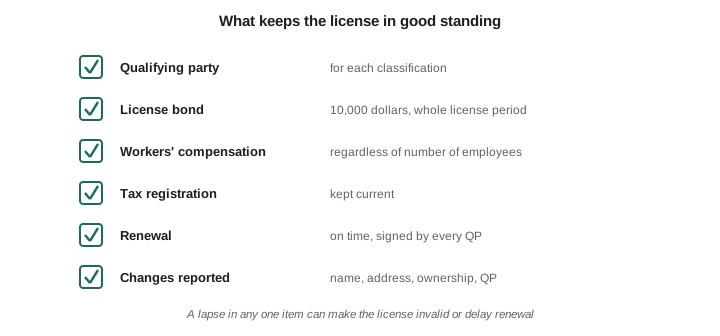
At the end of the meeting Dolores had her list. The QP change: add Lucía in January, remove Ramón with written notice within 30 days of his last day. The bond: renew with the license and keep Ernesto's renewal date on the calendar. Workers' compensation: keep the policy in force and keep the certificate on file. Liability insurance: renew annually and send updated certificates to customers. Tax registration: keep it current. Renewal: watch for CID's renewal form, which is mailed at least 30 days before the license expires, and make sure every QP signs it.
Advertising and the license number
Contractors advertise in many ways: trucks, yard signs, websites, social media and printed bids. New Mexico's rules expect a contractor to identify itself by its licensed name and license number in the way the rules require, so that customers can check the license. A business that advertises electrical work without a license is contracting without a license under the act's broad definition, even if it has not yet signed a contract. Teresa checked every new truck wrap, website page and bid template to make sure the license number and the company's legal name appeared correctly.
Checking a license
CID offers an online license search. Owners use it to check contractors, general contractors use it to check subcontractors and contractors use it to check their own records. The search shows the license number, the business name, the classifications, the status and the qualifying parties. Teresa checked Arroyo Seco's record every quarter and after every change, because a mismatch between the company's paperwork and CID's record is often the first sign of a problem with a bond, a renewal or a QP change.
Subcontracting electrical work
A licensed electrical contractor that subcontracts part of its work must make sure the subcontractor holds the right classification for that part. A low-voltage subcontractor installing a fire alarm system needs a classification that covers it, such as ES-3, and its own qualifying party. The prime contractor cannot lend its EE-98 license to cover a subcontractor who lacks one. Teresa's subcontractor file included a printout of each subcontractor's license record showing the classification and status on the day the subcontract was signed, and she refreshed it when the job ran longer than a few months.
Dolores asked one last question: what would happen if the company ever decided to add a second classification, such as EL-1 for line work? The answer was that each classification needs its own qualifying party with the experience and exams for that classification, and the license would be amended to add it. Nothing about adding a classification changes the bond, workers' compensation and renewal obligations already on the list.
Common mistakes
MistakeThinking a business that subcontracts all its electrical work does not need a license.
InsteadAnyone who undertakes or offers to do the work for compensation is a contractor and needs a license.
MistakeAssuming workers' compensation applies only at three or more employees.
InsteadFor CID-licensed work, coverage is required regardless of the number of employees.
MistakeTreating the license bond as insurance for the contractor.
InsteadThe bond protects others; the contractor reimburses the surety for claims paid.
MistakeLetting a bond cancellation run its course.
InsteadThe surety gives 30 days' notice; replace or reinstate the bond within that time.
Summary and key terms
- Anyone who undertakes or offers to do electrical work for compensation must be licensed in the right classification.
- An unlicensed contractor faces discipline, criminal penalties and, under section 60-13-30, may not sue to collect for licensed work.
- The rule sets a 10,000-dollar license bond in force for the whole licensure period, with 30 days' notice before cancellation.
- Employers in CID-licensed work must carry workers' compensation regardless of the number of employees.
- Liability insurance is required in practice by contracts, and changes to the business must be reported to CID.
- License bond
- A surety bond required for licensure that protects people who deal with the contractor.
- Surety
- The company that issues a bond and pays valid claims.
- Indemnity agreement
- The contractor's promise to reimburse the surety for claims it pays.
- Certificate of insurance
- A document showing that a policy is in force, with its limits and dates.
- Additional insured
- A party added to a liability policy by endorsement, often required by contract.
Practice problems
Work each problem on paper first, then reveal the answer to check.
What bond amount does 14.6.3 NMAC set?
Show answer
10,000 dollars.
How much notice must a surety give CID before canceling a bond?
Show answer
30 days' written notice.
Must an electrical contractor with one employee carry workers' compensation?
Show answer
Yes. Employers in CID-licensed work must carry it regardless of the number of employees.
Can an unlicensed contractor sue to collect for electrical work?
Show answer
Generally no, under section 60-13-30.
Lesson quiz · 5 questions
Score 60% or more to complete this lesson.
Create a free account to save your progress, take quizzes and earn a certificate.