
MELU-306 · Lesson 5 of 12 · 19 min
The NEC as adopted in New Mexico and state amendments
▶ Video coming soon A video version of this lesson is on the way.
The plans for a new rural clinic south of Los Lunas arrived at Arroyo Seco Electric with a note on the electrical cover sheet: designed to the 2023 NEC. Lucía read the note twice. The engineer's office was in Phoenix, where the code cycle runs on a different schedule, and she was fairly sure that the code CID would enforce on a job in unincorporated Valencia County was the 2020 New Mexico Electrical Code. Before Arroyo Seco priced the job, she needed to know which code applied, how the state amendments changed it and what to do about the difference.
This lesson explains how New Mexico adopts the National Electrical Code, which edition was in force in late 2026, what kinds of changes the state amendments make, how local jurisdictions fit in and how to handle conflicts between drawings, the exam edition and the enforced code. It paraphrases the amendments by topic. It does not reproduce code or rule text; read 14.10.4 NMAC itself for the exact wording.
How the NEC becomes state law
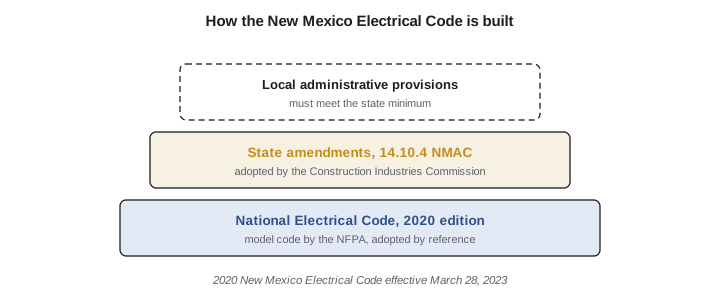
The NEC is a model code written by the National Fire Protection Association. It has no force in New Mexico until the state adopts it. The Construction Industries Licensing Act gives the Construction Industries Commission the power to adopt minimum electrical standards, based on the electrical bureau's recommendations and on nationally recognized codes, adjusted for New Mexico conditions. The Commission does this by rule. The rule adopts a named edition of the NEC by reference and then lists the state's changes.
The result is a single code known as the New Mexico Electrical Code, published as 14.10.4 NMAC. The rule is short compared with the NEC itself. It says the NEC is adopted, lists the sections that are amended, added or deleted, and states its effective date and any transition period. Anyone using the code needs both documents: the NEC for the base text and the rule for the changes.
The edition in force in late 2026
The 2020 New Mexico Electrical Code took effect on March 28, 2023. It adopts the 2020 NEC with state amendments. The rule excludes work covered by a permit application received before the effective date and allowed a six-month transition, ending September 28, 2023, during which permits could be issued under either the new rule or the old one. In late 2026, CID's rules and codes page still listed the 2020 New Mexico Electrical Code, and the CID rule-making notices published in 2025 and 2026 that this course reviewed did not include a new electrical code. The PSI bulletin's references for the EE-98 exam match: the 2020 NEC and the 2020 New Mexico Electrical Code.
That means New Mexico was one cycle behind the newest published NEC. The 2023 edition was available, and the 2026 edition was in preparation, but neither was the enforced code. Code adoption can change at any time through the Commission's rule-making process, so a contractor should check CID's rules page and the New Mexico Register before relying on an edition for a new job.
| Item | Late-2026 status | Where to check |
|---|---|---|
| Enforced electrical code | 2020 New Mexico Electrical Code | CID rules, laws and building codes page |
| Base model code | 2020 NEC | 14.10.4 NMAC |
| Effective date | March 28, 2023 | 14.10.4 NMAC |
| Transition period | Ended September 28, 2023 | 14.10.4 NMAC |
| Exam reference edition | 2020 NEC and 2020 NMEC | PSI candidate bulletin |
What the state amendments do
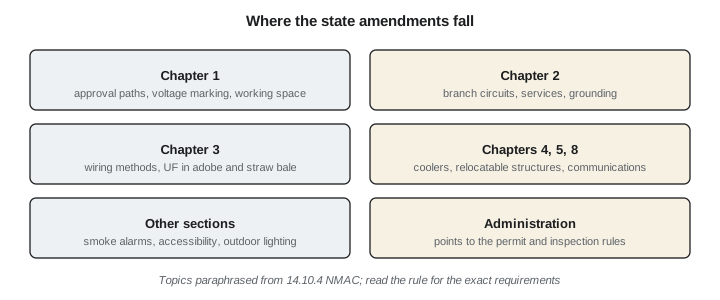
The amendments in 14.10.4 NMAC are organized by NEC chapter. They change existing requirements, add new ones and delete a few. Some are administrative, pointing to the state's permit and inspection rules. Others change technical requirements. The list below describes several of them by topic. It is not a complete list, and the exact requirement is always in the rule text.
Chapter 1 and administration
The administrative section of the rule points to the other Title 14 rules for permits, inspections, inspectors and unsafe wiring, rather than using the NEC's own administrative annex. Chapter 1 amendments describe the ways equipment can be approved, such as listing by a nationally recognized testing laboratory, a field evaluation or an engineer's certification, require voltage marking on equipment above a set voltage and add working-space exceptions for certain situations, including low-headroom water well enclosures common in rural New Mexico.
Chapter 2: branch circuits, services and grounding
The residential amendments are the ones most likely to show up on Part 2 of the exam. They include a limit on the number of outlets on a general-purpose branch circuit in a dwelling, limits on receptacles on the small-appliance circuits, a dedicated laundry circuit, rules for island countertop receptacles and garage receptacle height, and an exterior switch requirement at single-family dwellings. Service and feeder amendments address the cable types allowed for dwelling feeders, disconnect grouping, service mast support and a voltage drop limit for customer-owned service laterals. The grounding amendments set grounding electrode requirements for new construction, a minimum conductor size for concrete-encased electrodes and bonding of corrugated stainless steel gas tubing.
Chapter 3: wiring methods
The wiring methods amendments include corrosion protection for ferrous metal, ceiling support rules, a minimum length of free conductor at boxes, a restriction on small aluminum conductors, limits on exposed Schedule 40 PVC and a provision allowing UF cable in adobe and straw bale construction, a reflection of building methods common in the state. Concealed knob-and-tube wiring is allowed only with special written permission.
Chapters 4, 5 and 8 and other sections
Further amendments require a raceway and an equipment grounding conductor for evaporative coolers, which are common in New Mexico homes, add a demand factor table for relocatable structures, address manufactured home service equipment and supports, and require a listed raceway for communications penetrations through exterior walls. Other sections cover smoke alarm circuits and interconnection, accessibility, compliance with the state's Night Sky Protection Act for outdoor lighting and cross-references to the state energy codes.
Local jurisdictions and the state minimum
The Construction Industries Licensing Act makes the codes adopted by the Commission a minimum requirement for the codes of political subdivisions. A city or county that runs its own inspection program must enforce a code that at least meets the state code. An Attorney General opinion discussed in the annotations to section 60-13-44 says CID may decline to provide inspection services or certify local inspectors in a municipality that fails to adopt a code meeting the state minimum. In practice, most local programs adopt the New Mexico Electrical Code, and some add local administrative provisions. The amendments that matter on a New Mexico job are therefore state amendments, sometimes with local administrative rules on top.
This differs from states where each city amends the NEC on its own. In New Mexico the state rule is the common baseline, and a contractor who knows it well can work across jurisdictions with few surprises. The local building department is still the place to ask about local administrative requirements, such as plan submittal rules or inspection scheduling.
Resolving conflicts
Lucía's clinic plans show the most common conflict: an engineer designs to a newer edition than the one enforced. Three rules help. First, the enforced code is the legal minimum. Work must meet the 2020 New Mexico Electrical Code whatever the drawings say. Second, a design that exceeds the enforced code is usually acceptable, because codes are minimums, but a design that relies on a newer edition's relaxation of a requirement may not be. Third, when in doubt, ask the engineer and the inspection authority in writing before pricing the job.
design = {"edition": 2023, "items": ["feeder to RTU", "GFCI in break room", "EV charger branch"]}
enforced = 2020
exam = 2020
print("design edition:", design["edition"], "| enforced:", enforced, "| exam:", exam)
if design["edition"] != enforced:
    print("Ask the engineer to confirm each item meets the", enforced, "NMEC.")
    for item in design["items"]:
print(" RFI:", item, "-> confirm compliance with", enforced, "NMEC and state amendments")design edition: 2023 | enforced: 2020 | exam: 2020 Ask the engineer to confirm each item meets the 2020 NMEC. RFI: feeder to RTU -> confirm compliance with 2020 NMEC and state amendments RFI: GFCI in break room -> confirm compliance with 2020 NMEC and state amendments RFI: EV charger branch -> confirm compliance with 2020 NMEC and state amendments
Worked problem
The rural clinic
The clinic drawings cite the 2023 NEC. The job is in an area where CID is the inspection authority. What should Lucía do before pricing?
Show solution
- Confirm the enforced code on CID's rules page: the 2020 New Mexico Electrical Code.
- List the items where the 2023 design might differ from the 2020 code and the state amendments.
- Send the engineer a request for information asking for confirmation of compliance with the enforced code.
- Price the job to the enforced code, noting any items where the design exceeds it.
Answer: Arroyo Seco prices to the 2020 New Mexico Electrical Code, asks the engineer to confirm compliance in writing and notes any design items that exceed the minimum.
Studying the code for the exam
For the exam, a candidate needs the 2020 NEC and the 2020 New Mexico Electrical Code side by side. A good method is to tab every NEC section that the state amends and write the rule's section number on the tab. When a question asks about a requirement the state has changed, the tab sends the candidate to the rule, and the rule gives the New Mexico answer. Lucía spent two evenings doing this before her Part 2 exam and found four questions on which the state amendment changed the answer.
How a new edition is adopted
When the Commission adopts a new electrical code, the process follows the state's rule-making procedure. CID publishes a notice of proposed rule-making in the New Mexico Register, makes the proposed rule available, accepts written comments and holds a public hearing. After the hearing, the Commission votes on the rule, and the adopted rule is published with its effective date. The licensing act provides that adopted rules take effect no sooner than 30 days after adoption, and electrical code rules have typically included a transition period during which either the old or new code may be used for permits.
For a contractor, the important dates are the effective date, the end of any transition period and the date on which the PSI bulletin switches its reference editions. These may not line up. A candidate who studies for months while a new code is being adopted should check the bulletin before booking, because the exam may still be written to the older edition even after the new code is in force, or the reverse.
Local administrative provisions
Although the technical requirements are set by the state, local programs often have administrative rules of their own. A city may set its own permit fees, require electronic plan submittal, set rules for how inspections are requested and how late in the day they can be scheduled, or require a site plan for certain permits. These provisions do not change the electrical code, but they affect how a job runs. Teresa kept a page for each city Arroyo Seco worked in, listing these local procedures beside the state code.
The exam treats the state amendments as part of the code. A question on Part 2 may describe a New Mexico dwelling and ask what the code requires, expecting the answer that the state amendment gives. A candidate who answers from the national code alone will choose an option that would be right in another state and wrong in New Mexico. That is the strongest reason to tab the amendments before test day.
Common mistakes
MistakeAssuming the newest NEC is the enforced code.
InsteadNew Mexico enforces the edition adopted in 14.10.4 NMAC; in late 2026 that was the 2020 code.
MistakeStudying only the NEC for Part 2.
InsteadThe state amendments change several residential requirements; study the rule too.
MistakeTreating amendments as local.
InsteadThe amendments that matter are in the state rule; local programs must meet the state minimum.
MistakeFollowing the drawings when they rely on a newer edition's relaxation.
InsteadWork must meet the enforced code; ask the engineer in writing.
Summary and key terms
- The Construction Industries Commission adopts the NEC by rule, with state amendments, as the New Mexico Electrical Code.
- The 2020 New Mexico Electrical Code, based on the 2020 NEC, took effect March 28, 2023, and was still listed by CID in late 2026.
- State amendments change branch circuit, service, grounding, wiring method and other requirements.
- State codes are a minimum for political subdivisions.
- When drawings cite a different edition, build to the enforced code and confirm in writing.
- Adoption by reference
- A rule that makes a model code part of state law by naming it.
- State amendment
- A change to the model code made in the state rule.
- Transition period
- A period during which permits may be issued under either the old or the new code.
- Political subdivision
- A city, county or other local government.
- Request for information
- A written question to the designer asking them to clarify or confirm a design.
Practice problems
Work each problem on paper first, then reveal the answer to check.
What NEC edition does the 2020 New Mexico Electrical Code adopt?
Show answer
The 2020 NEC.
When did it take effect?
Show answer
March 28, 2023.
Can a city enforce a code weaker than the state code?
Show answer
No. State codes are a minimum for political subdivisions.
Where are the state amendments published?
Show answer
In 14.10.4 NMAC.
Lesson quiz · 5 questions
Score 60% or more to complete this lesson.
Create a free account to save your progress, take quizzes and earn a certificate.