
MELU-306 · Lesson 12 of 12 · 19 min
Practice exam review and test-day strategy
▶ Video coming soon A video version of this lesson is on the way.
On the evening of November 10, 2026, Lucía sat at her kitchen table with the score reports from her first three exams, a stack of practice tests and a calendar with one date circled: December 5, the day of EE-98 Part 1, the commercial and industrial exam. She had passed Business and Law in October and Parts 2 and 3 three days earlier. Part 1 was the longest and, by her own reckoning, the hardest. She had twenty-five days. This lesson follows the method she had already been using for Part 1 since October and the plan she made for the rest of the time.
This lesson turns the earlier lessons into a study and test-day plan. It covers building a plan from the bulletin's content outlines, preparing references, using timed practice tests, sorting misses by cause, pacing, test-day logistics and what to do after a failed part. The examples use Lucía's Part 1 preparation, but the same method works for Business and Law and the other EE-98 parts.
Start with the content outline
The PSI bulletin's content outline for each exam lists the topics and approximately how many questions come from each one. It is the most useful single page in the bulletin, because it tells a candidate where the points are. Lucía copied the Part 1 outline into a table and added three columns: where in the references each topic's answers are found, her self-rating from one to five and a priority score equal to the number of questions times five minus her rating. The topics with the highest priority scores went to the top of her plan.
Her table showed three high-priority topics: load calculations for commercial services and feeders, motor circuits and controls, and grounding and bonding for commercial systems. Hazardous locations and special occupancies carried fewer questions but low self-ratings, so they ranked in the middle. Topics she knew well, such as wiring methods and branch circuits, went to the bottom, to be covered in timed practice rather than study.
topics = [
    ("Services and feeder calculations", 12, 2),
    ("Motors and controls", 10, 2),
    ("Grounding and bonding", 9, 3),
    ("Hazardous locations", 5, 1),
    ("Special occupancies and equipment", 6, 2),
    ("Wiring methods", 10, 4),
    ("Branch circuits", 8, 4),
    ("State amendments", 4, 3),
]
ranked = sorted(topics, key=lambda t: t[1] * (5 - t[2]), reverse=True)
for name, q, rating in ranked:
print(f"{name:<36} questions {q:>2} rating {rating} priority {q * (5 - rating):>2}")Services and feeder calculations questions 12 rating 2 priority 36 Motors and controls questions 10 rating 2 priority 30 Hazardous locations questions 5 rating 1 priority 20 Grounding and bonding questions 9 rating 3 priority 18 Special occupancies and equipment questions 6 rating 2 priority 18 Wiring methods questions 10 rating 4 priority 10 Branch circuits questions 8 rating 4 priority 8 State amendments questions 4 rating 3 priority 8
Prepare the references
An open-book exam rewards a candidate who can find things quickly. Lucía tabbed her 2020 NEC by article, using permanent tabs, and added a second row of tabs for the sections she used most: the service and feeder calculation articles, the motor article's tables, the grounding conductor sizing table and the ampacity tables. She marked every section that the 2020 New Mexico Electrical Code amends with a small colored tab carrying the rule's section number. She also tabbed the NESC at the clearances section, since a few Part 1 questions draw on it.
She checked every book against the bulletin's rules: bound, the listed editions, highlighting, underlining and permanent tabs, but no loose notes or sticky notes. She removed a folded calculation sheet she had kept in her NEC for years. A proctor would have found it, and the book would have been kept out of the room.
Timed practice tests
A practice test is useful only if it is timed and reviewed. Lucía took her first full Part 1 practice test on October 24, a week after her Business and Law exam, with 80 questions in 200 minutes, her references and her calculator. She scored 54 correct, six short of the 60 she would need. The score mattered less than what she did next.
She sorted every miss into one of four causes. A knowledge miss meant she did not know the rule. A lookup miss meant she knew the rule but could not find it in time. A reading miss meant she misread the question, often a word like not or except. A calculation miss meant she set up the problem correctly but made an arithmetic or rounding error. Each cause has a different fix: study for knowledge, tabbing and lookup drills for lookups, slower reading for reading misses and a written checklist for calculations.
| Cause | What it looks like | Fix |
|---|---|---|
| Knowledge | The rule was unfamiliar | Study the article and do targeted questions |
| Lookup | The rule was known but not found in time | Add tabs; practice finding sections against the clock |
| Reading | Missed a word such as not or except | Underline the key words in each question before answering |
| Calculation | Correct setup, wrong arithmetic or rounding | Write each step; check units; recheck the final value |
Of Lucía's 26 misses, 9 were knowledge misses, mostly motors and hazardous locations; 8 were lookup misses; 4 were reading misses; and 5 were calculation misses. The lookup misses surprised her. They were questions she could have answered with another minute or a better tab. She spent the next two evenings on lookup drills: a list of fifty sections, a timer and her tabs.
Pacing
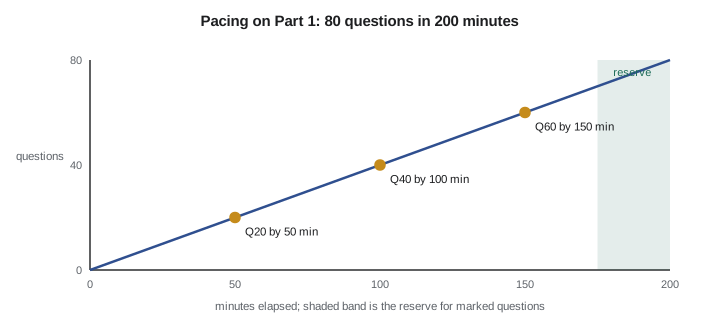
Part 1 allows 200 minutes for 80 questions, which is 2.5 minutes a question. Lucía used checkpoints. By minute 50 she should be past question 20; by minute 100, past question 40; by minute 150, past question 60. She would answer every question she could answer quickly on the first pass, mark any question that needed a long calculation or a lookup she could not find within two minutes and come back to the marked questions on a second pass. With no penalty for wrong answers, she would never leave a question blank.
TOTAL_Q, TOTAL_MIN = 80, 200
per_q = TOTAL_MIN / TOTAL_Q
print(f"minutes per question: {per_q:.2f}")
for minute in (50, 100, 150, 180):
    print(f"by minute {minute:>3}: about question {int(minute / per_q)}")
reserve = 25
first_pass = (TOTAL_MIN - reserve) / TOTAL_Q
print(f"with a {reserve}-minute second-pass reserve: {first_pass:.2f} min per question on the first pass")minutes per question: 2.50 by minute 50: about question 20 by minute 100: about question 40 by minute 150: about question 60 by minute 180: about question 72 with a 25-minute second-pass reserve: 2.19 min per question on the first pass
The second and third practice tests
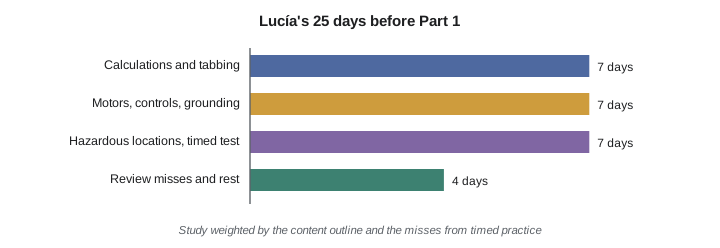
Lucía took her second full practice test on November 1 and scored 61. Her lookup misses fell from 8 to 3, and her calculation misses fell from 5 to 2 after she started writing each step on the scratch paper provided. Knowledge misses were still the largest group, now concentrated in hazardous locations. Her plan for the remaining weeks put the hazardous location articles and special occupancies first. She scheduled a third practice test for December 1, leaving the last four days for reviewing misses and resting.
Test-day logistics
The bulletin lists what a candidate must bring: the required identification, the confirmation details and the allowed references and calculator. It also lists what is prohibited, including phones and other electronic devices. Lucía planned to drive to the test center the day before to time the trip, to arrive at least thirty minutes early on the day, to bring a light snack for the break if one was allowed and to leave everything else in her truck. She would check in, have her references inspected and use the tutorial at the start of the session to settle in.
| Before the exam | During the exam |
|---|---|
| Confirm the date, time and test center | Read each question fully and underline key words |
| Check every reference against the bulletin rules | Answer quick questions first; mark long ones |
| Pack identification and the calculator | Watch the checkpoints at minutes 50, 100 and 150 |
| Time the drive the day before | Use the reserve for marked questions |
| Sleep; no cramming the night before | Answer every question; there is no penalty for guessing |
If a part is failed
A failed part is a setback, not a disaster. The candidate retakes only that part, no more than twice in any 30-day period, and passing scores on the other parts stay valid for one year from their exam dates. The score report's breakdown by content area is the best guide to the retake. Lucía's contingency plan was simple: if she failed Part 1 on December 5, she would book a retake as early as the rules allowed, sort the score report's weak areas into her priority table and repeat the cycle of study, timed practice and review. She would still be within her six-month window and well within a year of her other scores.
Worked problem
Planning a retake
Suppose Lucía fails Part 1 on December 5 with 57 correct. Her other scores date from October 17 and November 7. What are her limits?
Show solution
- She retakes only Part 1.
- She may not take Part 1 more than twice in any 30-day period.
- Her Business and Law score stays valid until October 17, 2027, and her Parts 2 and 3 scores until November 7, 2027.
- Her approval window, from September 28, 2026, runs about six months, so she should finish by late March 2027.
Answer: Lucía would retake Part 1 within the 30-day limit, well inside her six-month window and the one-year validity of her other scores.
After the last exam
Passing the final part is not the end of the process. The QP certificate must be issued and attached to Arroyo Seco's license, the change reported to CID and the transition with Ramón completed. Lucía's calendar from Lesson 3 already had those steps: certificate and addition to the license in January, joint supervision from January to March and Ramón's departure with written notice to CID within 30 days of March 31, 2027. The exams prove she is qualified. The work that follows is what makes her the company's qualifying party.
Studying for the Business and Law exam
The same method works for Business and Law, with a different emphasis. Most questions can be answered from the NASCLA guide, so the reference work is mostly tabbing the guide by chapter and learning its formulas for markup, overhead and break-even. The New Mexico-specific questions come from the licensing act and 14.6.3 NMAC, which are short enough to read in full several times. Lucía read both twice and made a one-page index of where each rule appears: the bond, the QP notices, the common ownership rule, the certificate expiration rules and the renewal signatures.
Keeping perspective
Exam preparation can crowd out everything else. Lucía kept working full-time, and she limited her study to two hours on weekday evenings and four hours on Saturday, with Sunday off. She found that steady study with timed practice did more than long weekend sessions, and that sleep before a practice test mattered as much as the last hour of review.
She also kept a short list of the mistakes she had made on practice tests and read it the morning of each exam. It held only five lines: read every word, check units, look for not and except, use the amendment tabs and never leave a question blank. Reading it took a minute and settled her nerves.
On December 5 she will walk into the test center with her tabbed books, her calculator and that list. Whatever the result, she will know exactly what to do next, and that, she decided, was the real purpose of the plan.
Common mistakes
MistakeStudying every topic equally.
InsteadUse the content outline to weight study by the number of questions and your weakness.
MistakeTaking practice tests without timing them.
InsteadUntimed practice hides pacing and lookup problems.
MistakeCounting misses without sorting them.
InsteadSort misses by cause; each cause has a different fix.
MistakeLeaving a question blank.
InsteadThere is no penalty for wrong answers; answer every question.
Summary and key terms
- Build the plan from the bulletin's content outline, weighting topics by question count and weakness.
- Prepare references to the bulletin's rules: listed editions, bound, highlighted and permanently tabbed.
- Take timed practice tests and sort every miss as knowledge, lookup, reading or calculation.
- Pace with checkpoints and a reserve for marked questions; answer every question.
- A failed part is retaken alone, no more than twice in any 30-day period, while other scores stay valid for a year.
- Content outline
- The bulletin's list of topics and approximate question counts for an exam.
- Lookup miss
- A miss caused by not finding a known rule in time.
- Checkpoint
- A planned point in the exam for checking progress against time.
- Second pass
- A return to marked questions after the first run through the exam.
- Priority score
- A ranking of topics by question count and the candidate's weakness.
Practice problems
Work each problem on paper first, then reveal the answer to check.
How many minutes per question does Part 1 allow?
Show answer
2.5 minutes: 200 minutes for 80 questions.
What are the four causes of a practice test miss?
Show answer
Knowledge, lookup, reading and calculation.
Should a candidate leave a hard question blank?
Show answer
No. There is no penalty for wrong answers.
After failing one part, how long do the other passing scores stay valid?
Show answer
One year from their exam dates.
Lesson quiz · 5 questions
Score 60% or more to complete this lesson.
Create a free account to save your progress, take quizzes and earn a certificate.