
MELU-306 · Lesson 2 of 12 · 19 min
Eligibility for the EE-98 Electrical Contractor License
▶ Video coming soon A video version of this lesson is on the way.
Lucía Baca spread eleven years of pay stubs, W-2 forms and old job lists across the conference table at Arroyo Seco Electric. Teresa Gallegos, the office manager, had pulled every personnel file the company had on her. Lucía's question was simple: did she meet the experience requirement for an EE-98 qualifying party, and could she prove it? She knew the number was four years. What she wanted to know was what counts as a year, which years count, who has to sign for them and whether her apprenticeship classes earned her anything.
This lesson works through the eligibility rules for an EE-98 qualifying party as they appear in CID's rules in late 2026: the age requirement, the four years of experience, the ten-year window, credit for training, the kind of work that counts, how experience is verified, and how eligibility for the QP certificate differs from eligibility for the journeyman certificate. It ends with Lucía's experience worksheet.
The basic requirements
Under 14.6.3 NMAC a qualifying party must be at least eighteen years old and must meet the experience requirement for the classification. The experience requirement for each classification is set in the classifications rule, 14.6.6 NMAC, and for EE-98 it is four years. The QP must also pass the required exams, which Lessons 3 and 4 cover. There is no requirement that a QP candidate already hold a journeyman certificate, though in practice most EE-98 candidates do, because the experience that qualifies a person for EE-98J is much the same kind of experience that qualifies them for EE-98.
Two features of the rule deserve attention. First, the four years must fall within the ten years before the application. Experience older than that does not count toward the minimum, however much of it a candidate has. Second, the experience must be qualifying experience: work in the trade of the classification, at a level that prepares the person to supervise it.
| Requirement | Source | Rule as published in late 2026 |
|---|---|---|
| Minimum age | 14.6.3 NMAC | 18 years |
| Experience | 14.6.6 NMAC | 4 years for EE-98 |
| Window | 14.6.3 NMAC | Within the 10 years before application |
| Training credit | 14.6.3 NMAC | Half a year per year of accredited training, up to half the requirement |
| Exams | 14.6.3 NMAC and the PSI bulletin | Trade exam plus Business and Law exam or an approved course |
| Passing score | 14.6.3 NMAC | 75 out of 100 |
What counts as a year of experience
The rules speak in years, and CID evaluates years of full-time work in the trade. A candidate who worked part-time, or who split time between electrical work and another job, should expect the experience to be counted in proportion. The safest practice is to document experience in a way that shows both the length of employment and that the work was electrical work in the scope of the classification. Pay records show the length; job descriptions and affidavits show the content.
The QP application instructions add a further condition. The experience must have been gained while working for a contractor licensed in the trade, or in legal work in the state where it was performed. A year spent doing unlicensed side jobs does not count, and neither does work done in violation of another state's licensing law. Experience out of state is accepted when it was legal there, which matters to candidates who learned the trade in Texas, Arizona or Colorado before moving to New Mexico.
The ten-year window
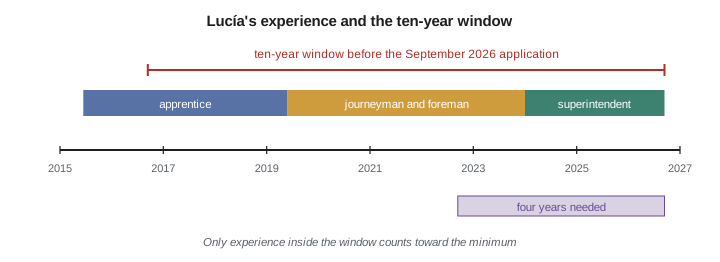
The ten-year window looks backward from the date of application. For Lucía, applying in September 2026, it reaches back to September 2016. She started her apprenticeship in the summer of 2015, so her first year falls partly outside the window. That does not hurt her, because she has nearly ten years of work inside it, but the window becomes important for candidates who left the trade for a while. An electrician who worked from 2008 to 2014, went into sales and came back in 2023 would have only about three years inside the window in 2026, even with nine years in total.
The window also explains why candidates should not wait too long after leaving the field. A superintendent who moved into project management or estimating may still be doing qualifying work if they are supervising electrical installations, but if their role has become purely commercial, the years may not count. CID evaluates what the person actually did.
Credit for training
The rules allow accredited training to substitute for part of the experience requirement. The published rate is one-half year of experience for each year of accredited training, and the credit is capped at one-half of the total requirement. For EE-98, with a four-year requirement, training can therefore provide at most two years. A graduate of a four-year accredited program could, in principle, claim two years of credit and need two years of work experience.
In practice most EE-98 candidates have far more than four years of work, and training credit matters only at the margin. Lucía completed a four-year registered apprenticeship program with classroom instruction, but she has enough work experience that she did not need to claim it. She decided to list the program on her application anyway, because it shows the depth of her training and costs nothing to document.
REQUIRED = 4.0
CAP = REQUIRED / 2

def credit(training_years):
    return min(training_years * 0.5, CAP)

for training, work in [(0, 4.0), (2, 3.0), (4, 2.0), (6, 1.5)]:
    c = credit(training)
    total = work + c
    status = "meets" if total >= REQUIRED else "short"
print(f"training {training} yr -> credit {c:.1f}, work {work:.1f}, total {total:.1f}: {status}")training 0 yr -> credit 0.0, work 4.0, total 4.0: meets training 2 yr -> credit 1.0, work 3.0, total 4.0: meets training 4 yr -> credit 2.0, work 2.0, total 4.0: meets training 6 yr -> credit 2.0, work 1.5, total 3.5: short
The kind of work that counts
Qualifying experience for EE-98 is experience in the EE-98 scope: residential, commercial and industrial electrical wiring at 5,000 volts or less. A candidate whose whole career has been residential wiring has qualifying experience for ER-1, and that experience is part of the EE-98 scope, but they may find the commercial and industrial part of the trade exam hard. The rules do not, as published, set a separate minimum share of commercial or industrial work for EE-98 the way some states do. Even so, the exam assumes broad experience, and a candidate who has never worked with three-phase services, motor circuits or commercial occupancies should plan extra study.
Supervisory experience is valuable. The QP's role is to supervise, so experience as a foreman, superintendent or lead journeyman shows that the candidate is ready for it. The experience affidavit is the place to describe it in plain terms: the kinds of buildings, the sizes of services and the number of workers supervised.
How experience is verified
The QP application asks for a work experience affidavit for each employer or affiant, signed and notarized, with no blanks. The affiant must be a qualified person, such as a past or present employer, supervisor, foreman or another contractor who knows the work. One form per employer means that a candidate who worked for three contractors needs three affidavits, or at least an affiant who can speak to each period.
Teresa's experience with past applications was that the affidavit is where most delays begin. An affiant leaves the dates blank, signs without a notary, describes the work in a single word or writes that the candidate was an employee without saying what they did. CID or PSI returns the packet, and the candidate loses weeks. She built a checklist for each affidavit: the employer's legal name and license number, the dates in month and year, the hours per week, a two- or three-sentence description of the work, the affiant's relationship to the candidate, the signature and the notary block.
| Affidavit item | Why it matters | Common problem |
|---|---|---|
| Employer's name and license number | Shows the work was for a licensed contractor | Using a trade name instead of the legal name |
| Dates of employment | Places the experience in the ten-year window | Year only, with no months |
| Hours per week | Shows full-time work | Left blank |
| Description of the work | Shows the work fits the classification | One word, such as electrician |
| Affiant's relationship | Shows the affiant knows the work | Office staff with no field knowledge |
| Signature and notary | Makes the affidavit valid | Signed but not notarized |
Lucía's experience worksheet
Lucía's career has three phases. From June 2015 to May 2019 she was a registered apprentice at Arroyo Seco, working full-time under journeymen on homes and small commercial jobs. In June 2019 she passed the journeyman exams and received her EE-98J certificate, and from then until December 2023 she worked as a journeyman and then foreman on commercial work. Since January 2024 she has been the company's field superintendent and lead estimator, supervising up to three crews at a time.
Worked problem
Counting Lucía's qualifying years
Lucía applies in September 2026. How many years of qualifying experience can she show inside the ten-year window, and does she need training credit?
Show solution
- The window runs from September 2016 to September 2026.
- Apprentice work from September 2016 to May 2019 is about 2.7 years inside the window.
- Journeyman and foreman work from June 2019 to December 2023 is about 4.6 years.
- Superintendent work from January 2024 to September 2026 is about 2.7 years, and it is supervisory electrical work.
- The total inside the window is about 10 years, well above the four-year minimum.
Answer: Lucía has about ten qualifying years inside the window and does not need training credit. One affidavit from Ramón covers all of it because she has worked for one employer.
Because Lucía has worked only for Arroyo Seco, one affidavit from Ramón as her supervisor covers her whole history. Teresa nevertheless suggested a second affidavit from a general contractor's superintendent who had worked with Lucía on several school remodels. It is not required, but it shows the supervisory experience from an outside perspective and protects the application if CID asks for more.
QP eligibility compared with journeyman eligibility
The EE-98J journeyman certificate also requires four years of experience under 14.6.4 NMAC. The two credentials look similar on paper, but they ask different things. The journeyman certificate shows that a person can do electrical work competently. The QP certificate shows that a person can take responsibility for a business's electrical work. That is why the QP path adds the Business and Law exam, why the QP trade exam covers commercial, residential and specialty work in three parts, and why the QP rules include duties, such as notifying CID when the QP leaves, that the journeyman rules do not.
A candidate who is newly certified as a journeyman could, in principle, meet the four-year QP requirement at the same time. In practice candidates who go straight from journeyman to QP often find the business side and the specialty part of the trade exam the hardest. Lucía's years as a superintendent and estimator gave her a head start on both.
Eligibility for other people in the company
Dolores asked whether anyone else at Arroyo Seco should apply. The company has two other senior journeymen. One has seven years and could meet the EE-98 requirement. The rules allow a license to have more than one qualifying party, and a second QP gives a business protection if the first one leaves. Dolores decided to encourage the second journeyman to apply for an ER-1 qualification the following year as a backup for the residential work, and to revisit EE-98 once Lucía was established. Lesson 7 covers what happens when a QP leaves without a replacement.
A note on documents CID may ask for
CID or PSI may ask for more than the affidavit if the experience is unclear. Pay records, tax forms, apprenticeship completion certificates, a journeyman certificate from another state or letters from general contractors can all help. A candidate should keep copies of these in one folder before applying, so that a request for more information can be answered in days rather than weeks.
Common mistakes
MistakeCounting all years in the trade, however old.
InsteadOnly experience within the ten years before application counts toward the minimum.
MistakeClaiming six years of training to cover the whole requirement.
InsteadTraining credit is a half year per year and is capped at half the requirement, two years for EE-98.
MistakeSubmitting an affidavit without a notary.
InsteadThe affidavit must be signed and notarized, with no blanks.
MistakeCounting unlicensed side work.
InsteadExperience must be with a licensed contractor or in legal work where it was performed.
Summary and key terms
- An EE-98 qualifying party must be at least 18 and have four years of qualifying experience.
- The experience must fall within the ten years before the application.
- Accredited training earns half a year per year, capped at half the requirement.
- Experience must be in the classification's scope and with a licensed contractor or in legal work.
- Each employer or affiant provides a signed, notarized affidavit with no blanks.
- Qualifying experience
- Work in the classification's scope that prepares the person to supervise it.
- Ten-year window
- The period before the application inside which the required experience must fall.
- Training credit
- Experience credit for accredited training, at half a year per year, up to half the requirement.
- Work experience affidavit
- A signed, notarized statement from an employer or other qualified person describing the candidate's experience.
- Affiant
- The person who signs an affidavit.
Practice problems
Work each problem on paper first, then reveal the answer to check.
How many years of training credit can an EE-98 candidate claim at most?
Show answer
Two years, half of the four-year requirement.
Does experience from 2012 count for an application in 2026?
Show answer
Not toward the minimum, because it is outside the ten-year window.
Who may sign a work experience affidavit?
Show answer
A qualified person such as an employer, supervisor, foreman or other contractor who knows the work.
Does out-of-state experience count?
Show answer
Yes, if the work was legal where it was performed.
Lesson quiz · 5 questions
Score 60% or more to complete this lesson.
Create a free account to save your progress, take quizzes and earn a certificate.