
MELU-306 · Lesson 10 of 12 · 19 min
Workplace safety law and OSHA for electrical contractors
▶ Video coming soon A video version of this lesson is on the way.
Two weeks before Lucía's Part 2 exam, one of Arroyo Seco's apprentices was replacing a breaker in an occupied office in Belen when the panel cover slipped and he felt a tingle through his glove. Nobody was hurt. The breaker was supposed to be off, but the panel was fed from two sources, and the second one had not been locked out. Lucía stopped the job, sent the crew home early and spent the evening with Ramón writing a report. The next morning she started reading the safety law that applies to New Mexico electrical contractors, because as QP she would soon be the person who answered for it.
This lesson explains who enforces workplace safety in New Mexico, the OSHA construction standards that apply to electrical work, injury reporting deadlines, the multi-employer approach on construction sites, NFPA 70E's role, the excavation rule and how a contractor builds a safety program. The OSHA standards are federal regulations that New Mexico has adopted under its state plan; the descriptions here paraphrase them and cite section numbers.
Who enforces workplace safety in New Mexico
New Mexico has an OSHA-approved state plan, run by the Occupational Health and Safety Bureau of the New Mexico Environment Department, often called New Mexico OSHA. The plan was first approved in 1975. It covers private-sector workplaces in the state and state and local government employers. Federal OSHA keeps jurisdiction over some workplaces, including federal government employers, private employers on military bases, maritime work and, where applicable law provides, private or tribal employment on tribal lands. A New Mexico electrical contractor working on an Air Force base or on tribal land may therefore be inspected by federal OSHA instead of the state.
New Mexico OSHA has adopted the federal OSHA standards that apply to private, state and local employers, so its construction standards are the same as the federal ones, with a small number of state-specific standards, including its own hazard communication standard. For an electrical contractor, the practical result is that the federal construction standards in 29 CFR Part 1926 apply, enforced by the state.
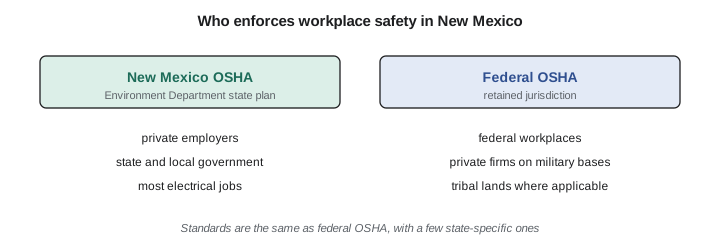
| Workplace | Safety enforcement |
|---|---|
| Private job in Albuquerque or rural New Mexico | New Mexico OSHA |
| State or local government workplace | New Mexico OSHA |
| Private contractor on a military base | Federal OSHA |
| Federal agency workplace | Federal OSHA |
| Tribal lands, where applicable law provides | Federal OSHA |
The construction standards for electrical work
The OSHA construction standards that matter most to electrical contractors are in Subpart K of Part 1926, electrical, which covers installation safety requirements, safety-related work practices, lockout and tagging of circuits, and the ground-fault protection program for temporary wiring on construction sites. Section 1926.404 addresses wiring design and protection, including the ground-fault circuit interrupter or assured equipment grounding conductor program for temporary power. Section 1926.416 sets general work practice requirements, such as not working near live parts unless protected, and section 1926.417 covers lockout and tagging of circuits.
Other subparts apply as well. Subpart M covers fall protection, Subpart L scaffolds, Subpart X ladders, Subpart P excavations, Subpart V power transmission and distribution, Subpart CC cranes and derricks near power lines, Subpart E personal protective equipment and Subpart D occupational health, including the silica standard that applies when crews cut or core concrete. The general duty to provide a workplace free from recognized hazards applies everywhere.
| Subpart | Topic | Why electrical contractors care |
|---|---|---|
| K | Electrical | Installation, work practices, lockout and tagging, temporary power protection |
| M | Fall protection | Work on roofs, lifts and open floors |
| X | Ladders | Daily use of portable ladders |
| P | Excavations | Trenches for underground services |
| V | Power transmission and distribution | Work near utility lines |
| CC | Cranes and derricks | Clearances from overhead lines when setting equipment |
Lockout and tagging
The incident in Belen was a lockout problem. The construction standard on lockout and tagging requires controls that are to be deactivated during work on energized or de-energized equipment or circuits to be tagged, and equipment or circuits that are de-energized to be rendered inoperative and tagged. Good practice, and NFPA 70E, go further: identify every source of supply, open the disconnects, apply locks and tags, test for absence of voltage and only then begin work. A panel with two sources needs two locks.
Lucía's report found three causes. The apprentice had not been told about the second source. The panel schedule did not show it. And the crew had no written procedure that required testing every conductor before work. Arroyo Seco's fix was a written procedure, a one-page checklist for every de-energized task and an updated panel schedule for the customer.
Injury reporting
OSHA's recordkeeping rule sets reporting deadlines for serious injuries, and New Mexico OSHA applies the same rule under its state plan. An employer must report a work-related fatality within 8 hours of learning of it, and an in-patient hospitalization, an amputation or the loss of an eye within 24 hours. Employers above certain size thresholds must also keep injury and illness logs, although many small construction employers are partially exempt from the logging requirement under the rule's size threshold. Lucía made sure the reporting numbers for New Mexico OSHA were on the company's emergency card in every truck.
from datetime import datetime, timedelta

deadlines = {"fatality": 8, "in-patient hospitalization": 24, "amputation": 24, "loss of an eye": 24}
learned = datetime(2026, 10, 20, 14, 30)
for event, hours in deadlines.items():
    due = learned + timedelta(hours=hours)
print(f"{event:<28} report within {hours:>2} h -> by {due.isoformat(sep=' ', timespec='minutes')}")fatality report within 8 h -> by 2026-10-20 22:30 in-patient hospitalization report within 24 h -> by 2026-10-21 14:30 amputation report within 24 h -> by 2026-10-21 14:30 loss of an eye report within 24 h -> by 2026-10-21 14:30
Multi-employer sites
Construction sites have many employers, and OSHA's multi-employer citation policy explains how more than one of them can be cited for the same hazard. An employer may be cited as the creating employer that caused the hazard, the exposing employer whose workers were exposed, the correcting employer responsible for fixing it or the controlling employer with general authority over the site. An electrical subcontractor is usually a creating, exposing or correcting employer, and sometimes all three. A contractor that leaves an open panel or an unguarded floor opening can be cited even if the workers exposed belonged to another trade.
NFPA 70E
NFPA 70E, the Standard for Electrical Safety in the Workplace, is not itself an OSHA standard, but OSHA and state plans use it to show what employers should know about electrical hazards and how to protect workers. It sets out the steps for establishing an electrically safe work condition, the risk assessment process for shock and arc flash, approach boundaries, the selection of personal protective equipment and training requirements for qualified persons. The exam may ask about 70E's concepts, and a QP needs them for writing the company's procedures.
Digging safely
Underground services, well circuits and site lighting all involve digging. New Mexico's excavation damage law requires an excavator to notify the state's one-call center before digging, a set number of working days in advance, so that the operators of underground facilities can mark their lines. After the lines are marked, the excavator must dig with care near them. OSHA's excavation standards in Subpart P add requirements for protective systems in trenches five feet or deeper, unless the excavation is in stable rock, and for a competent person to inspect the excavation. Lucía added the one-call ticket number to the job folder for every job with digging.
Worked problem
Planning the hay barn trench
The Belen hay barn service needs a 180-foot trench, about four feet deep, crossing the path of a buried irrigation line and near a gas service. What must Arroyo Seco do before and during the dig?
Show solution
- Submit a one-call locate request the required number of working days before digging.
- Wait for the operators to mark their lines and confirm the irrigation line with the owner, since private lines may not be marked.
- Dig carefully near the marks, exposing the gas service by hand.
- At four feet deep, a protective system is not required by the depth rule if a competent person finds no indication of a cave-in, but the competent person must still inspect the trench.
Answer: Arroyo Seco requests locates, confirms private lines with the owner, hand-digs near marked lines and has a competent person inspect the trench.
A small company's safety program
OSHA's construction standards require employers to have accident prevention programs and to provide training that lets workers recognize and avoid hazards. For a company of fourteen people, that does not need to be elaborate. Lucía's program had six parts: a written electrical safety procedure based on 70E, a lockout procedure with a checklist, a fall protection plan for roofs and lifts, an excavation procedure with one-call and competent person steps, a hazard communication program with safety data sheets and a short weekly toolbox talk on every job. Each part named the person responsible for it.
The program also included the company's response to an incident like the one in Belen. Stop the work, care for anyone hurt, make the area safe, report as the rules require, investigate the causes without blame, fix the system and share the lesson with every crew. Lucía wrote the near miss up as the first toolbox talk.
Safety and the license
A serious safety failure can also become a licensing matter. CID's rules require work to comply with the codes, and an installation that creates a hazard can lead to a stop work order or a complaint against the license. For the QP, workplace safety and code compliance are two sides of the same job: the code protects the people who use the building, and the safety standards protect the people who build it.
Training and the qualified person
OSHA's electrical standards and NFPA 70E both use the idea of a qualified person: someone with the skills and knowledge related to the construction and operation of the equipment and the installation, and with safety training to recognize and avoid the hazards involved. Only qualified persons should work on or near exposed energized parts. Apprentices are not automatically unqualified; they may be qualified for some tasks and not others, and the employer must decide and document which. Lucía planned an annual training session for every field employee on lockout, approach boundaries and the company's procedures, with a short written test and a sign-in sheet.
Inspections by New Mexico OSHA
New Mexico OSHA inspects workplaces after complaints, referrals, serious incidents and under programmed inspection plans. A compliance officer arriving on a job site will usually ask for the person in charge, explain the reason for the inspection and walk the site. The contractor has the right to accompany the officer, and the foreman should do so, taking notes and photographs of anything the officer photographs. Citations, if any, come later in writing with proposed penalties and an abatement date, and the employer has a set period to contest them.
Lucía also made safety part of every estimate. Each bid now included a line for the protective equipment, lockout devices, trench protection and fall protection the job would need, so that the crews never had to choose between safety and the budget. Ramón said it was the best change she had made so far.
She asked the foremen to report every near miss, not only injuries, and promised that a report would never be held against the person who made it. Near misses are free lessons, and the Belen panel had been one of them.
Common mistakes
MistakeAssuming federal OSHA inspects every New Mexico job.
InsteadNew Mexico OSHA, in the Environment Department, enforces the state plan for most private and public workplaces.
MistakeLocking out the obvious source only.
InsteadIdentify every source of supply, lock and tag each one and test for absence of voltage.
MistakeReporting a hospitalization the next week.
InsteadIn-patient hospitalizations must be reported within 24 hours, fatalities within 8.
MistakeAssuming only the employer whose workers are exposed can be cited.
InsteadUnder the multi-employer policy, the creating, correcting and controlling employers can be cited too.
Summary and key terms
- New Mexico OSHA, part of the New Mexico Environment Department, runs the state plan for private and state and local government workplaces.
- Federal OSHA covers federal workplaces, military bases, maritime work and, where applicable, tribal lands.
- Subpart K of Part 1926 covers electrical safety, including lockout and tagging and temporary power protection.
- Fatalities must be reported within 8 hours, and in-patient hospitalizations, amputations and eye losses within 24 hours.
- NFPA 70E describes the electrically safe work condition, and the state one-call law requires locates before digging.
- State plan
- A state-run workplace safety program approved by federal OSHA.
- Lockout and tagging
- Locking and tagging de-energized circuits so they cannot be re-energized during work.
- Multi-employer policy
- OSHA's approach to citing more than one employer for a hazard on a shared site.
- Electrically safe work condition
- A state in which equipment is de-energized, locked out and tested.
- Competent person
- A person able to identify hazards and authorized to correct them, such as in excavations.
Practice problems
Work each problem on paper first, then reveal the answer to check.
Who enforces OSHA standards for a private electrical contractor in Albuquerque?
Show answer
New Mexico OSHA, the Occupational Health and Safety Bureau of the Environment Department.
Who enforces safety for a contractor on a military base in New Mexico?
Show answer
Federal OSHA.
Within how many hours must a work-related fatality be reported?
Show answer
Within 8 hours.
Which Part 1926 subpart covers electrical work?
Show answer
Subpart K.
Lesson quiz · 5 questions
Score 60% or more to complete this lesson.
Create a free account to save your progress, take quizzes and earn a certificate.