
MELU-303 · Lesson 9 of 12 · 18 min
Contracts and mechanics' liens in Nevada
▶ Video coming soon A video version of this lesson is on the way.
In September 2026, a developer who owned a small retail center in North Las Vegas stopped paying the general contractor, and the general contractor stopped paying its subcontractors. Mojave Current had installed the service, feeders and lighting for the center and was owed 118,000 dollars (an illustrative figure). Marisol had been the qualified individual for three months. Denise pulled the job file and laid out what the company had done right at the start of the job, and what it needed to do now. This lesson covers the contract terms that protect an electrical contractor in Nevada, the prompt payment statutes, and the mechanics’ lien law in NRS 108.221 through 108.246, including the notice of right to lien, the residential notice of intent, recording, service and foreclosure.
Contracts that protect the contractor
Nevada law does not require every construction contract to be in writing, but a written contract is the first protection a contractor has. A good electrical contract or subcontract states the parties, the license number and monetary limit, the scope of work and what is excluded, the price and payment schedule, how change orders are requested, priced and approved, the schedule and what happens when it slips, retention, insurance and bond requirements, warranty terms, and how disputes are resolved. It also identifies the owner and the property, which matters for liens. Mojave Current’s subcontract review checklist runs to two pages, and Marisol reads every subcontract against it before signing.
Change orders are where most money is lost. Work added at a superintendent’s verbal request, without a signed change order, is hard to collect and harder to lien for. Marisol’s foremen carry a short change order form and are told not to start extra work until someone with authority signs it, except in an emergency affecting safety. For residential work, contracts with homeowners deserve extra care: a clear scope, a payment schedule that does not run ahead of the work, and the license number displayed.
Prompt payment in NRS Chapter 624
Nevada’s prompt payment statutes set deadlines that apply unless the contract sets its own schedule. Under NRS 624.609, an owner must pay a prime contractor on the date the written payment schedule sets or, with no schedule or an oral agreement, within 21 days after the contractor submits a payment request. Under NRS 624.624, a higher-tier contractor must pay a lower-tier subcontractor by the scheduled date or within 10 days after receiving payment for that subcontractor’s work, whichever is earlier. Without a written schedule, the deadline is 30 days after the subcontractor’s payment request or 10 days after the higher-tier contractor is paid for the work, whichever is earlier.
Retention is limited too. If the agreement allows it, the owner may withhold retention of no more than one-twentieth of each payment, and the same cap applies between a contractor and its subcontractor. Withholding more requires a written notice, given on or before the payment due date, that states the reason in detail. A contractor that is not paid on time also has statutory remedies, which can include stopping work after proper notice. These rules are detailed, and the statute should be read before acting on them.
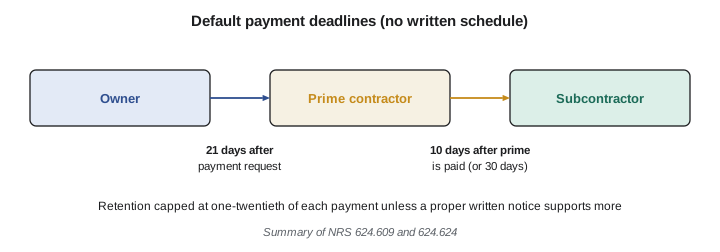
# Prompt payment deadlines when no written schedule applies (study aid)
from datetime import date, timedelta
request_to_owner = date(2026, 7, 1)
owner_due = request_to_owner + timedelta(days=21)
prime_paid = date(2026, 7, 20)
sub_request = date(2026, 7, 1)
sub_due = min(sub_request + timedelta(days=30), prime_paid + timedelta(days=10))
print("Owner pays prime by:", owner_due)
print("Prime pays sub by: ", sub_due)Owner pays prime by: 2026-07-22 Prime pays sub by: 2026-07-30
Who may claim a lien
Nevada’s mechanics’ lien law lets a person who provides work, materials or equipment for the improvement of private property claim a lien on that property for the unpaid amount. Electrical contractors, subcontractors at any tier, suppliers, equipment lessors and laborers can be lien claimants. The lien attaches to the owner’s interest in the property and can, in the end, lead to a court-ordered sale. Liens do not attach to public property, so on public jobs unpaid subcontractors and suppliers rely on payment bonds instead, as Lesson 8 explained. A contractor that was required to be licensed and was not generally cannot enforce a lien.
The notice of right to lien
The first step for most claimants is a preliminary notice called the notice of right to lien. Under NRS 108.245, every lien claimant must deliver this notice to the owner in person or by certified mail, in substantially the form the statute provides, except a person who performs only labor and a prime contractor or other person who contracts directly with the owner or sells directly to the owner. A subcontractor or supplier also sends a copy to the prime contractor for information. The notice is not a lien and does not cloud the title. It tells the owner that the claimant is on the job and may claim a lien if unpaid.
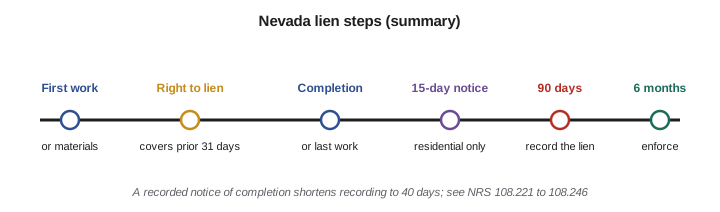
Timing determines what the notice protects. The statute does not set a final deadline for giving it, but a claimant may lien only for work, materials and equipment furnished in the 31 days before the notice is given and everything furnished afterward. Give it late and the earlier work is outside the lien. That is why Mojave Current sends the notice of right to lien within the first few days on every job where it is a subcontractor, not after trouble starts. Except for labor, a lien for materials, equipment or services cannot be perfected or enforced without it.
The 15-day notice of intent on residential work
Residential projects add another step. Under NRS 108.226, on work for the construction, alteration or repair of a single-family or multifamily residence, a lien claimant other than a laborer must serve a 15-day notice of intent to lien on the owner and the reputed prime contractor, by personal delivery or certified mail, before recording the lien. The notice gives the owner a last chance to pay. The statute extends the recording period by 15 days to account for it. On nonresidential projects such as the North Las Vegas retail center, this step does not apply.
Recording the lien
To perfect a lien, the claimant records a notice of lien with the county recorder in the county where the property is located. NRS 108.226 sets the deadline: within 90 days after the latest of the completion of the work of improvement, the last delivery of materials or equipment by the claimant, or the last performance of work by the claimant. If the owner records a valid notice of completion and serves it as the statute requires, the deadline shortens to 40 days after the notice of completion is recorded. The notice of lien must contain the information the statute lists, including the amount owed, the owner’s name, the claimant’s name and the property description, and it must be verified. After recording, the claimant serves a copy on the owner within the short period the statute sets.
| Step | Who and when (summary) | Statute |
|---|---|---|
| Preliminary notice of right to lien | Most claimants not in contract with the owner; covers the 31 days before it is given and after | NRS 108.245 |
| 15-day notice of intent | Residential work only, before recording | NRS 108.226 |
| Record the notice of lien | Within 90 days after the latest of completion or last work; 40 days after a recorded notice of completion | NRS 108.226 |
| Serve a copy | On the owner after recording, within the statutory period | NRS 108.227 |
| Enforce | Court action within 6 months after recording, or a recorded extension | NRS 108.233 and 108.244 |
Enforcing the lien
A recorded lien does not last forever. Under NRS 108.233, a lien does not bind the property for longer than six months after the notice of lien is recorded unless the claimant starts an action to enforce it within that time, or the claimant and the owner sign and record a written extension within the six months. An extension can be granted only once, cannot run more than one year after recording, and binds only those who signed it. If the deadline passes without an action or extension, the lien expires against the property.
Owners have tools of their own. An owner who believes a lien is frivolous or excessive can ask the court to release it, and a claimant who records a lien without reasonable cause can face penalties and attorney’s fees. An owner can also record a surety bond to release the lien from the property, moving the claim to the bond. Lien claimants should therefore record only amounts they can prove, with backup in the job file.
Lien waivers and releases
Payment on a construction job usually comes with paperwork. Owners, lenders and general contractors ask for lien waivers or releases with each progress payment and at final payment, to confirm that the claimant gives up lien rights for the amount paid. Nevada’s lien statute sets out the waiver and release forms that must be used, in conditional and unconditional versions for progress and final payments, and a waiver that does not follow the statutory form may not be enforceable. The practical rule is simple. Sign a conditional waiver when you submit a payment request, because it takes effect only when the payment actually clears, and sign an unconditional waiver only after the money is in the bank. Denise once caught a general contractor’s form that would have waived Mojave Current’s rights for all work through the end of the month, including work not yet billed; she replaced it with the statutory conditional form before Marisol signed.
The retail center
Back in North Las Vegas, Denise’s file showed that Mojave Current had sent its notice of right to lien to the developer by certified mail four days after the crew first mobilized, with a copy to the general contractor. The service and lighting were finished in late August 2026, and the work of improvement as a whole was completed in early September. The project was commercial, so no 15-day notice of intent was required. Marisol worked with the company’s lawyer to verify the amount, and the notice of lien was recorded with the Clark County recorder in early October 2026, well inside the 90 days, then served on the developer. The lawyer calendared the six-month enforcement deadline for April 2027. A week after the lien was recorded, the developer’s lender called to ask what it would take to clear the title.
Worked problem
Checking lien deadlines
Andre finishes a residential panel upgrade for a homeowner who stopped paying. He contracted directly with the owner. The last day he performed work was June 10, and the house is complete. What notices does he need, and when must he record?
Show solution
- As a prime contractor in direct contract with the owner, he is not required to give the notice of right to lien.
- The work is residential, so he must serve a 15-day notice of intent to lien on the owner before recording.
- He must record within 90 days after the latest of completion or his last work, extended by 15 days for the notice of intent.
- If he records, he must serve a copy and start an enforcement action within six months, unless an extension is recorded.
Answer: No notice of right to lien; serve the 15-day notice of intent, record within the extended period, then serve and enforce within six months.
Common mistakes
MistakeWaiting for trouble before sending the notice of right to lien.
InsteadSend it at the start; it covers only work in the 31 days before it is given and after.
MistakeForgetting the 15-day notice of intent on a residential job.
InsteadIt is required before recording on residential work, except for laborers.
MistakeCounting 90 days from the claimant’s last invoice.
InsteadThe period runs from completion or the claimant’s last work or delivery, or 40 days after a recorded notice of completion.
MistakeRecording a lien and letting it sit.
InsteadStart an enforcement action within six months or record a single permitted extension.
Summary and key terms
- Written contracts with clear scope, change order and payment terms are the first protection.
- Owners pay prime contractors within 21 days of a request and higher-tier contractors pay subcontractors within 10 days of being paid, when no schedule applies.
- Retention is capped at one-twentieth of each payment unless proper notice supports more.
- The notice of right to lien under NRS 108.245 protects work in the 31 days before it is given and afterward.
- Residential claimants serve a 15-day notice of intent before recording.
- Liens are recorded within 90 days of completion or last work, or 40 days after a recorded notice of completion, and enforced within six months.
- Right to lien (preliminary notice)
- The preliminary notice to the owner required of most lien claimants under NRS 108.245.
- 15-day notice of intent
- The residential pre-recording notice to the owner and prime contractor under NRS 108.226.
- Recorded notice of completion
- An owner’s recorded notice that shortens the lien recording period to 40 days.
- Retention
- Part of each payment withheld until a later point in the job, capped by statute.
Practice problems
Work each problem on paper first, then reveal the answer to check.
What period of earlier work does a notice of right to lien protect?
Show answer
Work, materials and equipment furnished in the 31 days before the notice is given, plus everything afterward.
Within what period must a lien be enforced after recording?
Show answer
Six months, unless a written extension is recorded within that time.
Does a prime contractor in direct contract with the owner need to send the notice of right to lien?
Show answer
No; the statute excludes those who contract directly with the owner.
Lesson quiz · 5 questions
Score 60% or more to complete this lesson.
Create a free account to save your progress, take quizzes and earn a certificate.