
MELU-303 · Lesson 8 of 12 · 18 min
Contractor licensing, insurance and bonding
▶ Video coming soon A video version of this lesson is on the way.
Andre’s exams were behind him by late May 2026, but his license was not. The Board’s approval letter listed three conditions: post a license bond in the amount the Board set, file proof of industrial insurance for his employees or the affidavit for a business with none, and pay the remaining fees. He also had to decide whether his company would do residential work, which would bring the Residential Recovery Fund assessment. This lesson covers the money side of a Nevada license: the monetary limit and how it is set and raised, the license bond and cash deposit alternative, the Residential Recovery Fund, and the insurance a contractor needs.
The monetary limit
Every Nevada license carries a monetary limit, the largest contract the licensee may undertake for one client on one site or subdivision, counting all its contracts there together. The Board sets the limit when it approves the license under NRS 624.260 through 624.265, considering the applicant’s financial responsibility, experience and the classification. The single biggest input is the financial statement, because the Board uses net worth and working capital to judge how large a job the business can safely carry. A licensee may also hold an unlimited license if its finances support one.
The type of financial statement depends on the limit requested. The Board’s requirements page sets four tiers. For a limit of 25,000 dollars or less, an independent CPA statement, a Board-prescribed business or personal statement, or an accounting-software balance sheet with an affidavit is accepted. Above 25,000 dollars and below 500,000 dollars, a CPA-compiled statement within six months or a CPA-reviewed or audited statement within a year is required. From 500,000 dollars to below 1 million dollars, a CPA-compiled statement with full disclosures within six months, or a reviewed or audited statement within a year, is required. At 1 million dollars or more, the statement must be CPA-reviewed or audited within a year.
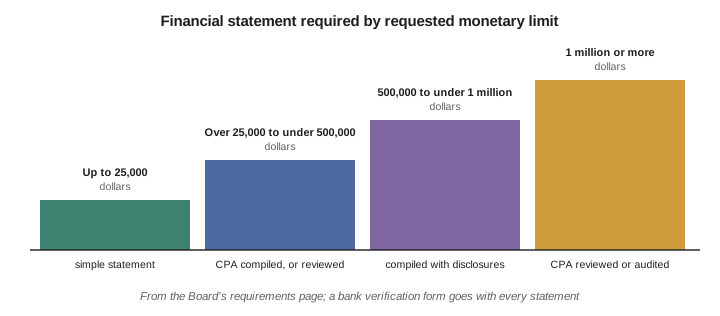
| Requested monetary limit | Financial statement the Board accepts (summary) |
|---|---|
| 25,000 dollars or less | Independent CPA, Board-prescribed or software balance sheet with affidavit |
| Over 25,000 to under 500,000 dollars | CPA-compiled within 6 months, or reviewed or audited within 1 year |
| 500,000 to under 1 million dollars | CPA-compiled with full disclosures within 6 months, or reviewed or audited within 1 year |
| 1 million dollars or more | CPA-reviewed or audited within 1 year |
A bank verification form goes with every statement. The Board may also accept an indemnification agreement, in which an owner or related party guarantees the business, to support a higher limit. Raising a limit later works the same way: the licensee files a request with a current financial statement in the tier required for the new limit, and the Board reviews it. Andre’s first statement, prepared on the Board’s form with his software balance sheet, supported a limit in the lowest tier. He planned to hire a CPA for a compiled statement after his first profitable year.
The license bond
Every licensee must post a bond or a cash deposit with the Board. Under NRS 624.270, the bond protects people who suffer damage from the licensee’s violations of Chapter 624, such as consumers, workers who go unpaid and suppliers. The Board sets the amount at approval. Its requirements page states that the bond can vary from 1,000 dollars to 500,000 dollars, based on the license type, the monetary limit, financial responsibility, experience and character. A licensee with a larger limit, a thin financial statement or a disciplinary history can expect a larger bond.
Most contractors post a surety bond, issued by a surety company for an annual premium that depends on the bond amount and the owner’s credit. A cash deposit is the alternative, and the Board’s page notes a biennial administrative fee of 200 dollars for cash bond deposits. The bond must stay in force continuously. If the surety sends the Board a cancellation notice, the licensee must replace the bond before the cancellation takes effect, or the license is suspended. The bond is not insurance for the contractor: when the surety pays a claim, it will seek repayment from the contractor and any indemnitors who signed the bond agreement.
# Illustrative bond premium estimates (not quotes; rates depend on credit and the surety)
bonds = [5_000, 15_000, 30_000, 50_000]
rates = {"strong credit": 0.01, "average credit": 0.025, "weak credit": 0.06}
for amount in bonds:
    row = [f"{amount:>7,} dollars:"]
    for label, r in rates.items():
        row.append(f"{label} {amount * r:,.0f}")
print(" ".join(row))5,000 dollars: strong credit 50 average credit 125 weak credit 300 15,000 dollars: strong credit 150 average credit 375 weak credit 900 30,000 dollars: strong credit 300 average credit 750 weak credit 1,800 50,000 dollars: strong credit 500 average credit 1,250 weak credit 3,000
The study aid shows why many new contractors are surprised by premiums. The bond amount is set by the Board, but the cost to the contractor depends on the surety’s view of the owner’s credit, so the same bond can cost several times more for one contractor than another.
Bond increases and claims history
The bond amount is not fixed forever. The Board can raise a licensee’s bond when it raises the monetary limit, when the financial statement weakens, or as a condition in a disciplinary order. Claims also matter. Every claim paid on a bond reduces the amount left to protect others, and a surety that pays claims may refuse to renew. A contractor with several paid claims may struggle to find any surety willing to write its license bond, which can end the license as surely as a suspension. Ray’s view, shared with Marisol in her first week as qualifier, was that the cheapest bond is the one no one ever claims against: pay suppliers on time, finish jobs and answer complaints.
The Residential Recovery Fund
Nevada protects homeowners through the Residential Recovery Fund, created by NRS 624.400 through 624.560. Licensed contractors who engage in residential construction pay an assessment into the fund, and NRS 624.283 lists the residential assessment as part of renewal. A homeowner who occupies a single-family residence and contracted with a properly licensed residential contractor can apply to the fund for an actual loss caused by the contractor’s conduct, after exhausting other ways to recover. The Board’s page states that the payout is capped at 40,000 dollars per claim, that a complaint must be filed with the Board within four years after the work is completed, and that a homeowner with a Nevada court judgment must apply within two years of the judgment.
The fund does not protect homeowners who hire unlicensed people, owner-builders who pulled their own permits, or owners of buildings other than single-family residences. When the fund pays a claim caused by a licensee, the licensee’s license is generally suspended until the fund is repaid. For a C-2 contractor that does service upgrades and remodel wiring on houses, as Andre planned, the residential assessment is part of the cost of doing business. Mojave Current pays it too, because its Henderson tract-home work is residential.
Workers’ compensation and the affidavit
Before granting an original or renewal license, the Board must receive proof under NRS 624.256 that the applicant has industrial insurance covering its employees, or proof that it is a qualified self-insured employer or member of an association of self-insured employers. The only alternative is a sworn affidavit that the applicant is not subject to the industrial insurance law, which applies only to a business with no employees that is not and does not plan to be a subcontractor for a principal contractor and has not bid and does not plan to bid on jobs for one. Failing to keep the required coverage is grounds to deny, suspend, revoke or refuse to renew the license. Lesson 10 explains how Nevada workers’ compensation works.
Andre planned to hire one journeyman and an apprentice in his first month, so the affidavit was never an option for him. He bought a workers’ compensation policy from a private carrier and filed the proof with the Board in June 2026.
Other insurance
The law requires workers’ compensation, but the market requires more. General contractors, property managers and public agencies usually require commercial general liability insurance with stated limits, often with the customer named as an additional insured. Commercial auto insurance covers the vans, an umbrella policy adds limits above the primary policies, and contractors’ equipment coverage protects tools and machinery. Installation floaters or builder’s risk coverage protects material and work in progress before the owner accepts it. Professional liability matters for contractors who do design-build work. The right package depends on the work, so Mojave Current reviews its program with a broker every year before renewal.
Certificates and additional insured endorsements
Customers rarely ask to read a contractor’s policies. They ask for a certificate of insurance, a one-page summary issued by the broker, and often for endorsements that name the customer as an additional insured or waive the insurer’s right to recover from the customer. The certificate itself changes nothing; the endorsements do. A general contractor’s subcontract may require specific limits, specific endorsements and notice before cancellation, and a contractor that signs the subcontract without checking its policy can end up in breach. Denise sends every new subcontract’s insurance requirements to the broker before Marisol signs, and keeps the certificates for each job in its file. When a certificate expires during a job, the general contractor will usually hold payment until a new one arrives, so the renewal dates go on the office calendar.
Workers’ compensation interacts with subcontracting in a way the exam likes to test. In Nevada, a principal contractor can become responsible for injuries to a subcontractor’s workers if the subcontractor has no coverage, which is why general contractors collect proof of coverage from every subcontractor before work starts. Mojave Current does the same with its own subcontractors, such as the low-voltage installer it uses on office jobs.
Andre found that his general liability carrier asked about the kinds of work he planned, the share of residential work and his subcontracting, and priced the policy accordingly. Being accurate on the application matters, because a policy can be challenged if the insurer was told one thing and the contractor did another.
Payment and performance bonds
License bonds are different from project bonds. A performance bond guarantees that the contractor will finish the job; a payment bond guarantees that the contractor will pay its subcontractors and suppliers. Nevada’s public works statutes require payment and performance bonds from contractors on many public projects, and private owners and general contractors may require them by contract. On a bonded public job, subcontractors and suppliers who go unpaid generally claim against the payment bond, because mechanics’ liens do not attach to public property. Bonding capacity, the size of project bonds a surety will write, depends on the contractor’s finances and track record, much like the monetary limit.
Worked problem
Putting the money pieces together
Andre’s new company will do residential service upgrades and small commercial jobs, with two employees, and his first financial statement is on the Board’s form. What will the Board require before issuing the license, and what will customers require?
Show solution
- The Board will set a monetary limit in the lowest tier based on his statement.
- The Board will set a license bond in its range, which he will post through a surety or with cash.
- Because he will do residential work, he will pay the Residential Recovery Fund assessment.
- He must file proof of workers’ compensation coverage, since he will have employees.
- Customers and general contractors will likely require general liability insurance and certificates naming them.
Answer: A low monetary limit, a Board-set bond, the residential assessment and proof of workers’ compensation, plus the liability insurance the market requires.
Common mistakes
MistakeTreating the license bond as insurance for the contractor.
InsteadThe surety pays claimants and then seeks repayment from the contractor.
MistakeBidding as if the monetary limit were unlimited.
InsteadThe limit applies to all contracts for one client on one site.
MistakeFiling the no-employee affidavit while planning to hire.
InsteadThe affidavit is only for businesses with no employees that do not work as subcontractors.
MistakeExpecting the recovery fund to cover any building.
InsteadIt covers owner-occupied single-family residences and licensed residential contractors.
Summary and key terms
- The Board sets each license’s monetary limit, mainly from the financial statement.
- Financial statement requirements rise in four tiers with the requested limit.
- The license bond or cash deposit ranges from 1,000 to 500,000 dollars, set by the Board.
- Residential contractors pay into the Residential Recovery Fund, which caps claims at 40,000 dollars.
- NRS 624.256 requires proof of workers’ compensation coverage or a narrow affidavit for an original or renewal license.
- Payment and performance bonds are project bonds, required on many public jobs.
- License bond
- A bond or cash deposit with the Board protecting people harmed by Chapter 624 violations.
- Indemnitor
- A person who agrees to repay the surety for claims it pays on a bond.
- Residential Recovery Fund
- The fund that compensates qualifying homeowners for losses caused by licensed residential contractors.
- Payment bond
- A project bond guaranteeing payment of subcontractors and suppliers.
Practice problems
Work each problem on paper first, then reveal the answer to check.
What range does the Board’s requirements page give for license bonds?
Show answer
From 1,000 dollars to 500,000 dollars, set by the Board.
What is the maximum payout per claim from the Residential Recovery Fund, according to the Board?
Show answer
40,000 dollars.
What financial statement is required for a monetary limit of 1 million dollars or more?
Show answer
A CPA-reviewed or audited statement dated within one year.
Lesson quiz · 5 questions
Score 60% or more to complete this lesson.
Create a free account to save your progress, take quizzes and earn a certificate.