
MELU-303 · Lesson 6 of 12 · 19 min
Permits, inspections and the inspection authority
▶ Video coming soon A video version of this lesson is on the way.
Denise has pulled electrical permits in six Nevada jurisdictions, and she says the hardest part of the job is not the forms. It is knowing which building department has authority over the address, what that department wants submitted, and how to keep inspections moving so a crew is never standing around waiting for a green tag. This lesson covers how permits and inspections work in Nevada, who the inspection authority is, how county and city electrician cards fit in, and how the utility releases service at the end.
The inspection authority
The inspection authority, often called the authority having jurisdiction, is the building department of the county or city where the work is located. In the south, that means the Clark County Department of Building and Fire Prevention for unincorporated areas, including much of the Las Vegas Strip corridor, and the building departments of Las Vegas, Henderson, North Las Vegas, Boulder City and Mesquite inside their city limits. In the north, it means the Washoe County building program for unincorporated areas and the Reno and Sparks building departments in the cities. Carson City and the other counties run their own programs or rely on county arrangements. For state-owned buildings, the State Public Works Division is the authority.
The address alone does not always tell you which department has authority. Las Vegas mailing addresses cover large areas of unincorporated Clark County, and a Reno mailing address can sit in unincorporated Washoe County. Denise looks up the parcel in the county assessor’s records before every new job to confirm whether it is inside a city. Filing with the wrong department wastes days.
Who may pull an electrical permit
Building departments issue electrical permits to licensed contractors whose license covers the work, and in most jurisdictions to owners doing work on their own homes under owner-builder rules. The department checks the contractor’s license on the Board’s records, including the classification and often the monetary limit, before issuing the permit. A C-2 licensee can pull electrical permits; a contractor with only a narrow C-2 subclassification can pull permits only for work inside that subclassification’s scope. Many departments also require the contractor to register with them or keep a current local business license on file.
The permit belongs to the contractor who pulled it, and that contractor answers for the work under it. If Mojave Current is replaced on a job partway through, the new contractor generally needs its own permit or a formal transfer, and the work already installed may need to be inspected before the change. Permits also expire if work does not start or stalls for a period the jurisdiction sets, so a permit pulled months before a job may need to be renewed.
Plans and plan review
Residential service changes and small alterations usually need only a permit application with a simple description and perhaps a load calculation. Larger work, such as a new commercial service, a tenant improvement with new feeders, or a solar and storage system, usually needs drawings: a one-line diagram, panel schedules, load calculations, fault current information and, for some projects, an engineer’s stamp. The building department reviews the drawings against the adopted code and amendments and returns comments. The contractor or designer corrects the drawings and resubmits until the plans are approved.
Plan review time is part of the schedule. Large departments publish target review times, and complex projects can take several review cycles. Marisol learned to read plan review comments the day they arrived and answer them quickly, because a week lost in review is a week the general contractor will ask about.
Inspections
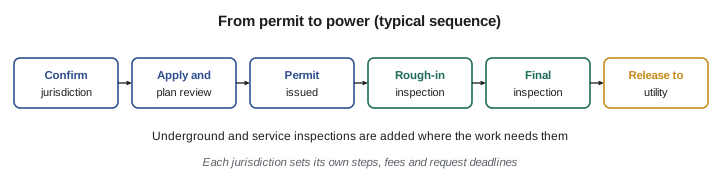
Electrical inspections follow the construction sequence. A typical new building or major remodel has an underground inspection for conduits and grounding electrodes before concrete or backfill, a rough-in inspection after boxes, raceways and cables are installed but before walls are covered, and a final inspection when devices, fixtures and equipment are installed and energized or ready to energize. Services, solar systems and special equipment may have their own inspections. The job is not finished until the final inspection passes.
Inspections are requested through the department’s portal or phone line, usually by the permit holder, with a cutoff time for next-day service. The inspector checks the work against the approved plans and the adopted code and amendments, and either approves it or issues a correction notice listing the items to fix. Corrections are made and a reinspection is requested, often with a reinspection fee. The approved plans and permit card must be on site, and the work must be accessible. An inspector who arrives to find the panel cover screwed on and no ladder will not wait.
| Inspection | When it happens | What the inspector looks at (examples) |
|---|---|---|
| Underground | Before trenches are backfilled or concrete is placed | Conduit, depth, grounding electrodes |
| Rough-in | Before walls and ceilings are covered | Boxes, raceways, cables, support, fill |
| Service | Before the utility connects | Service equipment, grounding and bonding, clearances |
| Final | When the work is complete | Devices, fixtures, labeling, equipment, panel schedules |
Electrician cards and the job site
County and city electrician card programs add a second check on the job. In Clark County, electricians who perform electrical work generally must hold a current card for their level, such as master, journeyman or residential electrician, and apprentices must be enrolled in an approved program and work under carded supervision. The City of Reno similarly requires anyone installing electrical wiring or equipment in the city to hold a valid journeyman certificate, with exceptions for homeowners and for contractors who keep a written supervision agreement on site naming their supervisors and their certifications. Cards are issued and renewed through Electrical Safety Professionals, and the qualifying exams are the International Code Council’s national master, journeyman and residential electrician exams. Other jurisdictions have their own rules or none at all.
Inspectors and building departments enforce the card rules. An inspector may ask to see cards on site, and a jurisdiction can stop work or cite the contractor when uncarded workers are doing work that requires a card. For a contractor, keeping a current roster of cards with expiration dates is part of running jobs. Denise keeps one for both offices, and Hank checks it before sending anyone to a Reno job. Lesson 11 covers how the cards renew.
# Card roster check before assigning a crew (illustrative dates)
from datetime import date
roster = [
    ("Marisol Vega", "Clark County journeyman", date(2028, 3, 1)),
    ("Hank Tsosie", "Reno journeyman", date(2027, 1, 15)),
    ("Luis Serrano", "Clark County journeyman", date(2026, 10, 31)),
]
job_date = date(2026, 11, 16)
for name, card, expires in roster:
    status = "current" if expires >= job_date else "EXPIRED - do not assign"
print(f"{name:14} {card:24} expires {expires} {status}")Marisol Vega Clark County journeyman expires 2028-03-01 current Hank Tsosie Reno journeyman expires 2027-01-15 current Luis Serrano Clark County journeyman expires 2026-10-31 EXPIRED - do not assign
The roster check catches the problem before the crew leaves the shop. In the illustrative example, one card expired two weeks before the job date, so that electrician cannot be assigned work requiring a card until it is renewed.
Temporary power and phased jobs
Most construction sites need temporary power long before the permanent service exists. Temporary power poles and temporary distribution are electrical installations in their own right, and most building departments require a permit and an inspection for them before the utility will connect. Ground-fault protection for personnel, secure enclosures and safe cord routing matter here as much as on any finished job, because temporary systems take abuse every day. Jordan Pike’s first assignment as an apprentice was helping set a temporary pole at a North Las Vegas warehouse, and the inspector failed it the first time for a missing bonding connection. Marisol made him find and fix the problem himself.
Large jobs are often permitted and inspected in phases: a shell building first, then tenant improvements suite by suite, each with its own permit or its own inspection sequence. A phased job needs a clear record of which circuits and equipment belong to which phase, so the inspector is never asked to approve work that belongs to a later permit. Phasing also affects the monetary limit, as Lesson 8 explains, because the phases on one site for one client count together.
Working with the general contractor
On most commercial jobs the electrical contractor is a subcontractor, and the general contractor controls the schedule. Inspections have to fit into that schedule: the rough-in inspection must happen after the electricians finish and before the drywall crew starts, and the final inspection needs the ceiling grid, the fixtures and the equipment in place. Marisol gives the superintendent a short inspection plan at the start of each job, with the dates she needs walls left open, and updates it at the weekly coordination meeting. A failed inspection that delays drywall becomes the electrical contractor’s problem, so she schedules a walk-through of her own a day before each inspection.
Service release and the utility
When the final or service inspection passes, the building department notifies the serving utility that the installation is approved, often called releasing the service. The utility then sets the meter and energizes the service according to its own requirements. In most of Nevada, the serving utility is NV Energy, though some rural areas are served by cooperatives or other utilities. Utility service requirements cover meter locations, service equipment, clearances and the paperwork for new or upgraded services, and the utility may inspect its own equipment points separately.
Solar and storage systems add an interconnection process with the utility, which runs beside the permit. The utility reviews an interconnection application and usually requires the building department’s final approval before it grants permission to operate. A system that passes inspection but lacks permission to operate cannot be turned on. Mojave Current’s solar coordinator starts the interconnection paperwork when the permit is filed so the two processes finish together.
Working without a permit
Electrical work that requires a permit and is done without one creates problems for everyone. The building department can stop work, charge investigation fees, require walls to be opened for inspection and refuse to release the service. The Board can discipline a licensee for failing to obtain required permits, since NRS Chapter 624 treats code and permit violations as grounds for discipline. Insurers may deny claims arising from unpermitted work, and a later buyer’s inspection may turn it up. For the qualified individual, permits are not paperwork to skip when a customer is in a hurry; they are part of the job.
Worked problem
Planning inspections on a tenant improvement
Mojave Current has a dental office tenant improvement in Henderson with new branch circuits, a new panel fed from the building’s existing distribution, and dental equipment connections. How should Marisol plan permits and inspections?
Show solution
- Confirm the suite is inside the City of Henderson and file the permit with the city’s building department, with drawings as the city requires.
- Answer plan review comments promptly and keep the approved plans on site.
- Schedule rough-in inspection before the walls close, and coordinate with the general contractor so drywall does not start early.
- Request the final inspection when the panel, devices, fixtures and equipment connections are complete and labeled.
Answer: File with the City of Henderson, keep the approved plans on site, and sequence the rough-in and final inspections with the general contractor.
Records and correction notices
A good permit file holds the application, the approved plans and any revisions, every inspection result, correction notices and how each was resolved, and the final approval. The file protects the contractor if a question comes up later, such as a warranty claim or a dispute over whether a change was approved. Correction notices deserve particular attention: they show what the inspector found and how quickly the company fixed it. Marisol reviews every correction notice from both offices at the monthly foremen’s meeting, because the same item failing on several jobs points to a training problem, not a single mistake.
Common mistakes
MistakeFiling the permit by the mailing address.
InsteadConfirm the parcel’s jurisdiction first; many Las Vegas and Reno addresses are unincorporated county.
MistakeCovering work before the rough-in inspection.
InsteadRequest inspection before walls close; opening them later costs more.
MistakeAssuming a C-2 license replaces electrician cards.
InsteadCard programs such as Clark County’s and Reno’s apply to the individuals doing the work.
MistakeEnergizing a solar system after final inspection without utility approval.
InsteadWait for the utility’s permission to operate.
Summary and key terms
- The inspection authority is the building department of the county or city where the work is located.
- Permits go to licensed contractors whose classification covers the work, or to qualifying owners.
- Larger work needs drawings and plan review before the permit is issued.
- Inspections typically include underground, rough-in, service and final inspections.
- Clark County and Reno card programs apply to individual electricians on the job.
- After approval, the building department releases the service and the utility connects it.
- Authority having jurisdiction
- The body that enforces the code for a job, usually the local building department.
- Correction notice
- An inspector’s list of items that must be fixed before approval.
- Service release
- The building department’s notice to the utility that a service has passed inspection.
- Permission to operate
- The utility’s approval to energize an interconnected generating system.
Practice problems
Work each problem on paper first, then reveal the answer to check.
A job has a Las Vegas mailing address. Which building department issues the permit?
Show answer
It depends on the parcel; it may be the City of Las Vegas or unincorporated Clark County, so check the assessor’s records.
What must be on site for an inspection?
Show answer
The approved plans and permit card, with the work accessible.
Who releases a new service to the utility?
Show answer
The building department, after the service or final inspection passes.
Lesson quiz · 5 questions
Score 60% or more to complete this lesson.
Create a free account to save your progress, take quizzes and earn a certificate.