
MELU-303 · Lesson 5 of 12 · 18 min
The NEC as adopted in Nevada and local amendments
▶ Video coming soon A video version of this lesson is on the way.
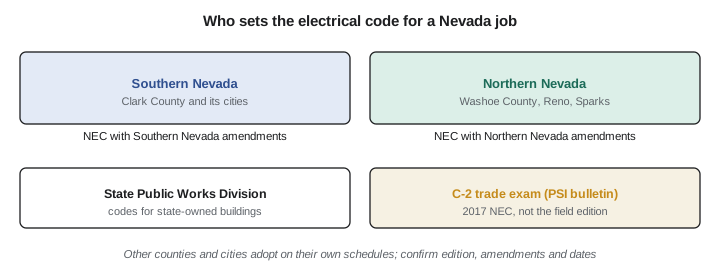
In April 2026, a week before her CMS exam, Marisol walked a tenant improvement in Summerlin with the general contractor’s superintendent. He had just moved from another state and asked which edition of the National Electrical Code Nevada used. “Which part of Nevada?” she asked. It was not a joke. Nevada has no single statewide electrical code for private construction. Counties and cities adopt the codes that apply inside their boundaries, usually with amendments developed regionally by their building officials. The State Public Works Division adopts codes for state-owned buildings. And the C-2 trade exam, as Lesson 4 showed, is written to yet another edition. This lesson sorts out who adopts what and how to confirm the code for any job.
Why Nevada adopts codes locally
Nevada law gives counties and cities the power to regulate building within their boundaries, including adopting building, electrical and related codes. The state does not impose one electrical code on all private work. In practice, the populous jurisdictions adopt the latest national model codes on a regular cycle, and many smaller ones follow the same editions, sometimes a few years later. Rural areas without their own building department may rely on a county program or have limited enforcement. For an electrical contractor, the result is that the right question is never what code Nevada uses but what code the jurisdiction where this job sits has adopted, with what amendments, effective on what date.
The answer also depends on when the permit application was filed. Jurisdictions usually set an effective date for a new code and sometimes allow a transition period during which applicants may choose the old or the new edition, but not mix them. A project whose permit was submitted under the older code generally stays under it through completion, even after the new code takes effect.
Southern Nevada
In the south, Clark County and the cities inside it, including Las Vegas, Henderson, North Las Vegas, Boulder City and Mesquite, coordinate their code adoptions through their building officials. The building officials develop Southern Nevada amendments to each model code, and each jurisdiction adopts the model code together with those amendments by its own ordinance. As of late 2026, Clark County’s code page lists the 2023 National Electrical Code with Southern Nevada amendments as the current electrical code, and Henderson publishes its own page on the NEC it enforces.
Regional amendments help contractors who work across jurisdictions, since the electrical rules are similar from Las Vegas to Henderson. Similar is not identical, though. A city can adopt the regional amendments with local changes, or adopt them on a different date. Denise keeps a one-page table at the permit desk listing, for each jurisdiction where Mojave Current pulls permits, the NEC edition, the amendments, the effective date and the link to the official page. She updates it whenever a building department announces an adoption.
Northern Nevada
In the north, Washoe County, Reno and Sparks follow a similar pattern with the Northern Nevada Chapter of the International Code Council, which develops Northern Nevada amendments. Washoe County’s adopted codes page lists the 2023 National Electrical Code among its current codes, adopted with the 2024 international codes effective July 1, 2025, along with the 2024 Northern Nevada amendments. During a transition period that ended December 31, 2025, applicants could use either the old or the new set but not both. Reno and Sparks adopt by their own ordinances, so check each city’s building department as well as the county.
Hank, who leads the Sparks branch, deals with three jurisdictions in a ten-minute drive. A distribution center east of Sparks might sit in the City of Sparks, a remodel across the river in Reno, and a ranch house a few miles north in unincorporated Washoe County. Each building department adopts and amends its own codes, even when the editions match.
| Area | Who adopts | Electrical code (as listed in late 2026) |
|---|---|---|
| Unincorporated Clark County | Clark County | 2023 NEC with Southern Nevada amendments |
| Las Vegas, Henderson, North Las Vegas | Each city by ordinance | Check each city; regional amendments are common |
| Unincorporated Washoe County | Washoe County | 2023 NEC, with the 2024 Northern Nevada amendments listed |
| Reno, Sparks | Each city by ordinance | Check each city |
| State-owned buildings | State Public Works Division | The edition the Division adopts |
| C-2 trade exam | PSI bulletin | 2017 NEC |
State buildings and other state rules
The state itself adopts codes for buildings it owns. The State Public Works Division sets the codes for state buildings and inspects them, and its adopted edition may differ from the local one. A school district, a university or a state agency job can therefore follow a different edition than the private building across the street. The State Fire Marshal also has authority over fire codes in some buildings and areas. None of these are state amendments to the NEC for private work; they are separate adoptions for particular kinds of buildings. Read the project specifications and ask the owner’s representative which code authority applies.
Some other electrical rules come from the serving utility rather than any code. NV Energy and other utilities publish service requirements for meters, service equipment and interconnection of solar and storage systems. Those requirements sit beside the code, not inside it, and the inspector and the utility each enforce their own.
What amendments usually do
Local amendments change the model code to fit local conditions and practice. They may add administrative provisions about permits, plan review and inspections, change requirements for particular wiring methods, adjust rules for specific occupancies common in the region, or delete provisions the building officials consider unnecessary locally. Amendments are published as separate documents that list each changed section by number. They do not reprint the whole code, so you need both the code book and the amendment document to know the rule in force.
This course does not reproduce code or amendment text. When a job turns on a specific requirement, read the adopted code section and then check whether the local amendment document mentions that section number. If it does, the amendment controls in that jurisdiction. If it does not, the model code text applies as adopted.
# Look up the code in force for a job (illustrative table, not official)
adoptions = {
    "Clark County": ("2023 NEC", "Southern Nevada amendments"),
    "Washoe County": ("2023 NEC", "Northern Nevada amendments"),
    "Sample City": ("2020 NEC", "local amendments"),
}
def code_for(jurisdiction):
    edition, amendments = adoptions.get(jurisdiction, ("unknown", "ask the building department"))
    return f"{jurisdiction}: {edition} with {amendments}"

for place in ["Clark County", "Washoe County", "Sample City", "Rural County"]:
print(code_for(place))Clark County: 2023 NEC with Southern Nevada amendments Washoe County: 2023 NEC with Northern Nevada amendments Sample City: 2020 NEC with local amendments Rural County: unknown with ask the building department
The lookup returns an honest unknown for a jurisdiction not in the table, which is the right behavior. The worst code mistakes come from assuming. A crew that wires a job in a rural county to the edition they know from Las Vegas may be right, or may be one or two editions off.
Other codes that touch electrical work
The NEC is not the only code an electrical contractor works under. Jurisdictions that adopt the 2024 international codes also adopt an energy conservation code, which sets requirements for lighting power, lighting controls, occupancy sensors, daylight zones and receptacle controls in many commercial buildings. The building code and fire code set requirements for fire-resistance-rated assemblies, which matter every time a raceway or cable passes through a rated wall or floor and needs a listed firestop system. Fire alarm work follows the fire code and NFPA 72 as adopted locally. The residential code has its own electrical chapters, although many jurisdictions direct electrical work in dwellings to the NEC itself; check how the local adoption handles it.
The energy code generates more failed inspections than many electricians expect. A tenant improvement in Summerlin can pass every NEC item and still fail because the lighting controls do not meet the energy code as amended locally. Mojave Current’s estimators read the energy code sections and the local amendments on every commercial job, and Marisol includes a controls check on every commercial rough-in.
How editions move over time
Model codes are published on a three-year cycle, and Nevada’s large jurisdictions have tended to adopt each NEC edition a year or two after publication, with their regional amendments. Clark County’s code page still lists the 2017 NEC and its amendments alongside the current 2023 edition, because projects permitted under older codes, and work on existing buildings, may still refer to them. A contractor who has worked in Las Vegas for many years has probably installed under three or four editions. That history is useful, but it also creates the risk of applying a rule that has since changed.
When a new edition is coming, building departments usually announce it to the industry months in advance, publish the proposed amendments for comment and hold public hearings before the county commission or city council votes. Contractors can comment on proposed amendments, and trade associations often do. Denise subscribes to the industry notices from each building department Mojave Current works with, so the company hears about a change before it takes effect rather than at a failed inspection.
The exam edition and the field edition
The C-2 trade exam uses the 2017 NEC, while the largest jurisdictions enforce the 2023 NEC. The gap is not unusual; exam programs update their references on their own schedules. For the exam, answer every question by the 2017 text and do not import changes from later editions. For the field, follow the edition the jurisdiction adopted. Marisol found this harder than she expected, because some requirements she used daily had moved or changed between editions. She marked those sections in her 2017 book with a small note in her study log and reviewed them the week before the exam.
Worked problem
Confirming the code for a new job
Mojave Current is bidding a medical office in Henderson and a warehouse addition in unincorporated Washoe County in the same week. How should Denise confirm the electrical code for each?
Show solution
- For Henderson, check the City of Henderson’s building and fire safety pages for its adopted NEC and amendments and their effective dates.
- For the Washoe County job, check the county’s adopted codes page and the Northern Nevada amendments it lists.
- Note whether either jurisdiction is in a transition period and which code the permit application will be filed under.
- Record the edition, amendments and dates in the bid file, and confirm again when the permit is filed.
Answer: Check each jurisdiction’s official adoption pages, note any transition period, and record the result in the bid file.
When jurisdictions disagree with your habits
Crews pick up habits in the jurisdiction where they work most. A Las Vegas crew sent to a Reno job may install something the Southern Nevada amendments allow but the Northern Nevada amendments treat differently, or the reverse. The cure is a short job-start briefing: the foreman reviews the adopted code and amendments for the job and points out any differences from what the crew usually sees. Hank does this every time Las Vegas electricians come north to help on a large job.
Inspectors also differ in interpretation, even under the same code. When an interpretation matters to cost or schedule, ask the building department in writing before you install, and keep the answer in the job file. A written interpretation from the authority having jurisdiction carries far more weight than a memory of what another inspector said on another job.
Common mistakes
MistakeSaying that Nevada uses one statewide NEC edition for private work.
InsteadCounties and cities adopt the NEC locally; confirm the edition for each job.
MistakeCalling Southern or Northern Nevada amendments state amendments.
InsteadThey are regional amendments adopted by each local jurisdiction.
MistakeAnswering exam questions by the 2023 NEC.
InsteadThe C-2 trade exam bulletin lists the 2017 edition.
MistakeReading the model code without the amendment document.
InsteadCheck the amendment list for the section number before relying on the model text.
Summary and key terms
- Nevada has no single statewide electrical code for private work; counties and cities adopt the NEC locally.
- Southern Nevada jurisdictions adopt the NEC with Southern Nevada amendments; Clark County lists the 2023 NEC.
- Washoe County lists the 2023 NEC with Northern Nevada amendments, effective July 1, 2025.
- The State Public Works Division adopts codes for state buildings.
- Utilities set service and interconnection requirements alongside the code.
- The C-2 trade exam uses the 2017 NEC, so separate the exam edition from the field edition.
- Adoption
- The ordinance or rule by which a jurisdiction makes a model code enforceable, often with amendments.
- Southern Nevada amendments
- Regional amendments to model codes used by Clark County and its cities.
- Northern Nevada amendments
- Regional amendments developed with the Northern Nevada Chapter of the ICC.
- Transition period
- A window when applicants may choose the old or new code edition, but not mix them.
Practice problems
Work each problem on paper first, then reveal the answer to check.
A superintendent asks which NEC edition Nevada uses. What is the best answer?
Show answer
It depends on the jurisdiction; confirm the edition and amendments with the local building department.
Which NEC edition should Marisol use to answer C-2 exam questions?
Show answer
The 2017 edition listed in the PSI bulletin.
Who sets the codes for a state-owned building?
Show answer
The State Public Works Division.
Lesson quiz · 5 questions
Score 60% or more to complete this lesson.
Create a free account to save your progress, take quizzes and earn a certificate.