
MELU-303 · Lesson 12 of 12 · 18 min
Practice exam review and test-day strategy
▶ Video coming soon A video version of this lesson is on the way.
Marisol missed the C-2 trade exam by three questions on her first attempt in late April 2026. She walked out of the Las Vegas test center, sat in her truck and read the score report twice. The report showed her weakest areas: transmission lines, motors and safety information. That afternoon she called Ray, who had passed the same exam in 1999 on his second try, and he told her what he had done: stop rereading the code book and start doing timed questions, then study only what the misses showed. Two weeks later she passed. This lesson turns her two attempts into a plan you can use: a study schedule, practice exams, a miss log, lookup drills and a test-day routine for both Nevada exams.
A study plan built on the outlines
The PSI bulletin gives two maps. The C-2 outline lists fifteen areas and their question counts, and the CMS outline lists ten. A good plan spends time in proportion to the counts and to your weaknesses. Marisol’s first plan, for her first attempt, spent most of its time on code reading and too little on practice. Her second plan reversed that. Over eight weeks, a candidate with a full-time job can prepare for both exams with about ten hours a week: three evenings of timed practice, one long weekend session, and short lookup drills on the remaining days.
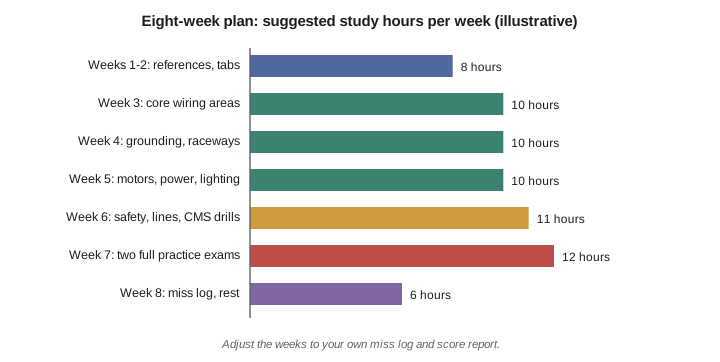
| Week | C-2 trade exam focus | CMS focus |
|---|---|---|
| 1-2 | Get the 2017 NEC and NFPA 72; tab the articles; locate tables fast | Read the manual’s table of contents; build a one-page index |
| 3-4 | Services, feeders, branch circuits, grounding, conductors, raceways | Licensing, lien law, contracts |
| 5 | Motors, power, overcurrent, lighting, special occupancies | Financial management and tax |
| 6 | Safety, transmission lines, low voltage, signs, fire alarm | Labor law, risk, project management, safety |
| 7 | Full timed practice exam; review every miss | Full timed practice exam; review every miss |
| 8 | Miss log review; light practice; rest before the exam | Miss log review; light practice |
Practice exams and the miss log
A practice exam is useful only if you treat it like the real one: timed, with only the allowed references, no phone and no breaks beyond those the real exam allows. Afterward the work begins. Every missed question goes into a miss log with four entries: the topic, why you missed it, where the answer is, and what you will do differently. The reasons usually fall into a few groups: you did not know the rule, you knew it but could not find it in time, you misread the question, or you made a calculation error. Each reason has a different cure, which is why the log asks for it.
Marisol’s log after her first attempt told a clear story. Most of her misses on code questions were lookups she could not finish in time, not rules she did not know. Her safety and transmission line misses were knowledge gaps, because her career had been inside buildings and the exam’s safety block includes overhead line work and clearances. Her motor misses were calculation errors made in a hurry. She spent the two weeks before her retake on those three problems and nothing else.
# Summarize a miss log by reason and area (illustrative entries)
from collections import Counter
misses = [
    ("Grounding and Bonding", "lookup too slow"), ("Motors", "calculation error"),
    ("Transmission Lines", "did not know"), ("Safety Information", "did not know"),
    ("Raceways and Boxes", "lookup too slow"), ("Motors", "calculation error"),
    ("Conductors and Cables", "misread question"), ("Safety Information", "did not know"),
]
by_reason = Counter(reason for _, reason in misses)
by_area = Counter(area for area, _ in misses)
print("By reason:", dict(by_reason))
print("Top areas:", by_area.most_common(3))By reason: {'lookup too slow': 2, 'calculation error': 2, 'did not know': 3, 'misread question': 1}
Top areas: [('Motors', 2), ('Safety Information', 2), ('Grounding and Bonding', 1)]The summary points at the plan. Lookups that are too slow call for tab work and timed lookup drills. Knowledge gaps call for reading and targeted questions in that area. Calculation errors call for slowing down on a written routine and checking units. Misreads call for underlining the key words in the question, such as minimum, maximum, not, except and shall.
Lookup drills
The trade exam is open book, so speed in the book is a skill to train. A lookup drill takes ten minutes. Pick ten requirements at random from the index or from your miss log, start a timer and find each one, writing down the section number. The goal is under a minute each for common lookups. Marisol drilled every morning before work for the two weeks between attempts and cut her average lookup time from about two and a half minutes to under a minute. She did the same with the business manual for the CMS, practicing questions on lien deadlines, payroll taxes and licensing rules.
Calculations without panic
Calculation questions on the trade exam come from the core electrical topics: loads, conductor sizing and adjustment, voltage drop, box and conduit fill, motor circuits and transformers. Each type has a routine: write the given values, name the rule or formula, find the table or section, compute, and check the units and the size of the answer. Most calculation errors on exam day come from skipping a step under time pressure. A routine written on the scratch paper at the start of the exam is not wasted time.
Worked problem
A motor-circuit style calculation (illustrative)
A three-phase, 480-volt load draws 40 amperes. What is its apparent power in kilovolt-amperes, to one decimal place?
Show solution
- For a three-phase load, apparent power equals the square root of 3 times voltage times current.
- 1.732 x 480 x 40 is about 33,255 volt-amperes.
- Dividing by 1,000 gives about 33.3 kilovolt-amperes.
- Check the size: a few tens of kilovolt-amperes is reasonable for a 40-ampere, 480-volt load.
Answer: About 33.3 kVA.
The CMS in practice
Candidates who fail the CMS usually fail it on time. Sixty questions in 120 minutes leaves no room for reading chapters, so the CMS plan is mostly about the manual’s layout. Know where each outline area lives. Know the lien deadlines and the prompt payment rules well enough to recognize them instantly, and confirm them in the manual only when a question turns on a detail. Know the financial ratios cold: current ratio, quick ratio, debt to equity, gross and net profit margins, and how to compute them from a short balance sheet or income statement. Practice payroll tax and markup questions with the calculator you will bring. Marisol passed the CMS on her first attempt with a few questions to spare, which she credits to her one-page index.
A mixed review of the Nevada material
The CMS and the trade exam both reward quick recall of the Nevada-specific facts this course has covered. The table below collects the ones candidates most often need, with the lesson where each is explained. Use it as a final review sheet, but confirm each item in the current bulletin, statute or official page, since any of them can change.
| Topic | Fact to recall | Lesson |
|---|---|---|
| Experience | Four full years as journeyman, supervisor or contractor within fifteen years | 2 |
| Sequence | Apply first; exam eligibility letter after experience is verified | 3 |
| C-2 trade exam | 80 scored questions, four hours, 56 to pass, 2017 NEC | 4 |
| CMS | 60 scored questions, 120 minutes, 45 to pass, open book | 4 |
| Attempts | Three attempts; two-week wait between attempts on a portion | 3 |
| Code adoption | Local, with Southern and Northern Nevada amendments | 5 |
| Changes | Report address and personnel changes within thirty days | 7 |
| Bond | 1,000 to 500,000 dollars, set by the Board | 8 |
| Recovery fund | Up to 40,000 dollars per claim for qualifying homeowners | 8 |
| Lien notice | The notice of right to lien covers the prior 31 days and after | 9 |
| Lien recording | Within 90 days of completion or last work; 40 after a notice of completion | 9 |
| Lien enforcement | Action within six months of recording | 9 |
| Training cards | 10-hour and 30-hour cards within 15 days of hire | 10 |
| Renewal | License expires two years after issue; automatic suspension if not renewed | 11 |
Marisol turned the same list into flash cards and quizzed herself in the truck before each job. She found that the numbers were easy to remember but easy to confuse with each other: the 31-day lookback, the 90-day recording period, the 15-day notice and the 15-day training card deadline all sound alike under pressure. Writing each one with its trigger event, not just the number, fixed the confusion. The 31 days run backward from when the notice of right to lien is given. The 90 days run forward from completion or the claimant’s last work. The 15 days for the residential notice run before recording, and the 15 days for the training card run from the date of hire.
The day before
The day before an exam is for logistics, not cramming. Confirm the appointment time and the test center address; the Las Vegas center is open seven days a week and the Reno center most days, according to the Board’s exam page. Pack the allowed references, checking them against the bulletin’s list, the allowed calculator with fresh batteries, and the identification PSI requires, which must match the name on your registration. Remove any loose papers from the books. Sleep. Marisol laid everything out on her kitchen table the night before her retake, checked it against the bulletin and put her phone in the truck’s glove box the next morning so she would not carry it in by habit.
At the test center
Arrive early. PSI checks identification, inspects the references and assigns a seat. The exam begins with a short tutorial on the testing software, which shows how to answer, flag questions for review, move between questions and see the time remaining. Use the flag feature for the three-pass approach from Lesson 4: answer what you know, flag what needs a lookup, then return. Watch the clock at your checkpoints. Answer every question before time runs out, because a blank is always wrong. When you finish, review flagged questions, then submit. The score report follows at the end of the session.
# Three-pass pacing check during the exam (illustrative)
total_q, total_min = 80, 240
answered_by_hour = [24, 47, 66, 80]
for hour, done in enumerate(answered_by_hour, start=1):
    target = total_q * hour * 60 // total_min
    flag = "on pace" if done >= target else "speed up"
print(f"Hour {hour}: {done} done, target {target} -> {flag}")Hour 1: 24 done, target 20 -> on pace Hour 2: 47 done, target 40 -> on pace Hour 3: 66 done, target 60 -> on pace Hour 4: 80 done, target 80 -> on pace
If you do not pass
A failed attempt is information. Read the score report’s breakdown by area, update the miss log, and book the retake for the earliest date that leaves enough time to fix the problem, remembering PSI’s two-week wait and the Board’s limit of three attempts before the application is voided. Do not simply take more practice exams; study what the report says you missed. Marisol’s two weeks went to lookup drills, overhead line and safety reading, and motor calculations. On the retake, her score in each of those areas rose, and she passed with five questions to spare.
After the exam
Passing the exams completes one part of the license. The Board still has to confirm the remaining conditions and approve the license or the change of qualifier, as Lesson 3 explained. Keep the score reports, since the Board may ask for them and they are useful if you later qualify another license. Then use the material. The business manual Marisol studied for the CMS now sits on her desk, and she opens it when a lien deadline or a payroll question comes up. Her 2017 code book went on the shelf next to the 2023 edition the jurisdictions enforce, a reminder that the exam and the field each have their own edition.
Common mistakes
MistakeRereading the code book instead of doing timed questions.
InsteadTimed practice and a miss log show what to study.
MistakeTreating every miss the same way.
InsteadSort misses by reason: knowledge, lookup speed, misreading or calculation.
MistakeBringing a reference not on the bulletin’s list.
InsteadCheck every book against the current bulletin the day before.
MistakeLeaving questions blank when time runs short.
InsteadOnly correct answers count, so answer everything.
Summary and key terms
- Plan study time by the outlines’ question counts and your weak areas.
- Take practice exams under real conditions and log every miss with its reason.
- Train lookup speed with short daily drills in the allowed references.
- Use a written routine for calculations and check units and size.
- On test day, bring only allowed references, the right calculator and matching identification.
- After a failed attempt, study what the score report shows, within PSI’s two-week wait and the three-attempt limit.
- Miss log
- A record of missed practice questions with topic, reason, answer location and fix.
- Lookup drill
- A timed exercise finding requirements in the allowed references.
- Three-pass method
- Answering known questions first, lookups second and the hardest last.
- Score report
- PSI’s end-of-session result, with area breakdowns for failing candidates.
Practice problems
Work each problem on paper first, then reveal the answer to check.
Marisol’s misses were mostly slow lookups. What should she practice?
Show answer
Timed lookup drills and tab work in the allowed references.
How should a candidate use a failing score report?
Show answer
Study the weakest areas it shows and log the reasons for misses before the retake.
What should be checked the day before the exam?
Show answer
Appointment details, allowed references against the bulletin, calculator and identification.
Lesson quiz · 5 questions
Score 60% or more to complete this lesson.
Create a free account to save your progress, take quizzes and earn a certificate.