
MELU-303 · Lesson 2 of 12 · 18 min
Eligibility for the C-2 Electrical Contractor License
▶ Video coming soon A video version of this lesson is on the way.
Two days after Ray’s offer, Marisol sat down with Denise in the Mojave Current office with a legal pad and the Board’s license requirements page open on the screen. Before she bought a single book, she wanted to know whether she qualified. Eligibility for a Nevada contractor license has two halves. One half belongs to the qualified individual: experience, knowledge shown on the exams, and good character. The other half belongs to the business: a lawful entity, financial responsibility, a bond and proof of workers’ compensation coverage. Because Mojave Current already held its license, most of the business half was already in place. Marisol’s job was the first half, and that is where this lesson starts.
Who may be the qualified individual
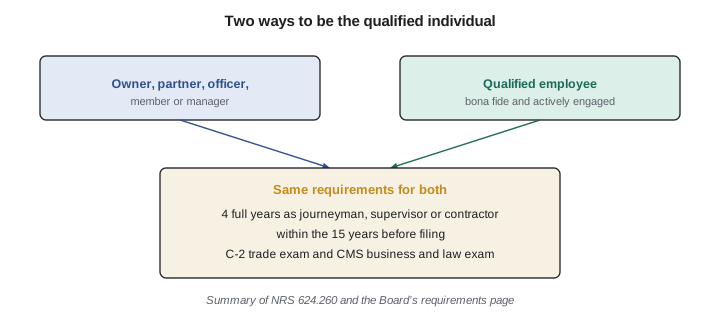
NRS 624.260 lets a business qualify for a license through a natural person who has the required experience and passes the exams. That person may be an owner of a sole proprietorship, a partner, an officer of a corporation, a member or manager of an LLC, or a qualified employee. Whatever the title, the person must be a bona fide member or employee of the business and actively engaged in its contracting work, which means really working for the company, directing its electrical work and answering for it. The Board looks hard at arrangements in which a qualifier appears on paper only.
Marisol would qualify Mojave Current as a qualified employee. She was not an owner, and Ray had no plan to make her one, although he talked about offering her a minority share someday. A qualified employee is an ordinary path, and the duties that come with it are the same as for an owner who qualifies: supervise the work, keep the company within the scope and limit of its license, and see that the law is followed. Lesson 7 covers those duties. Andre, starting his own company in Reno, would qualify it himself as its owner.
Four years of experience within fifteen
The core requirement is experience. The Board’s requirements page states that each trade qualifier must have at least four full years of experience as a journeyman, supervising employee or contractor in the classification applied for, gained within the fifteen years before the application is filed. Time as a helper or apprentice does not count as journeyman-level experience, though accredited training can count in part, as described below. The experience must be in the trade itself: for the C-2, real electrical work, not general construction or sales.
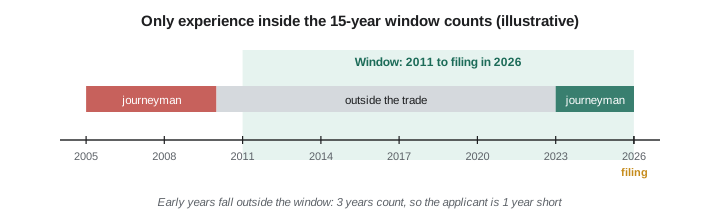
The fifteen-year window matters for people who left the trade for a while. An electrician who worked as a journeyman from 2005 to 2010, managed a hardware store for several years and returned to the tools in 2023 could count only the years that fall inside the window counted back from the filing date. Marisol had no gap. Her journeyman years ran continuously from 2017, and her six years as a foreman were supervising experience, so she had far more than four years inside the window.
# Which experience falls inside the 15-year window? (illustrative)
filing_year = 2026
window_start = filing_year - 15
periods = [  # (start, end, role)
    (2005, 2010, "journeyman"),
    (2010, 2023, "outside the trade"),
    (2023, 2026, "journeyman"),
]
counted = 0
for start, end, role in periods:
    if role == "outside the trade":
        continue
    s = max(start, window_start)
    if end > s:
        counted += end - s
        print(f"{role} {start}-{end}: counts {end - s} years")
    else:
        print(f"{role} {start}-{end}: outside the window")
print("Years counted:", counted, "| needs 4:", counted >= 4)journeyman 2005-2010: outside the window journeyman 2023-2026: counts 3 years Years counted: 3 | needs 4: False
In the illustrative case, the early journeyman years fall entirely before the window opens in 2011, so only the three recent years count, and the applicant falls one year short. He would need another year of journeyman work, or training credit the Board accepts, before applying.
Proving the experience
The Board does not take experience on faith. The requirements page lists the ways to document it. The usual way is four Certification of Work Experience forms for each trade qualifier, each completed by someone with firsthand knowledge of the work, such as a former employer, a supervisor, a general contractor or a building official. Each qualifier also completes a resume of experience describing where and when the work was done. A qualifier who was self-employed adds a list of customers with addresses and phone numbers. Instead of the four certificates, an applicant may submit a current master certification from a government agency in a substantially similar discipline, or documentation of transferable military experience and training.
For Marisol, the certificates were straightforward. Ray completed one, the general superintendent at a Henderson general contractor she had worked under for years completed another, a retired Clark County inspector who knew her work completed a third, and her former apprenticeship coordinator completed the fourth. Denise kept copies of everything and noted the dates each form was signed.
Training credit and exceptions
Accredited training can substitute for part of the experience. The Board’s requirements page allows up to three years of credit for accredited training, documented by apprenticeship certificates, transcripts or similar records. A graduate of a registered electrical apprenticeship, for example, may count part of that training toward the four years, though at least one year of journeyman-level or higher experience is still needed. The Board decides how much credit to give.
Two exceptions save paperwork for people who have already qualified a license. The certificates are not required if the qualifier served as a qualified employee in the same classification on another Nevada license within the last five years. The Board’s exam page adds that a person who served as a qualified employee on a license in the same classification within the last four years generally does not need to retake the exam, though the Board may still require it. The third route is licensure by endorsement, for a contractor who has held a license in another state for at least four years without discipline. Endorsement can also support a waiver of the trade exam, based on the Board’s equivalency chart. None of the exceptions removes the business and law exam unless the Board says so.
| Requirement | What the Board looks for (summary) |
|---|---|
| Experience | Four full years as journeyman, supervising employee or contractor in the classification |
| Window | Within the fifteen years before the application is filed |
| Proof | Four Certification of Work Experience forms, or a qualifying master certification or military record |
| Training credit | Up to three years for accredited training, as the Board decides |
| Exams | The C-2 trade exam and the business and law exam (CMS), unless waived |
| Character | Fingerprints and background review; honest answers on the application |
Character and background
The Board considers the honesty, integrity and reputation of every owner, officer and qualified individual named on an application. Applicants submit fingerprints for a criminal history check and answer questions about past convictions, prior license discipline, unpaid judgments and bankruptcies. A past problem does not automatically disqualify anyone, but failing to disclose one is a serious matter, and the Board can deny an application for a false statement alone. The PSI bulletin also notes the fingerprint requirement as part of eligibility.
Nevada also expects construction workers and supervisors to have safety training. NRS 618.983 requires construction workers to hold an OSHA 10-hour completion card and supervisory employees a 30-hour card, obtained within fifteen days after hire. Marisol had both cards from her apprenticeship and foreman years. Lesson 10 covers the safety law in detail.
The business half
The qualified individual is only half of the application. The business must be a lawful entity with a Nevada Business ID from the Secretary of State, and it must show financial responsibility, post a bond and prove workers’ compensation coverage. The Board requires a financial statement with every application, whatever the monetary limit requested. For a limit of 25,000 dollars or less, a statement on the Board’s form or a similar simple statement can be used. Higher limits require statements prepared by a certified public accountant, compiled, reviewed or audited depending on the limit requested, and the largest limits require a reviewed or audited statement. A bank verification form goes with the statement.
The financial statement does more than prove the company is solvent. It drives the monetary limit the Board sets, because the Board uses the business’s net worth and working capital to decide how large a job it can safely carry. Lesson 8 covers the limit, the bond and insurance. For Mojave Current, the business half was already done. The change of qualified individual would go through the Board as an application to change the license’s qualifier, using the same experience, exam and character requirements for Marisol.
Worked problem
Checking eligibility
Andre Boyd worked as an apprentice in Reno from 2016 to 2020 through a registered program, then as a journeyman from 2020 to early 2026, and has a Reno journeyman card. He plans to file in spring 2026 as owner and qualified individual of his new company. Does he meet the experience requirement?
Show solution
- His journeyman years from 2020 to 2026 are about six years, well inside the fifteen-year window.
- Six years of journeyman experience is more than the four required, so he does not need training credit.
- He needs four certificates of work experience from people with firsthand knowledge, plus his resume of experience.
- He must still pass both exams, submit fingerprints and file a financial statement for his new business.
Answer: Yes. He meets the four-year requirement on journeyman experience alone; the rest of the application still applies.
Andre’s weak point is not experience. It is money. His new company has little working capital, so its financial statement will support only a modest monetary limit. He decided to start with residential and small commercial work, keep his costs low for the first year and request a higher limit once his books showed a profit. That is a common path for a new electrical contractor in Nevada.
One qualifier, more than one license
Some candidates ask whether one person can qualify two companies. The statute and regulations restrict it. Because the qualified individual must be a bona fide, actively engaged part of each business, serving several unrelated companies at once is generally not allowed, and the Board’s rules limit a qualified employee to one license except in narrow cases where the businesses are linked by ownership. Check NRS 624.260 through 624.265 and the Board’s current guidance before agreeing to qualify a second company. Marisol had a friend who ran a small sign company and asked her to qualify it on the side. She declined, and Ray agreed with her: one license, one set of crews, one person answering for the work.
Common eligibility problems
The most common problem is weak experience documentation: certificates signed by people who never saw the work, vague descriptions of duties, or dates that do not line up with the resume. The Board checks references, and inconsistent forms delay an application or lead to a denial. The second problem is experience in the wrong trade, such as years spent in low-voltage systems offered as full C-2 experience. Low-voltage experience may support a C-2 subclassification but not the broad electrical classification. The third problem is the window: experience that is real but too old.
A fourth problem is the bona fide employment test. A company that hires a qualified employee in name only, perhaps an electrician who lives in another state and never visits the jobs, puts its license at risk. The Board can ask for payroll records, and NRS Chapter 624 treats sham qualification arrangements as grounds for discipline. Ray made the point bluntly: “You will be here every day, signing for this work. That is the whole idea.”
Common mistakes
MistakeCounting apprentice years as journeyman experience.
InsteadJourneyman, supervising or contractor experience is required; accredited training can earn only partial credit.
MistakeUsing experience from twenty years ago.
InsteadOnly experience within the fifteen years before filing counts.
MistakeTreating low-voltage experience as full C-2 experience.
InsteadExperience must match the classification applied for.
MistakeLeaving a past conviction off the application.
InsteadDisclose it; nondisclosure can lead to denial on its own.
Summary and key terms
- The qualified individual may be an owner, partner, officer, member, manager or qualified employee who is a bona fide part of the business.
- The Board requires four full years of journeyman, supervising or contractor experience within the fifteen years before filing.
- Experience is usually proved by four certificates of work experience and a resume of experience.
- Accredited training can count for up to three years, as the Board decides.
- Prior qualifiers, master certificate holders and endorsement applicants may avoid some paperwork or the trade exam.
- The business must register with the Secretary of State and file a financial statement, which drives the monetary limit.
- Qualified employee
- A bona fide employee who qualifies a license on behalf of the business.
- Certificate of work experience
- A Board form completed by someone with firsthand knowledge of the applicant’s work.
- Endorsement
- Licensure based on at least four years of licensure in another state without discipline.
- Financial statement
- The statement of the business’s finances that the Board uses to set the monetary limit.
Practice problems
Work each problem on paper first, then reveal the answer to check.
How many years of experience must a C-2 qualified individual have, and within what period?
Show answer
At least four full years within the fifteen years before the application is filed.
Marisol’s certificates come from Ray, a general contractor’s superintendent, a retired inspector and her apprenticeship coordinator. Is that a reasonable set?
Show answer
Yes, if each person has firsthand knowledge of her work.
Why does a new company’s financial statement matter so much?
Show answer
The Board uses it to set the monetary limit on the license.
Lesson quiz · 5 questions
Score 60% or more to complete this lesson.
Create a free account to save your progress, take quizzes and earn a certificate.