
MELU-303 · Lesson 3 of 12 · 18 min
Applying, approval and booking the exam
▶ Video coming soon A video version of this lesson is on the way.
In Nevada the order of steps matters, and it is not the order many candidates expect. Some states let you book a trade exam first and apply later. Nevada works the other way: you file the application with the Board, Board staff verify your experience, and only then does the Board issue an exam eligibility letter that lets you book with PSI. Marisol learned this in her first week of planning, when she tried to schedule the C-2 exam online and found she could not do it without the letter. This lesson walks through the sequence from the first form to a license record with her name on it.
The sequence in Nevada
The Board’s exam page states the rule plainly: exams come after filing. An exam eligibility letter is issued only after the application is filed and staff verify the applicant’s experience. The PSI bulletin says the same from the testing side: the Board must accept your qualifications first, and then sends a candidate eligibility letter with the bulletin and registration instructions. Fingerprints for the criminal history check are part of the package.
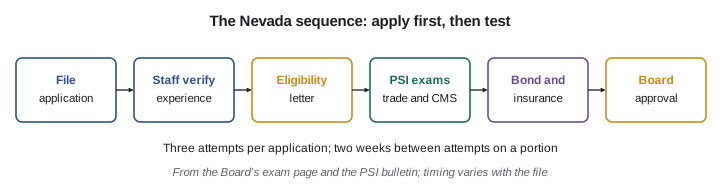
Laid out as steps, the path looks like this. First, gather the application: business information, the qualified individual’s experience documents, fingerprints, the financial statement and supporting forms. Second, file it with the Board and pay the application fee. Third, wait while staff review the experience and character information; they may call references or ask for more documents. Fourth, receive the eligibility letter and book the exams with PSI. Fifth, pass the exams. Sixth, satisfy the remaining conditions, such as the bond and proof of workers’ compensation coverage. Finally, the Board approves the application, usually at one of its regular meetings, and issues the license or updates the record.
The application packet
The Board’s application packet asks for information about the business and about every person connected to it. For the business: its legal name and any trade name, its Nevada Business ID from the Secretary of State, its addresses, its type of entity and its owners and officers. For the license: the classification or classifications requested and the monetary limit requested. For the qualified individual: personal information, the resume of experience, the four certificates of work experience or an alternative, and fingerprints. For finances: the financial statement and bank verification form. For employees: proof of industrial insurance or the affidavit described in Lesson 8.
Each piece has a purpose, and missing pieces cause most delays. Denise built a checklist for Marisol’s change-of-qualifier application, since the business already held its license. The checklist was shorter than a new application but still included Marisol’s experience documents, her fingerprints, her disclosure answers, the forms adding her and later removing Ray as qualifier, and a signature from Ray as the company’s managing member.
# Application checklist tracker (illustrative)
items = {
    "Qualified individual form": True,
    "Resume of experience": True,
    "Four work experience certificates": True,
    "Fingerprints submitted": True,
    "Disclosure questions answered": True,
    "Managing member signature": False,
    "Application fee paid": False,
}
missing = [name for name, done in items.items() if not done]
done = len(items) - len(missing)
print(f"{done} of {len(items)} items complete")
for name in missing:
print("Still needed:", name)5 of 7 items complete Still needed: Managing member signature Still needed: Application fee paid
Board review and the eligibility letter
After filing, Board licensing staff review the file. They check that the experience falls inside the fifteen-year window, that the certificates are complete and consistent, that the classification matches the experience, and that the character information raises no unresolved questions. The financial statement is reviewed to support the monetary limit requested. If something is missing, staff contact the applicant, and the clock runs while the file waits.
When staff accept the qualifications, the Board issues the exam eligibility letter. The letter tells the candidate which exams are required and how to register with PSI. In Marisol’s case, the letter arrived in early March 2026, about four weeks after Denise filed the application, and listed two exams: the C-2 Electrical trade exam and the Contractor Management Survey, the Board’s business and law exam, called the CMS.
Booking with PSI
PSI administers the Board’s exams. Candidates register online or by phone and pay PSI’s exam fee directly. The PSI bulletin lists the fee as 95 dollars for one exam portion and 140 dollars for two portions taken together when the second is the CMS. Registration fees are not refundable or transferable, so pick a date you can keep. The Board’s exam page lists testing in Las Vegas seven days a week, in Reno on most days of the week, and on a limited schedule in Elko, and candidates outside Nevada can test at PSI centers in other states.
Marisol booked the CMS first, for a Saturday in early April at the Las Vegas center, and the C-2 trade exam for a Saturday three weeks later. She reasoned that the open-book business exam would build her confidence with the testing routine before the longer trade exam. Denise put both dates on the company calendar and blocked Marisol’s schedule for the Friday before each one.
| Step | Who acts | Typical result |
|---|---|---|
| File application | Applicant and business | Board opens the file |
| Verify experience | Board staff | References checked; missing items requested |
| Eligibility letter | Board | Candidate may book exams with PSI |
| Exams | Candidate and PSI | Score report at the end of each exam |
| Final conditions | Business | Bond, insurance proof and fees completed |
| Approval | Board | License issued or qualifier added to the record |
Using the waiting time
The weeks between filing and the eligibility letter are study time, not idle time. Marisol used them to set up her references. The C-2 trade exam is open book with the edition of the National Electrical Code that the bulletin names, and the CMS is open book with the Construction Business and Law Manual for Nevada, so she bought the exact editions listed, not the newer code book she used on jobs. She tabbed the articles she looked up most often, practiced finding sections against a timer and worked through the business manual’s chapters on licensing, liens and labor law. Lesson 4 explains the formats, and Lesson 12 the study plan.
The waiting time is also when to prepare the business side. For a new company that means choosing a surety for the bond, getting a quote for workers’ compensation coverage, and opening a business bank account so the bank verification form can be completed. For Andre, it also meant registering his LLC with the Secretary of State and obtaining the state business license before the Board could finish its review, since the Nevada Business ID on the application must match the Secretary of State’s records. Denise’s advice to him, when they met at a supplier’s counter in Sparks, was simple: “Have every piece ready before the Board asks for it.”
Keeping the file current
An application is a snapshot, and life does not stop while it is pending. If the business changes its address, adds an owner or officer, or changes its entity type while the file is open, tell the Board in writing. If the qualified individual changes employers or a disclosure answer changes, such as a new judgment or charge, the Board needs to know. Surprises discovered later look worse than facts disclosed early. After the license is issued, the same habit continues: NAC Chapter 624 requires licensees to report changes of address and personnel to the Board within thirty days, as Lesson 7 explains.
Attempts, retakes and voided applications
Nevada limits attempts. The Board’s exam page states that applicants get three attempts to pass, that failing the third attempt voids the application, and that a new application may be filed after a thirty-day waiting period. The PSI bulletin adds that a candidate who fails an exam portion must wait two weeks before retaking it, and cannot book the new appointment on the same day as the failed exam. A voided application means starting over: new forms, new fees and a new review.
The limit changes how you should think about the first attempt. Treat it as the real exam, not a practice run. Marisol passed the CMS on her first attempt in April. On the C-2 trade exam she fell three questions short of the passing score, waited the two weeks, spent the time on her miss log and passed on her second attempt in mid-May 2026. Lesson 12 shows how she rebuilt her study plan between the two attempts.
Each exam portion produces its own result, and a passed portion generally does not have to be repeated because the other portion was failed. How the Board counts attempts when one portion is passed and another is not is set by the Board’s rules, so check the bulletin and the eligibility letter for your case, and keep a written record of each exam date and result. A simple log in a notebook or spreadsheet is enough: the exam, the date, the score and what you changed before the next attempt.
Approval and the license record
After the exams, the Board confirms the remaining conditions. For a new license, those include the bond in the amount the Board sets and proof of workers’ compensation coverage or the affidavit. For Marisol’s change of qualifier, the bond and insurance were already in place. The Board approved the change at its meeting in June 2026, and the license record on the public search began listing Marisol as the qualified individual for the C-2. Ray stayed on as a second qualifier so the transition would be smooth, with a plan to file to step off at the end of 2026.
A new license works the same way, with more conditions. Andre filed his application in March 2026, received his eligibility letter in April, passed both exams in May, posted his bond and filed proof of insurance in June, and the Board approved his license with a modest monetary limit in July 2026. He could not bid or advertise as a contractor until the license was issued, so he spent the waiting months lining up suppliers and a bookkeeper.
Worked problem
Planning the timeline
Andre wants his license approved in time to bid a remodel season that starts in late summer. Board review usually takes several weeks, exams take a few more, and the Board approves licenses at regular meetings. How should he plan?
Show solution
- File the complete application as early as possible, because the clock starts only when the file is complete.
- Book both exams promptly after the eligibility letter arrives, leaving room for a two-week retake if needed.
- Have the bond and insurance ready to file as soon as he passes, so the final conditions do not delay approval.
- Check the Board’s meeting schedule and count back from the date he needs the license.
Answer: Work backward from the date he needs the license, file a complete packet early, and keep the bond and insurance ready.
Marisol’s own timeline ran from early February to June 2026, about four months from filing to approval, with one failed attempt along the way. Andre’s ran from March to July. Neither timeline is a promise, since the Board’s workload and the completeness of each file vary, but four to five months is a reasonable planning figure for a well-prepared applicant.
Common application mistakes
The most common mistake is filing an incomplete packet. A missing signature, a certificate without dates or an unanswered disclosure question can add weeks. The second is booking exams before the eligibility letter arrives, which PSI will not allow. The third is treating the first attempt casually, which wastes one of the three attempts. The fourth is letting the business conditions lag behind: a candidate who passes both exams but has no bond ready still has no license.
Common mistakes
MistakeTrying to book the exams before filing the application.
InsteadFile first; the eligibility letter comes after staff verify experience.
MistakeTreating the first attempt as practice.
InsteadApplicants get three attempts before the application is voided.
MistakeRetaking the day after failing.
InsteadPSI requires a two-week wait before retaking a portion.
MistakeLeaving the bond and insurance for later.
InsteadHave them ready so approval is not delayed after the exams.
Summary and key terms
- In Nevada the application is filed first; staff verify experience before the exams.
- The Board issues an exam eligibility letter that lets the candidate book with PSI.
- PSI lists 95 dollars for one exam portion and 140 dollars for two when the second is the CMS.
- Applicants get three attempts; a third failure voids the application, with a thirty-day wait to reapply.
- A failed portion can be retaken after two weeks.
- The Board approves licenses and qualifier changes after the exams and final conditions are complete.
- Exam eligibility letter
- The Board’s letter authorizing a candidate to book the required exams with PSI.
- CMS
- The Contractor Management Survey, the Board’s business and law exam.
- Change of qualifier
- An application to add or replace the qualified individual on an existing license.
- Voided application
- An application canceled after a third failed exam attempt.
Practice problems
Work each problem on paper first, then reveal the answer to check.
Marisol tries to book the C-2 exam before filing. What happens?
Show answer
PSI will not book it; she needs the Board’s eligibility letter first.
How many attempts does an applicant get before the application is voided?
Show answer
Three.
What must a business have in place, besides passed exams, before a new license is issued?
Show answer
The bond set by the Board and proof of workers’ compensation coverage or the affidavit, along with any other conditions.
Lesson quiz · 5 questions
Score 60% or more to complete this lesson.
Create a free account to save your progress, take quizzes and earn a certificate.