
MELU-303 · Lesson 7 of 12 · 18 min
Duties of the qualified individual on a contractor license
▶ Video coming soon A video version of this lesson is on the way.
The Board approved Marisol as Mojave Current’s qualified individual at its June 2026 meeting. The next Monday, Ray put a framed copy of the license record on her office wall, and then handed her a folder. Inside were the company’s bond, its insurance certificates, its monetary limit letter, the card roster, the permit tracking sheet and a list of every open complaint and warranty call. “You passed the exams,” he said. “Now this is yours.” This lesson covers what the qualified individual is responsible for under Nevada law and practice: supervision, scope and limits, permits and codes, advertising and bids, reporting changes, payment, records and complaints.
Bona fide and actively engaged
The foundation of the role is in NRS 624.260: the qualified individual must be a bona fide owner, officer, member, manager or employee of the business and actively engaged in its contracting work. For a qualified employee like Marisol, that means real employment, on the payroll, working for the company, with the authority to direct its electrical work. It is not enough to be available by phone. The Board can ask for payroll records, organizational charts and descriptions of duties, and it can discipline both the licensee and the qualifier when the relationship turns out to be a sham.
Being actively engaged also means having the authority to say no. A qualified individual who cannot stop a crew from covering uninspected work, or cannot refuse a job outside the license’s scope, is not really qualifying the license. Ray made this explicit in Marisol’s new job description: she has final authority over electrical methods, permits, inspections and safety, and she reports directly to him as owner.
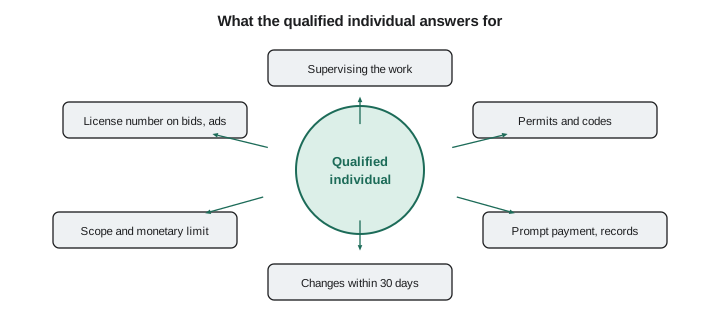
Supervising the work
The qualified individual answers to the Board for the quality and legality of the electrical work done under the license. In a small company, that means direct supervision of most jobs. In a company Mojave Current’s size, with crews in two cities, it means systems: foremen with the right cards and experience on every job, written procedures for permits and inspections, regular job visits, review of correction notices and a clear chain of authority. Marisol visits every active commercial job at least once a week in Las Vegas and talks with Hank about the Sparks jobs every morning. She visits Sparks twice a month.
Supervision also covers apprentices. Clark County and Reno require apprentices to be enrolled in approved programs and to work under carded electricians, and the company’s apprenticeship agreements set ratios and duties. Jordan Pike works only on crews with a carded journeyman, and his foreman signs his on-the-job training log every week.
Scope and the monetary limit
A licensee may contract only for work inside its classification and up to its monetary limit. NAC 624.640 makes the point directly: a bid or contract for work outside the scope of the license, or over the monetary limit placed on the license, breaks the Board’s rules, and the regulation treats such a bid or contract as void. For an electrical contractor the scope question usually arises at the edges of the trade. Mojave Current’s C-2 covers electrical work, but a job that adds significant work in another trade, such as structural framing or plumbing, needs a properly licensed subcontractor for that work. The monetary limit question arises on large or phased jobs, where the values on one site for one client add together.
Before every bid over a few hundred thousand dollars, Marisol checks the running total for that client and site against the company’s limit. When Mojave Current was invited to bid all three phases of a North Las Vegas distribution campus, the total came to more than the illustrative 1.5 million dollar limit, so the company asked the Board for an increase with a new reviewed financial statement before bidding. Lesson 8 covers how limits are set and raised.
# Running total against the monetary limit for one client on one site
limit = 1_500_000  # illustrative
contracts = [("Phase 1 shell", 620_000), ("Phase 2 offices", 410_000)]
proposed = ("Phase 3 dock equipment", 530_000)

current = sum(v for _, v in contracts)
total = current + proposed[1]
print(f"Signed on this site: {current:,} dollars")
print(f"With {proposed[0]}: {total:,} dollars against a limit of {limit:,}")
print("OK to bid" if total <= limit else "Request a higher limit before bidding")Signed on this site: 1,030,000 dollars With Phase 3 dock equipment: 1,560,000 dollars against a limit of 1,500,000 Request a higher limit before bidding
Permits, codes and inspections
The qualified individual sees that required permits are obtained, work meets the adopted code, and inspections are passed before work is covered or energized. NRS Chapter 624 lists willful or deliberate disregard of building codes and failure to obtain required permits among the grounds for discipline. In practice, Marisol signs off on every permit application the office files, reviews correction notices weekly and keeps a list of any jurisdiction-specific amendment that has caused a failed inspection, as Lesson 5 describes.
License number and limit on bids, contracts and ads
Nevada requires a licensee to identify itself. NAC 624.640 requires the license number, and any monetary limit, to appear on bids and contracts for construction work. NRS Chapter 624 also requires the license number in advertising, and it treats advertising without it, or advertising work outside the license, as a violation. The Board can cite unlicensed people for advertising contracting services. For Mojave Current, the license number appears on the vans, the website, the proposal template, the contract template and every printed estimate. Marisol checked them all in her first week and found an old business card without the number, which she had reprinted.
The same regulation requires a licensee to confirm that subcontractors who bid to it are appropriately licensed, and to show proof of its own license on request. Denise checks every subcontractor’s license, classification and limit on the Board’s search before the company signs a subcontract, and saves a screenshot in the job file.
Reporting changes
A license record has to stay accurate. NAC 624.640 requires licensees to report changes of address and of personnel to the Board within thirty days. Changes of owners, officers, the business name, the entity type and the qualified individual all need Board action, and some, such as a change of entity type, may require a new license. If the qualified individual leaves, the business must notify the Board and replace the qualifier within the time the Board allows, or the license can be suspended. Mojave Current planned for this risk by keeping Ray on as a second qualifier through the end of 2026.
| Event | What the licensee does (summary) |
|---|---|
| Address change | Report to the Board within thirty days |
| New officer, member or manager | Report to the Board within thirty days; the Board may review the person |
| Qualified individual leaves | Notify the Board promptly and add a qualified replacement within the time allowed |
| Business name or entity change | Ask the Board; an entity change may require a new license |
| Bond cancellation notice | Replace the bond before the cancellation takes effect |
| Workers’ compensation lapse | Restore coverage; a lapse is grounds for discipline |
Paying subcontractors, suppliers and workers
Nevada’s prompt payment statutes in NRS Chapter 624 set deadlines for owners to pay prime contractors and for higher-tier contractors to pay lower-tier subcontractors, as Lesson 9 explains. Failing to pay money due to subcontractors, suppliers or employees, when the contractor has received payment for the work, is grounds for discipline, and unpaid workers and suppliers are the source of many Board complaints. The qualified individual does not always control the company’s checkbook, but he or she shares responsibility when the license is disciplined. Marisol and Ray agreed that she would see the accounts payable aging report every week, so she would know if any supplier on her jobs was going unpaid.
Lending a license
One of the most serious violations in Nevada contracting is letting someone else use a license. A licensee that pulls permits for an unlicensed person’s work, signs a contract and hands the job to an unlicensed crew, or allows another business to bid under its number is aiding unlicensed contracting. NRS Chapter 624 treats that as grounds for discipline, and the Board pursues it. The temptation usually arrives as a favor. A former employee who never got a license asks the company to pull a permit for a side job he will do himself, or a general contractor asks the electrical contractor to sign for work its own crews will install. Marisol’s rule is simple: if Mojave Current’s name is on the permit, Mojave Current’s carded electricians do the work and Mojave Current answers for it.
Safety leadership
The qualified individual is often the most senior electrical person in the company, and safety follows from that role. Nevada OSHA enforces workplace safety, and Lesson 10 covers the rules, but the qualified individual sets the tone: lockout procedures that are actually used, energized work only with a justified permit and the right protective equipment, and foremen who stop work when conditions change. Clark County’s card renewals include hours on electrical safety for the same reason. Marisol made safety the first item at every foremen’s meeting, ahead of schedule and cost.
Records worth keeping
Good records make the qualified individual’s job possible. Marisol keeps, for every job, the contract and change orders, the permit file, the inspection results, the daily reports, the card roster for the crew, and lien notices sent and received. For the company, she keeps the license record, the monetary limit letter, the bond and its renewal dates, insurance certificates, the safety program and training records, and the complaint file. Most of these are kept for years after a job ends, because warranty claims, lien disputes and Board complaints can arrive long after the crew has moved on. NRS Chapter 624 also lets the Board ask for records during an investigation, and records that cannot be produced do not help.
Complaints and discipline
Owners, other contractors, suppliers and the public can file complaints with the Board. The Board investigates and can require corrective work, impose fines, require additional training, place conditions on the license, increase the bond, suspend or revoke the license, and in some cases name the qualified individual personally in the action. Common complaint grounds include poor workmanship, abandonment of a job, failure to pay, contracting beyond the license, unpermitted work and misleading advertising. A complaint is not a finding; the licensee responds, and the Board decides. A licensee who ignores a complaint makes a bad outcome much more likely.
Marisol’s first complaint arrived in August 2026, from a Henderson homeowner who said a new subpanel had been installed in the wrong place. The file showed the location was approved on the plans and inspected, and the homeowner had changed her mind after the work was done. Marisol answered in writing within the deadline, attached the approved plan and the inspection record, and offered to move the panel at cost. The Board closed the complaint.
Worked problem
Responding to a qualified individual’s departure
Suppose Marisol had to leave Mojave Current suddenly in 2027, after Ray had stepped off as a qualifier. What should the company do?
Show solution
- Notify the Board promptly that the qualified individual has left.
- Identify a replacement with the required experience, file the change of qualifier application and schedule exams if needed.
- Keep working only within the Board’s rules for a license without a qualifier, which generally means a short grace period at most.
- Consider keeping a second qualified individual in future to avoid this risk.
Answer: Report the departure promptly, file a replacement quickly, and plan for a second qualifier.
Common mistakes
MistakeQualifying a license on paper while working elsewhere.
InsteadThe qualified individual must be bona fide and actively engaged in the business.
MistakeBidding the next phase without totaling the site.
InsteadContracts for one client on one site count together against the monetary limit.
MistakeLeaving the license number off proposals and ads.
InsteadBids, contracts and advertising must show the license number, and bids and contracts any monetary limit.
MistakeTelling the Board about an address change months later.
InsteadReport address and personnel changes within thirty days.
Summary and key terms
- The qualified individual must be a bona fide, actively engaged part of the business.
- The qualified individual answers for supervision, code compliance, permits and inspections.
- Bids and contracts outside the scope or over the monetary limit break the Board’s rules.
- The license number, and any limit, belong on bids and contracts, and the license number in advertising.
- Address and personnel changes go to the Board within thirty days.
- Unpaid subcontractors, suppliers and workers are a ground for discipline and a common complaint.
- Actively engaged
- Working in the business with real authority over its contracting work.
- Scope
- The work a classification or subclassification allows.
- Complaint
- A report to the Board alleging a licensee violated the law or did poor work.
- Discipline
- Board action against a license, from fines and conditions to suspension or revocation.
Practice problems
Work each problem on paper first, then reveal the answer to check.
Which Board regulation requires the license number and monetary limit on bids and contracts?
Show answer
NAC 624.640.
Within how many days must an address change be reported?
Show answer
Thirty days.
Why did Mojave Current keep Ray on as a second qualifier for a while?
Show answer
To protect the license during the transition if anything happened with the new qualifier.
Lesson quiz · 5 questions
Score 60% or more to complete this lesson.
Create a free account to save your progress, take quizzes and earn a certificate.