
MELU-303 · Lesson 4 of 12 · 20 min
The exam format and the references allowed
▶ Video coming soon A video version of this lesson is on the way.
The eligibility letter told Marisol which exams she had to pass. The PSI candidate information bulletin for the Nevada C classifications told her what each one looked like: how many questions, how much time, what score passes and which books she could bring. She printed the bulletin, highlighted the C-2 page and the CMS page, and taped them inside the cover of her study binder. Everything in this lesson comes from those two pages and the Board’s exam page, summarized as of late 2026. PSI updates the bulletin, so read the current one before you book.
Two exams
Every C-2 qualified individual takes two exams unless one is waived. The first is the trade exam for the classification, here the C-2 Electrical Contractor exam. The second is the Contractor Management Survey, or CMS, the Board’s general business and law exam, taken by qualifiers in every classification. Both are computer-based, given at PSI test centers, and scored at the end of the session, so the candidate leaves with a score report.
| Feature | C-2 Electrical trade exam | CMS business and law exam |
|---|---|---|
| Scored questions | 80 | 60 (plus 3 unscored) |
| Time allowed | 4 hours | 120 minutes (plus 6 for the unscored items) |
| Minimum passing score | 56 correct | 45 correct |
| Book | Open book with the listed code references | Open book with the Nevada business and law manual |
| Calculator | Silent, non-programmable | Silent, nonprinting, non-programmable |
The passing scores work out to the same idea expressed differently. On the trade exam, 56 of 80 is seven correct answers out of every ten. On the CMS, 45 of 60 is three out of every four, a higher bar. Candidates who are strong on code but weak on business sometimes pass the trade exam and miss the CMS, which is why Marisol took the CMS seriously even though it is open book.
Score reports state the result and, for a failing candidate, generally show performance by content area. That diagnostic is valuable: it tells a candidate who missed by a few questions where to spend the two weeks before a retake.
The C-2 trade exam
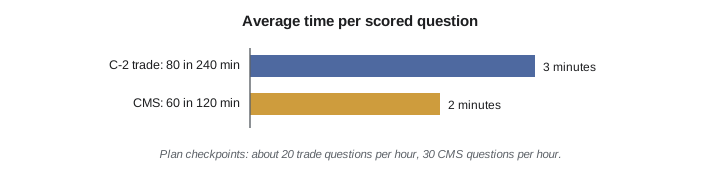
The C-2 trade exam has 80 scored questions in four hours, which allows three minutes per question. The bulletin’s content outline lists fifteen areas and the number of questions in each. The largest blocks are conductors and cables, grounding and bonding, services, feeders and branch circuits, raceways and boxes, and safety information. Smaller blocks cover general electrical knowledge, electrical power, motors, lighting, transmission lines, overcurrent protection, special occupancies and equipment, and, at two questions each, low voltage, illuminated signs and fire detection and alarm systems.
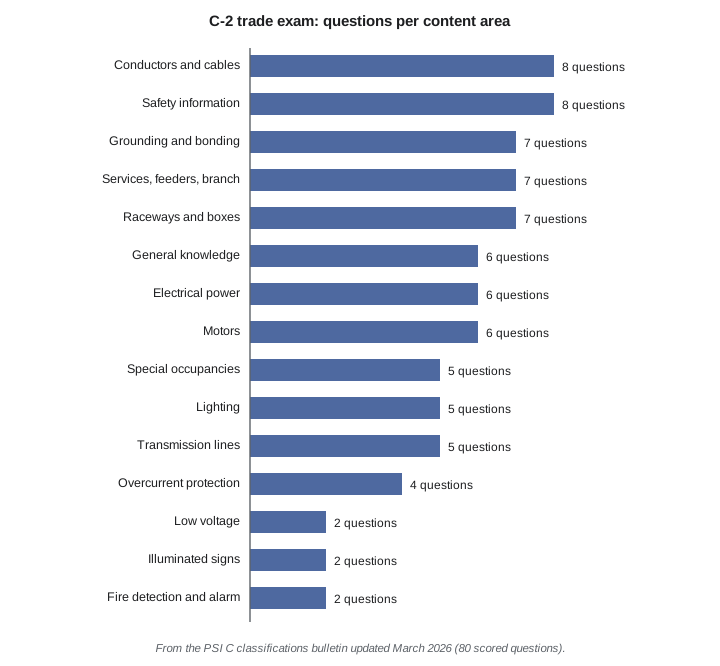
The outline is a study map. Areas with seven or eight questions deserve the most practice, but the small areas add up: low voltage, signs and fire alarm together are six questions, more than enough to decide a close result. The presence of transmission lines and safety information also tells you the exam covers more than building wiring. Expect questions on overhead line work, clearances and safe work practices.
The references for the trade exam
The trade exam is open book, but only with the references the bulletin lists. For the C-2, the bulletin lists the 2017 edition of the National Electrical Code, or the 2017 NEC Handbook, and NFPA 72, the National Fire Alarm Code, in its 2010 or 2013 edition or the matching handbook. The bulletin also lists several popular references as not allowed in the exam room, even though they appear in its reading list for study. Read that list carefully before you pack your bag.
The edition matters. Many Nevada jurisdictions enforce the 2023 NEC on jobs, as Lesson 5 explains, but the trade exam is written to the 2017 edition. Marisol bought a 2017 code book for the exam and kept her 2023 book for work. On the exam, answer by the 2017 text; on the job, follow the edition the jurisdiction adopted. Mixing them up costs points on the exam and causes failed inspections in the field.
The CMS business and law exam
The CMS has 60 scored questions in 120 minutes, two minutes each, plus three unscored items with six minutes added for them. The minimum passing score is 45. It is open book with the Construction Business and Law Manual for Nevada, published for PSI, and a silent, nonprinting, non-programmable calculator. The content outline groups the questions into ten areas: licensing, estimating and bidding, lien law, financial management, tax laws, labor laws, project management, contracts, risk management, and environmental and safety topics. Financial management and licensing are the largest areas.
The CMS rewards fast lookup more than memory. Every question can be answered from the manual, but two minutes per question leaves no time to read a chapter. Learn the manual’s layout: where the Nevada licensing rules sit, where the lien deadlines are, where the payroll tax and labor law tables are, and how the financial ratios chapter is organized. Marisol made a one-page index of the manual on the inside cover and practiced finding answers in under a minute.
What the trade questions look like
Trade exam questions fall into three broad styles. Lookup questions ask for a requirement that is in the code book: a minimum, a maximum, a permitted method or a prohibited one. Calculation questions ask you to apply the code or basic electrical theory to numbers: a load, a conductor size, a voltage drop, a box or raceway fill, a motor circuit. Judgment questions describe a situation and ask which choice complies or which hazard comes first. Most candidates are strongest on one style and weakest on another, and the practice exams in Lesson 12 are meant to find out which.
Calculation questions reward a steady routine. Write down what is given, identify the code rule or formula, compute, and check that the answer has the right units and a sensible size. The theory side is the same everywhere. A 240-volt circuit carrying 30 amperes delivers 7,200 volt-amperes, and a resistive load of 4,800 watts on 240 volts draws 20 amperes. The code side requires looking up the right article in the right edition.
Worked problem
A theory calculation in the exam style
An illustrative question: a single-phase, 240-volt water heater is rated 5,500 watts. What current does it draw, to the nearest tenth of an ampere?
Show solution
- For a resistive single-phase load, current equals power divided by voltage.
- 5,500 watts divided by 240 volts is about 22.92 amperes.
- Rounded to the nearest tenth, that is 22.9 amperes.
- Sizing the branch circuit is a separate step that needs the code rules for water heaters in the edition the exam uses.
Answer: About 22.9 amperes.
What the CMS areas cover
The CMS areas map onto the business side of running a Nevada contracting company. Licensing questions draw on NRS and NAC Chapter 624: classifications, monetary limits, qualified individuals, renewals, discipline and the rules for advertising and bidding. Lien law questions draw on the Nevada mechanics’ lien statute covered in Lesson 9. Financial management covers financial statements, ratios, cash flow, job costing and depreciation. Tax and labor law cover payroll taxes, withholding, wage and hour rules and employee records. Contracts, project management and risk management cover contract terms, scheduling, change orders, insurance and bonds. Environmental and safety topics cover workplace safety law and waste handling.
Because every answer is in the manual, the CMS is really a test of organization. Candidates who fail it usually knew the material but could not find it fast enough. The cure is timed practice with the manual itself, not more reading. Marisol drilled with sets of ten business questions at a time, two minutes each, and logged every question she could not find within a minute along with the page where the answer turned out to be.
Unscored items
PSI includes experimental questions that do not count toward the score. The bulletins describe one to ten unscored items on an exam, which PSI uses to test new questions. They look exactly like scored questions, and you cannot tell which is which, so answer every question as if it counts. On the CMS the bulletin lists three unscored items with six minutes of extra time; on other exams the unscored items count against the exam time, which is one more reason to keep a steady pace.
Pacing the trade exam
Three minutes per question sounds generous until a lookup goes wrong. A plan helps. Marisol used three passes. On the first pass she answered every question she could answer from knowledge, in well under a minute each, and flagged the rest. On the second pass she did the flagged lookups, keeping each to three or four minutes. On the third pass she returned to the hardest questions and checked any calculation she had rushed. She also set checkpoints: 20 questions answered or flagged by the end of the first hour, 40 by the end of the second.
# Pacing checkpoints for a timed exam (study aid)
def checkpoints(questions, minutes, marks=4):
    per_q = minutes / questions
    print(f"{questions} questions in {minutes} minutes: {per_q:.1f} minutes each")
    for k in range(1, marks + 1):
        q = questions * k // marks
        print(f"  by minute {minutes * k // marks}: about question {q}")

checkpoints(80, 240)   # C-2 trade exam
checkpoints(60, 120) # CMS80 questions in 240 minutes: 3.0 minutes each by minute 60: about question 20 by minute 120: about question 40 by minute 180: about question 60 by minute 240: about question 80 60 questions in 120 minutes: 2.0 minutes each by minute 30: about question 15 by minute 60: about question 30 by minute 90: about question 45 by minute 120: about question 60
The checkpoints are not a rule, just an early alarm. If Marisol reached the end of the second hour with only 30 questions done, she knew to stop chasing a hard lookup and move on. Guessing is better than leaving an answer blank: the bulletin scores only correct answers, so a blank is always wrong.
Marisol also practiced with the calculator she would bring, so that its keys and memory functions were second nature by exam day.
Waivers and endorsement
The Board’s exam page notes that the trade exam may be waived for some applicants qualifying by endorsement, depending on circumstances, using the Board’s equivalency chart for other states. A waiver of the trade exam does not waive the CMS unless the Board says so. A qualified employee who served on a license in the same classification within the last four years generally does not need to retake the exam, though the Board may require it. Andre had no out-of-state license and took both exams.
Worked problem
Reading the bulletin
Andre wants to bring a popular pocket reference and his 2023 code book to the trade exam, along with a programmable calculator. What should he bring instead?
Show solution
- The bulletin lists the 2017 NEC or its handbook as allowed, so the 2023 book is the wrong edition.
- The pocket reference appears on the bulletin’s list of books not allowed in the exam room.
- The calculator must be silent and non-programmable.
- NFPA 72 in an allowed edition may also come, for the fire alarm questions.
Answer: Bring the 2017 NEC or handbook, an allowed edition of NFPA 72 if he wants it, and a silent, non-programmable calculator.
Common mistakes
MistakeBringing the 2023 NEC to the trade exam.
InsteadThe bulletin lists the 2017 edition; check the current bulletin before buying books.
MistakeSkipping the small content areas.
InsteadLow voltage, signs and fire alarm are six questions together; they can decide a close result.
MistakeExpecting the CMS to be easy because it is open book.
InsteadIt needs 45 of 60 in two minutes per question; practice fast lookups.
MistakeLeaving questions blank.
InsteadOnly correct answers count, so answer every question.
Summary and key terms
- The C-2 trade exam has 80 scored questions in four hours and needs 56 correct to pass.
- The CMS has 60 scored questions in 120 minutes plus three unscored items and needs 45 correct.
- The trade exam allows the 2017 NEC or handbook and NFPA 72 in a listed edition.
- The CMS allows the Construction Business and Law Manual for Nevada and a silent calculator.
- Unscored experimental items appear and cannot be identified.
- Plan the pace: about three minutes per question on the trade exam and two on the CMS.
- Content outline
- The bulletin’s list of exam areas and the number of questions in each.
- Open book
- An exam that allows specified references in the room.
- Unscored item
- An experimental question that does not count toward the score.
- Equivalency chart
- The Board’s chart for deciding when another state’s exam can waive the Nevada trade exam.
Practice problems
Work each problem on paper first, then reveal the answer to check.
How many questions must Marisol answer correctly to pass the C-2 trade exam?
Show answer
At least 56 of the 80 scored questions.
Which edition of the NEC does the bulletin list for the trade exam?
Show answer
The 2017 edition, or the 2017 NEC Handbook.
What is the time per question on the CMS?
Show answer
About two minutes: 60 scored questions in 120 minutes.
Lesson quiz · 5 questions
Score 60% or more to complete this lesson.
Create a free account to save your progress, take quizzes and earn a certificate.