
MELU-303 · Lesson 10 of 12 · 18 min
Workplace safety law and OSHA for electrical contractors
▶ Video coming soon A video version of this lesson is on the way.
Jordan Pike’s second month as an apprentice nearly ended badly. On a hot July afternoon in 2026 at a North Las Vegas warehouse, a foreman from another trade asked him to help move a cord set that ran through standing water near a loading dock. Jordan stopped, called his foreman, and the cord turned out to have a damaged jacket and no working ground-fault protection. Nobody was hurt. At the next safety meeting, Marisol used the story to open a discussion of Nevada’s workplace safety law, and this lesson follows the same outline: who enforces safety in Nevada, the mandatory 10-hour and 30-hour training cards, electrical hazards, heat, recordkeeping and reporting, and workers’ compensation.
Nevada OSHA
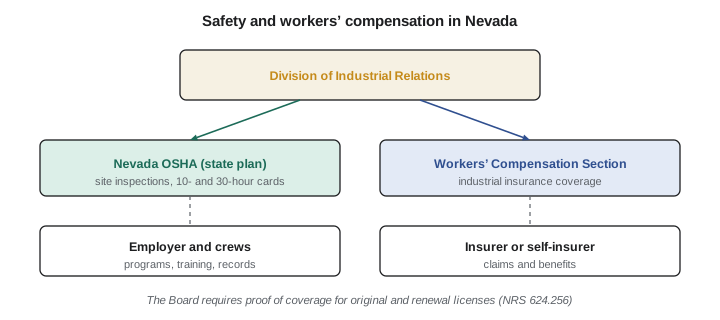
Nevada runs its own occupational safety and health program under a state plan approved by federal OSHA. The program, called Nevada OSHA, is part of the Division of Industrial Relations within the Department of Business and Industry, and its authority comes from NRS Chapter 618. Nevada OSHA covers most private employers and state and local government employers in the state. Its standards must be at least as effective as the federal ones, and for construction it generally follows the federal construction standards in 29 CFR Part 1926, with additional Nevada requirements. A separate Safety Consultation and Training Section offers free consultation visits and training that do not result in citations.
For an electrical contractor, Nevada OSHA is the agency that inspects job sites, investigates accidents and complaints, issues citations and penalties, and enforces the training card law. Its inspectors look at the same hazards federal OSHA would, with particular attention to the hazards that injure electricians: contact with energized parts, arc flash, falls from ladders and lifts, trench collapse, and heat illness.
The 10-hour and 30-hour cards
Nevada goes further than federal law on training. NRS 618.983 requires construction workers to obtain a completion card for a 10-hour construction safety course, commonly called OSHA-10, and supervisory employees to obtain a card for a 30-hour course, commonly called OSHA-30. The card must be obtained no later than 15 days after the date of hire. The courses must be approved under the statute, and employers are responsible for making sure their workers have the cards. Nevada OSHA can cite employers whose workers lack them.
For Mojave Current, the card law shapes hiring. Every new electrician and apprentice gets the 10-hour course in the first two weeks, and every foreman holds a 30-hour card. Denise tracks the cards on the same roster as the electrician cards. When a foreman is promoted from journeyman, the 30-hour card comes before the first day running a crew. Jordan had his 10-hour card from his apprenticeship program’s orientation; his foreman, Luis Serrano, completed the 30-hour course when he was promoted in 2024.
# Training card deadlines for new hires (study aid; NRS 618.983 sets 15 days)
from datetime import date, timedelta
hires = [("Jordan Pike", "worker", date(2026, 5, 4)),
         ("Rosa Ibarra", "supervisor", date(2026, 9, 14))]
for name, role, hired in hires:
    course = "30-hour" if role == "supervisor" else "10-hour"
    due = hired + timedelta(days=15)
print(f"{name}: {course} card due by {due}")Jordan Pike: 10-hour card due by 2026-05-19 Rosa Ibarra: 30-hour card due by 2026-09-29
Electrical hazards
The federal construction standards that Nevada OSHA enforces include an electrical subpart covering wiring design and protection, ground-fault protection for temporary power, equipment installation and safety-related work practices, along with lockout and tagout requirements. Contractors also use NFPA 70E, the consensus standard for electrical safety in the workplace, to set their practices for energized work, approach boundaries, arc flash risk assessment and personal protective equipment. NFPA 70E is not itself a regulation, but inspectors and courts look to it as evidence of what a reasonable employer does, and Clark County’s electrician card renewals include hours on it.
Mojave Current’s rules follow a simple order. De-energize and lock out whenever possible, verify the absence of voltage with a tested meter, and treat the equipment as energized until it is verified. When energized work cannot be avoided, it requires a written justification, an energized work permit signed by Marisol or a designated supervisor, a risk assessment and the protective equipment the assessment calls for. Temporary power on job sites uses ground-fault protection for personnel, and cords are inspected every day. The cord Jordan found would have failed that inspection in seconds.
Heat and other hazards
In southern Nevada, heat is a hazard on most summer days. Electricians work in attics, on roofs and inside unconditioned buildings where temperatures far exceed the outside air. Nevada OSHA’s heat illness regulation, approved in late 2024, requires employers to address heat illness, through a written job hazard analysis and measures such as water, rest, shade and training, and Nevada OSHA enforces it alongside the general duty to protect workers from recognized hazards. Check the current regulation for the specific requirements. Mojave Current starts summer crews early, sets mandatory water and shade breaks, and pairs new workers with experienced ones during their first heat waves so someone is watching for symptoms.
Other hazards on electrical jobs include falls from ladders, scaffolds and aerial lifts, which require fall protection and training; trenches for underground conduit, which require protective systems at the depths the standard sets; and struck-by and caught-between hazards around heavy equipment. Hank’s crews in Sparks add winter hazards: ice on roofs and lifts, and short daylight on long industrial jobs.
The company safety program
A written safety program turns the rules into daily practice. Nevada’s construction safety requirements and federal standards call for written programs in several areas, and most general contractors require a subcontractor’s program before work starts. Mojave Current’s program includes hazard communication, lockout and tagout, energized work, ladders and fall protection, heat illness, excavation, emergency response and injury reporting. Each foreman holds a short tailgate meeting at the start of each week on a topic tied to the work in front of the crew, and each meeting is signed and filed. New hires get a site-specific orientation on their first day, separate from the 10-hour course.
The program is also a business document. General contractors and owners ask for it during prequalification, along with the incident rate and the experience modification rate from the workers’ compensation insurer. A strong program and a low rate win work; a weak one can disqualify a company before its price is considered.
When Nevada OSHA visits
Nevada OSHA inspections usually begin after a complaint, a referral, a reported injury or as part of a targeted program for high-hazard industries such as construction. The inspector presents credentials and holds an opening conference, walks the site with representatives of the employer and the employees, reviews records such as the injury log, training cards and written programs, and holds a closing conference. Citations, if any, follow in writing with proposed penalties and an abatement date. The employer can request an informal conference and can contest citations within the deadline stated on them. Marisol’s instruction to foremen is to be courteous, call her immediately, accompany the inspector, take the same photographs the inspector takes and fix obvious hazards on the spot.
Recordkeeping and reporting
Employers covered by the recordkeeping rule keep a log of work-related injuries and illnesses that meet the recording criteria, an incident report for each case, and an annual summary that is posted for employees. Construction contractors above the small-employer size threshold are generally covered. Employers must also report serious events to Nevada OSHA within short deadlines: a fatality within hours, and an in-patient hospitalization, amputation or loss of an eye within a slightly longer period. Check the current reporting rules for the exact times and methods.
The log feeds the incident rate that customers ask about in prequalification. The total recordable incident rate is the number of recordable cases multiplied by 200,000 and divided by the total hours worked by all employees in the year. The 200,000 represents 100 full-time workers working 40 hours a week for 50 weeks, so the rate expresses cases per 100 full-time workers.
# Total recordable incident rate (TRIR) = cases x 200,000 / hours worked
def trir(cases, hours):
    return cases * 200_000 / hours

print("Mojave Current 2025 (illustrative):", round(trir(2, 62_000), 2))
print("Smaller company (illustrative): ", round(trir(1, 18_000), 2))Mojave Current 2025 (illustrative): 6.45 Smaller company (illustrative): 11.11
The comparison shows why small companies worry about a single injury. One recordable case at a company with 18,000 hours gives a higher rate than two cases at a company with 62,000 hours, and a general contractor screening subcontractors by rate may see the smaller company as riskier.
Hank uses the incident rate differently in the Sparks branch. He tracks near misses as well as recordable cases, because a near miss is a free lesson: nobody was hurt, but the same conditions could hurt someone next time. The cord Jordan found in Las Vegas went into the company’s near-miss log, and the following week both branches inspected every cord set and portable ground-fault device they owned. Two more damaged cords came out of service, and the foremen added a quick cord check to every morning tailgate meeting. A rate is a lagging measure that reports harm already done; near-miss reports and daily inspections are the leading measures that prevent it.
Workers’ compensation in Nevada
Nevada’s industrial insurance law, in NRS Chapters 616A through 617, requires employers with employees to provide workers’ compensation coverage for work-related injuries and occupational diseases. Employers obtain coverage from a private insurance carrier, by qualifying as a self-insured employer, or by joining an association of self-insured employers. The Workers’ Compensation Section of the Division of Industrial Relations regulates the system and enforces coverage. In return for no-fault benefits, covered employees generally cannot sue their employer for a work injury, which is the trade-off at the heart of every workers’ compensation system.
The Board ties the license to this coverage. As Lesson 8 explained, NRS 624.256 requires proof of coverage, or the narrow no-employee affidavit, before an original or renewal license, and a lapse is grounds for discipline. An employer that fails to carry required coverage also faces penalties from the Division and can be liable for the full cost of an injured worker’s claim. Employees must report injuries promptly, and employers must report claims to their insurer within the deadlines the law sets. Mojave Current posts the required workers’ compensation notices in both offices and trains foremen on what to do in the first hour after an injury.
| Topic | Nevada rule (summary) | Source |
|---|---|---|
| Safety enforcement | Nevada OSHA, a state plan in the Division of Industrial Relations | NRS Chapter 618 |
| Training cards | 10-hour for workers, 30-hour for supervisors, within 15 days of hire | NRS 618.983 |
| Electrical work practices | Construction electrical standards and lockout rules; NFPA 70E as the consensus standard | 29 CFR 1926 as enforced |
| Incident rate | Cases x 200,000 / hours worked | Recordkeeping rule |
| Workers’ compensation | Required for employers with employees | NRS Chapters 616A to 617 |
| License link | Proof of coverage for original and renewal licenses | NRS 624.256 |
Worked problem
Training a new supervisor
Mojave Current promotes Rosa Ibarra, a journeyman in the Sparks branch, to foreman, effective September 14, 2026. What must happen, and by when?
Show solution
- As a supervisory employee, she needs a 30-hour completion card under NRS 618.983.
- The card is due no later than 15 days after the date she starts as a supervisor, by September 29.
- Her electrician card must stay current, and her crew members need their own 10-hour cards.
- Marisol should also confirm Rosa is trained on the company’s energized work and heat procedures before she runs a crew.
Answer: Rosa needs a 30-hour card by September 29, 2026, along with company training for her new role.
Common mistakes
MistakeAssuming federal OSHA inspects Nevada job sites.
InsteadNevada OSHA, a state plan, enforces workplace safety for most employers.
MistakeGiving a new hire the 10-hour course after the first month.
InsteadNRS 618.983 requires the card within 15 days of hire.
MistakeTreating NFPA 70E as optional advice.
InsteadIt is the consensus standard inspectors look to for electrical safe work practices.
MistakeLetting workers’ compensation lapse between policies.
InsteadA lapse exposes the company to claims and is grounds for license discipline.
Summary and key terms
- Nevada OSHA, a federally approved state plan, enforces workplace safety under NRS Chapter 618.
- Construction workers need a 10-hour card and supervisors a 30-hour card within 15 days of hire.
- Electrical safety rests on the construction standards, lockout and NFPA 70E practices.
- Heat illness is a major hazard in southern Nevada and is addressed by state regulation.
- The incident rate is recordable cases times 200,000 divided by hours worked.
- Employers with employees must carry workers’ compensation, and the Board requires proof of it.
- State plan
- A state safety program approved by federal OSHA, such as Nevada OSHA.
- OSHA-10 card
- The completion card for the 10-hour construction safety course required of workers.
- Energized work permit
- A written authorization for justified work on or near energized parts.
- Industrial insurance
- Nevada’s statutory term for workers’ compensation coverage.
Practice problems
Work each problem on paper first, then reveal the answer to check.
Which agency enforces workplace safety for most Nevada private employers?
Show answer
Nevada OSHA, within the Division of Industrial Relations.
A company had 3 recordable cases in 75,000 hours. What is its incident rate?
Show answer
3 x 200,000 / 75,000 = 8.
When must a new construction worker in Nevada have a 10-hour card?
Show answer
No later than 15 days after the date of hire.
Lesson quiz · 5 questions
Score 60% or more to complete this lesson.
Create a free account to save your progress, take quizzes and earn a certificate.