
MELU-219 · Lesson 9 of 12 · 20 min
Contracts and mechanics' liens in Maine
▶ Video coming soon A video version of this lesson is on the way.
Most of Casco Tide's payment problems start long before a bill goes unpaid. They start with a contract that does not say what the company agreed to do, with a change that nobody wrote down, or with a deadline nobody tracked. Art has collected on almost every job in his career, and he credits three habits: a written contract for every job, a signed change order for every change, and a calendar entry on the day of the last work showing the lien deadlines. This lesson covers the contract rules that matter most to a Maine electrical contractor, the special rules for home construction contracts, and Maine's mechanics' lien law in Title 10, chapter 603.
This lesson explains general rules, not legal advice for a particular dispute. Lien law is strict, and a lien filed a day late can be lost. When real money is at stake, talk to a Maine construction lawyer early. The facts here come from sections 1487, 3251, 3253 and 3255 of Title 10 and related provisions, checked in November 2026.
What a good electrical contract says
A contract does not have to be long, but it has to be clear. For an electrical contractor, the essentials are the parties and the job address; the scope of work, described specifically enough that both sides can tell what is included and what is not; the price or the method of pricing; the payment schedule, including any retainage; the procedure for changes; the start and completion dates and what happens if they slip; who pulls the permit and pays the fees; the code edition the price is based on; insurance and indemnity; warranty; and how disputes are resolved.
The code edition clause matters in 2026 because Maine's edition depends on when the installation commenced. A bid written in May for work that will start in August is a bid for a job under the 2026 edition. If the price was built on the 2023 edition, the contract should say so, and the contractor should expect to explain any cost difference before signing, not after.
| Contract term | Why it matters |
|---|---|
| Scope of work and exclusions | Defines what the price covers and what is extra |
| Price and payment schedule | Sets when money is due and how much is held back |
| Change order procedure | Makes extra work billable and documented |
| Code edition and permits | Puts the risk of a code change where it belongs |
| Insurance and indemnity | Allocates the cost of accidents and claims |
| Lien waivers and payment | Controls when lien rights are released |
Home construction contracts
Maine has a specific statute for home construction work. Section 1487 of Title 10 requires any home construction contract for more than 3,000 dollars in materials or labor to be in writing, signed by both the contractor and the homeowner or lessee, with copies given to both before work begins. The statute lists the required contents: the names, addresses and phone numbers of the parties; the location of the property; estimated start and substantial completion dates; the total price, or for a cost-plus job the agreed basis and estimates; the method of payment, with the down payment limited to no more than one third of the total contract price; a general description of the work and materials; a warranty statement; a dispute resolution statement offering arbitration or mediation options as well as small claims court; a change order statement; and several consumer notices, including the Attorney General's consumer protection information.
The warranty statement is set by the statute. In plain terms, the contractor warrants that the work will be free from faulty materials, built according to the applicable building code, constructed in a skillful manner and fit for habitation or appropriate use, in addition to any warranties under the Uniform Commercial Code. The change order statement says that any alteration that changes the price will be made only by a written change order signed by the parties.
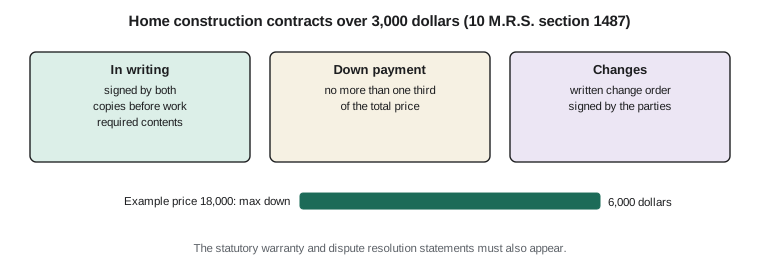
Electrical work on a home, such as a service upgrade, a kitchen renovation or a whole-house rewire, can be a home construction contract within the statute. Casco Tide uses a standard home contract form that its lawyer reviewed against section 1487, and it never takes more than one third of the price as a down payment on a home job. Failing to follow the statute can be treated as an unfair trade practice, which is a far bigger problem than a lost payment.
Worked problem
Down payment on a home job
A homeowner in Gorham signs an 18,000 dollar contract for a service upgrade and kitchen rewiring. What is the largest down payment Casco Tide may take?
Show solution
- Section 1487 limits the down payment to one third of the total price.
- One third of 18,000 is 6,000.
Answer: 6,000 dollars. The balance is paid on the schedule in the contract.
Changes and payment timing
Changes are the biggest source of payment disputes. The contract should require changes to be in writing, signed before the work is done, with a price or a method for pricing them. In the field, someone always asks for one more outlet or one more circuit. A foreman who does the work without a signed change order has given away the company's leverage. Casco Tide's foremen carry a pad of change order forms and a rule: no signature, no extra work, unless a safety problem requires it.
Maine also has a prompt payment statute for private construction, in chapter 201-A of Title 10, which sets default rules for when owners must pay contractors and contractors must pay subcontractors, and limits retainage, unless the contract provides otherwise. The course describes it only generally; when a payment is late, read the statute and the contract together.
What a mechanics' lien is
A mechanics' lien is a claim against real property, the land and the building, for the value of labor or materials furnished to improve it. It lets an unpaid contractor, subcontractor or supplier ask a court to have the property sold to pay the debt. In Maine, section 3251 gives a lien to whoever performs labor or furnishes labor or materials for erecting, altering, moving or repairing a house or building, by virtue of a contract with or by consent of the owner. The lien attaches to the building, the land it stands on and the owner's interest in that land.
The words by consent of the owner matter. An electrical subcontractor does not have a contract with the owner; it has a contract with the general contractor. Its lien rests on the owner's consent to the work, which is usually present when the owner has hired a general contractor to build or renovate. A contractor who works for a tenant without the owner's consent may have no lien on the owner's property at all.
The deadlines
Maine's lien deadlines are short and run from the last day of work. Under section 3253, a claimant who does not have a contract with the owner, such as a subcontractor or supplier, must file a sworn statement of the amount due, a description of the property and the owners' names in the registry of deeds for the county where the property sits within 90 days after last performing labor or furnishing materials, and must mail a copy to the owner. If the filing is not made, the lien is dissolved. This filing requirement does not apply to a contractor working under a contract with the owner.
Under section 3255, every lien, whether the claimant contracted with the owner or not, is lost unless it is preserved and enforced by a court action commenced within 120 days after the last labor, materials or services were furnished, with an exception in section 3256. The action is filed in the Superior Court or the District Court for the county or division where the property is located. In practice, this means an unpaid electrical contractor has about four months from the last day on the job to sue, and a subcontractor must also file in the registry within the first three months.
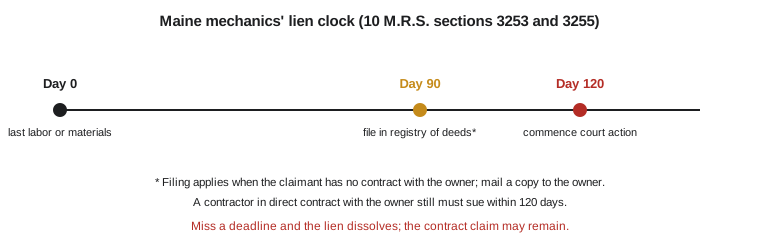
# Lien calendar from the last day of work
from datetime import date, timedelta
last_work = date(2026, 10, 2)
registry = last_work + timedelta(days=90)
action = last_work + timedelta(days=120)
print("last day of work:", last_work)
print("subcontractor registry filing by:", registry)
print("court action commenced by:", action)last day of work: 2026-10-02 subcontractor registry filing by: 2026-12-31 court action commenced by: 2027-01-30
The last day of work must be real. Returning to a job to replace a cover plate in order to restart the clock does not usually count, and courts look at whether the work was part of the original contract or a pretext. Casco Tide records the last substantive day of work in its job file the day it happens.
Owner protection
Section 3255 also limits an owner's exposure to claimants who did not contract with the owner. An owner who has paid the general contractor in good faith can find a subcontractor's lien on the house. The statute caps what such a claimant can recover from the owner at the balance due from the owner to the contractor at the time the owner receives written notice of the claim or is served in the lien action, whichever is first. This protection does not apply to work for business, commercial or industrial purposes unless the owner resides on the premises. A subcontractor on a residential job therefore has a strong reason to give written notice to the owner early, before the owner pays the general contractor in full.
Lien waivers and releases
Owners and lenders often require lien waivers with each payment, in which the contractor releases its lien rights for work paid to date. A conditional waiver releases rights only when the payment actually clears; an unconditional waiver releases them immediately. Signing an unconditional waiver before the check clears is a common and avoidable mistake. Art's rule is to sign conditional waivers until the money is in the bank.
Documenting the job for payment
Liens and lawsuits are the last resort. Most money is collected because the paperwork makes payment easy and nonpayment hard. Casco Tide sends invoices that match the payment schedule in the contract, attaches signed change orders to the invoice that bills them, and includes the permit number and inspection dates when a milestone payment depends on passing an inspection. When a payment is late, Corinne calls within a week, then sends a polite letter that mentions the contract terms. Only when that fails does Art look at the lien calendar, and by then the dates are already in it.
Good records also decide disputes about the last day of work. Daily reports showing who was on site and what they did, delivery tickets for material, inspection reports and photographs all help prove when the work was substantially finished. A lien claimant who cannot prove the date of the last work may be unable to prove that it filed on time.
Public jobs
Liens generally cannot be enforced against public property such as schools, town halls and state buildings. On public jobs, the payment bond required under section 871 of Title 14, discussed in Lesson 8, takes the place of lien rights. A subcontractor or supplier who is not paid makes a claim on the bond, following the notice and suit deadlines in the statute and the bond. Those deadlines are different from the lien deadlines, so a contractor working public jobs needs both calendars.
Common mistakes
MistakeAssuming a contractor in direct contract with the owner has no deadline.
InsteadSection 3255 still requires a court action within 120 days of the last work.
MistakeFiling a subcontractor's lien statement on day 100.
InsteadSection 3253 requires filing within 90 days, or the lien dissolves.
MistakeTaking half the price as a down payment on a home job.
InsteadSection 1487 limits the down payment to one third.
MistakeDoing extra work on a verbal request.
InsteadSection 1487 and good practice require a written, signed change order.
MistakeRecording a lien against a public school.
InsteadPublic property is protected by payment bonds, not liens.
Summary and key terms
- Write a contract for every job, with scope, price, payment, changes and the code edition.
- Home construction contracts over 3,000 dollars must be written with the contents in 10 M.R.S. section 1487, including a down payment of no more than one third.
- Section 3251 gives a lien for labor or materials furnished by contract with or consent of the owner.
- A claimant without a contract with the owner files in the registry within 90 days of the last work and mails a copy to the owner.
- Every lien must be enforced by a court action commenced within 120 days of the last work.
- Public jobs rely on payment bonds instead of liens.
- Mechanics' lien
- A claim against real property for unpaid labor or materials used to improve it.
- Registry of deeds
- The county office where lien statements and other property records are filed.
- Section 1487
- The Maine statute requiring written home construction contracts over 3,000 dollars.
- Lien waiver
- A release of lien rights, conditional or unconditional, often exchanged for payment.
- Owner's consent
- The basis for a subcontractor's lien when it has no contract with the owner.
Practice problems
Work each problem on paper first, then reveal the answer to check.
Casco Tide, as a subcontractor, last worked on October 2. By when must it file in the registry?
Show answer
Within 90 days, by December 31.
By when must it commence a court action?
Show answer
Within 120 days, by January 30 of the next year.
A home contract is 9,000 dollars. What is the most Casco Tide may take as a down payment?
Show answer
3,000 dollars.
Does a contractor hired directly by the owner file a registry statement under section 3253?
Show answer
No, but it must still sue within 120 days.
What replaces lien rights on a public school job?
Show answer
The general contractor's payment bond.
Lesson quiz · 5 questions
Score 60% or more to complete this lesson.
Create a free account to save your progress, take quizzes and earn a certificate.