
MELU-219 · Lesson 5 of 12 · 20 min
The NEC as adopted in Maine and state amendments
▶ Video coming soon A video version of this lesson is on the way.
In August 2026 Casco Tide had two multifamily buildings under way in South Portland. The first had started in May; its permit, rough-in and service were all under the 2023 National Electrical Code. The second started in late July, after the board's new rule took effect, and was under the 2026 edition. The two buildings sat across a parking lot from each other, wired by the same crew, and the inspector checked them against different books. Nadia spent an afternoon with Art going through the differences that mattered for the second building. This lesson explains how Maine adopts the electrical code, how the edition that applies to a job is decided, what the state amendments are and how to find them, and why the exam may test a different edition from the one in force on the job.
The facts in this lesson come from section 1153-A of Title 32, the board's announcements, its spring 2026 newsletter and published notices of its Chapter 120 rulemaking, checked in November 2026. The course describes the Maine amendments in general terms only; read the rule itself for the exact wording.
Who adopts the code
In Maine the Electricians' Examining Board adopts the electrical installation standard for the whole state. Section 1153-A of Title 32 directs the board to adopt standards for electrical installations, and the board does so by rule, in its Chapter 120, Electrical Installation Standards. The rule incorporates the National Electrical Code, published by the National Fire Protection Association as NFPA 70, by reference, together with the amendments and inclusions written into the Maine rule. Because adoption is statewide, the same edition and the same amendments apply in every city, town and unorganized territory. A municipal electrical inspector enforces the state standard; a town does not adopt its own edition.
This is a real difference from states where cities and counties adopt the code on their own schedules. In Maine there is one answer to which code applies, and it depends only on when the installation commenced, not on where it is.
The adoption process
Adopting a new edition is ordinary state rulemaking under the Maine Administrative Procedure Act. The board's spring 2026 newsletter described the steps. The board drafts the proposed rule, including any Maine amendments. The Secretary of State posts it in the list of proposed rules. A public comment period follows, commonly about thirty days, and the board may hold a public hearing, which it must hold if one is requested in the way the law provides. The board reviews the comments and may change the amendments or the timeline in response. Finally, the board adopts and files the rule, which becomes enforceable on the effective date stated in it.
Licensees can take part. The board emails licensees when a proposal is published, explains how to comment, and considers the comments it receives. Contractors who expect a new requirement to raise costs or cause supply problems, such as a new protection requirement that some equipment cannot yet meet, often comment on the effective date or ask for a transition period.
Recent editions
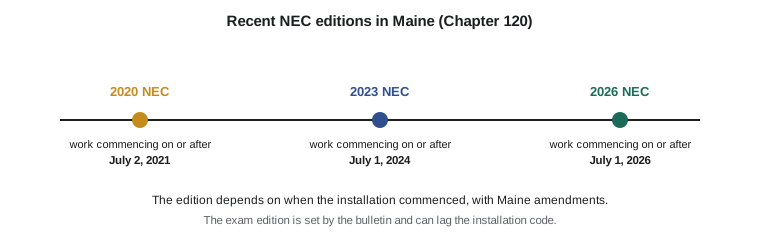
Maine has followed the three-year NEC cycle closely in recent years. The 2020 NEC took effect for work commencing on or after July 2, 2021. The 2023 NEC took effect for installations commencing on or after July 1, 2024. In 2026 the board repealed and replaced Chapter 120 to adopt the 2026 NEC for installations commencing on or after July 1, 2026, subject to the Maine amendments and inclusions in the new rule.
Which edition applies to a job
The key words in the board's announcement are installations commencing on or after the effective date. The edition attaches to the installation by its start, not by the date of the inspection or the date the building is occupied. For the two South Portland buildings, the first commenced in May 2026, before the July 1 effective date, so it remains under the 2023 edition even though its final inspection may come in 2027. The second commenced after July 1, so it is under the 2026 edition from start to finish.
Proving when an installation commenced is a practical matter. The permit date is good evidence, but it is not always the same as the start of the electrical work. A contractor who pulls a permit in June and starts work in August should expect an inspector to ask which code applies, and the honest answer depends on the facts. Casco Tide records the date of the first electrical work on each job in its job file, alongside the permit number, so there is no argument later.
| Job | Electrical work commenced | Edition |
|---|---|---|
| South Portland building A | May 2026 | 2023 NEC with Maine amendments |
| South Portland building B | Late July 2026 | 2026 NEC with Maine amendments |
| Service change in Saco | November 2026 | 2026 NEC with Maine amendments |
| Renovation started in 2023, still open | 2023 | The edition in force then, the 2020 NEC |
What the Maine amendments do
Maine's rule adopts the NEC with amendments and inclusions, but the amendments are modest compared with some states. They typically address how the code fits Maine's administrative law, for example how the board's permit and inspection statute interacts with the code's administrative chapter, and they sometimes adjust the timing of a new requirement that the board believes the market cannot yet meet. A recent example came from the 2023 edition's ground-fault protection rule for outdoor outlets serving heating, ventilating and air-conditioning equipment. The board's announcements noted that the exception for listed HVAC equipment in section 210.8(F) of the 2023 code would sunset on September 1, 2026. The point for a master is that the published NEC is not the whole of the Maine standard; the amendments in Chapter 120 are part of it.
The course does not list the 2026 amendments section by section. The board posts the adopted rule, and code questions can be sent to its code staff. A master should keep a copy of the current Chapter 120 with the code book in the truck and in the office, and should read it each time a new edition is adopted.
Advisories and code decisions
Besides the rule, the board and its senior electrical inspector publish advisories and code decisions on questions that come up often. The board's page in 2026 listed decisions on solar tracker grounding, signing certificates of completion for solar fields, and solar disconnects, as well as advisories on municipal streetlight work, lighting retrofit permits, the wiring of certain regulated facilities, incidental work, and common violations of the 2023 code. These are not amendments to the code, but they show how the board and its inspectors read it, and a contractor who ignores them is likely to fail an inspection.
The spring 2026 newsletter gave a few examples of what inspectors were seeing. It reminded electricians that overcurrent devices may not be installed in bathrooms, under section 240.24(E). It reminded them that service equipment at buildings other than dwelling units must be field marked with the available fault current and the date of the calculation, under section 110.24, and that the marking must be durable for the environment. It cautioned that a ground rod at the utility pole alone does not bond a service lateral conduit, under section 250.4, and suggested asking the utility for a grounding conductor down the pole. And it reminded readers that an accessory dwelling unit, even one called an in-law apartment, is treated as a multifamily dwelling and needs a permit and inspections, with each unit's overcurrent devices accessible to its occupants and each unit's branch circuits serving only that unit.
The exam edition and the installation edition
The exam does not always use the edition in force on the job. The April 2026 PROV bulletin named the 2023 NEC for the master and journeyman exams, three months before the 2026 edition took effect for installations. Testing companies need time to write and validate new questions, and they usually switch editions some months after a state adopts a new one. A candidate testing in the months after July 2026 may therefore study one edition for the exam while working under another on the job.
For Nadia, this means two books. Her exam book is the softcover edition the bulletin names on her exam date. Her job book is the 2026 edition with the Maine amendments. She studies from the exam book and checks the bulletin again before her January exam in case it changes. The section numbers in the two editions are mostly the same, but some requirements have moved or changed, and an answer that is right under one edition can be wrong under the other.
Worked problem
Choosing the right book
Nadia is answering a practice question about a requirement that changed between the 2023 and 2026 editions. Her exam bulletin names the 2023 NEC. Which edition should she use for the answer?
Show solution
- Identify what the question tests: knowledge for the exam, not a job in the field.
- Check the edition the bulletin names: the 2023 NEC.
- Answer from the 2023 edition, even though the 2026 edition applies to her jobs that commenced after July 1, 2026.
Answer: Use the 2023 edition for the exam answer. On the job, use the edition and amendments in force when the installation commenced.
Staying current between editions
A master has to manage the change from one edition to the next, not just know the current one. At Casco Tide, Art and Nadia keep a short list of the changes in each new edition that affect the company's usual work: new ground-fault or arc-fault protection requirements, changes to service disconnect and surge protection rules, changes to load calculation methods, and anything that changes the material or labor on a typical job. They review the list with the crew at a morning meeting before the effective date, update the company's estimating sheets, and tell the supply house which new products they will need. When a bid is written in May for a job that will commence in August, the estimate states the edition it is based on.
The continuing education cycle helps. Every renewal requires the 15-hour course on the current code as adopted by the board, so licensees get a structured review of each edition. But a renewal may fall up to two years after a new edition takes effect. A master who waits for the renewal course to learn the new code will have run jobs under it for months. Reading the change summaries, attending a supplier or association update session, and keeping in touch with the inspector who covers the company's area all help close the gap.
When a contractor and an inspector read a requirement differently, the first step is a conversation with the section number in hand. The board's code staff answer questions by email, and the senior electrical inspector's decisions settle many recurring disputes. If a disagreement turns into a written order, the appeal routes in Lesson 6 apply.
Other codes on the same job
The electrical code does not stand alone. Maine adopts a statewide building and energy code, and the fire marshal's office enforces life safety and fire codes for many occupancies, including fire alarm requirements that overlap with the electrical work. Elevator, boiler and plumbing work have their own boards and rules. A master coordinating a multifamily or commercial job needs to know which code covers which piece and which inspector checks it, even though the electrical inspector checks only the electrical installation.
Common mistakes
MistakeAssuming each Maine town adopts its own code edition.
InsteadThe board adopts one statewide standard in Chapter 120; towns enforce it.
MistakeUsing the inspection date to decide the edition.
InsteadThe edition depends on when the installation commenced.
MistakeTreating the published NEC as the whole Maine standard.
InsteadThe Maine amendments and inclusions in Chapter 120 are part of the standard.
MistakeStudying the installation edition for the exam without checking the bulletin.
InsteadThe exam uses the edition the bulletin names, which can lag the installation code.
MistakeIgnoring board advisories because they are not rules.
InsteadAdvisories show how inspectors read the code and help avoid failed inspections.
Summary and key terms
- The board adopts the NEC statewide by rule in Chapter 120, with Maine amendments and inclusions.
- Adoption follows the Administrative Procedure Act: proposal, comment, possible hearing, adoption and an effective date.
- The 2020 NEC applied from July 2, 2021, the 2023 NEC from July 1, 2024 and the 2026 NEC from July 1, 2026, for installations commencing on or after those dates.
- Board advisories and code decisions show how inspectors apply the code.
- The exam edition is set by the bulletin and may differ from the installation edition.
- Keep the current Chapter 120 with the code book.
- NFPA 70
- The National Electrical Code, published by the National Fire Protection Association.
- Incorporation by reference
- Adopting a published standard as law by naming it in a rule rather than copying its text.
- Maine amendment
- A change to the NEC made by the board's Chapter 120 rule.
- Effective date
- The date from which installations commencing on or after it must meet the new edition.
- Code decision
- A published interpretation from the board's senior electrical inspector on a recurring question.
Practice problems
Work each problem on paper first, then reveal the answer to check.
A job's electrical work commenced on June 20, 2026. Which edition applies?
Show answer
The 2023 NEC with Maine amendments.
Can Bangor adopt the 2020 NEC for its own inspections?
Show answer
No; the state standard in Chapter 120 applies statewide.
Where would Nadia find the Maine amendments?
Show answer
In the board's current Chapter 120 rule.
Which code section did the newsletter cite for overcurrent devices in bathrooms?
Show answer
Section 240.24(E).
Nadia's exam bulletin names the 2023 NEC. Which edition does she use on the exam?
Show answer
The 2023 NEC.
Lesson quiz · 5 questions
Score 60% or more to complete this lesson.
Create a free account to save your progress, take quizzes and earn a certificate.