
MELU-219 · Lesson 6 of 12 · 18 min
Permits, inspections and the inspection authority
▶ Video coming soon A video version of this lesson is on the way.
On a Monday in October 2026, Casco Tide had four new jobs to start: a small office fit-out in Westbrook, a six-unit apartment building in Biddeford, a kitchen and bath renovation in a single-family home in Gorham, and a service upgrade at a machine shop in Sanford. Corinne Dube, the office manager, asked Nadia a question that sounds simple: which of these need a permit, and from whom? The answer was different for each job. This lesson explains Maine's permit statute, the exceptions, the split between state and municipal inspection, how inspections work, what an inspector can order, and how to appeal.
The facts here come from sections 1102-C, 1102-D, 1103 and 1104 of Title 32, section 4173 of Title 30-A, the board's FAQ, its online permit guide and its spring 2026 newsletter, checked in November 2026. Local programs change, so confirm the current arrangements for each town.
The basic rule
Section 1102-C sets the basic rule. Unless an exception applies, a permit must be obtained from the board before an electrical installation may be performed. The application is filed by a licensed master or limited electrician on the board's form, with whatever plans or schedules the board requires. The board issues the permit if the planned work complies with the applicable statutes, ordinances and rules and the fee has been paid. The board's FAQ puts it in plain terms: the master or limited electrician doing the work gets the permit before starting.
Applications are filed online through the board's permit portal. The board's guide walks through the steps: choose the type of permit, the facility type and the town, enter the electrician's and owner's details, describe the scope of work, attest, and pay by card. The guide noted that permits are emailed within minutes of submission. It also told applicants to check that the town does not do its own permitting for the work before finishing the form, which leads to the most important split in Maine's system.
State permit or municipal permit
Section 4173 of Title 30-A allows a municipality that has provided for electrical inspection to require that no electrical equipment be installed or altered without first obtaining a permit from its electrical inspector. The person doing the work applies in writing to the town inspector, who may ask for plans, and the inspector issues the permit when the applicant has complied and paid any town fee. No major deviation from the permitted installation may be made without the inspector's written approval. Municipalities that do not require permits, and the unorganized territories, are governed by the state statute instead.
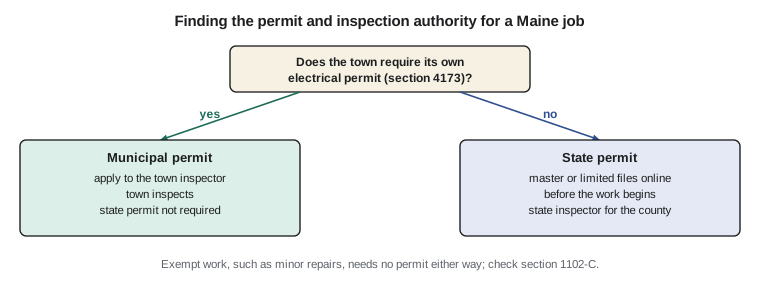
Section 1102-C then excepts from the state permit requirement any work that needs a permit and inspection under a municipal ordinance adopted under section 4173. The result is a simple decision tree. If the town requires its own electrical permit, the contractor applies to the town and the town inspects; no state permit is needed. If it does not, the contractor files a state permit and a state electrical inspector covers the job. Either way, section 1103 says the town may not issue a permit unless it is satisfied that the applicant complies with the state licensing law, so a town inspector will check that the person pulling the permit holds the right state license.
Which towns run their own programs changes over time. Larger cities are the most likely to have a municipal electrical inspector, but the course does not name any town as a fact; the board posts a jurisdiction map, and its permit portal lists towns that do their own permitting. Corinne checks both each time Casco Tide takes work in a town it has not worked in for a year.
The exceptions
Section 1102-C lists the work that needs no state permit. Electrical work in a single-family dwelling performed by a licensed electrician is excepted, as is work by an owner in an existing, owner-occupied single-family dwelling, an exception added in 2025. Installations by a public utility or its contractor in the course of utility business, and work on aboveground transmission lines, are excepted. So are minor repairs, such as replacing lamps, fuses, fixtures, switches and sockets. Work that needs a municipal permit under section 4173 is excepted, as discussed above. Electrical work in or about industrial or manufacturing facilities is excepted, as is certain work by a manufacturer's employees under the supervision of an engineer or master electrician. Finally, specified work by licensed oil burner technicians, propane and natural gas installers, plumbers and pump installers is excepted within the limits of their licenses.
An exception from the permit requirement is not an exception from the code or from licensing. Work in a single-family house still has to meet the code, and in most cases it still has to be done by a licensed electrician. The permit exception removes the paperwork and the state inspection, not the standard.
| Casco Tide job | State permit needed? | Why |
|---|---|---|
| Office fit-out, Westbrook | Yes, unless Westbrook requires its own permit | Commercial work; no exception applies |
| Six-unit apartment, Biddeford | Yes, unless Biddeford requires its own permit | Multifamily is not single-family |
| Kitchen and bath, single-family home, Gorham | No | Single-family work by a licensed electrician |
| Service upgrade, machine shop, Sanford | Check carefully | Industrial or manufacturing facility exception may apply |
The Sanford job shows why the exceptions need care. Whether a machine shop is an industrial or manufacturing facility within the meaning of the statute is a question of fact. Nadia's practice is to ask the state inspector for the area before starting when a job sits near the edge of an exception. The cost of a permit is small compared with the cost of explaining later why one was not pulled.
Homeowner work in a new single-family home
Section 1102-D lets a person do the electrical installation in a newly built single-family home that the person will occupy as a primary residence, if the work meets the code and the person applies for and receives a single-family dwelling certificate. The homeowner must contact the state electrical inspector before starting and notify the inspector when the work is ready, before it is covered. Before the utility will connect power, the installation must be certified by a state electrical inspector, a local inspector, a licensed master electrician or a licensed limited electrician in house wiring. This is one place where a master's signature carries legal weight: certifying a homeowner's installation is a statement that it meets the code, and a master should not sign one without inspecting the work.
Inspections
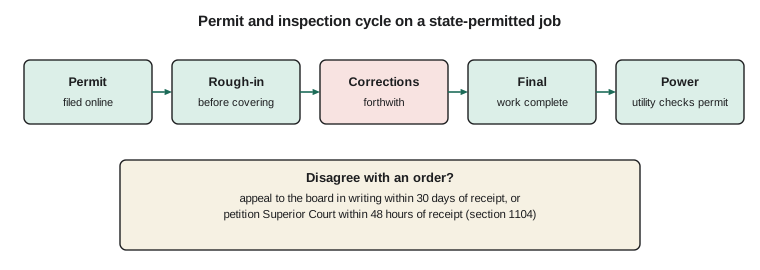
Section 1102-C requires an inspection before wiring is enclosed. The licensed electrician notifies the state electrical inspector, or the municipal inspector where there is one, when the work is ready. The spring 2026 newsletter reminded electricians that calling for rough-in inspections is required by statute, a reminder that suggests some were not. Most jobs also have a final inspection when the work is complete, and services may be inspected before the utility connects. The utility must require proof of a permit before connecting power.
The board's state inspectors cover large territories. The spring 2026 newsletter listed four inspectors: one, the senior inspector, for York and western Cumberland counties; one for Aroostook, Piscataquis, Penobscot, Hancock and Washington; one for Oxford, Androscoggin, Sagadahoc, Lincoln, Franklin and eastern Cumberland; and one for Somerset, Kennebec, Knox and Waldo. With so few inspectors, a contractor who calls for an inspection the day before the drywall crew arrives may wait. Casco Tide calls as soon as rough-in is close and plans the other trades around the inspection.
Inspector powers and orders
Section 1104 sets out what an inspector may do. An inspector may enter and inspect buildings and premises within the inspector's jurisdiction at reasonable hours, on a complaint of imminent danger, on a written complaint from an owner, lessee or tenant, or whenever the inspector considers it necessary, with the permission of the person in control or a court order. If an installation does not comply, the inspector orders it removed or corrected, and the order must be complied with forthwith by the owner, the occupant or the electrician who did the work. If an installation endangers other property or the public, the inspector may forbid use of the building by a written order to vacate within a reasonable time stated in the order.
Section 1104-A deals with failure to comply. If a person does not carry out a final order, the board may ask the Superior Court for an injunction to compel compliance. Ignoring an order is also grounds for discipline against a licensee.
Appeals
A person who disagrees with an inspector's order has two routes under section 1104. The first is an appeal to the board by filing a written notice within 30 days of receiving the order. The board holds a hearing and issues a written decision within a reasonable time; if it upholds the order, it sets the time for correction in its decision. The second is a petition for review in the Superior Court within 48 hours of receiving the order. The very short court deadline reflects the urgency of an order to vacate; for ordinary code disagreements, the board appeal is the usual route. Unless an order is appealed, it must be complied with.
In practice, most disagreements end well before an appeal. Nadia's habit is to ask the inspector for the section number, read it with the inspector on site, and, if they still disagree, send a short email to the board's code staff. An appeal is for the rare case where real money or safety is at stake and the conversation has failed.
Temporary service and changes of scope
The board's online application offers two kinds of permit: a standard permit and a temporary-service-only permit, which limits the work to temporary power for construction. On a new building, Casco Tide often files a temporary service permit first so the builder can get power for tools and heaters, then files a standard permit for the permanent installation once the plans are settled. Each permit describes its scope, and work beyond that scope needs a new or amended permit. Section 4173 makes the same point for municipal permits: no major deviation from the installation described in the permit may be made without the inspector's written approval.
Scope changes happen on most jobs. A tenant adds a server room, a builder adds a detached garage, an owner decides to add a generator. Each change can move the job across a line: from single-family to multifamily, from a minor repair to an installation, or from one inspector's scope to another's. Nadia reviews the permit whenever a change order adds circuits or equipment and asks whether the permit still describes the work.
Permit records
Every permit becomes part of the job file. Casco Tide keeps the permit, the inspection dates and results, any correction notices and the inspector's final sign-off with the job's drawings and change orders. These records answer the questions that come later: which code edition applied, who was the responsible master, whether a correction was made. They also protect the company when a future owner or insurer asks whether the work was permitted and inspected.
Fees
Section 1102-C requires a combined fee for the permit and inspection with each application. The fee schedule is set by rule, and the statute provides that no scheduled service fee may exceed 100 dollars. The board posts a permit fee schedule; the course does not quote the amounts, which change. Municipal programs set their own fees.
Common mistakes
MistakeStarting work and filing the state permit afterward.
InsteadSection 1102-C requires the permit before the installation is performed.
MistakeLetting a journeyman file the permit.
InsteadOnly a licensed master or limited electrician may apply.
MistakeAssuming a multifamily building counts as a single-family dwelling.
InsteadThe single-family exception does not cover multifamily buildings, and an ADU is treated as multifamily.
MistakeCovering wiring before the rough-in inspection.
InsteadInspection is required before wiring is enclosed.
MistakeWaiting a week to appeal an order to vacate in court.
InsteadA Superior Court petition must be filed within 48 hours of receipt; a board appeal within 30 days.
Summary and key terms
- Unless an exception applies, a state permit is required before work begins, filed by a master or limited electrician.
- A town with its own program under 30-A section 4173 issues permits and inspects; no state permit is needed there.
- Exceptions include single-family work by a licensed electrician, minor repairs, utility work and industrial facilities.
- Inspection is required before wiring is enclosed; the utility must see a permit before connecting.
- Inspectors may order correction forthwith and may order a dangerous building vacated.
- Appeal to the board within 30 days or to Superior Court within 48 hours of receiving an order.
- Section 1102-C
- The Maine statute requiring a permit and inspection for electrical installations, with exceptions.
- Municipal electrical inspector
- A town official who issues permits and inspects under 30-A section 4173.
- Single-family dwelling certificate
- The certificate that lets an owner wire a new home for personal occupancy under section 1102-D.
- Order to vacate
- An inspector's written order forbidding use of a building whose wiring endangers others.
- Rough-in inspection
- The inspection required before wiring is covered.
Practice problems
Work each problem on paper first, then reveal the answer to check.
Does Casco Tide need a state permit to rewire a single-family home's kitchen?
Show answer
No; single-family work by a licensed electrician is excepted, but the code still applies.
The town requires its own electrical permit. Does Casco Tide also file a state permit?
Show answer
No; section 1102-C excepts work permitted under section 4173.
Who may certify a homeowner's new single-family installation before power is connected?
Show answer
A state or local inspector, a master electrician or a limited electrician in house wiring.
Within how many days must a board appeal of an inspector's order be filed?
Show answer
Within 30 days of receipt of the order.
What must the utility see before connecting power to a permitted job?
Show answer
Proof of a permit.
Lesson quiz · 5 questions
Score 60% or more to complete this lesson.
Create a free account to save your progress, take quizzes and earn a certificate.