
MELU-219 · Lesson 3 of 12 · 18 min
Applying, approval and booking the exam
▶ Video coming soon A video version of this lesson is on the way.
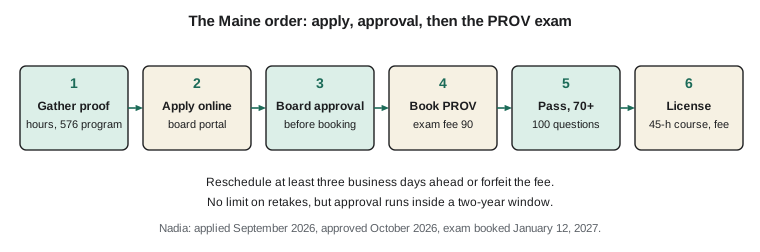
Once Nadia knew she qualified, the next question was order. Some states let a candidate book the exam first and apply for the license afterward. Maine works the other way round. The board must approve a candidate before the testing company will let her schedule, so the application and its proof come first, the exam second, and the license third. This lesson follows Nadia through each step in the order she took it, from gathering her records in August 2026 to the January 2027 exam date she has booked.
The facts in this lesson come from the board's master electrician and examination pages, its FAQ and the PROV candidate information bulletin dated April 2026, all checked in November 2026. Testing companies update their bulletins and fees, and the board updates its forms. Read the current versions before you apply.
Step 1: gather the proof
An application is only as good as its attachments. Nadia collected four kinds of proof. First, her license history: her helper license number from 2017, her journeyman license number from 2022 and the dates of each. Second, her hours: a verification of her journeyman hours at Casco Tide, signed by Art, and a shorter one from the Gorham shop where she worked as a journeyman for a few months before joining Casco Tide. Third, her schooling: the community college transcript showing the full 576-hour program. Fourth, the certificate for the 45-hour code course she finished in August 2026, which she will need again when the license is issued.
She also checked that the board had her current email address. The board's page warns that licenses and board communications are sent by email, and that candidates should check spam and junk folders for messages from the state's no-reply address. An approval that sits unread in a junk folder can cost a candidate a month.
Step 2: apply online
Applications for examination and for reciprocity are filed online through the board's licensing portal. The application asks for personal details, license history, the route the candidate is using, the hours and the schooling, and it asks the questions about criminal history and discipline that every Maine licensing board asks. The board's master page lists a license fee and a fee for a State Bureau of Identification criminal history report. Fees change, so the course does not rely on them; the portal shows the current amounts at checkout.
Honesty on the application matters. A conviction or a past discipline does not automatically bar a license, but failing to disclose one can be treated as a separate problem. Licensees must also report convictions and changes of contact information within ten days, according to the board's page, a duty that continues for as long as they hold a license.
Step 3: board approval
The PROV bulletin states the rule plainly: candidates must receive approval from the agency before scheduling an appointment to take the exam. The board's staff review the application, check the hours against the route, confirm the program and decide whether anything is missing. If something is missing, the candidate is asked for it, and the clock stops until it arrives. When the application is complete and the candidate qualifies, the board approves the candidate to test and the candidate's information is passed to the testing company.
Nadia applied in mid-September 2026 and received her approval email in mid-October. Her application was simple: one employer for most of the hours, one transcript and no history to explain. A candidate with experience out of state, gaps in employment or a comparable-training claim should expect longer.
Step 4: book with PROV
With approval in hand, the candidate schedules with PROV, either online through the testing company's scheduling site or by phone during business hours. The bulletin says the candidate ID for online scheduling is the candidate's Maine license ID, which is one reason to keep the helper or journeyman license number handy. The April 2026 bulletin lists the master exam fee as 90 dollars, paid to the testing company, separate from any fee paid to the board.
Seats and sites vary. The board's page has posted updates on physical testing locations, and candidates in northern and eastern Maine may need to travel farther than those in Portland or Augusta. Nadia chose a Tuesday in January at the closest site, taking a day off work, January 12, 2027, which gives her about three months of study after approval.
Rescheduling has a deadline. The bulletin says changes must be made at least three business days before the test, or the candidate forfeits the fee. Three business days before a Saturday exam is the preceding Wednesday, not Thursday, because the weekend does not count. A candidate who wakes up sick on exam day has lost the fee unless the bulletin's emergency provisions apply, so it pays to read them before booking.
# Finding the last day to reschedule (three business days before the exam)
from datetime import date, timedelta
exam = date(2027, 1, 12)
days_back = 0
d = exam
while days_back < 3:
    d -= timedelta(days=1)
    if d.weekday() < 5:          # Monday=0 ... Friday=4
        days_back += 1
names = ["Monday", "Tuesday", "Wednesday", "Thursday", "Friday", "Saturday", "Sunday"]
print("exam day:", names[exam.weekday()], exam)
print("last day to change without losing the fee:", names[d.weekday()], d)exam day: Tuesday 2027-01-12 last day to change without losing the fee: Thursday 2027-01-07
The calculation above ignores holidays. If a holiday falls inside the window, the testing company's definition of a business day controls, so check the bulletin and give yourself an extra day.
Step 5: exam day and results
Exam day rules are covered in Lesson 4: what identification to bring, which book is allowed and how it may be marked, which calculator is permitted and how the time is structured. For the application process, the key fact is what happens after. The bulletin requires a score of 70 to pass. A candidate who passes moves on to the license application; a candidate who fails may retest.
The bulletin says failed examinations have no restrictions on retesting, although the two-year window applies. In plain terms, there is no waiting period or limit on the number of attempts set in the bulletin, but the approval to test does not last forever. A candidate who has not passed within the window should expect to reapply. Each attempt costs the exam fee again.
Step 6: the license
Passing the exam does not by itself make Nadia a master. The license is issued when she applies with proof of passing, pays the license fee and shows evidence of the 45-hour code course completed within the two years before the application. The board's master page gives the term as two years from the date of first licensure, so her renewal dates will fall on the anniversary of the day her license is issued, not on a fixed statewide date.
Once the license is issued, Casco Tide can begin naming Nadia on permits. Art plans to keep his license active for a few months after that so the two of them overlap, which lets jobs that were permitted under Art's name finish under him while new jobs go under Nadia's.
| Step | Who acts | What to watch |
|---|---|---|
| Gather proof | Candidate | Transcripts, hour verifications, license numbers |
| Apply online | Candidate | Complete answers, current email, fees |
| Approval | Board staff | Requests for missing items stop the clock |
| Book the exam | Candidate with PROV | Maine license ID, 90 dollar fee, three business days to reschedule |
| Take the exam | Candidate | 70 to pass; retake inside the two-year window |
| License | Board | Proof of passing, 45-hour course within two years, fee |
Reciprocity and endorsement applications
A candidate licensed in a state with a reciprocity agreement applies differently. Instead of an exam approval, she files a sworn application with proof of her current license, her passing exam in that state and her years of experience. The board's master page lists six years of active work as an electrician for master reciprocity. Because the list of agreement states has changed over time, check it before paying any fee.
Keeping the paperwork
Art keeps a folder for every license he has ever held, and he has told Nadia to do the same. In it go copies of every application, every verification, the transcript, the code course certificate, the approval email, the exam score report and the license itself. These papers are needed again for renewal, for reciprocity applications in other states, and for the occasional customer or general contractor who asks for proof of qualifications. Losing them means asking former employers to sign again, sometimes years later.
Using the waiting time
The weeks between applying and approval are study time, not idle time. Nadia used them to set up her code book and her study plan. She bought the softcover code edition the bulletin names, added permanent tabs at the articles she uses most, and began working through the core review courses in this series, starting with code navigation and load calculations. She set a target of eight to ten hours of study a week, mostly in two long weekend sessions with a timed practice set at the end of each. By the time the approval email arrived, she had already worked through two full practice tests and knew which topics needed the most work.
She also planned the logistics of exam day early. She checked the route to the testing site, the parking, the start time and how early the bulletin asks candidates to arrive. She confirmed that her driver's license would be current on the exam date. She told Art and the crew which day she would be out, so that nobody scheduled a rough-in inspection that needed her that morning. Small arrangements like these remove distractions from the one day that matters.
What a good hour verification looks like
Board staff read many verifications, and the clear ones move quickly. A good verification names the employer, its address and the signer's license number; gives the dates of employment; states the license the applicant held during that time; estimates the hours of electrical installation work, not just the hours on the payroll; and describes the kind of work, such as commercial services and feeders, multifamily rough-in, motor controls or solar installations. It is signed by someone who actually supervised the applicant. A verification that just says the person worked here for four years and was a good employee invites a follow-up question.
When an employer has closed or the owner has died, the applicant should collect what evidence remains: tax forms showing wages, pay stubs, letters from former supervisors, and permit records showing the applicant's name on jobs. The board can accept other reasonable proof, but the applicant carries the burden of showing the hours.
Accommodations
Candidates who need a testing accommodation because of a disability, or who need a reader or other arrangement, should read the bulletin's section on special arrangements before booking. Accommodations usually need to be requested in advance with supporting documentation, and they can take longer to arrange than a standard seat. A candidate who books first and asks later may have to move the exam date.
Common application mistakes
The mistakes that slow applications are predictable. Candidates book a vacation for the week the approval arrives and miss the best exam dates. They use a personal email they rarely check. They apply on the wrong route. They submit a transcript with one course missing. They schedule an exam before approval and are turned away. They forget that the 45-hour course has a two-year shelf life. Each of these is avoidable with a checklist and a calendar.
Common mistakes
MistakeBooking the PROV exam before the board approves the application.
InsteadThe bulletin requires board approval before scheduling.
MistakeCounting weekend days in the three-business-day rescheduling deadline.
InsteadOnly business days count; a Saturday exam's deadline is the Wednesday before.
MistakeAssuming a pass issues the license automatically.
InsteadThe license needs an application with proof of passing, the 45-hour course and the fee.
MistakeBelieving there is a waiting period between attempts.
InsteadThe bulletin sets no retest restriction, but the two-year window applies.
MistakeExpecting a fixed statewide renewal date.
InsteadThe term runs two years from the date of first licensure.
Summary and key terms
- In Maine the board approves the candidate before the testing company will schedule the exam.
- Applications are filed online with proof of hours, the 576-hour program and license history.
- PROV delivers the exam; the April 2026 bulletin lists a 90 dollar master exam fee and a three-business-day rescheduling deadline.
- A score of 70 passes; retakes have no set restriction inside the two-year window.
- The license is issued after passing, on proof of the 45-hour course within two years and payment of the fee.
- Keep copies of every document for renewal and reciprocity.
- Approval to test
- The board's decision that a candidate qualifies and may schedule the exam.
- PROV
- The testing company that delivers the board's electrician exams.
- Candidate information bulletin
- The testing company's rules for registration, fees, exam content and the testing room.
- Two-year window
- The period in which an approved candidate may test and retest.
- SBI report
- A criminal history record check from the Maine State Bureau of Identification.
Practice problems
Work each problem on paper first, then reveal the answer to check.
Nadia's exam is on Tuesday, January 12, 2027. What is her last day to reschedule without losing the fee, ignoring holidays?
Show answer
Thursday, January 7, 2027: counting back Monday, Friday and Thursday as the three business days.
Can Nadia schedule before the board approves her?
Show answer
No; approval comes first.
What score passes the master exam?
Show answer
70.
She fails her first attempt in January. Must she wait six months?
Show answer
No set waiting period in the bulletin, but the two-year window applies.
When is her license term measured from?
Show answer
The date of first licensure; the term is two years.
Lesson quiz · 5 questions
Score 60% or more to complete this lesson.
Create a free account to save your progress, take quizzes and earn a certificate.