
MELU-219 · Lesson 8 of 12 · 20 min
Contractor licensing, insurance and bonding
▶ Video coming soon A video version of this lesson is on the way.
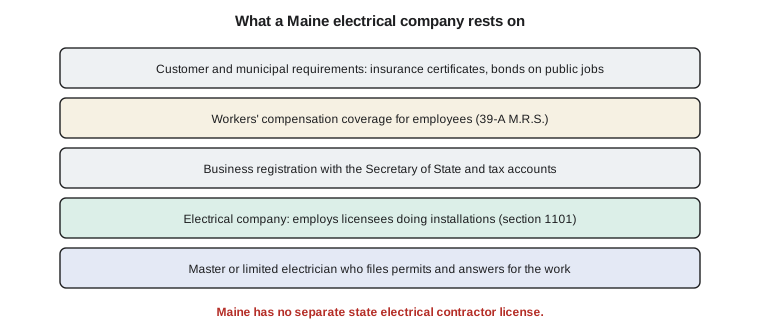
When Nadia told her brother-in-law, who runs an electrical company in Massachusetts, that she was preparing to take over the license side of Casco Tide, his first question was whether Maine would also make her pass a contractor exam. In many states it would. In Maine it will not. Maine has no separate state license for electrical contractors. What it has instead is a set of rules that together decide who can run an electrical business: the individual licenses in chapter 17, the definition of an electrical company, the permit statute, business registration, workers compensation, and the insurance and bonds that customers and public owners demand. This lesson puts those pieces together.
The facts here come from sections 1101, 1102-C and 1202-B of Title 32, the board's FAQ, the workers compensation statute in Title 39-A and the public works bond statute in Title 14, checked in November 2026. The course found no statewide insurance or bond requirement tied to an electrical license; where amounts appear, they are customer or contract examples, not state minimums.
No separate contractor license
Chapter 17 licenses people, not businesses. The board's FAQ covers individual licenses only and does not describe any company license. The statute does recognize businesses, through its definition of an electrical company: a person, firm, corporation or partnership employing licensees engaged in the business of doing electrical installations. Journeymen, journeymen-in-training and helpers may work only while employed by a supervising master, a limited electrician or an electrical company. And the statute's definition of a master electrician speaks of a person qualified to engage in the business of installing electrical wiring.
In practice, this means a Maine electrical business needs at least one master or, for work within a category, a limited electrician, because only those licenses can file state permits and work without being employed by someone else. An electrical company may be owned by someone who holds no electrical license at all, such as an investor or a family member, but it must employ licensed people to do the work and a master or limited electrician to file the permits and answer for the installations.
Forming the business
Casco Tide is a limited liability company registered with the Maine Secretary of State. Like any business, it has a registered agent, files an annual report, holds federal and state tax accounts, and withholds payroll taxes for its employees. Many small electrical businesses start as sole proprietorships, owned by a master working alone, and later form an LLC or corporation to separate business debts from personal assets. The choice of form affects taxes and liability, not the electrical license; the license stays with the individual master.
Section 1103 bars municipalities from requiring their own electrician licenses, but towns may still require business registrations or permits of general application, such as a business license for operating in the town or a contractor registration for building permits. These are not electrical licenses and are not barred by section 1103. Corinne keeps a list of any such requirements in the towns where Casco Tide works.
Workers compensation
Maine's workers compensation law, Title 39-A, requires most employers to carry workers compensation insurance or to be approved to self-insure. An electrical company with employees is almost certainly covered. The law provides benefits to injured workers regardless of fault, and in exchange it generally limits the employer's liability to those benefits. Lesson 10 covers the reporting duties after an injury.
The law has exemptions, including some for sole proprietors and business owners and for certain independent contractors, but the line between employee and independent contractor is tested carefully. A company that treats its electricians as independent contractors to avoid coverage risks penalties and, if one is hurt, a claim that the company was the employer all along. The board's requirement that journeymen and helpers be employed by a master, limited electrician or electrical company also points toward employment, not independent contracting, for those licenses.
Liability insurance
Maine does not set a minimum liability insurance amount for an electrical license. Every serious electrical contractor carries commercial general liability insurance anyway, because customers, general contractors, property managers and public owners demand it. Insurance protects the contractor against claims by third parties for bodily injury and property damage caused by its work or operations, such as a fire traced to a loose connection, or a visitor who trips over a cord on a job site.
Contract requirements set the amounts. A typical commercial subcontract might require general liability of one million dollars per occurrence and two million in the aggregate, automobile liability on the company's trucks, workers compensation with employer's liability, and an umbrella policy for larger jobs. It may also require the contractor to name the owner and general contractor as additional insureds and to provide a certificate of insurance before starting. These figures are examples; the contract controls.
| Coverage | What it protects | Who usually requires it |
|---|---|---|
| Commercial general liability | Third-party injury and property damage claims | Owners, general contractors, property managers |
| Commercial auto | Accidents involving company vehicles | State law for vehicles; contracts for limits |
| Workers compensation and employer's liability | Employee injuries | Title 39-A, for employers |
| Umbrella or excess | Claims above the primary limits | Larger commercial contracts |
| Tools and equipment | The contractor's own property | The contractor's own choice |
Bonds
A bond is different from insurance. Insurance protects the contractor. A surety bond protects someone else, the owner or the people who supply labor and materials, by having a surety company promise to pay if the contractor fails. The contractor remains responsible to repay the surety. Three kinds of bond matter most to an electrical contractor. A bid bond guarantees that a contractor who wins a bid will sign the contract. A performance bond guarantees that the contractor will finish the work. A payment bond guarantees that the contractor will pay its subcontractors and suppliers.
Maine's public works bond statute, section 871 of Title 14, often called a Little Miller Act after the federal Miller Act, requires contractors on many public construction contracts to furnish performance and payment bonds. The payment bond takes the place of lien rights, which generally cannot be enforced against public property. The thresholds and procedures are set in the statute and in the contracting agency's documents, so a contractor bidding public work should read both. An electrical subcontractor on a public job relies on the general contractor's payment bond, and Lesson 9 covers how that fits with lien rights on private jobs.
Insurance certificates and additional insured status
A certificate of insurance is a one-page summary of a contractor's policies, issued by the insurance agent. It is evidence of coverage, not coverage itself. A general contractor that asks to be named as an additional insured wants the actual policy endorsed so the general contractor is covered for claims arising from the electrical work. Corinne sends certificates for every new customer and tracks their expiry dates, because an expired certificate can hold up a payment.
Estimating, cash flow and taxes
Running an electrical business is a business skill as much as a technical one, and master exams in many states include business questions. A master should be able to read a simple profit and loss statement, understand overhead and markup, estimate labor and material, and manage cash flow on a job with retainage. Payroll taxes, unemployment insurance contributions and sales and use tax on materials all affect the price. The MELU-107 core course covers business and law in more depth.
Worked problem
Markup and margin
Casco Tide estimates a job at 30,000 dollars in direct cost (labor, material and equipment). It wants a gross margin of 25 out of every 100 dollars of the selling price to cover overhead and profit. What price should it bid?
Show solution
- Margin is a share of the selling price, not of cost.
- Price equals cost divided by (1 minus the margin share): 30,000 divided by 0.75.
- 30,000 divided by 0.75 is 40,000.
Answer: Bid 40,000 dollars. Adding 25 out of every 100 to the cost would give only 37,500 and a smaller margin.
# Markup versus margin
cost = 30000
margin_share = 0.25
price = cost / (1 - margin_share)
markup_share = (price - cost) / cost
print(f"price for a 0.25 margin: {price:,.0f} dollars")
print(f"that is a markup of {markup_share:.3f} on cost")
print(f"adding 0.25 to cost gives {cost * 1.25:,.0f} dollars, a margin of {(cost*1.25 - cost)/(cost*1.25):.3f}")price for a 0.25 margin: 40,000 dollars that is a markup of 0.333 on cost adding 0.25 to cost gives 37,500 dollars, a margin of 0.200
Bonding capacity
A surety does not issue a bond to anyone who asks. Before bonding a contractor, the surety looks at the company's financial statements, work in progress, experience, credit and the owners' personal finances, and it usually asks the owners to sign a personal indemnity agreement. The surety then sets a bonding capacity, a limit on the size of any single job and on the total bonded work the company may carry. A small electrical contractor that wants to bid public school or municipal work must build that capacity over years, with clean books, timely tax filings and a record of finishing jobs. Art built Casco Tide's capacity slowly, starting with small town projects, and Nadia will need to meet the surety herself when she becomes the company's master.
Indemnity and risk transfer in contracts
Insurance and bonds are only part of how risk is shared on a job. The subcontract often contains an indemnity clause, in which the electrical contractor promises to defend and pay the general contractor or owner for claims arising from the electrical work. Some clauses are narrow, covering only claims caused by the electrician's negligence; others are broad, trying to shift the general contractor's own negligence onto the subcontractor. A master who signs subcontracts should read the indemnity clause, compare it with what the company's insurance actually covers, and ask the insurance agent or a lawyer when the two do not match. A promise that is not insured is paid out of the company's own pocket.
Other common risk terms include waivers of subrogation, which stop an insurer from suing another party after paying a claim; limits on consequential damages; and requirements to keep insurance in force for years after completion. None of these is unusual, but each has a cost, and a master who prices a job without reading them may be pricing the wrong job.
Safety as a business cost
Workers compensation premiums depend partly on a company's claims history, through an experience modification factor that raises or lowers the premium. A company with frequent injuries pays more, and some general contractors will not hire subcontractors whose factor is above a set level. A written safety program, regular toolbox talks, lockout and tagout discipline, and prompt reporting all lower the cost of doing business as well as protecting people. Lesson 10 covers the legal side of safety.
Working in neighboring states
Casco Tide sometimes takes work in New Hampshire, a short drive from York County. A Maine license does not by itself authorize work there. New Hampshire licenses electricians through its own board, and Maine's reciprocity agreements, discussed in Lesson 2, affect whether a Maine licensee can obtain a New Hampshire license without retesting. Insurance, workers compensation and business registration must also cover the out-of-state work. Lesson 11 returns to this.
Common mistakes
MistakeAssuming Maine has a state electrical contractor license and exam.
InsteadMaine licenses individuals; there is no separate contractor license.
MistakeTreating a bond as insurance for the contractor.
InsteadA bond protects the owner or suppliers; the contractor must repay the surety.
MistakeThinking a certificate of insurance creates coverage.
InsteadIt is evidence of coverage; an endorsement adds an additional insured.
MistakeCalling journeymen independent contractors to avoid workers compensation.
InsteadJourneymen and helpers must be employed, and misclassification risks penalties.
MistakeConfusing markup on cost with margin on price.
InsteadA 0.25 margin requires dividing cost by 0.75, not multiplying by 1.25.
Summary and key terms
- Maine has no separate electrical contractor license; it licenses individuals.
- An electrical company employs licensees, and a master or limited electrician files permits and answers for the work.
- Most employers must carry workers compensation under Title 39-A.
- Liability insurance amounts come from contracts and customers, not a state minimum tied to the license.
- Bid, performance and payment bonds protect owners and suppliers; public works bonds are required under 14 M.R.S. section 871.
- Business skills such as estimating, margin and cash flow are part of a master's job.
- Electrical company
- A person or business employing licensees engaged in electrical installations.
- Surety bond
- A promise by a surety to pay if the contractor fails to perform or pay.
- Payment bond
- A bond guaranteeing payment to subcontractors and suppliers, common on public work.
- Additional insured
- A party added to the contractor's liability policy by endorsement.
- Margin
- The share of the selling price left after direct costs.
Practice problems
Work each problem on paper first, then reveal the answer to check.
Does Nadia need a Maine contractor license in addition to her master license?
Show answer
No; Maine has no separate electrical contractor license.
Can a non-electrician own an electrical company in Maine?
Show answer
Yes, if the company employs licensees and a master or limited electrician files permits and answers for the work.
What does a payment bond protect?
Show answer
Subcontractors and suppliers on the job.
A job costs 12,000 dollars. What price gives a margin of 0.20?
Show answer
15,000 dollars: 12,000 divided by 0.80.
Which law requires workers compensation for most employers?
Show answer
Title 39-A of the Maine Revised Statutes.
Lesson quiz · 5 questions
Score 60% or more to complete this lesson.
Create a free account to save your progress, take quizzes and earn a certificate.