
MELU-219 · Lesson 7 of 12 · 20 min
Duties and responsibilities of the Master Electrician License holder
▶ Video coming soon A video version of this lesson is on the way.
Art Lindgren keeps a framed copy of his first master license on the office wall in Westbrook, dated 1994. Below it, in a plain folder, he keeps the things that license has made him responsible for: the current license card, a list of every employee's license number and expiry date, the company's open permits, and a short note in his own handwriting that says, every job, every day, someone licensed is watching the work. When Nadia passes her exam, that folder will become hers. This lesson explains what the law makes a Maine master responsible for: the scope of the license, supervision of others, verifying licenses, permits and inspections, honest dealing with the board, and the conduct that can cost a license.
The facts here come from sections 1101, 1102-C, 1104, 1155-B and 1202-B of Title 32 and the board's FAQ, checked in November 2026. Where the board's FAQ and the statute describe the same rule differently, the course notes it; the statute controls.
The scope of the master license
Section 1202-B, subsection 5 says a master electrician may make electrical installations without limitation. There is no ceiling on voltage, building size or occupancy, and no category limit like those on a limited license. The master is also the license that can file permits for any kind of installation, and the license around which most electrical companies are built. The definition in section 1101 describes the master as a licensed person qualified to engage in the business of installing electrical wiring and equipment.
Without limitation does not mean without rules. The master is bound by the code as adopted in Chapter 120, by the permit and inspection statute, and by the other laws that govern a business. It also does not cover work regulated by other licenses, such as plumbing, gas piping or oil burner work, which the statute treats separately.
Responsibility for supervised work
The statute is direct about responsibility: a master is responsible for the master's own installations and for the installations of the individuals the master supervises. When a helper at Casco Tide makes up a panel under a journeyman's eye on a job Art permitted, Art is responsible for that panel. This is why supervision is not a formality. A master who signs permits for work that no licensed person is actually watching is exposed to discipline if something goes wrong, even if the master never touched the work.
Responsibility also runs through the permit. The master or limited electrician who files the permit is the person the board and the inspector look to for that installation. If the inspector writes a correction order, it goes to the electrician who did the work, the owner or the occupant, and in practice the company and its master are expected to fix it forthwith.
Supervision limits
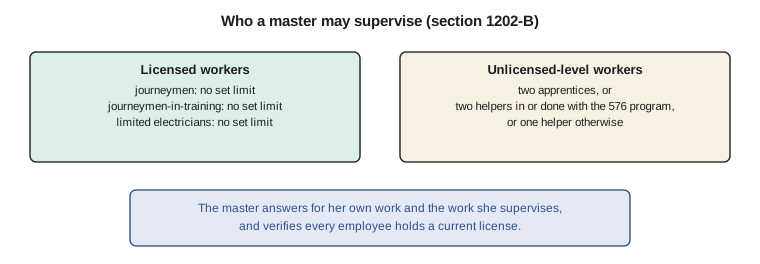
Section 1202-B sets limits on how many lower-level workers a licensee may supervise. A master may supervise two helpers who are enrolled in or have completed a 576-hour course, or two apprentices the master employs, or one helper the master employs. A master may supervise an unlimited number of licensed journeymen, journeymen-in-training and limited electricians. Journeymen and limited electricians have similar limits on helpers and apprentices: two helpers in or done with the 576-hour program, two apprentices, or one helper. A journeyman-in-training may not supervise anyone.
Helpers and apprentices must work under direct supervision. The statute does not define the phrase in chapter 17's definitions, but the plain meaning, and the way inspectors apply it, is that the supervising licensee is on the job and available to direct and check the work, not reachable by phone from another town. The board's FAQ, dated 2020, described the helper limit more simply as one helper at a time for a master. Because the FAQ and the statute differ in detail, read the statute and ask the board if a crew arrangement is close to the line.
Worked problem
Checking a crew against the limits
On the Biddeford apartment job, Nadia, as master, plans to supervise directly one journeyman, one journeyman-in-training, Tyler Grant, who is a registered apprentice, and Owen Paquette, a helper enrolled in the 576-hour program. Is the crew within her limits?
Show solution
- Licensed journeymen and journeymen-in-training: no set limit, so both are fine.
- Lower-level workers: one apprentice and one helper enrolled in the program.
- The statute allows two helpers in the program or two apprentices; mixing one of each is within that count on a plain reading.
- Because the statute lists the options with or, confirm with the board if mixing categories matters for the crew.
Answer: Probably within the limits, but the statute lists the helper and apprentice options separately; a careful master confirms a mixed arrangement with the board.
Verifying licenses
Section 1202-B adds a specific duty: a master must verify the current licensure of all employees, where applicable. Licenses expire, and a helper who forgets to renew is no longer licensed. The board offers free online license verification, and Casco Tide checks every employee's license on hire and on each renewal date. Corinne keeps a spreadsheet of names, license types, numbers and expiry dates, and she flags any license expiring in the next sixty days at the Monday meeting.
# Flag licenses expiring within 60 days (illustrative data)
from datetime import date
today = date(2026, 11, 10)
crew = [("Nadia Thibodeau", "Journeyman", date(2028, 6, 14)),
        ("Tyler Grant", "Apprentice", date(2026, 12, 20)),
        ("Owen Paquette", "Helper", date(2027, 3, 2)),
        ("Dana Michaud", "Journeyman", date(2026, 11, 30))]
for name, lic, exp in crew:
    days = (exp - today).days
    flag = "RENEW NOW" if days <= 60 else ""
print(f"{name:16s} {lic:11s} expires {exp} ({days} days) {flag}")Nadia Thibodeau Journeyman expires 2028-06-14 (582 days) Tyler Grant Apprentice expires 2026-12-20 (40 days) RENEW NOW Owen Paquette Helper expires 2027-03-02 (112 days) Dana Michaud Journeyman expires 2026-11-30 (20 days) RENEW NOW
Permits, inspections and the job file
Lesson 6 covered the permit rules. As a duty, they come down to a few habits. File the permit before work begins. Make sure the permit describes the work actually being done and amend it when the scope changes. Call for the rough-in inspection before anything is covered. Make corrections promptly when an inspector orders them. Do not let anyone else use your license number to pull a permit for work you are not responsible for. Keep the records.
That last point deserves emphasis. Lending a license, by letting another company or an unlicensed person pull permits under a master's name for a fee or a favor, is one of the most serious violations in any licensing system. It puts the master's name on work nobody licensed is supervising. In Maine it is grounds for discipline under section 1155-B and can expose both parties to the penalties for unlicensed practice.
Certifying installations
A master's signature carries weight in a few places. Under section 1102-D, a master may certify a homeowner's installation in a new single-family home before the utility connects power. The board's page also lists decisions on signing certificates of completion for solar fields. Any certification is a statement that the work meets the code. Art's rule is simple: he does not sign for work he has not inspected himself, and he keeps a record of what he looked at.
Dealing with the board
A master must deal honestly with the board. Applications and renewals must be truthful. The board's page says licensees must report convictions and changes of contact information within ten days. Renewals require proof of the continuing education course. When the board investigates a complaint, it expects a timely, complete response. Failure to cooperate can itself be grounds for discipline.
Grounds for discipline
Section 1155-B allows the board to deny or refuse to renew a license, or to impose discipline, on grounds that include fraud or deceit in obtaining a license, gross negligence, incompetence or misconduct in practice, violation of the chapter or the board's rules, and conviction of certain crimes, among others listed in the general licensing statutes. Discipline can include warnings, censure, probation, fines, suspension and revocation. The process follows the Administrative Procedure Act, with notice and an opportunity for a hearing.
| Conduct | Why it is risky |
|---|---|
| Lending a license to another company | Puts the master's name on unsupervised work; grounds for discipline |
| Working without a permit when one is required | Violates section 1102-C; inspectors can order work removed |
| Covering work before rough-in inspection | Violates the inspection requirement; work may have to be opened |
| Exceeding supervision limits | Puts unlicensed workers on unsupervised work |
| Letting an employee's license lapse | The master must verify current licensure |
| False statements on a renewal | Fraud or deceit is grounds for discipline |
Unlicensed practice
Section 1201 requires a license to make electrical installations, subject to the exceptions in sections 1102 and 1201-A. Section 1105 ties violations of section 1201 to the general enforcement statute for licensing boards, section 8003-C of Title 10, and treats violations of the chapter as strict liability crimes unless the law provides otherwise. Strict liability means the state does not have to prove the person knew the conduct was unlawful. For a master, the main exposure is indirect: putting unlicensed people on jobs, or letting a license lapse, creates unlicensed practice under the master's supervision.
When a master leaves a company
Because permits are filed by a master or limited electrician, a company that loses its only master has a problem on every open job. Permits filed under the departing master's name remain tied to that master, and new permits cannot be filed until another master or limited electrician is in place. A careful transition, like the one Art and Nadia are planning, overlaps the two licenses for a few months. Jobs permitted under Art finish under him; new jobs are permitted under Nadia. Where a job must change hands midstream, the company should talk to the inspector or the board about how to reflect the change, rather than letting the old master's name stay on work he no longer supervises.
The same issue arises in reverse when a master leaves one company for another. The master should make sure every open permit under her name is either finished, transferred in a way the inspector accepts, or closed out, so that she is not left responsible for work at a company she no longer works for. Keeping a list of open permits makes this simple.
Working with other trades and the general contractor
On most commercial and multifamily jobs, the electrical contractor is a subcontractor to a general contractor. The master's duties do not change, but the pressures do. The general contractor wants the drywall up on schedule; the master must make sure the rough-in inspection happens first. The owner's designer may specify equipment or a layout that does not meet the code; the master must raise it before installing it. Another trade may cut into a raceway or drill through a cable; the master must find out and see it repaired. A master who simply follows instructions from others, without exercising independent judgment about code compliance, is still responsible for the electrical installation.
The master as a teacher
The law treats supervision as a legal duty, but in practice it is also how the next generation learns. The master decides who works with whom, which helper is ready for more responsibility, and when a journeyman-in-training is ready to sit the journeyman exam. Casco Tide pairs each helper and apprentice with a journeyman for months at a time, and the master checks the work at each rough-in. Art has said that the best measure of a master is how many good electricians came through the shop.
Common mistakes
MistakeThinking a master is responsible only for work she does with her own hands.
InsteadSection 1202-B makes a master responsible for the installations of the people she supervises.
MistakeSupervising helpers from another job site by phone.
InsteadHelpers and apprentices need direct supervision on the job.
MistakeAssuming employees renew their own licenses so the master need not check.
InsteadThe master must verify current licensure of employees.
MistakeLetting another company use your license number for permits.
InsteadLicense lending is grounds for discipline and can amount to unlicensed practice.
MistakeSigning a homeowner certification without inspecting the work.
InsteadA certification states that the work meets the code; inspect before signing.
Summary and key terms
- A master may make installations without limitation and may file permits for any installation.
- A master is responsible for her own installations and for the work of those she supervises.
- A master may supervise unlimited licensed journeymen, journeymen-in-training and limited electricians, but only two apprentices, two helpers in the 576-hour program, or one helper.
- A master must verify the current licensure of employees.
- License lending, permit violations and false statements are grounds for discipline under section 1155-B.
- Report convictions and contact changes to the board within ten days.
- Direct supervision
- Supervision by a licensee on the job who directs and checks the work.
- License lending
- Letting another person or company use a license to obtain permits or work.
- Section 1155-B
- The statute on denial, nonrenewal and discipline of licenses.
- Strict liability crime
- An offense that does not require proof the person knew the conduct was unlawful.
- Verification of licensure
- Checking that each employee holds a current license.
Practice problems
Work each problem on paper first, then reveal the answer to check.
How many apprentices may Nadia supervise as a master?
Show answer
Two apprentices she employs.
How many licensed journeymen may she supervise?
Show answer
No set limit.
A helper's license expired last week. Who should have caught it?
Show answer
The master, who must verify employees' current licensure.
Within how many days must Nadia report a change of address to the board?
Show answer
Ten days, according to the board's page.
May a journeyman-in-training supervise a helper?
Show answer
No; a journeyman-in-training may not supervise.
Lesson quiz · 5 questions
Score 60% or more to complete this lesson.
Create a free account to save your progress, take quizzes and earn a certificate.