
MELU-219 · Lesson 10 of 12 · 20 min
Workplace safety law and OSHA for electrical contractors
▶ Video coming soon A video version of this lesson is on the way.
In March 2026, one of Casco Tide's journeymen took a shock while working near an energized panel in a Portland office building. He was not badly hurt, but he lost two days of work, and the company spent a week working out what it had to report, to whom and by when. Nadia handled much of it, and she learned that safety law for a Maine electrical contractor comes from three directions at once: federal OSHA standards, the federal injury recording and reporting rules, and Maine's workers compensation law. This lesson covers each, with the electrical safety practices that keep a company out of trouble in the first place.
The facts here come from the federal OSHA regulations in title 29 of the Code of Federal Regulations, the Occupational Safety and Health Act, sections 301 and 303 of Title 39-A of the Maine Revised Statutes, and OSHA's description of the Maine state plan, checked in November 2026. The incident at Casco Tide is invented for the course.
Who enforces safety for private employers
The federal Occupational Safety and Health Act lets states run their own safety and health plans if they are at least as effective as federal OSHA. Maine has a state plan, but it covers only public employers: state agencies, counties, cities, towns and other public bodies. Private employers in Maine, including every private electrical contractor, are covered by federal OSHA. A Casco Tide job site is inspected, if at all, by federal OSHA compliance officers, and the federal standards apply.
This matters on mixed jobs. If Casco Tide wires a new town public works garage, its own employees are still covered by federal OSHA as private-sector workers; the town's employees on the same site are covered by the state public-sector plan. Maine's Bureau of Labor Standards runs the public-sector plan and also offers free safety consultation and training to private employers through its SafetyWorks program, separate from enforcement.
The OSHA standards that matter most
OSHA's construction standards are in part 1926 of title 29, and its general industry standards are in part 1910. An electrical contractor deals with both: construction standards on new building and renovation jobs, and general industry standards when servicing equipment in an existing workplace. Subpart K of part 1926 covers electrical safety in construction, including ground-fault protection for temporary power through ground-fault circuit interrupters or an assured equipment grounding conductor program, and the rules for working near energized parts. Subpart S of part 1910 covers electrical safety in general industry. Lockout and tagout of hazardous energy is covered in section 1910.147, with construction-specific rules in subpart K.
Other standards come up on almost every job: fall protection in subpart M of part 1926, ladders in subpart X, scaffolds in subpart L, personal protective equipment in subpart E, hazard communication for chemicals in section 1926.59, which incorporates the general industry rule, and excavation in subpart P for trenches and underground services. Aerial lifts, confined spaces and work near overhead power lines each have their own rules.
OSHA also recognizes NFPA 70E, the consensus standard for electrical safety in the workplace, as a guide to how employers can meet the general duty to protect workers from arc flash and shock. NFPA 70E sets out the energized electrical work permit, shock and arc flash risk assessments, approach boundaries and the selection of arc-rated clothing and other protective equipment. The core principle in both OSHA's rules and NFPA 70E is that equipment should be put into an electrically safe work condition, de-energized, locked out, tested and verified, before work begins, with energized work only when it is truly infeasible to de-energize or would create a greater hazard.
| Topic | Main federal rule |
|---|---|
| Electrical safety in construction | 29 CFR 1926 subpart K |
| Electrical safety in general industry | 29 CFR 1910 subpart S |
| Lockout and tagout | 29 CFR 1910.147 |
| Fall protection in construction | 29 CFR 1926 subpart M |
| Ladders | 29 CFR 1926 subpart X |
| Recording and reporting injuries | 29 CFR 1904 |
Recording injuries
Part 1904 of title 29 requires many employers to keep records of work-related injuries and illnesses on the OSHA 300 log, with an incident report for each case and an annual summary posted from February through April. Electrical contractors are in an industry that is not exempt from recordkeeping, so a company with more than ten employees at any time in the previous year generally must keep the log. A recordable case includes one that results in days away from work, restricted work, medical treatment beyond first aid, loss of consciousness or a significant diagnosed injury. The journeyman's shock, with two days away from work, was recordable.
Reporting to OSHA
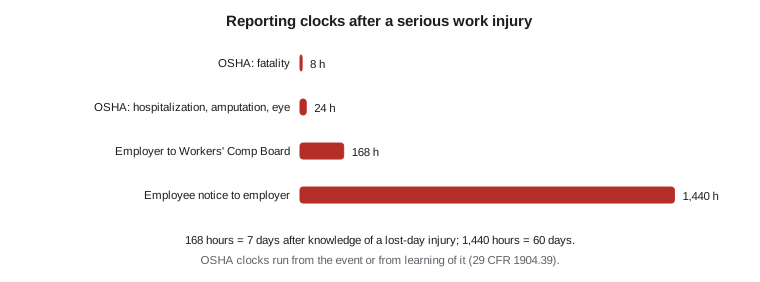
Separate from recording, section 1904.39 requires every employer, regardless of size, to report certain events to OSHA directly. A work-related fatality must be reported within eight hours of learning of it. An in-patient hospitalization, an amputation or the loss of an eye must be reported within 24 hours. Reports can be made by phone to the nearest OSHA area office, through OSHA's national hotline or online. The shock at Casco Tide did not require an OSHA report, because the journeyman was treated and released, not admitted.
Maine workers compensation reporting
Maine's workers compensation law has its own clocks. Under section 303 of Title 39-A, an employer must report to the Workers' Compensation Board within seven days after the employer receives notice or has knowledge of an injury that causes an employee to lose a day's work. For injuries that need health care but do not cause lost time, the employer completes a first report of injury within seven days, gives a copy to the employee and keeps a copy, and files it with the board only if the injury later causes lost time or the board requires it. The employer must also file wage information within 30 days after receiving notice of a claim, unless it has already done so, and must report when the employee returns to work.
The employee has a duty too. Under section 301, for injuries on or after January 1, 2020, proceedings for compensation may not be maintained unless notice of the injury is given within 60 days after the injury. The notice must state the time, place, cause and nature of the injury and the employee's name and address. Earlier injuries had shorter notice periods. Most employers encourage immediate reporting so that care starts early and the paperwork is complete.
Worked problem
Casco Tide's reporting after the shock
On Tuesday, March 10, 2026, a Casco Tide journeyman is shocked, treated at an emergency department and released. He misses his Wednesday and Thursday shifts. What reports are due?
Show solution
- OSHA direct report: none, because there was no fatality, in-patient admission, amputation or eye loss.
- OSHA 300 log: record the case, because it involved days away from work.
- Workers' Compensation Board: report within 7 days of knowledge of an injury causing a lost day, so by March 17.
- Employee notice: given the same day, well inside 60 days.
Answer: Record it on the OSHA 300 log and report it to the Workers' Compensation Board by March 17, 2026; no direct OSHA report was required.
Coverage and return to work
Workers compensation pays medical bills and, after a waiting period, a share of lost wages for work injuries, without anyone having to prove fault. In exchange, the injured worker generally cannot sue the employer for the injury. The insurer, not the employer, usually pays the benefits, but the employer controls much of what happens next: how fast the injury is reported, whether light-duty work is offered, and how the return to work is managed. A worker who comes back to modified duty, such as layout, material handling or estimating help, recovers faster and costs less than one who sits at home for weeks.
Casco Tide's journeyman returned to full duty the following Monday. Corinne reported his return and his wages to the board, as section 303 requires, and the claim closed with medical costs only. The company also posted the required workers compensation notice in its shop, which tells employees how to report an injury and who the insurer is. Small steps like these keep a minor claim minor.
Investigating and preventing
Reporting is the legal minimum. Learning from the event is what prevents the next one. After the shock, Nadia and Art walked the site, interviewed the journeyman and the foreman, and found that the panel had been assumed dead because a breaker upstream was off, but a second feed from a generator transfer switch was still live. Nobody had tested before touching. The fix was not new equipment; it was enforcing the rule they already had: lock out, tag out, test before touch, every time, with a tester checked on a known live source before and after.
The company also reviewed its written program. A lockout and tagout program should identify energy sources, assign locks to individuals, require verification of zero energy, and cover group lockout and shift changes. An energized work program should state when energized work is allowed, who approves it, what the risk assessment covers and what protective equipment is required. Training must be documented, and refresher training given when procedures change or someone is seen not following them.
# Simple incident triage: which reports are due?
def reports(fatal=False, admitted=False, amputation=False, eye_loss=False,
            days_away=0, medical_beyond_first_aid=False):
    due = []
    if fatal:
        due.append("OSHA report within 8 hours")
    elif admitted or amputation or eye_loss:
        due.append("OSHA report within 24 hours")
    if fatal or days_away > 0 or medical_beyond_first_aid or admitted or amputation or eye_loss:
        due.append("record on OSHA 300 log (if the employer keeps one)")
    if days_away > 0:
        due.append("Maine WCB report within 7 days of knowledge")
    return due or ["first aid only: keep an internal note"]

print(reports(days_away=2, medical_beyond_first_aid=True))
print(reports(admitted=True, days_away=10))['record on OSHA 300 log (if the employer keeps one)', 'Maine WCB report within 7 days of knowledge'] ['OSHA report within 24 hours', 'record on OSHA 300 log (if the employer keeps one)', 'Maine WCB report within 7 days of knowledge']
Citations and penalties
Federal OSHA can inspect after a complaint, a referral, a serious accident or as part of a targeted program, such as fall protection in construction. It can issue citations for violations, classified as other-than-serious, serious, willful or repeat, with penalties that are adjusted for inflation each year. An employer may contest a citation within fifteen working days of receiving it. The course does not give penalty amounts, which change annually; the exam is more likely to test the reporting clocks and who has jurisdiction.
Utility lines and digging
Two more safety laws come up often for electrical contractors. Maine's underground facility damage prevention law requires anyone excavating to notify the one-call center, Dig Safe, before digging so that buried utilities can be marked, and OSHA's excavation rules require locating utilities before digging as well. Work near overhead lines is governed by OSHA's clearance rules and by Maine's high voltage line safety law, which requires notice to the utility before work within set distances of high voltage lines. The course describes these generally; read the current statutes for the distances and notice periods.
Common mistakes
MistakeAssuming Maine's state plan covers private contractors.
InsteadMaine's plan covers public employers only; private employers are under federal OSHA.
MistakeReporting a hospital admission to OSHA after three days.
InsteadIn-patient hospitalization must be reported within 24 hours.
MistakeWaiting a month to report a lost-time injury to the Workers' Compensation Board.
InsteadSection 303 requires a report within 7 days after knowledge of a lost-day injury.
MistakeTreating an upstream breaker as proof that equipment is dead.
InsteadLock out, tag out and test before touching; there may be other sources.
MistakeConfusing recording with reporting.
InsteadRecording is the OSHA 300 log; reporting is the direct call to OSHA for fatalities and serious events.
Summary and key terms
- Private Maine employers are under federal OSHA; Maine's state plan covers public employers only.
- Key rules include 29 CFR 1926 subpart K, 1910 subpart S, 1910.147 lockout and tagout, and part 1904 recordkeeping.
- Report a fatality to OSHA within 8 hours, and an in-patient hospitalization, amputation or eye loss within 24 hours.
- Report a lost-day injury to the Maine Workers' Compensation Board within 7 days of knowledge.
- Employees must give notice of an injury within 60 days for injuries since January 1, 2020.
- Establish an electrically safe work condition before work; test before touch.
- State plan
- A state-run occupational safety and health program approved by federal OSHA; Maine's covers public employers.
- OSHA 300 log
- The federal log of recordable work-related injuries and illnesses.
- Electrically safe work condition
- Equipment de-energized, locked out, tested and verified before work begins.
- NFPA 70E
- The consensus standard for electrical safety in the workplace.
- First report of injury
- The Maine form an employer completes after a work injury.
Practice problems
Work each problem on paper first, then reveal the answer to check.
Who inspects safety at a private Casco Tide job site?
Show answer
Federal OSHA.
A worker is admitted to the hospital overnight after a fall. How soon must OSHA be told?
Show answer
Within 24 hours.
A worker loses three days after a cut. When is the Maine board report due?
Show answer
Within 7 days after the employer learns of the lost-day injury.
How long does an employee injured in 2026 have to give notice?
Show answer
60 days.
What federal rule covers lockout and tagout?
Show answer
29 CFR 1910.147.
Lesson quiz · 5 questions
Score 60% or more to complete this lesson.
Create a free account to save your progress, take quizzes and earn a certificate.