
MELU-219 · Lesson 1 of 12 · 19 min
How electrical licensing works in Maine
▶ Video coming soon A video version of this lesson is on the way.
Nadia Thibodeau has worked in the electrical trade in southern Maine for nine years. She started in 2017 as a licensed helper for a small residential shop in Gorham, finished the 576-hour electrical program at a community college at night, and in 2022 passed the journeyman exam and earned her Maine journeyman electrician license. For the last four years she has run crews for Casco Tide Electric, LLC, an eleven-person contractor in Westbrook that does light commercial, multifamily and residential work across Cumberland and York counties. The company is invented for this course, but the questions it faces are real. Its owner, Art Lindgren, has held a Maine master electrician license since 1994. Art is sixty-six and wants to step back. He has asked Nadia to earn her master license so the company can keep filing permits and taking work after he retires, and this course follows her from her first question to exam day.
This is the Maine course in the HSM University master electrician exam prep series. The core courses, MELU-101 through MELU-107, teach the National Electrical Code skills that every master-level exam tests: navigating the code, load calculations, conductors and overcurrent protection, grounding and bonding, motors and transformers, special occupancies, and business and law. This course adds what is specific to Maine: who licenses electricians, what the master license requires, how the exam is run, which code edition applies, who issues permits and inspects, and the state laws on contracts, liens, safety and workers compensation that a master is expected to know.
Two cautions apply to every lesson. First, licensing rules change. The facts in this course were checked in November 2026 against chapter 17 of Title 32 of the Maine Revised Statutes, the Electricians' Examining Board's licensing pages, announcements and newsletter, the candidate information bulletin of the board's testing company, the lien and home construction contract statutes in Title 10, and the workers compensation statute in Title 39-A. The lessons say so when a fact comes from an older page or could not be confirmed. Before you apply, pay a fee or book an exam, check the current pages yourself. Second, electrical codes are copyrighted. This course cites code articles and sections by number and explains them in plain words, but it never reproduces their text, tables or figures. Keep your own copy of the code your exam uses open beside you.
One statewide license
Maine licenses electricians at the state level. A single board, the Electricians' Examining Board, examines candidates and issues every electrician license in the state, from helper to master. The board sits within the Office of Professional and Occupational Regulation, part of the Department of Professional and Financial Regulation in Augusta, and that office handles applications, renewals, permits and complaints on the board's behalf. The board's authority comes from chapter 17 of Title 32, sections 1101 through 1207, and from the rules it adopts under that chapter.
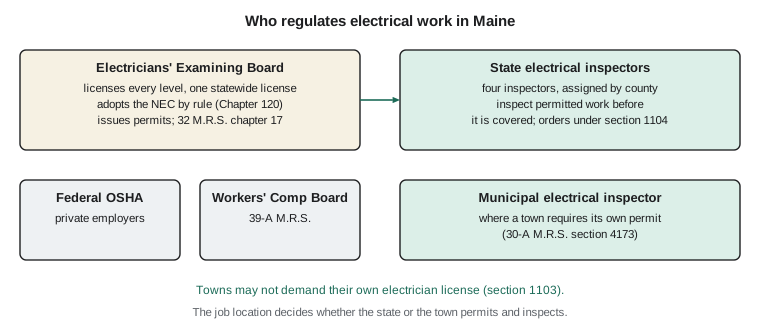
Because the license is statewide, a master licensed in Augusta can work in Kittery, Lewiston, Bangor or Presque Isle without passing another test. Section 1103 goes further. It says a municipality may not require a licensed electrician to hold a municipal license as well, whatever its charter or ordinances say. A town may run its own electrical permit and inspection program, but it may not issue a permit unless it is satisfied that the applicant complies with chapter 17. In other words, towns can check that the person doing the work holds the right state license; they cannot add a license of their own.
This is different from states where cities license electricians and from states where a separate board licenses electrical contractors. In Maine the state license is the license. There is no separate state electrical contractor license, and Lesson 8 explains what a business needs instead.
The license types
Section 1202-B lists the licenses the board issues. A helper electrician license needs only an application and fee, and a helper works under the direct supervision of a master, journeyman or limited electrician while employed by a master, limited electrician or electrical company. An apprentice electrician license requires enrollment in a registered apprenticeship program approved by the United States Department of Labor or a recognized state agency, and an apprentice also works under direct supervision. A journeyman-in-training license requires an exam and a set mix of hours and schooling; the holder may make installations while employed by a master, limited electrician or electrical company, but may not supervise anyone. A journeyman license requires an exam and more hours, and a journeyman may supervise a small number of helpers or apprentices. A master license requires an exam and the most experience, and a master may make electrical installations without limitation.
Beside this ladder sit the limited licenses. Each covers one category of work: water pumps, outdoor signs, gasoline dispensing equipment, traffic signals, house wiring in one- and two-family dwellings, refrigeration, low-energy electronics such as fire alarm and limited energy systems, and crane wiring. A limited electrician may make installations within that category without limitation, but not outside it. The limited house wiring license matters in this course because it is one of the licenses that can file permits and certify homeowner installations.
| License | Exam | Can supervise? | Works independently? |
|---|---|---|---|
| Helper electrician | No | No | No; direct supervision |
| Apprentice electrician | No | No | No; direct supervision |
| Journeyman-in-training | Yes | No | No; employed by a master, limited electrician or company |
| Journeyman electrician | Yes | Yes, a few helpers or apprentices | No; employed by a master, limited electrician or company |
| Limited electrician | Usually | Yes, within the category | Yes, within the category |
| Master electrician | Yes | Yes | Yes, without limitation |
Individuals and companies
Chapter 17 defines an electrical company as a person, firm, corporation or partnership employing licensees engaged in the business of doing electrical installations, and it defines a master electrician as a licensed person qualified to engage in the business of installing electrical wiring and equipment. Journeymen, journeymen-in-training and helpers must be employed by a master, a limited electrician or an electrical company. In practice, a Maine electrical company is built around at least one master or limited electrician, because permits must be filed by a licensed master or limited electrician, and that person answers for the work.
That is why Art's retirement matters to Casco Tide. Every state permit the company pulls names Art as the master electrician. If he retired with no other master on staff, the company could keep its journeymen and its trucks, but it could not file permits for the commercial and multifamily work that is most of its business. Nadia is training to close that gap.
Permits and inspections
Maine's permit system is unusual. Section 1102-C says that, unless an exception applies, a permit must be obtained from the board before an electrical installation may be performed, and only a licensed master or limited electrician may apply. Inspection is required before wiring is enclosed. The licensed electrician notifies a state electrical inspector, or the municipal inspector where the town has one, when the work is ready, and the utility must see proof of a permit before it connects power.
The exceptions are broad, and they shape a contractor's paperwork. Electrical work in a single-family dwelling done by a licensed electrician needs no state permit. Minor repairs, utility work and work in industrial or manufacturing facilities are excepted. So is work that needs a permit and inspection under a municipal ordinance adopted under section 4173 of Title 30-A, which lets a town that has provided for electrical inspection require its own permit from its own inspector. Lesson 6 works through how Nadia decides which office handles a given job.
The board employs a small staff of state electrical inspectors. Its spring 2026 newsletter listed four, each assigned to a group of counties, from York and western Cumberland in the south to Aroostook and Washington in the north. Section 1104 gives inspectors the power to enter premises, order noncompliant work removed or corrected, and in a dangerous case order a building vacated.
The code
The board adopts the National Electrical Code statewide by rule, in its Chapter 120, with Maine amendments. The 2023 NEC applied to installations commencing on or after July 1, 2024, and the board's new Chapter 120 adopts the 2026 NEC for installations commencing on or after July 1, 2026. Because the edition depends on when the work commenced, a job that began in the spring of 2026 can still be under the 2023 edition while a job that began in August is under 2026. Lesson 5 covers the adoption and how to find the amendments.
The exam picture
The board contracts with a testing company, PROV, to deliver its exams. The candidate information bulletin dated April 2026 describes the master exam as 100 questions in four hours, open book, with a passing score of 70, and it allows only a softcover copy of the National Electrical Code edition it names. Candidates must be approved by the board before they schedule. Lessons 3 and 4 cover the application, approval, booking and exam-day rules in detail.
Enforcement
Licensing would mean little without enforcement. Working without a required license is handled under section 1105, which ties unlicensed practice to the general enforcement statute for licensing boards and treats violations of the chapter as strict liability crimes unless the law says otherwise. The board can also deny, refuse to renew, suspend or revoke a license and impose other discipline under section 1155-B, and inspectors enforce the code through orders under section 1104. The exam is more likely to ask who has which power than to ask for a fine amount, and fine amounts change; check the current statute before relying on a number.
For a master, enforcement is personal. Section 1202-B says a master is responsible for her own installations and for the installations of the people she supervises, and must verify that her employees hold current licenses. Art has told Nadia that the best protection is dull paperwork: a current license, permits filed before work starts, rough-in inspections called before anything is covered, helpers and apprentices on the payroll with current licenses, and a file for every job. Lesson 7 returns to these habits.
How this course is organized
The lessons follow Nadia's path. Lesson 2 covers eligibility for the master license, Lesson 3 the application, approval and booking process, and Lesson 4 the exam format and references. Lesson 5 explains Maine's adoption of the NEC and Lesson 6 permits and inspections. Lesson 7 covers the duties of the master, Lesson 8 running an electrical company, insurance and bonding, and Lesson 9 contracts and mechanics' liens. Lesson 10 covers safety law, OSHA and workers compensation, Lesson 11 renewal and continuing education, and Lesson 12 a practice review and test-day strategy. Every lesson ends with a quiz that mixes multiple choice, true or false, number, ordering and matching questions, and the course ends with a final exam.
The calculator below shows the first planning Nadia did. Art wants to step back in about fourteen months. Nadia needs time to confirm her hours, take the 45-hour code course, apply and wait for approval, study, sit the exam, possibly retake it, and receive the license before Art leaves. Change the numbers to fit your own plan.
# Nadia's planning check (illustrative months)
months_until_art_steps_back = 14
steps = {
    "confirm journeyman hours and 576-hour program records": 1,
    "complete the 45-hour NEC course": 2,
    "apply and wait for board approval": 1,
    "study for the master exam": 4,
    "sit the exam": 1,
    "retake allowance, if needed": 2,
    "license issued; permits move to Nadia": 1,
}
needed = sum(steps.values())
for step, months in steps.items():
    print(f"{step}: {months} months")
print(f"Total: {needed} months; margin: {months_until_art_steps_back - needed} months")confirm journeyman hours and 576-hour program records: 1 months complete the 45-hour NEC course: 2 months apply and wait for board approval: 1 months study for the master exam: 4 months sit the exam: 1 months retake allowance, if needed: 2 months license issued; permits move to Nadia: 1 months Total: 12 months; margin: 2 months
Common mistakes
MistakeAssuming Maine towns license electricians.
InsteadThe Electricians' Examining Board issues every license; section 1103 bars municipal licenses for licensed electricians.
MistakeThinking a journeyman can file a state permit.
InsteadSection 1102-C says the application is filed by a licensed master or limited electrician.
MistakeBelieving Maine has a separate electrical contractor license.
InsteadThere is no separate state contractor license; companies employ licensees, and a master or limited electrician files permits.
MistakeAssuming every job needs a state permit.
InsteadSection 1102-C has broad exceptions, including single-family work by a licensed electrician and work permitted by a town under section 4173.
MistakeAssuming one NEC edition applies to every job in 2026.
InsteadThe edition depends on when the installation commenced: 2023 before July 1, 2026, and 2026 on or after.
Summary and key terms
- The Electricians' Examining Board issues every Maine electrician license; the license is valid statewide.
- Towns may not require their own electrician license, but may run their own permit and inspection program.
- The ladder runs helper, apprentice, journeyman-in-training, journeyman and master, with limited licenses beside it.
- Only a master or limited electrician may file a state permit, and inspection is required before work is covered.
- The board adopts the NEC statewide in Chapter 120; the 2026 NEC applies to work commencing on or after July 1, 2026.
- Check current statutes, rules and board pages before relying on any detail.
- Electricians' Examining Board
- The Maine board that examines and licenses electricians, adopts the electrical code by rule and issues permits.
- OPOR
- The Office of Professional and Occupational Regulation, which administers the board's licensing and permits.
- Electrical company
- A person or business employing licensees engaged in the business of doing electrical installations.
- Limited electrician
- A licensee who may make installations without limitation, but only within one category of work.
- Chapter 120
- The board rule that adopts the National Electrical Code with Maine amendments.
Practice problems
Work each problem on paper first, then reveal the answer to check.
Does Nadia need a Portland electrician license to work in Portland once she holds a Maine master license?
Show answer
No; section 1103 bars municipal licenses for licensed electricians, though Portland may require its own permit.
Who issues Nadia's master license?
Show answer
The Electricians' Examining Board, through OPOR.
Can Casco Tide's journeyman file a state permit while Art is on vacation?
Show answer
No; a licensed master or limited electrician must file it.
Which NEC edition applies to a commercial job that commenced in September 2026?
Show answer
The 2026 NEC as adopted with Maine amendments in Chapter 120.
What passing score does the April 2026 bulletin give for the master exam?
Show answer
70.
Lesson quiz · 5 questions
Score 60% or more to complete this lesson.
Create a free account to save your progress, take quizzes and earn a certificate.