
MELU-219 · Lesson 11 of 12 · 19 min
Renewal and continuing education
▶ Video coming soon A video version of this lesson is on the way.
Art has renewed his master license sixteen times since 1994. He has never let it lapse, and he can tell stories about masters who did: a colleague who discovered on a Monday that his license had expired the previous Friday, with three permits waiting to be filed; another who moved, never got the renewal notice, and found out from an inspector. When Nadia's license is issued, Art wants her to set up the renewal habits on the first day. This lesson covers the license term, the continuing education requirement, the renewal process, late renewal and reinstatement, and how a Maine license relates to work in other states.
The facts here come from section 1204 of Title 32, the board's master electrician page and FAQ, and its announcements on continuing education, checked in November 2026. Fees and course lists change; confirm them before each renewal.
The license term
The board's master electrician page gives the term of a master license as two years from the date of first licensure. Unlike states that renew every license on the same calendar date, Maine's terms run from the individual license's anniversary, unless the Commissioner of Professional and Financial Regulation sets a different expiration schedule, which section 1204 allows. If Nadia's license is issued on February 15, 2027, her first renewal will be due by February 15, 2029, and every two years after that.
The renewal fee on the board's page in November 2026 was 150 dollars for a master and 20 dollars for a senior master, a reduced-fee license for masters over 70. Renewal is filed online through the board's licensing portal, and the board sends notices by email, so a current email address on file matters as much as it did during the application.
Continuing education
Section 1204 requires licensees to document continuing education set by the board's rules as a condition of renewal. For masters, journeymen and limited electricians, the board's page and FAQ describe the requirement as a 15-hour course on the current National Electrical Code as adopted by the board, completed before renewal. Helpers and apprentices have no continuing education requirement. The course must be from a board-approved provider; the board's license search lets licensees look up approved providers and courses.
The board's course search lists both 15-hour and 45-hour code courses. The 45-hour course is the one required within two years before initial licensing, discussed in Lesson 2. The requirement the board's pages state for renewal is the 15-hour update course on the code as currently adopted, which in a renewal period after July 1, 2026 means the 2026 NEC with the Maine amendments. Whether a 45-hour course taken for another purpose also satisfies a renewal is a question to confirm with the board before relying on it.
Maine and Massachusetts have a continuing education reciprocity agreement, in effect since April 2017, under which approved code update courses can count in both states for licensees who hold licenses in each. A licensee relying on it should confirm the current terms and which courses qualify.
Late renewal and reinstatement
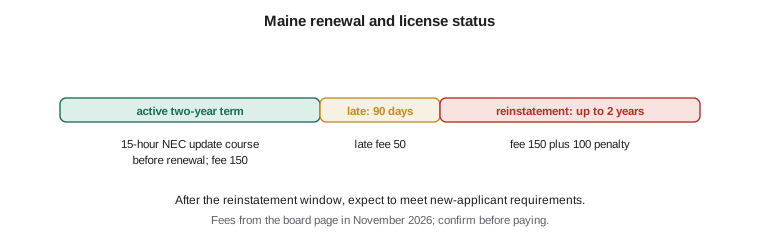
Section 1204 gives a 90-day grace period. A license may be renewed up to 90 days after its expiration date by paying a late fee in addition to the renewal fee. The board's page in November 2026 listed the late fee as 50 dollars. After 90 days, the statute requires an additional late fee and subjects the person to all the requirements for new applicants, though the board may waive the examination or other requirements after considering the protection of the public. The board's page described renewal between 91 days and two years after expiration as reinstatement, with the 150 dollar license fee plus a 100 dollar penalty fee.
The grace period is for renewing, not for working. A license that has expired is not current, and doing electrical installations or filing permits on an expired license is unlicensed work, even if the license is later renewed within 90 days. A master whose license lapses also leaves her company unable to file permits, and every helper and apprentice under her supervision without a licensed supervisor.
Section 1204 also protects people in military service. If a license lapsed because of active duty, the board must waive the examination if the renewal is received within 90 days after separation under conditions other than dishonorable, subject to a limit on the length of service unless the longer service was mandatory.
| When renewed | What applies |
|---|---|
| Before expiration | Renewal fee and proof of the 15-hour code course |
| 1 to 90 days after expiration | Renewal fee plus late fee; no work while expired |
| 91 days to 2 years after | Reinstatement: license fee plus penalty fee, as the board's page described |
| More than 2 years after | Expect new-applicant requirements, which the board may waive in part |
# Renewal status on a given date (illustrative)
from datetime import date, timedelta
expires = date(2029, 2, 15)
for check in (date(2029, 1, 20), date(2029, 3, 10), date(2029, 7, 1), date(2031, 6, 1)):
    days_late = (check - expires).days
    if days_late <= 0:
        status = "active: renew on time"
    elif days_late <= 90:
        status = f"expired {days_late} days: late renewal window"
    elif days_late <= 730:
        status = f"expired {days_late} days: reinstatement"
    else:
        status = "expired over 2 years: expect new-applicant rules"
print(check, "->", status)2029-01-20 -> active: renew on time 2029-03-10 -> expired 23 days: late renewal window 2029-07-01 -> expired 136 days: reinstatement 2031-06-01 -> expired over 2 years: expect new-applicant rules
Senior licenses
Maine offers senior master and senior journeyman licenses for licensees over 70, at a reduced fee. The board's master page listed a 20 dollar license and renewal fee for a senior master. The page did not describe different continuing education rules for senior licensees, so a senior master should assume the code course is still required unless the board says otherwise. The senior license keeps experienced electricians in the trade, often as part-time masters or inspectors of their own former company's work.
What the update course covers
A 15-hour code update course is not a general review of the whole code. It concentrates on what changed in the edition the board most recently adopted and on the Maine amendments, with time for the requirements that inspectors most often find violated. A typical course walks through new and revised sections article by article, explains the reasons the code-making panels gave for the changes, and works examples on the topics that affect daily work, such as ground-fault and arc-fault protection, service equipment, surge protection, energy storage and solar installations, and load calculations. Good instructors also bring in the board's advisories and the senior inspector's code decisions.
Licensees choose among approved providers: community colleges, trade associations, union training centers, supply houses and private instructors. Courses are offered in classrooms, in the evening over several weeks, and in other formats the board approves. The certificate of completion is what proves the course was taken, and a licensee should check that the provider reports completion in the way the board requires before relying on it at renewal.
Why the renewal cycle matters to the company
For an electrical company, a master's renewal is not a personal errand; it is a business continuity issue. If the only master's license lapses, the company cannot file permits, helpers and apprentices lose their required supervision, and customers and general contractors who check licenses may stop calling. Casco Tide treats Nadia's future renewal the way it treats its insurance renewal: the date goes on the company calendar, the course is booked months ahead and paid by the company, and a second person, Corinne, checks that the renewal confirmation has arrived. The company also plans to encourage a second journeyman to work toward a master license, so that it is never again dependent on a single license.
Keeping records
The board may audit continuing education, and a licensee should keep the course certificate for at least the renewal cycle and preferably longer. Casco Tide keeps a renewal folder for each licensed employee, with the license card, the expiry date, the course certificate and a copy of the renewal confirmation. Corinne's spreadsheet, described in Lesson 7, flags every license expiring in the next sixty days, including the masters'.
Worked problem
Planning Nadia's first renewal
Suppose Nadia's master license is issued on February 15, 2027. When is her first renewal due, and when should she plan to take the 15-hour course?
Show solution
- The term is two years from first licensure: February 15, 2029.
- The course must be completed before renewal, and enrollment can fill up near common renewal dates.
- A sensible plan is to take the course in the autumn of 2028, leaving time for the certificate to be posted.
Answer: Renewal due February 15, 2029; plan the 15-hour course for the autumn of 2028.
Working in other states
A Maine license authorizes work in Maine only. Casco Tide's crews sometimes cross into New Hampshire, and occasionally a customer asks about a job in Massachusetts. Each of those states licenses electricians through its own board. Maine's reciprocity agreements, discussed in Lesson 2, may let a Maine licensee obtain a license in another state without retesting, but each state sets its own conditions, fees and continuing education. The board's master page in November 2026 named New Hampshire and Vermont for master reciprocity; an older FAQ also listed Massachusetts and Rhode Island. Confirm current terms with both states before relying on reciprocity.
Holding licenses in two states means two renewal cycles, two continuing education requirements and two sets of rules. The Maine and Massachusetts continuing education agreement eases the course burden for those two states, but not the renewal dates. Nadia plans to concentrate on her Maine license for the first year and to consider a New Hampshire license once she is settled as Casco Tide's master.
Changes of name, address and employer
The board's page says licensees must report changes of contact information within ten days. A change of employer does not change the license itself, but it changes who supervises whom and whose name goes on permits. A master who changes companies should close out or transfer her open permits, as Lesson 7 explained, and a journeyman or helper must be employed by a master, limited electrician or electrical company to work at all.
If something goes wrong
Missed renewals happen. If a license expires, stop doing electrical work and filing permits immediately, renew within the 90-day window if possible, and tell any company that relies on the license. If the license is past the window, contact the board about reinstatement before doing anything else. Trying to work through a lapse and fix it later turns an administrative problem into a disciplinary one.
The same advice applies to the continuing education certificate. If a provider has not posted a completion by the time renewal is due, contact the provider and the board at once rather than waiting. A renewal held up by missing paperwork is usually fixed quickly when the licensee acts early, and a short delay inside the license term costs nothing. A delay that carries the license past its expiration date costs a late fee at best and, for a master, a stop on every permit the company needs. Nadia has already written February 15, 2029 on the company calendar as a placeholder, to be corrected once her license is actually issued, with reminders set ninety, sixty and thirty days before it.
Common mistakes
MistakeAssuming every Maine license renews on the same statewide date.
InsteadTerms run two years from first licensure, unless the Commissioner sets another schedule.
MistakeWorking during the 90-day late renewal window.
InsteadAn expired license is not current; renew before working.
MistakeThinking helpers need the 15-hour course.
InsteadHelpers and apprentices have no continuing education requirement.
MistakeAssuming a Maine license covers work in New Hampshire.
InsteadEach state licenses its own electricians; reciprocity requires an application.
MistakeWaiting until the expiry week to find a course.
InsteadBook the 15-hour course well before renewal.
Summary and key terms
- A Maine master license runs two years from the date of first licensure.
- Masters, journeymen and limited electricians complete a 15-hour current NEC course before renewal; helpers and apprentices do not.
- Renewal up to 90 days late requires a late fee; after that, reinstatement or new-applicant rules apply.
- Do not work or file permits on an expired license.
- Maine and Massachusetts share a continuing education reciprocity agreement.
- Report contact changes to the board within ten days and keep course certificates.
- Renewal
- Extending a license for another term by meeting the fee and education requirements.
- 15-hour code course
- The board-approved update course on the current NEC required before renewal.
- Late renewal window
- The 90 days after expiration in which a license may be renewed with a late fee.
- Reinstatement
- Restoring a license that has been expired more than 90 days.
- Senior master
- A reduced-fee master license for licensees over 70.
Practice problems
Work each problem on paper first, then reveal the answer to check.
Nadia's license is issued on February 15, 2027. When does it expire?
Show answer
February 15, 2029.
What continuing education must she complete before renewing?
Show answer
A board-approved 15-hour course on the current NEC as adopted.
Her license expired 40 days ago. May she file a permit today?
Show answer
No; she must renew first, within the 90-day late window.
What did the board's page list as the late fee within 90 days?
Show answer
50 dollars.
Does her apprentice need the 15-hour course?
Show answer
No; apprentices have no continuing education requirement.
Lesson quiz · 5 questions
Score 60% or more to complete this lesson.
Create a free account to save your progress, take quizzes and earn a certificate.