
MELU-219 · Lesson 4 of 12 · 20 min
The exam format and the references allowed
▶ Video coming soon A video version of this lesson is on the way.
Nadia's approval email arrived in October 2026 with a link to the PROV candidate information bulletin. Art had told her that the exam was open book, which sounded easier than it is. An open book exam with 100 questions in four hours gives about two and a half minutes per question. A candidate who looks up every answer runs out of time; a candidate who knows the code well enough to go straight to the right article finishes with time to check. This lesson covers what the bulletin says about the master exam, what may come into the testing room, and how to set up a code book that helps rather than slows.
The details here come from the PROV bulletin dated April 2026 and the board's examination page and FAQ, checked in November 2026. The board's page referred to a bulletin dated May 2026 as the current one. Bulletins are revised, especially around a change of code edition, so read the version that comes with your approval and follow it where it differs from this lesson.
The master exam at a glance
The April 2026 bulletin describes the Maine master electrician exam as 100 questions with a four-hour time limit. The journeyman exam is 80 questions in three hours, and the board's FAQ gives 50 questions for the limited exams. All require a score of 70 to pass. The exams are open book, and the questions are drawn from the National Electrical Code and from the electrical theory, calculations and practical knowledge a licensed electrician at that level is expected to have.
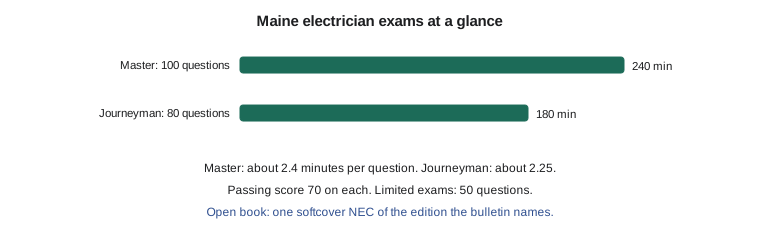
Two and a half minutes per question is an average, not a budget for each question. Some questions, such as what the minimum burial depth is for a given wiring method, take thirty seconds with a well-tabbed book. Others, such as a dwelling service calculation or a motor branch circuit with several steps, can take six or eight minutes. The strategy in Lesson 12 is built around that difference.
What the questions cover
Master exams across the country cover similar ground, and Maine's is no exception, though the board does not publish a detailed weighting in the bulletin summarized here. Expect questions on definitions and general requirements, wiring and protection, wiring methods and materials, equipment for general use, special occupancies, special equipment, special conditions, communications and limited energy systems, and the calculation topics: dwelling and commercial service and feeder loads, conductor ampacity and adjustment, box and conduit fill, voltage drop, motor circuits and transformer sizing. A master exam leans more heavily on design and calculation than a journeyman exam.
The core courses in this series map onto these topics. MELU-101 covers code navigation, MELU-102 load calculations, MELU-103 conductors and overcurrent protection, MELU-104 grounding and bonding, MELU-105 motors and transformers, MELU-106 special occupancies and MELU-107 business and law. Nadia's study plan works through them in that order and then returns to the weakest areas.
The book rule
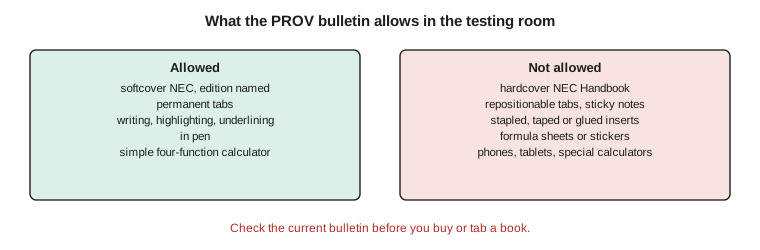
The bulletin's reference rule is short and strict. The only permitted book is the softcover version of the National Electrical Code edition the bulletin names. The April 2026 bulletin named the 2023 edition and said that the hardcover NEC Handbook is not allowed. The Handbook contains commentary and illustrations in addition to the code text, which is why it is excluded. A spiral-bound or loose-leaf version may or may not be acceptable, depending on the bulletin's wording; a candidate who wants one should confirm first.
The edition matters more than usual in 2026. The board adopted the 2026 NEC for installations commencing on or after July 1, 2026, but the April 2026 bulletin still named the 2023 edition for the exam. Exams often lag a new installation code by months while questions are written and reviewed. A candidate testing in early 2027 must use whichever edition the bulletin in force on the exam date names, and should not assume that the installation code and the exam code are the same.
Tabs, notes and highlighting
The bulletin lets candidates prepare their book within limits. Permanent tabs are allowed; repositionable tabs and sticky notes are not. The book may be written in, highlighted or underlined, though the bulletin specifies pen for highlighting and underlining. Nothing may be stapled, taped, glued or otherwise inserted into the book, and formula sheets or stickers may not be added. Proctors inspect books before the exam, and a book that breaks the rules can be refused, which would leave a candidate without a reference for an open book exam.
Within those limits, a good book is a personal tool. Nadia tabbed the articles she uses most: definitions in Article 100, the general requirements of Article 110, branch circuits, feeders and services in Articles 210, 215, 220 and 230, overcurrent protection in Article 240, grounding and bonding in Article 250, the wiring method articles, conductors and ampacity in Article 310, motors in Article 430, transformers in Article 450, and the special occupancy articles that come up most often. She wrote short margin notes pointing from one section to a related one, such as from a dwelling load section to the optional method, which is allowed because it is writing in the book rather than an inserted sheet.
| Preparation | Allowed by the April 2026 bulletin? |
|---|---|
| Permanent tabs on articles | Yes |
| Repositionable tabs or sticky notes | No |
| Handwritten notes in the margins | Yes |
| Highlighting and underlining in pen | Yes |
| A taped-in formula sheet | No |
| The hardcover NEC Handbook | No |
Calculators and identification
The bulletin allows only simple four-function calculators. Programmable, scientific and financial calculators are not allowed, and neither are phones, tablets or other devices. This affects how candidates practice: someone used to a scientific calculator for square roots and powers must learn to do three-phase calculations with a basic calculator, using 1.732 for the square root of three and doing the steps in order. Practice with the same kind of calculator you will use in the testing room.
Candidates must bring current, valid, government-issued photo identification. The bulletin describes limited alternatives for candidates without a photo ID, but nobody should rely on them. Check the expiry date on your driver's license when you book, not the night before.
Worked problem
A three-phase calculation on a four-function calculator
A 480-volt, three-phase load draws 52 amperes. What is the load in kilovolt-amperes, using only a basic calculator?
Show solution
- Write the formula: kVA equals volts times amperes times 1.732, divided by 1,000.
- Multiply 480 by 52: 24,960.
- Multiply by 1.732: about 43,231.
- Divide by 1,000: about 43.2 kVA.
Answer: About 43.2 kVA. With a four-function calculator, enter 1.732 as a constant rather than taking a square root.
How a question reads
Most questions are multiple choice with four options. Some ask for the minimum or maximum value the code allows; others describe an installation and ask which option complies. Read the stem carefully for the words that change the answer: dwelling or non-dwelling, copper or aluminum, continuous or noncontinuous load, wet or dry location, the temperature rating of terminations. Many wrong answers are the right number for a slightly different situation. A good habit is to underline the condition words in your head before turning to the book.
Some questions test Maine-specific knowledge. Because the exam is built for Maine, it can include questions about the state's licensing law, supervision limits, permits and amendments. These carry the same weight as code questions and are often quicker to answer for a candidate who has studied the statute. Lessons 1, 2, 6, 7 and 11 cover the facts most likely to appear.
Finding things fast
Speed in an open book exam comes from knowing where to look. There are three ways into the code: the table of contents, the index and the tabs. The table of contents is best when you know which article covers the topic but not which section. The index is best when you know the subject but not the article; it lists topics alphabetically, with section numbers. The tabs are best for the dozen articles you open on almost every practice test. Strong candidates use all three without thinking, and they practice lookups as a skill in its own right.
A useful drill is to pick ten topics at random, such as clearance in front of a panelboard, the minimum size of a grounding electrode conductor, the receptacle spacing rule along a kitchen counter, or the maximum overcurrent device for a small appliance branch circuit, and time how long it takes to find the governing section for each. Nadia's first attempt averaged almost two minutes a lookup. After three weeks of daily ten-minute drills, she was under forty seconds, which freed most of an hour on a full practice test.
A study plan built on the exam
Nadia's plan runs from her approval in October to her exam in January, about twelve weeks. The first six weeks work through the core review topics in order, with a short timed quiz at the end of each week. Weeks seven to ten are mixed practice: two full timed tests a week, each followed by an error review in which she records every missed question, the reason she missed it and the section that answers it. The last two weeks are for the weakest topics, Maine law, and one final full test under exam conditions the weekend before.
| Weeks | Focus | Measure |
|---|---|---|
| 1 to 2 | Code navigation, definitions, general requirements | Lookup drill times |
| 3 to 4 | Load calculations and services | Timed calculation sets |
| 5 to 6 | Conductors, grounding, motors, transformers | Weekly quiz scores |
| 7 to 10 | Full timed practice tests and error reviews | Score and time per test |
| 11 to 12 | Weak topics, Maine law, final rehearsal | Final test at exam pace |
Check-in on exam day
On the day, arrive early enough to check in calmly. Proctors check identification, inspect the code book page by page or by sample, and confirm the calculator. Personal items, including phones, are stored outside the testing area. A candidate whose book is refused for a forbidden insert may be allowed to remove it on the spot, but cannot count on that, so the time to inspect the book is the night before, not in the parking lot.
Pacing
Four hours sounds long until it is divided by 100. A useful plan is to aim for about 45 minutes per 20 questions in the first pass, answering everything that can be answered quickly and marking the rest, and to leave the hardest calculations for later. Lesson 12 develops a three-pass plan with specific checkpoints. For now, the point is that pacing must be practiced under time, with the same book and calculator, at least three or four times before exam day.
# Pace check: are you on track at each checkpoint?
total_q, total_min = 100, 240
for done in (20, 40, 60, 80, 100):
    allowed = total_min * done / total_q
print(f"after {done:3d} questions: about {allowed:5.1f} minutes used")after 20 questions: about 48.0 minutes used after 40 questions: about 96.0 minutes used after 60 questions: about 144.0 minutes used after 80 questions: about 192.0 minutes used after 100 questions: about 240.0 minutes used
Common mistakes
MistakeBringing the NEC Handbook because it has more explanation.
InsteadThe bulletin allows only the softcover code itself; the Handbook is excluded.
MistakeUsing sticky notes as tabs.
InsteadOnly permanent tabs are allowed; repositionable tabs and sticky notes are not.
MistakeAssuming the exam uses the newest installation code.
InsteadUse the edition the bulletin names; in April 2026 it was the 2023 NEC.
MistakePracticing with a scientific calculator.
InsteadOnly a simple four-function calculator is allowed; practice with one.
MistakeSpending ten minutes on an early calculation.
InsteadMark it and move on; come back after the quick questions are done.
Summary and key terms
- The master exam is 100 questions in four hours; the journeyman exam is 80 questions in three hours; 70 passes.
- Only a softcover NEC of the edition the bulletin names is allowed; the April 2026 bulletin named the 2023 edition.
- Permanent tabs, writing and pen highlighting are allowed; inserts, sticky notes and formula sheets are not.
- Only a simple four-function calculator is allowed.
- Bring current, valid, government-issued photo identification.
- Practice under time with the same book and calculator.
- Open book
- An exam in which candidates may consult the permitted reference during the test.
- Softcover NEC
- The paperback edition of the code, the only book the bulletin allows.
- NEC Handbook
- An annotated version of the code with commentary, not allowed in the testing room.
- Permanent tab
- A tab fixed to a page that cannot be moved, allowed by the bulletin.
- Condition words
- Words in a question, such as dwelling or copper, that change which code value applies.
Practice problems
Work each problem on paper first, then reveal the answer to check.
How many minutes per question does the master exam allow on average?
Show answer
2.4 minutes: 240 minutes divided by 100 questions.
May Nadia tape a sheet of formulas inside the back cover?
Show answer
No; nothing may be taped or inserted.
May she write a note in the margin pointing to a related section?
Show answer
Yes; writing in the book is allowed.
Which edition must she bring?
Show answer
The edition the current bulletin names; the April 2026 bulletin named the 2023 NEC.
What calculator may she bring?
Show answer
A simple four-function calculator.
Lesson quiz · 5 questions
Score 60% or more to complete this lesson.
Create a free account to save your progress, take quizzes and earn a certificate.