
MELU-216 · Lesson 9 of 12 · 19 min
Contracts and mechanics' liens in Kansas
▶ Video coming soon A video version of this lesson is on the way.
Most of Little River's problems with money start long before a bill goes unpaid. They start with a contract that does not say what the company agreed to do, or with a change that nobody wrote down, or with a deadline nobody tracked. Gene has collected on almost every job in his career, and he credits two habits: a written contract for every job, and a calendar for every lien deadline. As a master and future qualified person, Lena will sign contracts for the company and decide when to file a lien. This lesson covers the basics of electrical contracts and then the Kansas mechanics' lien law in K.S.A. 60-1101 and the sections after it, including the special rules for residential property and the bond rules that replace liens on public work.
This lesson explains general rules, not legal advice for a particular dispute. Lien law is strict, and a lien filed a day late or on the wrong form can be lost. When real money is at stake, talk to a Kansas construction lawyer early. The lien facts below were checked in November 2026 against the statutes and a published Kansas lien guide.
What a good electrical contract says
A contract does not have to be long, but it has to be clear. For an electrical contractor, the essentials are the parties and the job address, the scope of work described specifically enough that both sides can tell what is included and what is not, the price or the method of pricing, the payment schedule, the start and completion dates, and how changes will be handled. Electrical contracts should also say who pulls and pays for the permit, which code edition the price is based on, what happens if concealed conditions are found, who supplies which equipment, and what warranty the contractor gives.
The code edition clause matters more in Kansas than in many states, because each locality adopts its own edition on its own schedule. If a city adopts a new edition between the estimate and the permit, a clause stating the edition the price is based on turns the change into a change order instead of a loss. Lena added the clause to Little River's standard proposal after the company absorbed the cost of a code change on a long project in a Johnson County city.
| Contract term | Why it matters |
|---|---|
| Scope of work and exclusions | Defines what the price covers and what is extra |
| Price and payment schedule | Sets when money is due and how much is held back |
| Change order procedure | Makes extra work billable and documented |
| Code edition and permits | Puts the risk of a local code change where it belongs |
| Insurance and indemnity | Allocates the cost of accidents and claims |
| Lien waivers and payment | Controls when lien rights are released |
Changes, retainage and payment timing
Changes are the biggest source of payment disputes. The contract should require changes to be in writing, signed before the work is done, with a price or a method for pricing them. In the field, someone always asks for one more outlet or one more circuit. A foreman who does the work without a signed change order may be doing it for free. Lena's crews carry a one-page change order form, and the rule is no signature, no work.
Retainage is a share of each payment held back until the job is finished, to give the owner leverage to get the work completed. Kansas has statutes on payment timing and retainage in construction contracts: the Kansas Fairness in Private Construction Contract Act, at K.S.A. 16-1801 and the sections after it, for private work, and a similar act at K.S.A. 16-1901 and the sections after it for public work. They set rules on how quickly payments must flow and how much may be held, with exceptions. Read the current text before relying on a particular number, and read the contract, because the acts allow some terms to be set by agreement.
Consumer jobs
Work for a homeowner is a consumer transaction, and consumer protection law applies. The Kansas Consumer Protection Act, at K.S.A. 50-623 and the sections after it, prohibits deceptive and unconscionable practices in consumer transactions, such as misrepresenting what work is needed or what it will cost. A contract signed at the customer's home can also trigger a cancellation right under consumer protection rules for sales made away from the seller's place of business. For residential jobs, a clear written estimate, a signed contract and honest explanations of what the code requires protect both the customer and the company.
What a mechanics' lien is
A mechanics' lien is a claim against real property, the land and the building, for the value of labor, equipment or materials furnished to improve it. It lets an unpaid contractor, subcontractor or supplier ask a court to sell the property to pay the debt if the debt is not paid. In Kansas the lien statute is K.S.A. 60-1101 and the sections after it. The statute uses the singular, mechanic's lien, and the trade uses both forms. The right is powerful because it ties the debt to the property, not just to the person who ordered the work, and it is strict because it affects owners who may already have paid someone else.
Kansas divides lien claimants into two groups with different deadlines. An original contractor is one who contracts directly with the owner. A subcontractor or supplier is one who contracts with the original contractor or with another subcontractor. Little River is an original contractor when it works directly for a building owner and a subcontractor when it works for a general contractor.
Deadlines
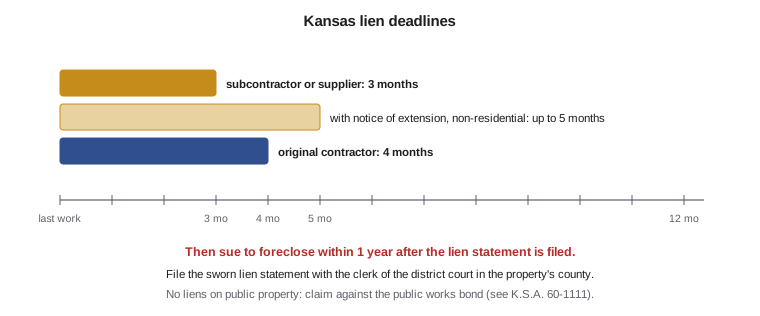
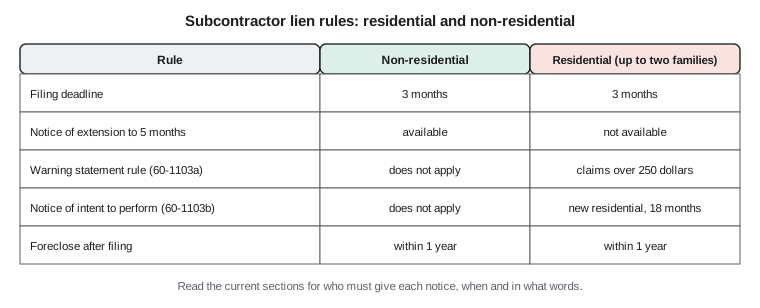
An original contractor must file its lien statement within four months after the date it last furnished labor, equipment or materials to the job. A subcontractor or supplier must file within three months after its last work or materials. On non-residential property, a subcontractor or supplier can extend its three months to as much as five months by filing a notice of extension with the clerk of the district court and giving copies to the contractor and owner as the statute requires, within the original three months. The extension is not available on residential property. The date of last work matters, and warranty work or trivial items added later to stretch the deadline are generally not counted. Record the real last day of work on every job.
After filing, the lien must be enforced by a lawsuit to foreclose it within one year after the lien statement is filed. A lien that is not foreclosed in time is lost, even if the debt is still owed. The contractor may still sue the person who owes the money on the contract, but it loses the claim against the property.
# Kansas lien deadline helper (months added to the last day of work; confirm with counsel)
from datetime import date
import calendar

def add_months(d, n):
    y, m = divmod(d.month - 1 + n, 12)
    y, m = d.year + y, m + 1
    days = calendar.monthrange(y, m)[1]
    return date(y, m, min(d.day, days))

last_work = date(2026, 8, 20)
print("Original contractor files by:", add_months(last_work, 4))
print("Subcontractor files by:", add_months(last_work, 3))
print("Subcontractor with extension (non-residential) files by:", add_months(last_work, 5))
filed = date(2026, 12, 1)
print("Foreclosure suit by:", add_months(filed, 12))Original contractor files by: 2026-12-20 Subcontractor files by: 2026-11-20 Subcontractor with extension (non-residential) files by: 2027-01-20 Foreclosure suit by: 2027-12-01
The helper adds calendar months, which is how the statute's months are usually counted, but courts can be strict about how a deadline that falls on a weekend or holiday is treated. Do not plan to file on the last day.
Filing the lien statement
The lien statement is filed with the clerk of the district court in the county where the property is located. It must be sworn, or verified, by the claimant or someone with knowledge, and it must contain the information the statute requires, such as the name of the owner, the name of the claimant, a description of the property, a reasonably itemized statement of the amount claimed and the dates of the work. A subcontractor or supplier must also name the contractor it worked for, and the statute requires the claimant to give copies to the owner and others as it describes. A lien statement that overstates the amount on purpose can be thrown out and can expose the claimant to liability, so claim only what is actually owed.
Residential property
Kansas gives homeowners extra protection. For lien purposes the statute treats residential property, roughly, as a structure designed for no more than two families. Three special rules apply. First, as noted above, the notice of extension that stretches a subcontractor's deadline is not available on residential property. Second, K.S.A. 60-1103a deals with a residential warning statement about subcontractor and supplier lien rights, which bears on claims above 250 dollars; read the current section for who must give it, when, and in what words. Third, K.S.A. 60-1103b allows a subcontractor or supplier on new residential construction to file a notice of intent to perform, which protects the filer's lien rights in the situations the statute describes and stays effective for eighteen months.
The practical point for a residential electrical subcontractor is that the usual protections can be weaker, and the deadline is shorter, on houses and duplexes than on commercial buildings. Little River does little new residential work, but when it does, Pat checks the residential rules before the first day on site, not after the first missed payment.
Lien waivers
Owners, lenders and general contractors usually ask for lien waivers before releasing payment. A waiver gives up lien rights, so it must be handled with care. A conditional waiver gives up rights only when the stated payment is actually received. An unconditional waiver gives them up at once, whether or not the money arrives. Never sign an unconditional waiver for money you have not received. Read each waiver for its scope, too: a waiver for one payment should not waive rights to retainage or unpaid change orders.
Public work
A mechanics' lien cannot be filed against public property such as a school, a city building or a state road. On public work, payment protection comes from bonds instead. Kansas requires contractors on public works to provide a bond for the benefit of those who furnish labor and materials; see K.S.A. 60-1111. An unpaid subcontractor or supplier makes a claim against the bond, following the statute's notice and suit requirements, which have their own deadlines. Before starting public work, get a copy of the bond and note the deadlines.
Collecting without a lawsuit
Most payment problems end before a lien is filed. A polite call, a clear invoice that matches the contract and the change orders, and a written reminder that lien deadlines are running usually work. Filing a lien is a serious step that clouds the owner's title, and owners and lenders take it seriously. Lena's rule is to send a written demand that names the amount owed and the date the company will file if it is not paid, and then to file on that date if it is not, well inside the deadline.
Good records make every step easier. For each job, Pat keeps the signed contract, every signed change order, each invoice and the payments received against it, the lien waivers the company has signed, the daily logs showing who worked and when, and the delivery tickets for major equipment. When a payment is late, she can tell within minutes what is owed, for what, and when the lien deadline runs. When a dispute reaches a lawyer, the same file is the evidence. A company that keeps those records rarely needs to go to court, because the other side can see that it would lose.
Common mistakes
MistakeWaiting to file until the last day.
InsteadDeadlines are strict; file well inside the three or four months.
MistakeUsing a notice of extension on a house.
InsteadThe extension is not available on residential property.
MistakeFiling a lien on a public school.
InsteadLiens do not attach to public property; claim against the bond.
MistakeForgetting the one-year foreclosure deadline.
InsteadA lien not foreclosed within one year after filing is lost.
MistakeSigning an unconditional waiver before payment.
InsteadUse a conditional waiver until the money is received.
Summary and key terms
- A clear written contract, with scope, price, payment, change orders and the code edition, prevents most disputes.
- Kansas lien law is K.S.A. 60-1101 and following sections; original contractors file within four months of last work.
- Subcontractors and suppliers file within three months, extendable to five on non-residential property with a notice of extension.
- Lien statements are sworn and filed with the clerk of the district court; foreclose within one year after filing.
- Residential property has special rules under K.S.A. 60-1103a and 60-1103b and no extension.
- Public work has no liens; claims go against the public works bond.
- Mechanics' lien
- A claim against real property for unpaid labor, equipment or materials used to improve it.
- Original contractor
- A contractor that contracts directly with the owner.
- Lien statement
- The sworn document filed with the district court clerk to claim a lien.
- Lien extension filing
- A notice of extension: a filing that extends a subcontractor's deadline to five months on non-residential property.
- Conditional lien waiver
- A waiver that takes effect only when the stated payment is received.
Practice problems
Work each problem on paper first, then reveal the answer to check.
Little River, working for a general contractor on an office building, finished on June 10. When must it file?
Show answer
Within three months, or up to five months with a timely notice of extension because the property is non-residential.
Little River contracted directly with a store owner and finished on March 3. What is the deadline?
Show answer
Four months after March 3.
Can Little River extend its deadline on a duplex?
Show answer
No; the extension is not available on residential property.
The lien was filed on January 5. When must Little River sue to foreclose?
Show answer
Within one year after January 5.
Little River is unpaid on a county courthouse job. Should it file a lien?
Show answer
No; it should make a claim against the public works bond.
Lesson quiz · 5 questions
Score 60% or more to complete this lesson.
Create a free account to save your progress, take quizzes and earn a certificate.