
MELU-216 · Lesson 2 of 12 · 20 min
Eligibility for the Local Master Electrician Licenses
▶ Video coming soon A video version of this lesson is on the way.
When Gene first raised the idea of a master certificate, Lena's first question was simple: am I allowed to sit the exam yet? In Kansas the answer depends on where she wants the credential, because each licensing authority checks eligibility under its own rules. But the rules are not as different as they first look. K.S.A. 12-1526 sets minimum experience levels that every licensing locality has to work within, and the big systems in this course build on them in similar ways. This lesson lays out the state minimums, then walks through MABCD, Johnson County, the Unified Government in Kansas City, Kansas, and Topeka, and ends with how to document experience so that an application is not sent back.
The word license is used loosely in this lesson, as it is in the trade. MABCD calls its individual credential a certificate, the Unified Government calls its credential a certificate of qualification, Johnson County speaks of license classes, and Topeka speaks of licenses. The catalog name for this course, Local Master Electrician Licenses, covers all of them. What they have in common is that each is a local credential that says a named person has the experience and the exam score to be trusted as a master.
The state minimums in K.S.A. 12-1526
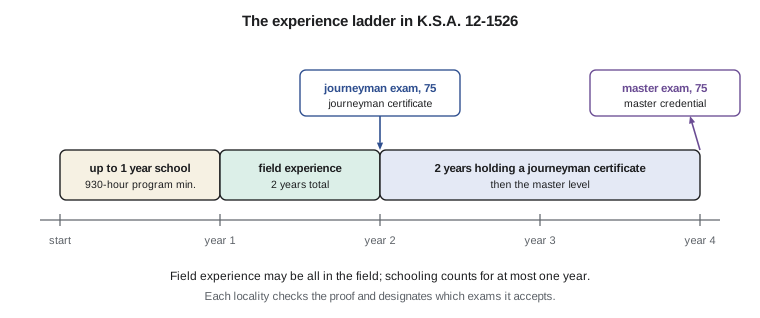
K.S.A. 12-1526 sets the floor. For a journeyman or residential electrician, the statute calls for two years of field experience. Up to one year of that may come from schooling, but only from a program of at least 930 hours. For a master, the statute calls for two years of experience while holding a journeyman certificate. In other words, the master level is built on top of the journeyman level rather than beside it. A person cannot skip straight to master on raw years in the field; the journeyman credential comes first, and the clock for the master starts when it is issued.
The statute also requires a designated examination passed with a score of 75. Experience alone does not make anyone a master in a Kansas licensing locality, and neither does a passing score without the experience. A candidate who passes a master exam before meeting the experience minimum can usually keep the score, but the certificate waits until the years are complete. Check how long a score stays valid with the testing company and the authority, because neither the statute nor every local page answers that question directly.
MABCD in Wichita and Sedgwick County
MABCD's master and journeyman trade certificate page follows the statute closely. A journeyman needs two years of field experience, or one year of field experience and one year of trade school. The approved journeyman exams are ICC exam 558, which ICC also lists as KGH, and for a residential credential, exam 565, listed as KGX. A master must hold a journeyman certificate and have two years of experience as a certified journeyman. The approved master exams are ICC exams 554 and KGD and exams listed as F16, G16 and T16 from other testing companies. The score must be 75 or better.
MABCD's page is explicit that it does not offer reciprocity on the strength of another state's testing or another jurisdiction's license. A candidate qualifies by showing a passing score on one of the approved exams and the required experience, not by showing a license from somewhere else. That does not conflict with K.S.A. 12-1526. The statute's portability rests on a designated exam and the experience, and MABCD's approved list is how it designates exams.
Lena's path fits neatly. Her MABCD journeyman certificate was issued in 2021 after one year of trade school and a year of field experience. Two years as a certified journeyman brought her to 2023, so she has met the experience minimum for the master certificate for some time. What she still needs is a passing score on an approved master exam.
| Level | MABCD experience | MABCD approved exams |
|---|---|---|
| Journeyman | 2 years field, or 1 year field and 1 year trade school | ICC 558 or KGH |
| Residential | As for journeyman, residential work | ICC 565 or KGX |
| Master | Journeyman certificate and 2 years as a certified journeyman | ICC 554 or KGD; F16, G16 or T16 |
| All levels | Proof of experience with the application | Score of 75 or better |
Johnson County
Johnson County Contractor Licensing handles contractor licensing for the Johnson County cities that take part in its program. Its exam information page lists license classes by letter. The standard master electrician class, coded DE, uses ICC exam 554, which ICC also lists as KGD, given through Pearson VUE. The county accepts ICC national exams if a score of 75 or higher can be verified. The page sets the exam requirement clearly; the experience proof the county wants and any other conditions are on its application pages, and they should be read before applying.
Not every Johnson County city works the same way, and the list of participating cities is set by agreements that can change. Before a job, confirm with the city's building department whether it relies on the county program and what else it requires, such as a city business license.
Kansas City, Kansas and Wyandotte County
The Unified Government's posted contractor requirements, dated March 2011, describe a system with one master per trade for each contractor. The master must have passed a Block, Experior or Prometric exam with a score of 75 or better and must apply for a certificate of qualification, which the chief building inspector approves. The same document lists a surety bond, card fees and an annual renewal, which Lesson 8 covers. Because the document is older, treat its exam vendor names and amounts as a starting point, and call the Unified Government's building inspection office before relying on them. Testing companies have merged and renamed since 2011, so the exam you would take today may carry a different brand.
Topeka
The Topeka Municipal Code licenses electrical masters and journeymen and ties its qualifications to K.S.A. 12-1526. Section 5.63.080 requires an exam score of at least 75. The code also sets duties for masters, continuing education and an apprentice ratio, which later lessons cover. A Topeka candidate should read the current chapter in the municipal code, because the city can amend it at any council meeting.
Other cities
Lawrence, Manhattan, Salina, Hutchinson, Emporia and other cities license electricians in their own ways, and some smaller cities use the license of a larger neighbor or of a county program. Many small towns and rural counties license no one. For any city not covered in this course, the eligibility question has three parts. Does the city license electricians at all? If so, which exams does it designate? And how does it apply the experience minimums in K.S.A. 12-1526? The building department can answer all three.
Documenting experience
Most applications that are returned are returned for weak proof of experience, not for a low score. Experience is easiest to prove from records made at the time, not from memory. The usual evidence is a letter from each employer on company letterhead, signed by an owner or the master who supervised the work, giving the dates of employment, the job title, the type of work and whether the time was full time. Pay records such as W-2 forms back the letters up. For schooling, a transcript showing program hours matters because the statute requires a program of at least 930 hours before school time can count. For the master level, a copy of the journeyman certificate with its issue date starts the two-year clock.
Some authorities ask for the experience on their own form, and MABCD's application package, described in Lesson 3, includes proof of experience. If a former employer has closed, collect what you can: old pay stubs, tax records, permit records showing your name, and a letter from the master who supervised you if you can find them. An authority may accept other evidence, but only if you ask before you file.
# When does a journeyman become eligible for the master level? (K.S.A. 12-1526: 2 years holding the journeyman certificate)
from datetime import date

def master_eligible(journeyman_issued, today):
    two_years_later = date(journeyman_issued.year + 2, journeyman_issued.month, journeyman_issued.day)
    return two_years_later, today >= two_years_later

for name, issued in [("Lena", date(2021, 6, 14)), ("Marco", date(2025, 3, 3))]:
    when, ok = master_eligible(issued, date(2026, 11, 9))
print(f"{name}: journeyman since {issued}, eligible from {when}: {'yes' if ok else 'not yet'}")Lena: journeyman since 2021-06-14, eligible from 2023-06-14: yes Marco: journeyman since 2025-03-03, eligible from 2027-03-03: not yet
The calculator assumes the experience runs continuously while the journeyman certificate is held. If a journeyman stopped working in the trade for a period, or let the certificate lapse, the authority may count the time differently. Ask before you apply.
Field experience and what counts
Field experience means hands-on electrical installation work under appropriate supervision, not time spent in sales, estimating, warehouse work or general labor on a site. An apprentice or helper who works under a licensed master is building field experience. Someone who installs low-voltage systems alone may or may not be building it, depending on how the authority reads its rules. If your work history includes mixed duties, describe the electrical portion honestly in the employer letter and let the authority decide.
Part-time work is counted by most authorities in proportion to full-time work, but practice varies. Self-employment can count where the work was lawful and documented, for example by permits pulled in the candidate's name in a locality that did not require a license. Military electrical experience is often accepted with a service record that describes it. Each of these is a question to ask the authority before applying rather than after.
Residential and unrestricted credentials
K.S.A. 12-1526 treats a residential electrician alongside the journeyman for experience purposes, and MABCD lists a separate residential exam. A residential credential is narrower: it covers dwelling work as the authority defines it and does not let the holder supervise commercial or industrial installations. A candidate who has spent most of her career in houses can start with the residential credential and move up later, but the residential credential is not the journeyman certificate that starts the two-year master clock unless the authority says so. If you hold a residential credential and want to become a master, ask the authority whether your residential years count as journeyman years before you plan around them.
The master credential in this course is the unrestricted one: it lets the holder take responsibility for any electrical work the authority licenses, and it is the credential a contractor needs as its qualified person. Johnson County's DE class, MABCD's master certificate and the Unified Government's master certificate of qualification are all at this level.
Choosing where to qualify first
Lena's first instinct was to qualify everywhere at once. Gene talked her out of it. Each authority charges its own fee, wants its own application and checks experience on its own schedule, so the sensible order is to qualify first where the company does most of its work and then carry the exam result to the others. For Little River that means MABCD first, because nearly two thirds of its jobs are in Wichita and unincorporated Sedgwick County, then Johnson County, then the Unified Government if the company keeps bidding work across the line in Wyandotte County.
The exam choice follows from that order. ICC exam 554, also listed as KGD, appears on both MABCD's and Johnson County's lists, so one sitting can support both applications. The Unified Government's older list names other vendors, which is a reason to call before assuming the same score will be accepted there. A candidate in Topeka or Lawrence should check those cities' lists in the same way before booking anything.
One more point matters for planning. Eligibility is personal, but the company's ability to work depends on its qualified person. If Gene retires before Lena's certificate issues, Little River would have no qualified master for its MABCD trade contractor license, and in most systems that stops new permits. Lena's eligibility date therefore sets a deadline for the company as well as for her.
Common mistakes
MistakeCounting raw years in the field toward the master level without a journeyman certificate.
InsteadThe master minimum is two years of experience while holding a journeyman certificate.
MistakeCounting two years of trade school toward the journeyman level.
InsteadAt most one year may come from schooling, from a program of at least 930 hours.
MistakeExpecting MABCD to accept another state's license in place of an approved exam.
InsteadMABCD does not reciprocate with other states' testing or other jurisdictions' licenses; it accepts approved exam scores.
MistakeTreating an exam score of 72 as passing.
InsteadK.S.A. 12-1526 and the local authorities in this course require 75.
MistakeRelying on memory for dates of employment.
InsteadUse signed employer letters, pay records and certificate issue dates.
Summary and key terms
- K.S.A. 12-1526 sets two years of field experience for journeyman or residential, with at most one year from a 930-hour program.
- The master minimum is two years of experience while holding a journeyman certificate, plus a designated exam passed with 75.
- MABCD approves ICC 554 or KGD and F16, G16 or T16 for masters and ICC 558 or KGH and 565 or KGX for journeyman and residential.
- Johnson County's DE class uses ICC 554 (KGD) through Pearson VUE and accepts verified ICC national scores of 75 or more.
- The Unified Government's 2011 requirements call for one master per trade with an approved exam score of 75 and a certificate of qualification.
- Document experience with employer letters, pay records, transcripts and the journeyman certificate's issue date.
- Field experience
- Hands-on electrical installation work under appropriate supervision.
- Certificate of qualification
- The Unified Government's credential for a qualified master.
- DE class
- Johnson County's standard master electrician license class.
- ICC 554
- The International Code Council master electrician exam, also listed as KGD.
- 930-hour program
- The minimum school program before schooling can count toward the journeyman level.
Practice problems
Work each problem on paper first, then reveal the answer to check.
Lena has held her journeyman certificate for five years. What else does she need for an MABCD master certificate?
Show answer
A score of 75 or better on an approved master exam and a complete application with proof of experience.
Can two years of a 600-hour program count toward the journeyman minimum?
Show answer
No; schooling counts for at most one year and only from a program of at least 930 hours.
A helper has three years of field experience and no journeyman certificate. Can he sit for an MABCD master?
Show answer
He may take an exam, but he cannot hold a master certificate until he has been a certified journeyman for two years.
Which exam does Johnson County name for its DE class?
Show answer
ICC exam 554, also listed as KGD, through Pearson VUE.
Who approves a certificate of qualification in Kansas City, Kansas, under the posted requirements?
Show answer
The chief building inspector.
Lesson quiz · 5 questions
Score 60% or more to complete this lesson.
Create a free account to save your progress, take quizzes and earn a certificate.