
MELU-216 · Lesson 8 of 12 · 19 min
Contractor licensing, insurance and bonding
▶ Video coming soon A video version of this lesson is on the way.
Lena's master certificate is personal. It says that she, Lena Castillo, has the experience and the exam score to be trusted with electrical work. It does not by itself let a company bid, contract or pull permits. For that, the company needs its own license in each locality that requires one, with a qualified master behind it, and it needs the insurance, bonds and registrations that the locality and the state require. This lesson covers the company side of licensing: MABCD's trade contractor license, the Johnson County and Unified Government requirements, insurance and how it is proved, bonds of the different kinds, and the state registrations every Kansas business needs.
Pat has run this side of Little River for eleven years, and she describes it as a calendar more than a body of law. Every license, insurance policy, bond and registration has its own expiration date, and a lapse in any of them can stop the company's permits. The lesson ends with the calendar she keeps.
MABCD's trade contractor license
MABCD licenses electrical contractors separately from the individuals who work for them. Its contractor licensing page lists the requirements for a trade contractor license. The company must name a qualified person who holds a master certificate in the trade. It must carry general liability insurance of at least 300,000 dollars and file a certificate of insurance naming MABCD as the certificate holder. It must file certificates of workers compensation and automobile insurance, or notarized waivers where the company is not required to carry them. It must provide a certificate of good standing, which for a Kansas company comes from the Kansas Secretary of State, and a company authorization letter naming who may act for the company. MABCD says review can take up to two weeks, so a new company should apply well before its first job.
Trade contractor licenses in MABCD's system expire on December 31 of every odd-numbered year, so the 2027 renewal falls on December 31, 2027. Renewal requires continuing education: twelve hours in the licensing period, six of them code-related. That is in addition to the continuing education each certified individual needs to renew his or her own certificate, which Lesson 11 covers.
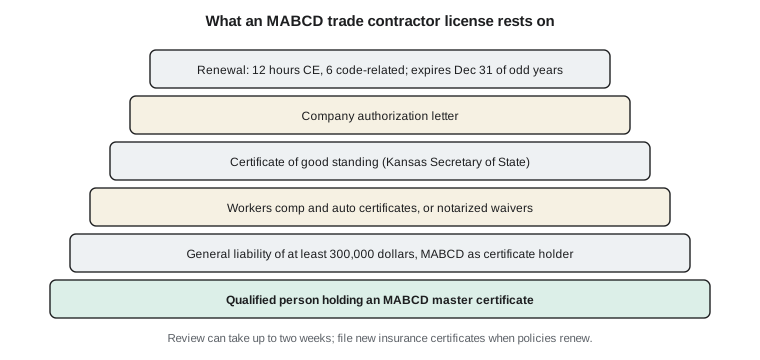
# MABCD trade contractor licenses expire December 31 of every odd-numbered year
from datetime import date

def next_expiration(today):
    year = today.year if today.year // 2 * 2 != today.year else today.year + 1
    exp = date(year, 12, 31)
    if exp < today:
        exp = date(year + 2, 12, 31)
    return exp

for d in (date(2026, 11, 9), date(2027, 3, 1), date(2027, 12, 31)):
print(f"On {d}: next expiration {next_expiration(d)}")On 2026-11-09: next expiration 2027-12-31 On 2027-03-01: next expiration 2027-12-31 On 2027-12-31: next expiration 2027-12-31
Johnson County
Johnson County Contractor Licensing licenses contractors by class for the cities that take part in its program. The standard master electrician class, DE, rests on a master exam, as Lesson 2 explains. The program also maintains the license records, continuing education records and insurance filings for licensed contractors, and the participating cities check those records when they issue permits. The county's application pages list the insurance and other filings required for each class. They were not all confirmed for this course, so read them before applying, and expect requirements similar in kind to MABCD's: a qualified person, liability insurance with a certificate on file, workers compensation proof and business registration.
A secondary source reported in 2020 that Johnson County required eight hours of continuing education per license class each calendar year. Treat that as a lead to confirm, not a rule, and check the county's continuing education page before planning hours.
Kansas City, Kansas and Wyandotte County
The Unified Government's posted contractor requirements, dated March 2011, describe a contractor registration built around one master per trade. The master needs a certificate of qualification, as Lesson 3 explains. The company files an original surety bond of 5,000 dollars. The document lists a fee of 60 dollars for a master card and 20 dollars for each employee card, an occupational tax, and an annual renewal. Because the document is old, call the building inspection office before relying on any amount; the structure, a bonded contractor with a qualified master and carded employees, is the part most likely to have survived.
| Requirement | MABCD | Unified Government (2011 list) | Johnson County |
|---|---|---|---|
| Qualified master | Master certificate holder | One master per trade, certificate of qualification | DE class on a master exam |
| Liability insurance | At least 300,000 dollars, MABCD as holder | Confirm with the office | See the county's class requirements |
| Workers comp and auto | Certificates or notarized waivers | Confirm with the office | See the county's class requirements |
| Bond | None listed on the licensing page | Original 5,000-dollar surety bond | See the county's class requirements |
| Term | Expires December 31 of odd years | Annual renewal | Confirm with the county |
Topeka and other cities
Topeka licenses electrical masters and journeymen under its municipal code and expects the master to oversee the work, as Lesson 7 explains. Contractors working in Topeka should read the current chapter for any company registration, insurance or bond requirement. Lawrence, Manhattan, Salina and other cities each have their own rules, and many require some form of contractor registration with an insurance certificate even when they rely on another locality's exam. A contractor that works in many cities can spend more time on registrations than on any other paperwork.
Insurance
Insurance protects the company, its customers and the public against the cost of accidents and mistakes. A Kansas electrical contractor typically carries four kinds of coverage. Commercial general liability covers injury to other people and damage to their property caused by the company's work or operations, including damage that shows up after the job is finished. Workers compensation covers the company's own employees for work injuries, as Lesson 10 explains. Commercial automobile coverage covers the company's vehicles. And an umbrella or excess policy adds limits above the others. Larger contractors may add an inland marine or equipment floater for tools and materials, and design-build contractors may need professional liability for design work.
Local minimums such as MABCD's 300,000 dollars are only a floor. General contractors, owners and lenders often require far higher limits in their contracts, along with endorsements that add them as additional insureds and that make the contractor's policy primary. Read the insurance section of every contract before signing, and send it to the company's insurance agent if it asks for anything unusual. A contract that requires coverage the company does not have is a promise the company cannot keep.
Proving insurance
Localities, general contractors and owners ask for proof of insurance in the form of a certificate of insurance. The certificate is a summary issued by the agent or carrier showing the policies, limits and dates, with the requesting party named as certificate holder. A certificate does not change the policy. If a contract requires additional insured status, the policy itself must be endorsed; a certificate that merely says so is not enough.
MABCD asks for a certificate naming MABCD as certificate holder. Because the certificate shows the policy dates, the company must file a new one each time a policy renews, or the licensing authority will treat the coverage as lapsed. Pat asks the agent to send renewal certificates to every licensing authority and every open general contractor automatically, and she checks a week after each renewal that they arrived.
Waivers
MABCD's page allows notarized waivers in place of workers compensation and automobile certificates where the company is not required to carry the coverage. A one-person company with no employees, for example, may not be required to carry workers compensation under Kansas law, and a company with no vehicles has no need for commercial auto. The waiver is a sworn statement, so it must be true. A company that signs a waiver and then hires an employee must buy the coverage and file the certificate before the employee starts.
Bonds
A bond is a promise by a surety company to pay if the contractor does not meet an obligation. The contractor pays a premium, and if the surety pays a claim, the contractor must usually repay the surety. Bonds therefore protect others, not the contractor. Three kinds matter here.
A license or permit bond protects the locality and the public if the contractor violates the licensing ordinance or fails to pay permit fees. The Unified Government's 5,000-dollar surety bond is this kind. A performance bond protects a project owner if the contractor fails to complete the work as contracted. A payment bond protects subcontractors and suppliers if the contractor fails to pay them. Performance and payment bonds are common on public works and large private jobs and are set by the contract, not the licensing ordinance. On Kansas public works, bonds take the place of mechanics' liens, as Lesson 9 explains; see K.S.A. 60-1111 for the public works bond statute.
# Bond premium estimate (illustrative rates; sureties quote each contractor)
bonds = {
    "license bond (5,000 dollars)": (5000, 0.02),        # flat-rate style example
    "performance and payment bond on a 400,000-dollar job": (400000, 0.015),
}
for name, (amount, rate) in bonds.items():
print(f"{name}: about {amount * rate:,.0f} dollars of premium")license bond (5,000 dollars): about 100 dollars of premium performance and payment bond on a 400,000-dollar job: about 6,000 dollars of premium
The rates in the calculator are invented for the example. Real premiums depend on the contractor's financial statements, experience and credit, and a new company may need to build a record before it can bond large jobs at all.
State registrations
Kansas does not license electrical contractors, but it does regulate them as businesses. A corporation or limited liability company must be formed or registered with the Kansas Secretary of State and must file annual reports to stay in good standing, which is why MABCD asks for a certificate of good standing. An out-of-state company working in Kansas usually must register to do business. A company with employees must register with the Kansas Department of Revenue for withholding and with the Kansas Department of Labor for unemployment insurance. Kansas sales and use tax rules for contractors are complex and depend on whether the customer is exempt and how the contract is written, so a contractor should get advice from an accountant who knows them.
Some cities add a business or occupation license of their own, separate from the trade license, such as the occupational tax listed in the Unified Government's requirements. Those are revenue measures rather than proof of competence, but working without one can still block permits.
Changing the qualified person
When Lena's certificate issues, Little River will change its qualified person with MABCD from Gene to Lena, or add her alongside him while he still works. The change is a filing, not a new license, but it is not automatic. The company tells MABCD in writing, with a new company authorization letter if the people who may act for the company change, and MABCD updates the license record. The same change must be made with every other authority where Gene qualifies the company. Until each record is updated, permits in that locality still run on Gene's name, and if Gene stops working before the change is made, the company may be unable to pull permits there at all. Pat has a single checklist for the change, with a line for each authority, the form it uses, the date filed and the date confirmed.
Pat's calendar
Pat's licensing calendar for Little River has one line for each item that can expire: MABCD contractor license, December 31, 2027; Gene's and Lena's master certificates, each on its own two-year cycle; each journeyman certificate; the Johnson County license and its continuing education; the Unified Government registration and bond, renewed every year; general liability, auto and workers compensation policies, each with its renewal date; the umbrella; the Secretary of State annual report; and the continuing education hours each license needs. Each line has a reminder ninety days and thirty days before the date. The calendar is dull, and it is the reason Little River has never had a permit refused for a lapse.
Common mistakes
MistakeThinking a master certificate lets a company pull permits.
InsteadThe company needs its own contractor license with a qualified master.
MistakeTreating MABCD's 300,000-dollar minimum as enough for every contract.
InsteadContracts often require higher limits and endorsements.
MistakeRelying on a certificate of insurance to add an additional insured.
InsteadAdditional insured status requires an endorsement on the policy.
MistakeBelieving a bond protects the contractor.
InsteadA bond protects others; the contractor usually repays the surety.
MistakeForgetting to refile certificates when policies renew.
InsteadA certificate shows policy dates; file a new one at each renewal.
Summary and key terms
- MABCD's trade contractor license needs a qualified master, at least 300,000 dollars of general liability with MABCD as certificate holder, workers comp and auto certificates or notarized waivers, a certificate of good standing and a company authorization letter.
- MABCD contractor licenses expire December 31 of every odd year and need 12 hours of continuing education, 6 code-related, to renew.
- The Unified Government's 2011 requirements list one master per trade, an original 5,000-dollar surety bond, card fees and annual renewal.
- Johnson County licenses by class for participating cities; confirm its insurance and continuing education rules.
- Insurance protects the contractor; license, performance and payment bonds protect others.
- Kansas businesses register with the Secretary of State and, with employees, with the Departments of Revenue and Labor.
- Trade contractor license
- MABCD's license for an electrical contracting business.
- Certificate of insurance
- A summary of a company's insurance issued to a named certificate holder.
- Additional insured
- A party added to a policy by endorsement so that it is covered too.
- Surety bond
- A surety's promise to pay if the contractor fails an obligation.
- Certificate of good standing
- The Secretary of State's confirmation that a company is current with its filings.
Practice problems
Work each problem on paper first, then reveal the answer to check.
What general liability minimum does MABCD list?
Show answer
At least 300,000 dollars, with MABCD as certificate holder.
When does Little River's MABCD contractor license next expire after November 2026?
Show answer
December 31, 2027.
Little River has no vehicles titled to the company. What can it file instead of an auto certificate with MABCD?
Show answer
A notarized waiver.
What kind of bond does the Unified Government's list require?
Show answer
An original 5,000-dollar surety bond, a license-type bond.
A general contractor wants to be an additional insured. Is a certificate enough?
Show answer
No; the policy must be endorsed.
Lesson quiz · 5 questions
Score 60% or more to complete this lesson.
Create a free account to save your progress, take quizzes and earn a certificate.