
MELU-216 · Lesson 4 of 12 · 19 min
The exam format and the references allowed
▶ Video coming soon A video version of this lesson is on the way.
The master exams that Kansas authorities designate are national exams. They are not written for Kansas, they do not test Kansas law, and they are given in the same form to candidates in many states. That is good news for Lena: everything she learned in the core courses applies directly, and the study materials written for these exams are widely available. It also means that the rules of the exam room come from the testing company, not from MABCD or Johnson County. This lesson describes the format of a typical designated master exam, explains how to read a candidate bulletin, and shows how to prepare a code book that is allowed in the room and fast to use.
One caution comes first. Exam details such as the number of questions, the time allowed, the code edition and the list of allowed references are set in each exam's candidate bulletin, and they change when the exam is revised. The descriptions in this lesson are general. Read the bulletin for the exact exam you booked, on the day you book it and again a week before the exam.
What a designated master exam looks like
The master exams on the MABCD and Johnson County lists, such as ICC exam 554, also listed as KGD, share a basic shape. They are computer-based, delivered at a test center or by remote proctoring. They are open book, which means the candidate may bring the code edition the exam is based on, and sometimes other listed references. They are multiple choice. They are timed, with a fixed number of questions and a fixed number of minutes, so pacing matters as much as knowledge. And they are scored by the number of correct answers, with a passing score of 75 under K.S.A. 12-1526 and the authorities' own rules.
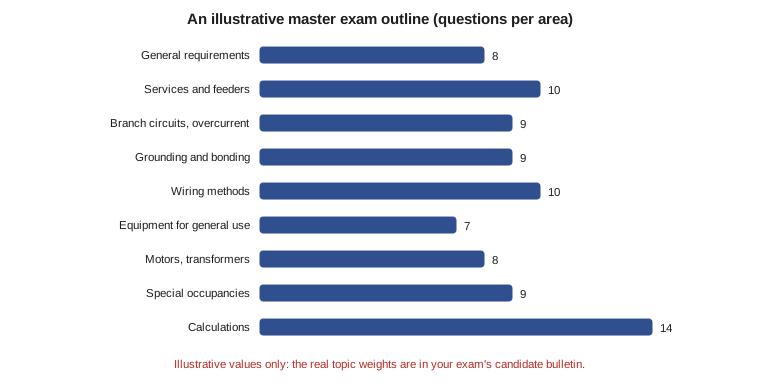
The questions cover the whole National Electrical Code at the master level. The bulletin's content outline usually lists topic areas and how many questions come from each. Typical areas include general requirements and definitions, services, feeders and branch circuits, overcurrent protection, grounding and bonding, wiring methods and materials, equipment for general use, motors, transformers and generators, special occupancies, special equipment and special conditions, and calculations such as service, feeder, motor and box fill. A master exam leans more heavily on calculations and on the special chapters than a journeyman exam does.
Reading the candidate bulletin
The bulletin is the contract between the candidate and the testing company. Read it for six things. The exam code and title, so you know you booked the right exam. The code edition, such as the 2020 or 2023 NEC. The number of questions and the time allowed. The content outline. The list of allowed references, with any rules about tabs, highlighting and notes. And the rules of the room: identification, arrival time, calculators, breaks and what happens if you leave the room.
Lena printed the bulletin for her exam and marked each of these items with a highlighter. She found that the bulletin allowed the NEC edition the exam was based on and nothing else, which made her preparation simple. Other exams allow more, such as a second reference on calculations or on business law. If yours does, decide whether the extra book is worth the time it takes to search it.
The code edition
The edition the exam uses and the edition your local authority enforces are separate questions. MABCD has adopted the 2023 NEC with local amendments, as Lesson 5 explains, but an exam on its approved list may be based on an older edition until the testing company updates it. Johnson County's cities each adopt their own editions. On the exam, answer from the edition the exam is based on, even if your city uses another. At work, install to the edition your city enforces. Many candidates lose points by answering from memory of a newer or older edition than the one in front of them.
If the exam is based on an edition you do not own, buy that edition. A newer book is not a substitute. Article and section numbers move between editions, rules are added and deleted, and a question written to one edition may have a different answer in another.
| Allowed in many bulletins | Usually not allowed |
|---|---|
| The named NEC edition, bound and unaltered | Loose pages, photocopies or printouts |
| Permanent tabs on pages | Handwritten notes, formulas or sample answers in the book |
| Highlighting and underlining | Inserted sheets, sticky notes with writing |
| A silent, nonprogrammable calculator, if listed | Phones, smart watches, programmable calculators |
| Other references only if the bulletin lists them | Study guides and exam prep books |
Preparing your code book
An open book exam is not an easy exam. The time limit means there is no time to read the code during the test; there is only time to find a section you already know is there and confirm a detail. The book is a tool, and preparing it well is part of studying. The goal is to reach any article in a few seconds and any frequently used section in a few more.
Start with tabs. Most bulletins allow permanent tabs, which are tabs fixed to the page that cannot be removed without tearing. Tab the start of each chapter and each article you use often, such as the articles on branch circuits, feeders, services, overcurrent protection, grounding, wiring methods, motors, transformers and the main special occupancy articles. Tab the tables you use for conductor ampacity, conduit fill, box fill and motor full-load current. Label tabs with article numbers only, unless the bulletin allows words.
Then highlight. Highlighting the key words in a section, the numbers in a rule or the exceptions you tend to forget makes the confirming step faster. Be selective. A page that is entirely yellow is no easier to read than a page with no highlighting at all. Do not write in the book unless the bulletin plainly allows it; handwritten notes are the most common reason a test center rejects a book.
Finally, use the index. The index is part of the book and always allowed. Many candidates waste time flipping through articles when the index would have pointed straight to the right section. Practice with the index until looking things up in it is a reflex, especially for terms that appear in several articles.
Calculators and other tools
The bulletin says which calculators are allowed. Typically it is a silent, battery-powered calculator without programming, text storage or communication. Bring a spare battery or a second allowed calculator. Practice with the same calculator you will bring, so that you know its keys and how it handles square roots and the square root of three in three-phase work. Some test centers provide an on-screen calculator; if yours does, practice with a similar one.
How the questions are written
Master exam questions tend to fall into three kinds. Lookup questions ask for a fact that is in one place in the code, such as a minimum clearance or a maximum spacing. Application questions describe a situation and ask which rule applies or what the installation must be. Calculation questions ask for a number, such as the minimum service size, the ampacity of an adjusted conductor or the maximum overcurrent device for a motor. Each kind has its own trap. Lookup questions hide the trap in a word such as minimum or maximum, application questions in an exception, and calculation questions in a step that is easy to skip, such as an adjustment factor or a demand factor.
Questions are written so that the wrong answers look right to someone who has made a common mistake. If you calculate an answer and it matches an option, it may still be wrong, because the option may be the result of the common error. Check the step that the question writer is most likely to be testing.
# Pacing check: minutes per question (illustrative; use your bulletin's real numbers)
questions = 80
minutes = 240
reserve_for_review = 20
per_q = (minutes - reserve_for_review) / questions
print(f"About {per_q:.1f} minutes per question, with {reserve_for_review} minutes kept for review")
for done in (20, 40, 60):
print(f"After question {done}: about {done * per_q:.0f} minutes used")About 2.8 minutes per question, with 20 minutes kept for review After question 20: about 55 minutes used After question 40: about 110 minutes used After question 60: about 165 minutes used
The numbers in the calculator are illustrative, not the numbers for any particular exam. Put in your own exam's question count and time from its bulletin. Lesson 12 builds a full test-day plan around this kind of pacing.
Remote and test center delivery
If the testing company offers both a test center and remote proctoring, choose the one that suits how you work. A test center supplies the computer, the desk and the quiet, and it checks your book at the door. Remote delivery saves travel but puts the burden on you: a clean desk, a closed room, a working webcam and a stable connection, and a proctor who may ask you to show your book page by page on camera. Remote rules on references are often stricter than test center rules, so read the remote section of the bulletin separately.
What the exam does not test
Because the designated exams are national, they do not ask about Kansas statutes, MABCD's amendments, Johnson County's license classes or the Kansas mechanics' lien deadlines. Those topics matter for running a business and for the quizzes in this course, but a candidate who spends her last week before the master exam memorizing lien deadlines has spent it on the wrong thing. Some national exams include questions on general business and law topics, such as contracts, insurance and safety, if the bulletin's outline lists them. Check the outline. If it lists no business section, every question will come from the code.
Local amendments raise a related point. MABCD's amendments to the 2023 NEC change some rules for work in its area, but the national exam is written to the code as published. On the exam, ignore local amendments. On the job, follow them.
Turning the outline into a study plan
The content outline is also a study plan. Give each topic area study time in proportion to its share of the questions and to how weak you are in it. A practice exam scored by topic shows where the weak spots are. Lena scored her first practice exam by topic and fed the results into a short script that ranked her topics by the points she was losing, so that she studied the most expensive gaps first.
# Rank topics by expected lost points (illustrative outline and practice results)
outline = {"calculations": 14, "services and feeders": 10, "wiring methods": 10,
           "grounding and bonding": 9, "motors and transformers": 8, "special occupancies": 9}
practice_right_share = {"calculations": 0.55, "services and feeders": 0.80, "wiring methods": 0.85,
                        "grounding and bonding": 0.65, "motors and transformers": 0.70, "special occupancies": 0.60}
lost = {t: round(n * (1 - practice_right_share[t]), 1) for t, n in outline.items()}
for topic, pts in sorted(lost.items(), key=lambda kv: -kv[1]):
print(f"{topic}: about {pts} questions lost")calculations: about 6.3 questions lost special occupancies: about 3.6 questions lost grounding and bonding: about 3.1 questions lost motors and transformers: about 2.4 questions lost services and feeders: about 2.0 questions lost wiring methods: about 1.5 questions lost
In Lena's results, calculations cost her the most even though her rate there was not the lowest, because calculations carry the most questions. That is the usual pattern on master exams, and it is why the core course on load calculations, MELU-102, deserves extra review.
Lena's book
Lena bought the edition named in her bulletin new, so that it had no notes from anyone else. She spent two evenings tabbing it with permanent tabs labeled by article number and a third highlighting the sections she had missed on practice exams. She kept a list of the sections she looked up most often, and by the end of her study she could open the book to any of them without the index. She also practiced every calculation from the core courses with the same calculator she planned to bring, so that the keys would not slow her down on exam day.
Common mistakes
MistakeBringing a newer edition than the exam's.
InsteadUse the edition the bulletin names; section numbers and rules change between editions.
MistakeWriting formulas in the margins of the code book.
InsteadMost bulletins forbid handwritten notes; use tabs and highlighting only.
MistakeAnswering from the city's adopted edition on the exam.
InsteadAnswer from the exam's edition; install to the city's.
MistakeSkipping the bulletin because the exam is national.
InsteadThe bulletin sets the edition, time, references and room rules.
MistakeTrusting a calculated answer because it matches an option.
InsteadWrong options are built from common mistakes; check the step being tested.
Summary and key terms
- Designated master exams in Kansas are national, computer-based, open book, multiple choice and timed.
- The candidate bulletin sets the edition, question count, time, content outline, references and room rules.
- Answer from the edition the exam uses, even if your city enforces another.
- Prepare the book with permanent tabs and selective highlighting; avoid handwritten notes unless allowed.
- Practice with the calculator you will bring and with the code index.
- Remote delivery has its own rules on references and room setup.
- Open book
- An exam that allows listed references in the room.
- Candidate bulletin
- The testing company's guide to an exam's format, references and rules.
- Permanent tab
- A tab fixed to a code book page that cannot be removed without damage.
- Content outline
- The list of topic areas and question counts on an exam.
- Lookup question
- A question answered by finding one fact in the code.
Practice problems
Work each problem on paper first, then reveal the answer to check.
Lena's city enforces the 2023 NEC; her exam uses the 2020 edition. Which does she bring?
Show answer
The 2020 edition, the one the exam uses.
May she write the motor formula on a tab?
Show answer
Only if the bulletin allows words or notes on tabs; most allow article numbers or simple labels only.
Is the code index allowed?
Show answer
Yes; it is part of the code book.
What should she check before choosing remote delivery?
Show answer
The remote section of the bulletin, including reference rules, room and equipment requirements.
A calculated answer matches option B. What should she do?
Show answer
Check the step the question is testing, such as a demand or adjustment factor, before choosing it.
Lesson quiz · 5 questions
Score 60% or more to complete this lesson.
Create a free account to save your progress, take quizzes and earn a certificate.