
MELU-216 · Lesson 6 of 12 · 19 min
Permits, inspections and the inspection authority
▶ Video coming soon A video version of this lesson is on the way.
A master certificate earns its keep on the permit counter. In every Kansas system in this course, the electrical permit is where licensing becomes real: the permit office checks that the contractor is licensed for the work, the permit records who is responsible, and the inspections that follow are how the locality makes sure the work meets the code it adopted. Lena has pulled permits under Gene's name for years. As a master and a qualified person she will soon pull them under her own, and she will be the one the inspector calls when something fails. This lesson covers who issues permits in Kansas, who may apply, how inspections work, what happens when work fails, and how to challenge a decision.
Permit rules are local and they change. The descriptions here are general and use MABCD, Johnson County cities, the Unified Government and Topeka as examples. Before you rely on a detail, read the permit rules in the locality's adopted code and its permit portal.
Who issues permits
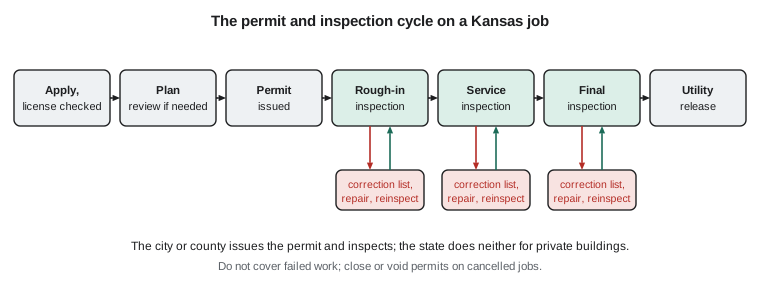
In Kansas, electrical permits are issued by the city or county where the work is done. The state issues no electrical permits for private buildings and employs no electrical inspectors for them. In the Wichita area, MABCD issues permits and inspects for Wichita, unincorporated Sedgwick County and the small cities that rely on it. In Johnson County, each city's building department issues permits, even though contractor licensing runs through the county program. In Kansas City, Kansas, the Unified Government's building inspection office does. Topeka's development services office issues permits under the Topeka Municipal Code. A few small cities contract with a county or a neighboring city for inspections, which is why the first question on any job is still which government has jurisdiction.
The NEC itself leaves enforcement to the authority having jurisdiction. Section 90.4 says the authority having jurisdiction enforces the code and has responsibility for interpreting it and for approving equipment and materials. In Kansas that authority is the local building official and the inspectors who work for him or her, acting under the locality's adopted code and administrative rules.
Who may apply for a permit
Most Kansas localities that license electricians allow only a licensed contractor to pull an electrical permit for work done for others, and they check the license at the counter or in the portal. Under MABCD's system, the company's trade contractor license, backed by a qualified master, is what allows it to pull permits. Johnson County cities check the county license class. The Unified Government checks its own contractor registration and certificate of qualification.
Many localities also allow a homeowner to pull a permit for work on the single-family dwelling the homeowner owns and lives in, provided the homeowner does the work personally. The conditions vary: some require the owner to pass a short test or sign an affidavit, and none allow the owner to hire an unlicensed person to do the work under the owner's permit. A contractor who works under a homeowner's permit is working without a permit of its own, which is a licensing violation in most systems.
Applying and plan review
A permit application usually asks for the job address, the owner, the scope of work, the value of the work, the service size and the contractor's license number. Residential alterations and small commercial jobs are often issued at the counter or online the same day. Larger commercial work, new services above a size the locality sets, and work in buildings that need plan review for the building permit usually require electrical plans, and the plans may be reviewed before the permit issues. MABCD and most larger cities publish what they require for electrical plan review on their websites.
The permit must usually be posted on the site or available to the inspector, and work should not start until it is issued. Starting before the permit issues is a common violation, and many localities charge a higher fee, often a multiple of the normal fee, for work started without a permit. The exact penalty is in the local fee schedule.
Inspections
Inspections follow the stages of the work. The common stages are an underground or slab inspection before concrete is poured or a trench is backfilled, a rough-in inspection after boxes, raceways and cables are installed but before walls are covered, a service inspection before the utility connects power, and a final inspection when the work is complete and devices and fixtures are installed. Large jobs may have partial inspections for each area or phase. Some localities combine stages for small jobs, such as a single final inspection for a service change.
| Stage | When | What the inspector looks at |
|---|---|---|
| Underground or slab | Before concrete or backfill | Raceways, depth, grounding electrodes in the footing |
| Rough-in | Before walls or ceilings are covered | Boxes, cables and raceways, supports, box fill, grounding |
| Service | Before the utility connects | Service equipment, grounding and bonding, clearances |
| Final | When the work is complete | Devices, fixtures, labeling, protection, working space |
Inspections are requested by phone, through a portal or by an app, depending on the locality, and most localities want a request by a set time the day before. The contractor must make the work ready and accessible: the job address marked, the permit available, panels open where the inspector needs to see inside, and ladders on site if the inspector must reach a ceiling. A job that is not ready usually fails and may incur a reinspection fee.
# Inspection readiness check before calling for a rough-in (illustrative list)
ready = {
    "permit posted on site": True,
    "all boxes and raceways installed": True,
    "cables secured and supported": True,
    "grounding conductors made up in boxes": False,
    "access and ladder available": True,
}
not_ready = [k for k, v in ready.items() if not v]
print("Call for inspection" if not not_ready else "Hold the request: " + "; ".join(not_ready))Hold the request: grounding conductors made up in boxes
When work fails
When an inspection fails, the inspector leaves a written correction list on site or in the portal. It names the items that do not comply and, ideally, the code sections involved. The contractor corrects the items and requests a reinspection. Covering failed work before it passes is a serious violation: the inspector can require the cover to be removed at the contractor's cost.
Most Kansas localities charge a reinspection fee after a failed inspection or a trip to a job that was not ready. Repeated failures can lead to more than fees. A building official can stop work on a job that is unsafe or not following the code, and local licensing rules usually treat repeated serious violations as grounds for discipline against the contractor or the master, as Lesson 7 explains. For an imminent hazard, the official can order the power disconnected.
A good inspector explains the reasons for a failure, and a good master listens. Lena has learned that most failures fall into a few groups: work not ready, missing or wrong labels, box fill and support, grounding and bonding details, and protection requirements that a local amendment changed. She now walks every job against those groups before calling for inspection.
Permit fees
Each locality sets its own permit fees in a fee schedule adopted by its governing body. The common methods are a flat fee for small jobs, a fee based on the value of the electrical work, a fee based on counts of items such as outlets, fixtures and circuits, and a fee based on service size, often with a minimum fee and a separate charge for plan review. Some localities add a technology or records fee. Because the fee schedule is local, a bid for work in a new city should include a look at its schedule. The calculator shows the kind of arithmetic a valuation-based fee involves; the rates in it are invented for the example.
# Valuation-based permit fee (invented rates, for illustration only)
def permit_fee(value_dollars):
    base, first_tier = 50, 1000
    fee = base
    if value_dollars > first_tier:
        fee += (value_dollars - first_tier) / 1000 * 6   # 6 dollars per added 1,000 dollars of value
    return round(max(fee, 50), 2)

for value in (800, 12000, 85000):
print(f"Work valued at {value:,} dollars: fee {permit_fee(value):,.2f} dollars")Work valued at 800 dollars: fee 50.00 dollars Work valued at 12,000 dollars: fee 116.00 dollars Work valued at 85,000 dollars: fee 554.00 dollars
Fees are not just a cost of doing business. A permit application that understates the value of the work to lower the fee is a false statement, and localities that discover it can charge the difference, add a penalty and treat it as a licensing violation. Lena values every job at its contract price for the electrical work.
Who does the inspecting
Inspectors in the larger Kansas systems are employees of the locality, usually with national certifications in electrical inspection. Some small cities and counties contract the work out to a neighboring government or to a private inspection firm, which acts for the locality under its adopted code. Either way, the inspector's authority comes from the locality, and the appeal goes to the locality's officials and boards. On large or specialized projects, the building official may also require special inspections or engineer's reports for parts of the work, such as fire alarm or emergency systems, under the building code's own rules. Ask during plan review whether any apply, because a special inspection scheduled late can hold up the final.
Final approval and the utility
When the final inspection passes, the locality records the approval and, for a new service or a service change, notifies the utility that it may connect. In much of the area this course covers, the electric utility will not set a meter on a new service until it receives that release from the inspecting authority. For a new building, the electrical final is also one of the approvals needed before the building official issues a certificate of occupancy.
In places with no adopted code, utilities may have their own requirements before they connect, such as an inspection by a third-party inspector or a signed statement from a licensed electrician. Ask the utility before the job starts.
Disagreeing with an inspector
Inspectors make mistakes, and the code allows room for interpretation. When Lena disagrees with a correction, her first step is to ask the inspector, politely and on site if possible, which section the correction is based on and how the inspector reads it. Many disagreements end there, one way or the other. If they do not, the next step is the chief electrical inspector or the building official, who can issue an interpretation.
If the disagreement continues, Kansas localities generally provide an appeal to a board, such as a board of appeals or a trade board, under their adopted administrative code. The appeal is usually limited to whether the official interpreted or applied the code correctly or whether an equivalent alternative should be approved; a board cannot simply waive the code. The process, time limits and fees are in the local code. Keep a calm written record of every step: photos, the correction list, the sections cited and the dates.
Permits across many cities
For a contractor working in several Kansas jurisdictions, permits are the paperwork that multiplies fastest. Each locality has its own portal, its own fees, its own inspection request cutoff and its own list of stages. Pat's binder at Little River has a page for each one, and every new permit gets a line in a shared spreadsheet showing the locality, the permit number, the inspections passed and the inspections still due. Closing permits matters as much as opening them. An open permit with no final inspection can block a future permit at the same address, delay a property sale and, in some systems, count against the contractor at renewal.
When a job is canceled after the permit issues, the contractor should ask the locality to void or close the permit rather than leaving it open. When another contractor takes over a job, the permit usually has to be transferred or a new one issued, and the first contractor should notify the locality in writing that it is no longer responsible for the work.
Common mistakes
MistakeExpecting a state inspector on a private job.
InsteadKansas issues no electrical permits and does no electrical inspections for private buildings; localities do.
MistakeStarting work before the permit issues.
InsteadMost localities treat this as a violation and charge a higher fee.
MistakeWorking under a homeowner's permit.
InsteadA homeowner permit covers only the owner's own work; a contractor needs its own permit.
MistakeCovering work that failed rough-in.
InsteadFailed work must be corrected and reinspected before it is covered.
MistakeLeaving permits open on canceled jobs.
InsteadAsk the locality to void or close them; open permits cause problems later.
Summary and key terms
- Electrical permits in Kansas are issued by the city or county where the work is done.
- Most licensing localities let only licensed contractors pull permits for work done for others; many allow homeowner permits for the owner's own dwelling.
- Inspections follow the work: underground, rough-in, service and final, with local variations.
- Failed inspections lead to a correction list, repair and reinspection, often with a fee.
- The final approval releases the service to the utility and supports the certificate of occupancy.
- Disagreements go to the inspector, then the building official, then a local board of appeals.
- Permit
- Local permission to do specific electrical work at a specific address.
- Rough-in inspection
- The inspection of boxes, cables and raceways before walls are covered.
- Correction list
- The inspector's written list of items that must be fixed.
- Reinspection fee
- A fee charged for a return trip after a failed inspection or a job not ready.
- Board of appeals
- A local board that hears appeals of code interpretations.
Practice problems
Work each problem on paper first, then reveal the answer to check.
Who issues the permit for Little River's Kansas City, Kansas job?
Show answer
The Unified Government's building inspection office.
May Lena's crew wire a house under the homeowner's permit?
Show answer
No; the homeowner's permit covers only the owner's own work.
The rough-in fails for missing grounding connections. Can drywall go up?
Show answer
No; correct the items and pass reinspection first.
Which NEC section gives enforcement to the authority having jurisdiction?
Show answer
Section 90.4.
A customer cancels after the permit issues. What should Lena do?
Show answer
Ask the locality to void or close the permit.
Lesson quiz · 5 questions
Score 60% or more to complete this lesson.
Create a free account to save your progress, take quizzes and earn a certificate.