
MELU-216 · Lesson 5 of 12 · 19 min
Local code adoption and amendments in Kansas
▶ Video coming soon A video version of this lesson is on the way.
Every electrical inspection in Kansas is an inspection against a particular code: a particular edition of the National Electrical Code, as adopted by a particular city or county, with that locality's amendments. The state does not pick the edition for private buildings. A job in Wichita, a job in Lenexa and a job in Kansas City, Kansas can each be governed by a different edition with different local changes, and an electrician who installs to the wrong one can fail an inspection for work that would pass across the city line. This lesson explains how Kansas localities adopt and amend the code, what MABCD has adopted, how to find the code for any job, and how the exam treats local adoption.
The facts in this lesson were checked in November 2026. Cities and counties adopt new editions on their own schedules, often a year or more after the NEC is published, so the edition in force where you work may change while you are studying. Check the adopting ordinance before every job in a new place.
Why there is no state code
Kansas has no statewide building code that applies to all private construction, and no statewide adoption of the National Electrical Code for private buildings. Instead, the power to adopt codes sits with local governments. Kansas cities have home rule powers under Article 12, Section 5 of the Kansas Constitution, which let them govern local affairs by ordinance, and counties have home rule powers granted by statute. A city or county that wants to regulate construction adopts a building code, an electrical code and the other trade codes by ordinance or resolution.
State agencies do apply codes to some buildings they regulate. For example, the state applies fire and life safety requirements to some occupancies through the State Fire Marshal, and other agencies set requirements for facilities they license or own. Those requirements may cite the NEC. For an ordinary commercial or residential job, though, the code that matters is the one the city or county adopted.
How a locality adopts the code
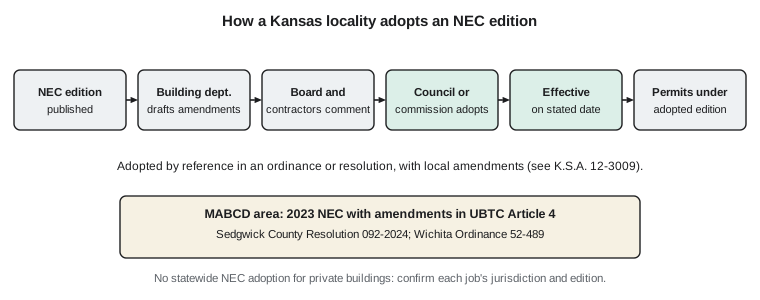
Most localities do not print the whole NEC in their ordinance. They adopt it by reference: the ordinance names the code and its edition, says that it is adopted as the electrical code of the city or county, and then lists local amendments, which delete, change or add sections. Kansas statutes allow cities to incorporate standard codes by reference in this way (see K.S.A. 12-3009 and the sections after it), so the published NEC becomes part of the local law without being reprinted. A copy of the adopted code is usually kept on file with the city clerk.
The process usually starts in the building department, which reviews a new edition and drafts amendments. Many localities consult contractors and a local board, such as a board of electrical examiners or a code advisory board, before the governing body acts. The city council or county commission then passes the ordinance or resolution, which takes effect on the date it states. Some localities set a grace period during which permits may be issued under either the old or the new edition.
What MABCD has adopted
MABCD's codes, resolutions and ordinances page lists the 2023 NEC as the electrical code in its area, with amendments in Article 4 of the Unified Building and Trade Code, the joint code that Wichita and Sedgwick County use. Sedgwick County adopted it by Resolution 092-2024, dated May 6, 2024, and Wichita by Ordinance 52-489. The page did not state an effective date when it was checked, so confirm the effective date with MABCD before relying on it for a permit issued near the change.
The joint code is the reason one inspector can work on both sides of the Wichita city limit. Because the city and the county adopted the same code and amendments, a job in Wichita and a job in unincorporated Sedgwick County follow the same edition and the same local changes. Small cities that rely on MABCD may also have adopted the joint code, but each city should be checked, because a city that contracts for inspections still adopts its own ordinances.
| Where | Who adopts | Where to look |
|---|---|---|
| Wichita and unincorporated Sedgwick County | City council and county commission, as the joint UBTC | MABCD codes, resolutions and ordinances page |
| Johnson County cities | Each city council | The city's municipal code and building department |
| Kansas City, Kansas | The Unified Government commission | The Unified Government's code of ordinances |
| Topeka | The city council | The Topeka Municipal Code |
| Rural county with no code | No electrical code may be adopted | The county clerk or planning office |
Amendments
A local amendment can do almost anything the governing body wants within state law. Common Kansas amendments cover the administrative chapter of the code, replacing the NEC's own administrative provisions with local rules on permits, inspections, fees and licensing. Others delete or soften requirements the locality considers costly, such as some protection requirements in dwellings, or add local requirements, such as limits on certain wiring methods in commercial buildings. Because amendments vary, the only safe approach is to read them.
An electrician who knows the national code well can still fail an inspection on an amendment. When Little River took its first Lenexa job, the foreman installed to the edition the company used in Wichita. The Lenexa inspector cited two items that the city had amended differently. Neither was hard to fix, but the reinspection cost a day. Since then, Pat has added each city's amendment list to the company's jurisdiction binder.
Reading an amendment
Amendments are written in a few standard forms, and knowing them makes a long amendment list quick to read. A deletion says that a section of the NEC is deleted, which means the requirement does not apply locally. A substitution says that a section is deleted and replaced with new wording, which means the local wording applies instead. An addition adds a new section or a new sentence to an existing one. An exception added locally relaxes a requirement in stated conditions. And an administrative amendment replaces the NEC's administrative chapter with the locality's own rules, usually by pointing to another chapter of the municipal code.
Read each amendment against your own copy of the code, with the section open. An amendment that deletes part of a section leaves the rest in force, and an amendment that renumbers a section can make later references confusing. When the meaning is not clear, ask the building official before you install, not after the inspection. Local officials are usually willing to explain their amendments, and a written answer protects the contractor if a different inspector later reads the amendment another way.
The Kansas City area
The Kansas side of the Kansas City area shows how local adoption plays out. Johnson County's contractor licensing program means that one license class can qualify a contractor in many cities, but it does not mean those cities share a code. Each participating city adopts its own edition and amendments, and they do not always change editions in the same year. The Unified Government adopts the code for Kansas City, Kansas and the parts of Wyandotte County it governs. Across State Line Road, Kansas City, Missouri adopts its own code under Missouri law, which is covered in this series' Missouri course. A contractor working along the state line can face three or four editions within a few miles.
Little River's estimators keep a short table of the editions in force in each city where the company bids, with the date each was last checked. Any entry more than six months old is checked again before the next bid in that city. The habit costs a phone call or a few minutes on a city website, and it has saved the company from more than one bid built on the wrong code.
Finding the code for a job
Before bidding a job in an unfamiliar place, answer four questions. First, which government has jurisdiction? An address can be in a city, in unincorporated county, or in a small city that contracts with a county or a neighbor for inspections, and the mailing address does not always tell you which. The county's property records or the city's permit portal usually settle it. Second, which edition is adopted, and when did it take effect? Third, what are the local amendments? Fourth, are there any pending changes, such as a new edition the governing body has adopted with a future effective date?
- Confirm the jurisdiction from property records or the permit office, not from the mailing address.
- Find the adopting ordinance or resolution and note the edition and effective date.
- Read the amendments, including the administrative chapter.
- Ask the building department about pending adoptions and grace periods.
- Record the answers in the company's jurisdiction file and date them.
# Jurisdiction file lookup (illustrative entries; confirm each with the locality)
jurisdictions = {
    "Wichita": {"code": "2023 NEC with UBTC Article 4 amendments", "checked": "2026-11"},
    "unincorporated Sedgwick County": {"code": "2023 NEC with UBTC Article 4 amendments", "checked": "2026-11"},
    "Lenexa": {"code": "check the city's adopting ordinance", "checked": None},
}
for place in ("Wichita", "Lenexa", "Hutchinson"):
    entry = jurisdictions.get(place)
    if entry is None:
        print(f"{place}: no entry; call the building department before bidding")
    elif entry["checked"] is None:
        print(f"{place}: {entry['code']}; not yet verified")
    else:
print(f"{place}: {entry['code']} (checked {entry['checked']})")Wichita: 2023 NEC with UBTC Article 4 amendments (checked 2026-11) Lenexa: check the city's adopting ordinance; not yet verified Hutchinson: no entry; call the building department before bidding
Edition changes and work in progress
When a locality adopts a new edition, the question for a contractor is which edition applies to a job already under way. The answer is usually set by the adopting ordinance or by the locality's administrative rules, and it usually depends on the permit date: a permit issued before the effective date stays under the old edition, and a permit applied for after it falls under the new one. Some localities allow an applicant to choose during a grace period. If the ordinance is silent, ask the building official, and get the answer in writing if it matters to the bid.
For design-build work and long projects, the edition can change between the estimate and the permit. Lena now adds a line to every estimate stating which edition it is based on, so that a change in the code is a change in the contract rather than a cost the company absorbs. Lesson 9 returns to that contract point.
When no code is adopted
Some rural counties and small towns in Kansas have adopted no electrical code at all. In those places there may be no permit and no inspection. That does not make the work unregulated in practice. Utilities often require an inspection or a certificate before they connect a new service, insurers and lenders may demand compliance, and a contractor that installs below the NEC risks liability if something goes wrong. The NEC remains the standard of good practice that a court is likely to look to, and federal OSHA's electrical rules still apply to the contractor's own employees.
Little River's policy is to install to the most recent edition it works under, the 2023 NEC in Wichita, wherever no code is adopted. Gene's reasoning is simple: the crews know it, the inspectors in the company's main market expect it, and it is the standard a lawyer would ask about.
How the exam treats local adoption
The national master exams test the code as published, not as amended. They may ask general questions about how codes are adopted, such as what it means to adopt a code by reference or which body has the authority to amend it, and the quizzes in this course do. But no national exam question will turn on MABCD's Article 4 amendments. On the exam, answer from the published edition the exam uses. On the job, follow the edition and amendments the locality has adopted.
The NEC itself recognizes the role of the authority having jurisdiction. Section 90.4 explains that the authority having jurisdiction enforces the code and interprets it, and Article 100 defines the term. In Kansas, the authority having jurisdiction for an ordinary job is the local building official or inspector who enforces the code the city or county adopted.
Common mistakes
MistakeAssuming Kansas has a statewide NEC adoption for private buildings.
InsteadEach city or county adopts its own edition by ordinance or resolution.
MistakeUsing the mailing address to identify the jurisdiction.
InsteadCheck property records or the permit office; mailing cities and legal jurisdictions differ.
MistakeIgnoring the administrative chapter of local amendments.
InsteadLocal amendments often replace the NEC's administrative provisions with local permit and fee rules.
MistakeAssuming a small city that uses MABCD inspectors adopted the joint code.
InsteadEach city adopts its own ordinances; confirm.
MistakeAnswering exam questions from local amendments.
InsteadNational exams test the published code edition named in the bulletin.
Summary and key terms
- Kansas has no statewide NEC adoption for private buildings; cities and counties adopt codes under home rule.
- Localities usually adopt the NEC by reference, with local amendments, in an ordinance or resolution.
- MABCD's area uses the 2023 NEC with amendments in Article 4 of the Unified Building and Trade Code, by Resolution 092-2024 and Ordinance 52-489.
- For each job, confirm the jurisdiction, edition, effective date, amendments and pending changes.
- Edition changes usually turn on the permit date; ask if the ordinance is silent.
- National exams test the published code; the job follows the adopted code.
- Adoption by reference
- Adopting a published code as local law by naming it in an ordinance without reprinting it.
- Local amendment
- A change that a locality makes to an adopted code.
- UBTC
- The Unified Building and Trade Code used jointly by Wichita and Sedgwick County.
- Authority having jurisdiction
- The official or office that enforces and interprets the code for a job.
- Effective date
- The date an adopted code begins to apply to permits.
Practice problems
Work each problem on paper first, then reveal the answer to check.
Who decides the NEC edition for a Lenexa tenant finish?
Show answer
The City of Lenexa, by its adopting ordinance.
What edition does MABCD's area use?
Show answer
The 2023 NEC with amendments in UBTC Article 4.
A city adopts a new edition effective March 1. Lena's permit was issued February 20. Which edition applies?
Show answer
Usually the old edition, but check the adopting ordinance.
A township has no electrical code. What standard should Little River install to?
Show answer
The NEC, as good practice; Little River uses the 2023 edition it works under in Wichita.
Which NEC section describes the authority having jurisdiction's role?
Show answer
Section 90.4, with the definition in Article 100.
Lesson quiz · 5 questions
Score 60% or more to complete this lesson.
Create a free account to save your progress, take quizzes and earn a certificate.