
MELU-216 · Lesson 7 of 12 · 19 min
Duties and responsibilities of the Local Master Electrician Licenses holder
▶ Video coming soon A video version of this lesson is on the way.
Gene keeps a framed copy of his first MABCD master certificate on the wall of the Little River office. When Lena asked him what it had meant in practice, he said it meant his name was on every job, whether he was there or not. That is the core of a master's duty in every Kansas system in this course. The master is the person the locality holds accountable for the electrical work done under the license, and for a company the master is the qualified person whose certificate keeps the contractor license alive. This lesson covers what that accountability means: supervision, code compliance, permits and records, apprentice ratios, the rule against lending a license, and the discipline a locality can impose.
Duties are set by local ordinance, so the details vary. The lesson uses the Topeka Municipal Code, which states several duties plainly, MABCD's contractor licensing rules, the Unified Government's posted requirements and Johnson County's program as examples. Read the current ordinance where you work.
The master as the accountable person
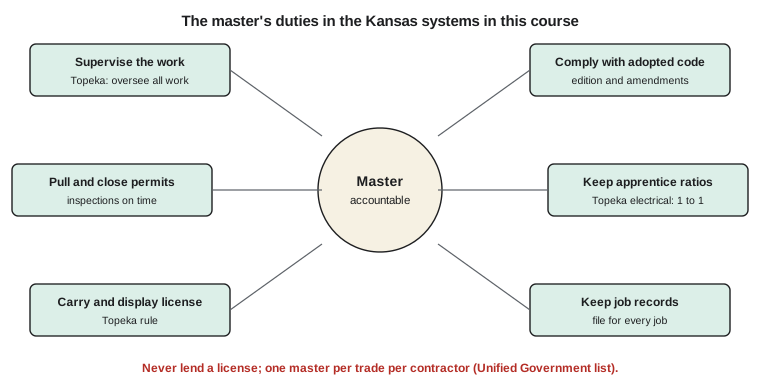
Topeka's municipal code puts the principle in one sentence: the master oversees all the work for compliance with the code. Other systems say the same thing in other words. MABCD's trade contractor license must name a qualified person who holds a master certificate. The Unified Government's posted requirements allow one master per trade for each contractor and call that person's credential a certificate of qualification. Johnson County licenses its master class on the strength of a master exam. In each case, the locality has a named individual to hold to the code.
Accountability does not mean the master must be on every job every day. A master supervises through the people in the field: journeymen who run crews, apprentices who work under them, and the company's systems for planning, checking and recording work. But the master is responsible for those systems working. A failed inspection, an unpermitted job or an unsafe installation is the master's problem as well as the crew's.
Supervision and ratios
Supervision has two parts. One is technical: making sure the people doing the work are qualified for it and that their work meets the code. The other is legal: making sure the company keeps the ratios and staffing rules the locality sets. Topeka's municipal code sets an apprentice ratio for electrical work of one apprentice to one licensed electrician, so a crew with two apprentices needs at least two licensed electricians supervising them. Other localities set their own ratios or none, and some count only journeymen and masters toward the licensed side.
Ratios are easy to break by accident. A foreman calls in sick, an apprentice is sent to a small job alone, a helper is moved to a crew that already has its full share of apprentices. Lena now checks her crews against the ratio every morning, and she keeps a written rule that no apprentice works alone on a job in a locality with a ratio.
# Crew ratio check: Topeka's electrical apprentice ratio is 1 apprentice per licensed electrician
def ratio_ok(licensed, apprentices, per_licensed=1):
    return apprentices <= licensed * per_licensed

crews = {"Crew A": (2, 2), "Crew B": (1, 2), "Crew C": (3, 1)}
for name, (licensed, apprentices) in crews.items():
    status = "OK" if ratio_ok(licensed, apprentices) else "over the ratio; add a licensed electrician"
print(f"{name}: {licensed} licensed, {apprentices} apprentices: {status}")Crew A: 2 licensed, 2 apprentices: OK Crew B: 1 licensed, 2 apprentices: over the ratio; add a licensed electrician Crew C: 3 licensed, 1 apprentices: OK
Code compliance
The master's most basic duty is to see that the work meets the code the locality has adopted, with its amendments. That means knowing which edition applies, as Lesson 5 explains, and making sure the crews know it too. It also means fixing what fails. When an inspection fails, the master should know why, see that the correction is made properly and ask whether the same mistake is being made on other jobs.
Compliance also covers materials and equipment. The NEC requires equipment to be approved, and section 110.2 and the definitions in Article 100 explain what that means: acceptable to the authority having jurisdiction, which in practice usually means listed and labeled by a recognized testing laboratory. Section 110.3 requires listed and labeled equipment to be installed and used according to its listing and instructions. A master who allows unlisted or misused equipment on a job is responsible for it.
Permits and records
Every Kansas system in this course ties permits to the license. The master, or the company through its master, is responsible for pulling permits before work starts, for calling inspections at the right stages and for closing permits when the work is done. Open permits and work without permits are among the most common grounds for discipline in local systems.
Records are the master's evidence. A job file should contain the contract, the permit, the plans if any, the inspection results with dates, the correction lists and what was done about them, and the names of the people who did the work. Payroll and timesheets show who was on site and support the ratio. Material records show what was installed. If a question comes up years later, after a fire or a sale, the file is how the master shows the work was done right.
| Duty | Example source | How to meet it |
|---|---|---|
| Oversee all work for code compliance | Topeka Municipal Code | Supervise crews; check work before inspection |
| Name a qualified master on the company license | MABCD contractor licensing | Keep the master employed and the certificate current |
| One master per trade per contractor | Unified Government (2011 list) | Do not split one master across companies |
| Display and carry the license | Topeka Municipal Code | Post it at the office; carry the card on jobs |
| Keep the apprentice ratio | Topeka: 1 to 1 for electrical | Check crews daily |
| Show the test agency and test name | K.S.A. 12-1526 | Keep the score report with the license file |
Carrying and displaying the license
Topeka requires the license to be displayed and carried. Other localities have similar rules: the company's license posted at its place of business, and the individual's card carried on the job and shown to an inspector who asks. The rule exists so that inspectors can check quickly who is responsible and whether the people on site hold the credentials they claim. A master who cannot produce a card on site may be asked to stop work until the license is confirmed.
Vehicles and advertising raise a related point. Many localities require a contractor's license number to appear on its advertising, bids or vehicles, and they treat advertising electrical work without a license as a violation in itself. Check the local rule before printing anything.
The rule against lending a license
The most serious duty is also the simplest: a master may not lend his or her license to anyone. Lending a license means letting another person or company use it to pull permits or qualify a business when the master does not actually supervise the work. It is sometimes offered as a favor or for a monthly fee, and it is a violation in every Kansas system that licenses masters. The Unified Government's one-master-per-trade rule and MABCD's qualified person rule both depend on the named master actually being responsible for the work.
Gene has turned down several such offers over the years, usually from former employees starting their own companies. His answer was always the same: if his name is on the permit, he supervises the job, and he works for one company. Lena has adopted the same rule. A master who qualifies a company should be its employee or owner, should supervise its electrical work and should be able to show that supervision if asked.
When the master leaves
Because the company's license depends on its master, the departure of a master is a licensing event. Most systems require the company to notify the licensing authority promptly when its qualified person leaves and to name a new qualified person within a set time, or the license lapses or is suspended. Until a new master is in place, the company may be unable to pull new permits, and existing permits may need a new responsible person. The master who leaves should also notify the authority in writing, so that his or her name is no longer tied to work he or she does not supervise.
For Little River, this is the reason Lena's master certificate is urgent. When Gene steps back, she will become the company's qualified person with MABCD and, if the company wants, with Johnson County. Pat has drafted the notices in advance, so that the change can be filed the day Lena's certificate issues.
Employees, temporary workers and subcontractors
Supervision assumes that the people doing the work are the company's own. Local systems that require journeymen and apprentices to be registered or certified usually expect them to be employees of the licensed contractor, working under its master. A company that fills a crew with workers paid as independent contractors may find that those workers need their own licenses, that the ratio no longer works, and that its workers compensation coverage, discussed in Lesson 10, does not cover them as it should. Workers supplied by a staffing agency raise similar questions. Ask the locality how it treats them before relying on them.
When Little River hires another electrical contractor as a subcontractor, for example for a fire alarm system or a large low-voltage package, that subcontractor needs its own license where the locality requires one and usually its own permit for its scope. Lena's master certificate does not cover another company's crew, and she should not pull a permit for work her company does not control.
Staying within the license
A master's credential covers the work the locality licenses at that level, and some systems issue separate credentials for limited fields such as signs, elevators, low-voltage systems or residential work. A master who takes on work outside the company's license class, or in a locality where the company is not licensed, puts the license at risk. Before bidding in a new city or a new kind of work, Lena asks two questions: is the company licensed here for this work, and does a separate trade license cover any part of it?
Discipline
Kansas localities that license electricians can discipline licensees for violations. The usual grounds include work without a permit, repeated or serious code violations, lending a license, fraud or misrepresentation in an application, failure to correct work after an inspection, failure to keep insurance or other license conditions, and conduct the ordinance lists as incompetence or negligence. The usual penalties are a warning letter, probation, suspension or revocation, sometimes with a fine, after notice and a hearing before the official or board the ordinance names.
Discipline in one locality can follow a master to another. Applications often ask whether the applicant has ever been disciplined elsewhere, and a false answer is itself a ground for discipline. Because K.S.A. 12-1526 makes certificates of competency portable among localities, a licensing authority that learns of serious discipline elsewhere may look closely at a renewal or a new application.
Professional conduct
Beyond the written rules, a master's reputation with inspectors and customers is part of the job. Inspectors in Kansas cities work with the same masters for years, and a master known for accurate permits, ready jobs and honest answers gets the benefit of the doubt when a code question is close. Customers notice the same things. Lena's rule for herself is to treat every inspection as if her license were on the line, because it is.
Honesty with customers is part of the same duty. A master should not promise that work will pass when it has not been inspected, should not tell a customer that a permit is unnecessary when the locality requires one, and should explain plainly when a customer's request would not meet the code. Customers who ask for shortcuts usually accept a clear explanation of why the shortcut would fail inspection or create a hazard, and the few who do not are customers worth losing.
Common mistakes
MistakeThinking the master must be on every job every day.
InsteadThe master supervises through qualified crews and company systems but remains accountable for the work.
MistakeLetting a former employee use your license for a fee.
InsteadLending a license is a violation in every system that licenses masters.
MistakeSending an apprentice alone to a Topeka job.
InsteadTopeka's electrical apprentice ratio is one apprentice per licensed electrician.
MistakeWaiting to tell the authority that the qualified person left.
InsteadNotify promptly; the company's license depends on its master.
MistakeLeaving the license card at the office.
InsteadTopeka requires the license to be displayed and carried; many localities have similar rules.
Summary and key terms
- The master is the person the locality holds accountable for the electrical work done under the license.
- Topeka's code says the master oversees all work for code compliance and requires the license to be displayed and carried.
- Topeka's electrical apprentice ratio is one to one; other localities set their own.
- Masters pull and close permits, keep job records and see that failed work is properly corrected.
- A master may not lend a license, and one master qualifies one company per trade in the Unified Government's system.
- Localities can warn, suspend or revoke for violations after notice and a hearing.
- Qualified person
- The master whose certificate supports a company's contractor license.
- Apprentice ratio
- The maximum number of apprentices per licensed electrician on a job.
- License lending
- Letting another person or company use a license without actual supervision.
- Approved
- Acceptable to the authority having jurisdiction, as defined in NEC Article 100.
- Revocation
- The cancellation of a license as discipline.
Practice problems
Work each problem on paper first, then reveal the answer to check.
A Topeka crew has one journeyman and two apprentices. Is that allowed?
Show answer
No; the ratio is one apprentice per licensed electrician, so one more licensed electrician is needed.
A friend asks Lena to qualify his new company while she works for Little River. Should she?
Show answer
No; that would be lending her license, and a master qualifies only the company whose work she supervises.
Gene retires. What must Little River do?
Show answer
Notify MABCD and name a new qualified master, such as Lena, within the time the rules allow.
Which NEC section requires listed equipment to be used according to its instructions?
Show answer
Section 110.3.
An inspector asks to see Lena's card on a Topeka job. What should she do?
Show answer
Show it; Topeka requires the license to be carried.
Lesson quiz · 5 questions
Score 60% or more to complete this lesson.
Create a free account to save your progress, take quizzes and earn a certificate.