
MELU-216 · Lesson 10 of 12 · 19 min
Workplace safety law and OSHA for electrical contractors
▶ Video coming soon A video version of this lesson is on the way.
Two winters ago an apprentice at Little River took a shock while reconnecting a circuit in a ceiling that someone else had told him was dead. He was not badly hurt, but he lost a week of work, and the company spent far longer than that on reports, doctor's visits, an insurance claim and a long conversation about how the circuit had been verified. Gene used the incident to rewrite the company's safety program, and he made Lena responsible for training the crews on it. A master in Kansas is not just a code expert. As the person who supervises the work, she is part of how the company meets its legal duties to the people doing it. This lesson covers the safety law that applies to Kansas electrical contractors, the federal OSHA rules that matter most for electrical work, the injury reporting clocks, and Kansas workers compensation.
Safety rules are federal and state law, not local ordinance, so they are the same in Wichita, Lenexa and Topeka. The federal rules cited here are well established; the Kansas workers compensation details were checked in November 2026 against the Kansas Department of Labor and the Kansas statutes. Standards are cited by number only.
Who enforces safety law in Kansas
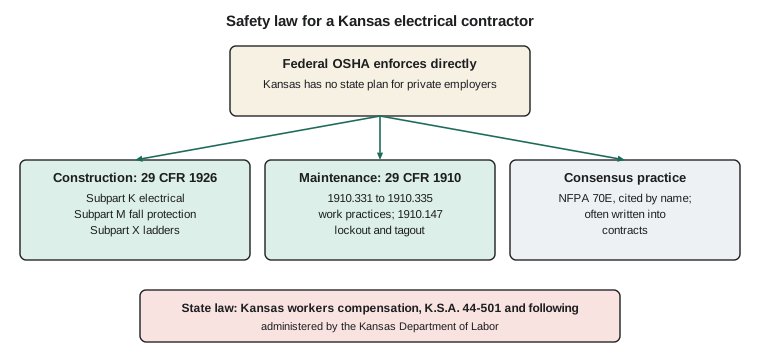
The federal Occupational Safety and Health Act allows a state to run its own approved plan for private employers. Kansas does not, so the federal Occupational Safety and Health Administration enforces safety standards for private employers in Kansas directly, through its area offices. That means Little River follows the federal OSHA standards, and federal OSHA compliance officers inspect its jobs. Public employees in Kansas are covered differently, under state arrangements, but that matters mainly to cities and schools, not to private contractors.
Kansas does offer help. The Kansas Department of Labor runs a free and confidential safety and health consultation service for small private employers, funded in part by OSHA, which can visit a job or shop, point out hazards and help write a program without issuing citations. Small contractors can use it before an OSHA inspection rather than after one.
The general duty and the construction standards
Every employer covered by the Act has a general duty to provide a workplace free from recognized hazards likely to cause death or serious physical harm, and a duty to comply with the standards OSHA has issued. For electrical contractors on construction work, the main standards are in Part 1926 of Title 29 of the Code of Federal Regulations. Subpart K covers electrical safety in construction, including the requirements for ground-fault protection on construction sites in section 1926.404 and the safety-related work practices for lockout and tagging of circuits in section 1926.417. Subpart M covers fall protection, Subpart X ladders and stairways, Subpart L scaffolds, Subpart P excavations and Subpart CC cranes and derricks. When Little River does maintenance or service work in an operating plant rather than construction, the general industry standards in Part 1910 may apply instead, including the electrical work practice rules in sections 1910.331 to 1910.335 and the lockout and tagout standard in section 1910.147.
OSHA's standards do not spell out every electrical work practice, and OSHA often looks to NFPA 70E, the consensus standard on electrical safety in the workplace, as evidence of what a recognized hazard is and how to control it. NFPA 70E is copyrighted and is cited here by name only. Many owners and general contractors write it into their contracts, which makes it a contract requirement as well.
Working de-energized
The central rule of electrical safety is to work on circuits de-energized unless that is not feasible or creates a greater hazard. De-energizing is a procedure, not a switch position. The usual steps are to identify every source of supply, open the disconnecting means, apply locks and tags, release stored energy, and verify the absence of voltage with a tester that is itself checked before and after the test. The apprentice at Little River was hurt because the verification step was skipped: someone had told him the circuit was off, and he believed it.
Lena now teaches the steps in a fixed order, and she will not let anyone on a crew touch a conductor that he or she has not personally verified dead. Work on energized circuits, where it is truly necessary, requires a written justification, a qualified person, the right protective equipment and the controls that the company's program and the applicable standards require.
Ground-fault protection, ladders and falls
On construction sites, OSHA requires employers to protect employees from ground faults, either with ground-fault circuit interrupters on temporary receptacles or, where the standard allows, with an assured equipment grounding conductor program that inspects and tests cords and tools on a schedule. Damaged cords and tools must be removed from service. Ladders must be the right type for electrical work, which means nonconductive side rails, and must be set up and used as the standard requires.
Falls are a leading cause of death in construction, and electricians work at height every day: on ladders, lifts, scaffolds and roofs. The fall protection standard in Subpart M sets when protection is required and what kinds are allowed. A master who sends a crew to a roof should know what protection the job needs and see that it is there.
Training, programs and records
Many OSHA standards require training, and some require written programs. A small electrical contractor usually needs at least a written safety program, a hazard communication program for chemicals on site, an energy control or lockout procedure, and training records for each employee. Training must be given in a language and vocabulary the employees understand, and it should be repeated when the work, the equipment or the rules change.
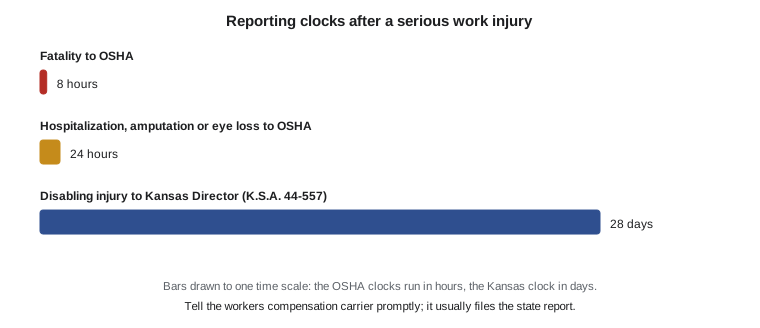
Recordkeeping under Part 1904 requires many employers to keep a log of recordable work injuries and illnesses and to post an annual summary, though some small employers are partly exempt from the routine log. Separately, every employer must report serious events to OSHA: a work-related fatality within 8 hours, and an in-patient hospitalization, an amputation or the loss of an eye within 24 hours.
| Event | Who must be told | Deadline |
|---|---|---|
| Work-related fatality | OSHA | 8 hours |
| In-patient hospitalization, amputation or loss of an eye | OSHA | 24 hours |
| Injury that disables beyond the day or shift | Kansas Director of Workers Compensation | 28 days after the employer knows (K.S.A. 44-557) |
| Any work injury | The workers compensation carrier | As the policy requires, promptly |
Incidence rates
Owners and general contractors often ask for a contractor's injury rates before awarding work. The standard rate is the number of recordable cases multiplied by 200,000 and divided by the hours worked, which gives the rate per 100 full-time workers for a year. The same formula gives rates for cases with days away, restricted work or transfer. A high rate can cost a company bids, and a low one is earned by the daily habits this lesson describes.
# OSHA-style incidence rate: cases x 200,000 / hours worked
def rate(cases, hours):
    return cases * 200000 / hours

hours = 14 * 2000          # fourteen people, about 2,000 hours each
for label, cases in (("recordable cases", 2), ("cases with days away", 1)):
print(f"{label}: rate {rate(cases, hours):.2f} per 100 full-time workers")recordable cases: rate 14.29 per 100 full-time workers cases with days away: rate 7.14 per 100 full-time workers
Inspections and citations
OSHA inspects after serious events and complaints, under emphasis programs that target high-hazard work, and at random. On construction sites, compliance officers often look at falls, struck-by and caught-between hazards, and electrical hazards. An inspection usually begins with an opening conference, continues with a walk of the site and interviews, and ends with a closing conference. Citations, if any, follow in writing and can carry penalties. An employer can contest a citation within the time stated on it, or negotiate an informal settlement. On a multi-employer site, OSHA may cite more than one employer for the same hazard, including the employer that created it, the one whose employees were exposed and the controlling contractor.
Workers compensation in Kansas
Workers compensation pays medical care and part of lost wages for employees injured on the job, regardless of fault, and in return the employee generally cannot sue the employer for the injury. In Kansas it is governed by K.S.A. 44-501 and the sections after it and administered by the Division of Workers Compensation in the Kansas Department of Labor. The department's employer page says coverage is required for Kansas employers except agricultural employers and employers with an estimated gross annual payroll under 20,000 dollars, and it notes that the payroll exemption does not help an employer that is a subcontractor in the circumstances the law describes. Coverage can be bought from an insurance carrier, provided through approved self-insurance, or obtained through a group pool.
For an electrical contractor, the payroll exemption is rarely useful. Any crew of more than one person quickly passes it, and general contractors and licensing authorities such as MABCD ask for proof of coverage or a notarized waiver. Kansas law also generally makes a principal contractor responsible for compensation to a subcontractor's employees if the subcontractor fails to provide it (see K.S.A. 44-503), which is why general contractors insist on certificates of workers compensation from every subcontractor and why Little River insists on them from its own.
Reporting a work injury in Kansas
K.S.A. 44-557 requires an employer to report a work injury to the Director of Workers Compensation within 28 days after the employer receives knowledge of it, when the injury disables the employee beyond the day or shift on which it occurred. An employer that repeatedly fails to report can be penalized up to 250 dollars for each failure. In practice, the carrier usually files the report once the employer tells it about the injury, so the employer's job is to tell the carrier promptly and make sure the report is made. The employee must also give notice of the injury to the employer within the time the statute sets, and a prompt, written incident report protects both sides.
Underground work
Electrical contractors dig: for services, site lighting, feeders and grounding electrodes. Kansas's underground utility damage prevention law, at K.S.A. 66-1801 and the sections after it, requires excavators to notify the one-call center, by calling 811 or using its online service, a set time before digging so that underground facilities can be marked. Digging without the call risks a strike on a gas or power line, injuries, repair costs and penalties. Lena's crews do not break ground until the locate ticket is on site and the marks are visible.
A safety program that works
Gene's rewritten program for Little River is short on purpose. It names who is responsible for safety on each job, which is the foreman, and who backs the foreman up, which is now Lena. It sets the energy control procedure in five steps that everyone learns by heart. It requires a brief meeting at the start of each job and each week, where the crew talks through the hazards of the work ahead. It lists the protective equipment each kind of work needs and where it is kept. It says how injuries and near misses are reported, to whom and how quickly. And it says that any employee may stop work that looks unsafe without being disciplined for it.
Near misses get the most attention. A near miss, such as a circuit found live when it was supposed to be dead, costs nothing if it is reported and studied, and it is often the warning before a serious injury. Lena keeps a log of near misses and reviews it with the foremen every month. The apprentice's shock two winters ago had been preceded by two near misses on other jobs that nobody had written down. That is the kind of record a compliance officer asks about after an injury, and the kind of pattern a good program catches before one.
Common mistakes
MistakeAssuming Kansas runs its own OSHA plan for private employers.
InsteadFederal OSHA enforces directly in Kansas for private employers.
MistakeTrusting someone else's word that a circuit is dead.
InsteadVerify absence of voltage personally with a tested tester.
MistakeReporting a hospitalization to OSHA a week later.
InsteadHospitalizations, amputations and eye losses are due to OSHA within 24 hours.
MistakeTreating the 20,000-dollar payroll exemption as a safe harbor for a contractor.
InsteadMost contractors exceed it, and the exemption has limits for subcontractors.
MistakeDigging a service trench without a locate.
InsteadCall 811 and wait for marks before excavating.
Summary and key terms
- Kansas has no state OSHA plan for private employers, so federal OSHA enforces directly.
- Construction electrical work falls under 29 CFR 1926, including Subpart K; maintenance work may fall under Part 1910.
- Work de-energized whenever feasible, and verify absence of voltage personally.
- Report a fatality to OSHA within 8 hours and a hospitalization, amputation or eye loss within 24 hours.
- Kansas requires workers compensation except for agricultural employers and those under 20,000 dollars of payroll, with limits.
- K.S.A. 44-557 requires a report within 28 days of knowledge for an injury that disables beyond the day or shift.
- State plan
- A state-run OSHA program approved by federal OSHA; Kansas has none for private employers.
- Subpart K
- The electrical safety subpart of OSHA's construction standards.
- Assured equipment grounding conductor program
- A program of scheduled cord and tool inspection and testing used in place of GFCIs where allowed.
- Incidence rate
- Cases times 200,000 divided by hours worked.
- Statutory employer
- A principal contractor that can be liable for a subcontractor's employees' compensation.
Practice problems
Work each problem on paper first, then reveal the answer to check.
Who will inspect a Little River job after a serious injury?
Show answer
Federal OSHA.
An electrician is hospitalized overnight after a fall. When must OSHA be told?
Show answer
Within 24 hours.
A journeyman's injury keeps him off work for three days. When must the report reach the Kansas Director?
Show answer
Within 28 days after Little River learns of it.
Little River had 2 recordable cases in 28,000 hours. What is its rate?
Show answer
2 x 200,000 / 28,000, about 14.29.
A subcontractor of Little River has no workers compensation. Why should Lena care?
Show answer
Little River can be responsible for the subcontractor's employees' compensation as a principal contractor.
Lesson quiz · 5 questions
Score 60% or more to complete this lesson.
Create a free account to save your progress, take quizzes and earn a certificate.