
MELU-216 · Lesson 11 of 12 · 18 min
Renewal, reciprocity and working in other jurisdictions
▶ Video coming soon A video version of this lesson is on the way.
Passing the exam is a one-time event. Keeping a master credential is a habit that lasts the rest of a career. Every Kansas certificate and contractor license in this course expires, every one requires continuing education to renew, and every locality has its own calendar. A master who works in several places can owe hours to three authorities at once, each with its own approved course list. And because Kansas has no state license, a master who wants to work across the state line in Missouri, Oklahoma, Nebraska or Colorado has to deal with those states' systems on their own terms. This lesson covers renewal and continuing education under K.S.A. 12-1526 and in the main Kansas systems, late renewal and reactivation, portability within Kansas, and working in neighboring states.
Renewal rules change often, and several of the details in this lesson come from local pages checked in November 2026 or from secondary sources, which the lesson identifies. Before planning hours, check the current page of every authority you renew with.
The state's continuing education rules
K.S.A. 12-1526 sets the continuing education framework for localities that license. It calls for twelve hours every two years, or six hours each year, and of those, six hours every two years, or three each year, must be on the code. It also prevents localities from limiting the number of continuing education providers, so a licensee is not forced to buy hours from a single approved vendor. Within that framework, each locality sets its own renewal period, approves courses and tracks hours.
The code share is the part most often missed. An electrician who takes twelve hours of business or safety courses in a two-year period has the total but not the code hours, and the renewal will be refused until the code hours are made up. Lena's rule is to take the code hours first, early in each cycle.
MABCD
MABCD's certificates are good for two years. To renew, a certificate holder needs continuing education each year: three hours specific to the trade and three hours of general education, and the renewal fee listed on MABCD's page is 35 dollars. Hours must come from courses MABCD accepts, and the holder should keep the completion certificates.
MABCD's page also has a table for late renewal. A certificate renewed between January 1 and March 31 after it expires falls in a grace period with no extra hours. Renewed between April 1 and June 30, it needs an extra 1.5 hours. Between July 1 and August 31, an extra 3 hours. Between September 1 and December 31, an extra 4.5 hours. After that, the holder must contact the section chief. The longer the delay, the more it costs, and the holder may not work under an expired certificate in the meantime.
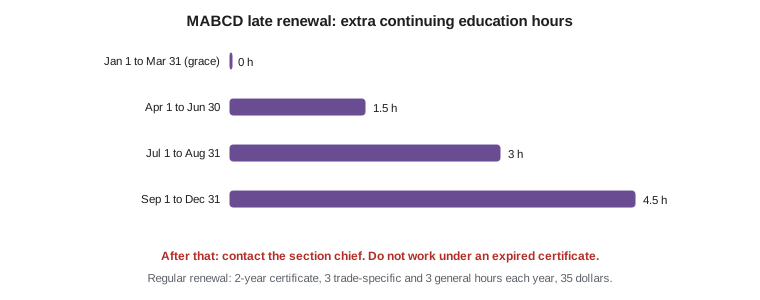
Company licenses have their own rules. As Lesson 8 explains, MABCD trade contractor licenses expire December 31 of every odd year and need twelve hours of continuing education, six of them code-related, to renew. The individual hours and the company hours are tracked separately, so a master who qualifies a company should know which hours count for which.
# MABCD late renewal: extra continuing education hours by renewal month after expiration
def extra_hours(month):
    if month <= 3:
        return 0.0            # grace period, January 1 to March 31
    if month <= 6:
        return 1.5            # April 1 to June 30
    if month <= 8:
        return 3.0            # July 1 to August 31
    return 4.5                # September 1 to December 31; later than that, contact the section chief

for m, name in ((2, "February"), (5, "May"), (8, "August"), (11, "November")):
print(f"Renewed in {name}: {extra_hours(m)} extra hours")Renewed in February: 0.0 extra hours Renewed in May: 1.5 extra hours Renewed in August: 3.0 extra hours Renewed in November: 4.5 extra hours
Topeka, Johnson County and Lawrence
Topeka's municipal code ties its continuing education to K.S.A. 12-1526 and sets a reactivation rule for licenses that lapse: six hours of continuing education for each year the license was lapsed, capped at twelve hours if it lapsed two years or more. A master who let a Topeka license lapse for one year would need six hours to reactivate it, and one who let it lapse for three years would need twelve.
For Johnson County, a secondary source published in 2020 reported eight hours of continuing education per license class each calendar year, and for Lawrence, a secondary source reported six hours each year from an approved list. Neither could be confirmed against the localities' own current pages for this course, so treat them as leads and check before relying on them. The county's continuing education pages list its own seminars, which it has long offered in spring and fall.
| Authority | Continuing education | Source |
|---|---|---|
| State framework | 12 hours every 2 years or 6 a year; 6 every 2 years or 3 a year on the code | K.S.A. 12-1526 |
| MABCD certificate | 3 trade-specific and 3 general hours each year; 2-year certificate; 35-dollar renewal | MABCD certificates page |
| MABCD contractor license | 12 hours, 6 code-related, per odd-year cycle | MABCD contractor page |
| Topeka | Per K.S.A. 12-1526; reactivation 6 hours per lapsed year, capped at 12 | Topeka Municipal Code |
| Johnson County | Reported 8 hours per class each calendar year | Secondary source, 2020; confirm |
| Lawrence | Reported 6 hours each year from an approved list | Secondary source; confirm |
Planning hours across authorities
A master who renews with several authorities should look for courses that count everywhere. Because K.S.A. 12-1526 bars localities from limiting the number of providers, a code course from a provider approved by one Kansas authority is often accepted by others, but approval is still each authority's decision. Lena plans her hours in a short list: the code hours that every authority needs, the trade and general hours MABCD needs, and the company hours for Little River's contractor license. She takes the courses most likely to count everywhere first and sends each completion certificate to every authority that tracks her hours.
# Continuing education tracker for one year (illustrative courses)
taken = [("2023 NEC changes, part 1", 3, "code"), ("Grounding and bonding review", 3, "code"),
         ("Construction safety", 2, "general"), ("Estimating and contracts", 2, "general")]
need = {"MABCD trade-specific": 3, "MABCD general": 3, "state code share (per year)": 3}
code_hours = sum(h for _, h, kind in taken if kind == "code")
general_hours = sum(h for _, h, kind in taken if kind == "general")
print(f"Code hours: {code_hours} (MABCD trade-specific needs {need['MABCD trade-specific']}, state code share {need['state code share (per year)']})")
print(f"General hours: {general_hours} (MABCD general needs {need['MABCD general']})")
print("Still need:", max(0, need["MABCD general"] - general_hours), "general hours")Code hours: 6 (MABCD trade-specific needs 3, state code share 3) General hours: 4 (MABCD general needs 3) Still need: 0 general hours
Portability within Kansas
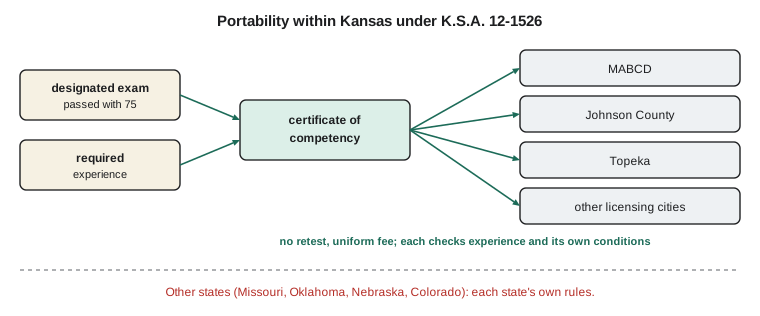
K.S.A. 12-1526 is what makes a Kansas master credential portable. A certificate of competency earned by passing a designated examination, together with the required experience, is valid in any Kansas locality that requires licensure, without retesting, for a uniform fee. A license must show the testing agency and the name of the test the holder passed, so that the next locality can see that it was a designated exam. In practice, a master who moves from Wichita to Topeka, or who wants to work in Lawrence as well as Wichita, applies to the new locality with proof of the exam and the experience, pays its fee and meets its other conditions, such as insurance and continuing education, rather than sitting a new exam.
The statute does not make every local license the same. Each locality still decides which exams it designates and checks the experience proof. MABCD's page says it does not reciprocate with other states' testing or other jurisdictions' licenses, which means a candidate qualifies at MABCD by showing an approved exam score and the experience, not by showing a license from somewhere else. Read the receiving locality's rules before assuming a credential will carry over.
Working in other states
Kansas credentials have no standing outside Kansas unless another state chooses to recognize them, and the neighboring states each run their own systems. Missouri has a voluntary statewide electrical contractor license and local licenses in Kansas City, St. Louis and other places, which this series' Missouri course covers. Oklahoma licenses electricians and electrical contractors statewide through its Construction Industries Board. Nebraska licenses electricians and electrical contractors through its State Electrical Division. Colorado licenses electricians through its State Electrical Board. Each state has its own experience rules, exams and reciprocity agreements, and few of them can recognize a local Kansas license, because there is no state license on the Kansas side to make an agreement with.
For Little River, the question has come up on jobs in Kansas City, Missouri, a few miles from its Johnson County work. Gene's answer was to treat Missouri as a separate market: before bidding, check what the Missouri locality requires, whether the company needs a local or statewide Missouri license, and how long qualifying would take. A Kansas master who expects to work regularly across a state line should plan for a second exam and a second set of renewals.
Changing employers or moving
An individual certificate belongs to the master, not to the company, so it goes with her if she changes employers. What changes is the company side. The old employer must replace her as qualified person if she was serving in that role, and the new employer must file to name her if it wants her to qualify its license. In systems that allow one master per trade per contractor, such as the Unified Government's, she can qualify only one company at a time. Address changes matter as well: most authorities require licensees to keep a current mailing address on file, and a renewal reminder sent to an old address is no excuse for a lapse.
Moving to another Kansas city is where K.S.A. 12-1526 helps most. Lena's cousin, a journeyman in Salina, moved to Lawrence two years ago and applied there with his exam record and experience proof instead of sitting a new exam. He still paid Lawrence's fee and met its continuing education rule, and he had to wait for approval before working on his own permits, but he did not have to study for and pass another test.
Stepping back
Masters near the end of their careers, like Gene, face a different question: whether to keep a certificate current after they stop working full time. Keeping it costs the renewal fee and the yearly hours. Letting it lapse costs more later if the master wants it back, as MABCD's late table and Topeka's reactivation rule show, and after a long lapse an authority may require a new exam. Some systems offer an inactive or retired status that keeps the record alive at a lower cost but does not allow work. Ask each authority what it offers before letting anything expire. Gene plans to keep his MABCD certificate current for at least two years after Lena takes over, so that he can step in if she is ever unavailable.
Keeping the record
Renewal is easier when the paperwork is in one place. Lena's folder has a page for each credential she holds or plans to hold: the authority, the credential number, the issue and expiration dates, the renewal fee, the continuing education needed and the hours completed, with the completion certificates behind it. A reminder ninety days before each expiration gives her time to take any missing hours. Pat keeps the company's matching page for each contractor license.
Common mistakes
MistakeTaking twelve hours of general courses in a two-year period.
InsteadSix of the twelve, or three each year, must be on the code.
MistakeWorking under an MABCD certificate after it expires.
InsteadRenew first; the late table adds hours as time passes.
MistakeExpecting a Kansas license to qualify you in Oklahoma or Nebraska.
InsteadThose states license statewide under their own rules.
MistakeAssuming every Kansas locality must accept any license without a fee.
InsteadPortability rests on a designated exam and experience, for a uniform fee, and each locality checks its conditions.
MistakeCounting the company's continuing education toward an individual certificate without checking.
InsteadIndividual and company hours are tracked separately.
Summary and key terms
- K.S.A. 12-1526 calls for 12 hours every 2 years or 6 a year, with 6 every 2 years or 3 a year on the code, and bars limits on providers.
- MABCD certificates last 2 years, need 3 trade and 3 general hours each year, and cost 35 dollars to renew.
- MABCD's late table adds 0, 1.5, 3 or 4.5 hours depending on when the renewal is made.
- Topeka's reactivation rule is 6 hours per lapsed year, capped at 12.
- A certificate of competency on a designated exam, with experience, carries to other Kansas licensing localities without retesting, for a uniform fee.
- Neighboring states license under their own rules; plan separately for work across a state line.
- Continuing education
- Courses required to renew a license or certificate.
- Code share
- The part of the required hours that must be on the electrical code.
- Grace period
- A period after expiration in which renewal needs no extra hours.
- Reactivation
- Restoring a lapsed license, often with added hours.
- Portability
- The ability to use one credential in several localities without retesting.
Practice problems
Work each problem on paper first, then reveal the answer to check.
Lena took six code hours and six safety hours in a two-year cycle. Has she met the state framework?
Show answer
Yes, if the locality uses the two-year option: twelve hours with six on the code.
Her MABCD certificate expired and she renews in May. How many extra hours?
Show answer
1.5 hours.
A Topeka license lapsed for three years. How many hours to reactivate?
Show answer
Twelve, the cap.
Can Lena use her MABCD credential to work in Topeka without retesting?
Show answer
Generally yes under K.S.A. 12-1526, with proof of a designated exam and experience, a uniform fee and Topeka's other conditions.
Little River wants a job in Kansas City, Missouri. What should it check?
Show answer
Missouri's local and statewide licensing requirements before bidding.
Lesson quiz · 5 questions
Score 60% or more to complete this lesson.
Create a free account to save your progress, take quizzes and earn a certificate.