
MELU-215 · Lesson 9 of 12 · 18 min
Contracts and mechanics' liens in Iowa
▶ Video coming soon A video version of this lesson is on the way.
The Grant Corners four-plex was a good job until the last invoice. Prairie Creek Builders, the general contractor, had paid Boone Ridge's first two progress bills on time, but the final bill of 18,400 dollars went unpaid for sixty days while the builder argued with the owner about a roofing problem that had nothing to do with the electrical work. Ben wanted to keep calling. Linda wanted to file a lien. Megan, as the new master, was asked to decide, and she found that the answer depended on dates Boone Ridge had recorded months earlier.
What a mechanics' lien is
A mechanics' lien is a claim against real property that secures payment for labor or materials that improved it. In Iowa, chapter 572 gives contractors, subcontractors and suppliers who furnish labor or materials for an improvement the right to a lien on the property, subject to the notice and filing requirements in the chapter. A lien does not by itself produce payment, but it clouds the owner's title, makes refinancing or sale difficult and gives the claimant a way to have a court order the property sold to pay the debt if the claim is not resolved.
Because a lien affects the owner's property even when the owner has paid the general contractor, Iowa's law balances the claimant's rights against the owner's. The notices described below are the main tool for that balance: they tell the owner who is working on the property so that the owner can make sure those people are paid.
The mechanics' notice and lien registry
For more than a decade Iowa has handled mechanics' lien notices and lien filings through a statewide online system, the mechanics' notice and lien registry, usually called MNLR, run by the Iowa Secretary of State. Instead of filing paper with the county, contractors post notices and liens on the registry, which is searchable by property. The registry is the official record, and a notice or lien that is not posted there correctly may not protect the claimant.
Linda has an MNLR account for Boone Ridge and posts notices as part of starting each job, the same way she files permits. She keeps the registry confirmation in the job file with the permit.
Residential work: the commencement notice and preliminary notices
For residential construction, Iowa adds two kinds of notice. A general contractor on a residential job must post a notice of commencement of work on MNLR within ten days after starting work. Subcontractors and suppliers who want to protect their lien rights against the owner on a residential job must post a preliminary notice on MNLR, and the timing matters: as law firm summaries describe the rule, the preliminary notice protects a subcontractor's rights against an owner who has not yet paid the general contractor in full. Payments the owner makes before receiving the notice can reduce or defeat the subcontractor's claim.
The four-plex was a residential building, and Boone Ridge was a subcontractor to Prairie Creek. Linda had checked that Prairie Creek posted its commencement notice and had posted Boone Ridge's preliminary notice in the first week of the job, months before the final bill. That single step was what gave Megan options now.
| Step | Who | Timing (summary) |
|---|---|---|
| Commencement notice (residential) | General contractor | Within 10 days after starting work |
| Preliminary notice (residential) | Subcontractors and suppliers | Early, before the owner pays the general contractor in full |
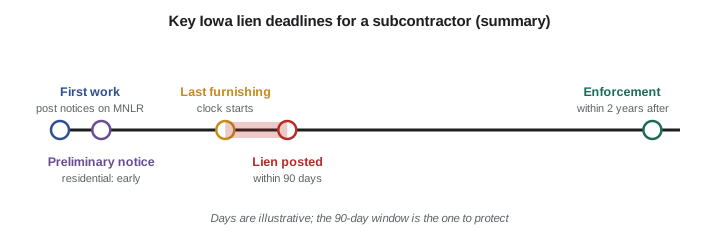
| Lien posted on MNLR | Any claimant | Within 90 days after last furnishing for full protection |
| Lien posted after 90 days | Any claimant | Protected only to the extent the owner has not paid |
| Enforcement action | Claimant | Generally within two years; 30 days after an owner's written demand |
The 90-day lien deadline
The central deadline in Iowa lien law is ninety days. A claimant who posts the lien on MNLR within 90 days after the last day it furnished labor or materials to the job has the full protection of the statute. A lien posted after that period may still be possible, but it is enforceable against the owner only to the extent the owner still owes money to the general contractor when the claimant's lien is posted. In practice this means late liens are often worth little, because by then the owner may have paid in full.
The last day of furnishing is a fact the contractor must be able to prove. It is the last day the contractor performed work or delivered materials under the contract, not the day of a warranty call or the day the invoice was sent. Boone Ridge's job file showed the last day of work at the four-plex as September 18, 2026, when the crew set the last fixtures and the final inspection passed.
# Lien dates for the Grant Corners four-plex (dates invented for this course)
from datetime import date, timedelta
last_furnished = date(2026, 9, 18)
lien_deadline = last_furnished + timedelta(days=90)
today = date(2026, 11, 20)
print("last day of furnishing:", last_furnished)
print("full-protection lien deadline:", lien_deadline)
print("days left today:", (lien_deadline - today).days)
# An owner's written demand starts a 30-day clock to sue
demand = date(2027, 1, 8)
print("suit due after owner's demand by:", demand + timedelta(days=30))last day of furnishing: 2026-09-18 full-protection lien deadline: 2026-12-17 days left today: 27 suit due after owner's demand by: 2027-02-07
Enforcing the lien
Posting a lien does not end the matter. To turn a lien into payment, the claimant may need to bring an action to enforce it in court. Iowa law sets a time limit for doing so, generally two years after the period for posting the lien ends, and an owner can shorten the time by serving the claimant with a written demand to start the action, after which the claimant generally has 30 days to sue or lose the lien. An owner who wants the property cleared during a dispute can also post a bond with the court, in an amount set by the statute, twice the amount of the lien as summarized by Iowa law firms, and the lien then attaches to the bond instead of the property.
Most liens never reach a courtroom. The lien gives the claimant a seat at the table when the owner wants to sell, refinance or simply close out the job, and the general contractor, the owner and the claimant usually settle. That is what happened at Grant Corners: two weeks after Linda posted the lien, Prairie Creek paid the balance and Boone Ridge posted a release.
Who may claim a lien
Lien rights in Iowa extend to those who furnish labor or materials for an improvement under a contract with the owner or with someone in the chain of contracts below the owner. A general contractor contracts with the owner directly. A subcontractor such as Boone Ridge contracts with the general contractor. A supplier may sell to either. Rights become narrower and notice requirements more important the further a claimant is from the owner, because the owner may not know the claimant exists. People far down the chain, such as a supplier to a sub-subcontractor, should check carefully whether the statute reaches them at all before relying on a lien.
Commercial work has its own notice rules, which differ from the residential rules described above, and the registry explains which notices are available for each kind of property. A contractor that does both kinds of work, as Boone Ridge does, should not assume that a habit built on residential jobs protects it on commercial ones. Linda's checklist asks one question at the start of every job: is this property residential or commercial under the lien law?
Talking before filing
A lien is a strong tool, and using it changes the relationship with the customer. Megan's practice before posting a lien is to send a short written reminder of the unpaid amount, the date of last furnishing and the lien deadline, and to offer a call. Many late payments are caused by a dispute elsewhere on the job, as at Grant Corners, and a reminder that the electrical subcontractor has rights of its own often moves the payment to the top of the general contractor's list. If the reminder does not work, the lien is posted well before the deadline, never on the last day.
Releasing the lien
When a lien claim is paid, the claimant must release the lien on the registry so that the owner's title is cleared. Failing to release a paid lien can expose the claimant to liability to the owner. Linda posts the release the day the payment clears and sends a copy to the owner and the general contractor, which closes the job file and preserves the relationship for the next project.
Public projects
Mechanics' liens do not attach to public property. On public improvements, Iowa protects subcontractors and suppliers through a separate law, Iowa Code chapter 573, which works through claims against retained funds held by the public owner and against the contractor's payment bond. The deadlines and procedures are different from chapter 572, and they are short. Boone Ridge's school and municipal work follows a separate checklist that Linda built with the company's attorney.
Contracts that prevent disputes
The best lien is the one never filed, and good contracts make liens less likely. Boone Ridge's subcontract checklist covers the scope and exclusions, the price and the payment schedule, how change orders are approved and priced, the code edition and permit responsibility, retainage and when it is released, and the dates on which payment is due. Megan added a clause that names the inspection authority and the edition of the code, after the ground-fault change described in lesson 5.
Lien waivers are another common tool. General contractors and owners often require a waiver from each subcontractor with each payment, stating that the subcontractor has been paid through a certain date or amount. A contractor should read every waiver before signing it and sign only waivers that match payments actually received. Signing a final waiver before final payment arrives can give up the lien rights that protect the company.
Change orders and extras
Many payment disputes begin with extra work done on a verbal request. When the four-plex owner asked for additional exterior lighting, the Boone Ridge lead wrote a one-page change order with a price and had it signed by Prairie Creek's superintendent before the work started. That paper turned a potential argument into a line on the final invoice. Unsigned extras are among the hardest amounts to collect, by lien or otherwise.
Worked problem
Is the lien in time?
Boone Ridge last furnished labor at the four-plex on September 18, 2026. It posted its preliminary notice on MNLR in April 2026. On November 20 the final bill is still unpaid. By what date must Linda post the lien on MNLR for full protection, and what happens if the owner then serves a written demand on January 8, 2027?
Show solution
- The full-protection period is 90 days after the last furnishing.
- September 18 plus 90 days is December 17, 2026.
- Posting on November 20 leaves 27 days to spare.
- After an owner's written demand, the claimant generally has 30 days to start an enforcement action, so by February 7, 2027.
Answer: Post by December 17, 2026; after a January 8 demand, sue by about February 7, 2027 or lose the lien.
Common mistakes
MistakeWaiting to post a preliminary notice on a residential job until the bill is late.
InsteadPost it early; payments the owner makes before notice can defeat the claim.
MistakeCounting the 90 days from the invoice date or a warranty visit.
InsteadCount from the last day labor or materials were furnished under the contract.
MistakeFiling a lien on a school or city project.
InsteadLiens do not attach to public property; use the chapter 573 claim procedure.
MistakeSigning a final lien waiver before the final payment clears.
InsteadSign only waivers that match payments actually received.
Summary and key terms
- Chapter 572 gives contractors, subcontractors and suppliers lien rights on improved property.
- Lien notices and liens are posted on the statewide mechanics' notice and lien registry.
- On residential jobs the general contractor posts a commencement notice within 10 days and subcontractors post preliminary notices early.
- A lien posted within 90 days after last furnishing has full protection; later liens reach only what the owner still owes.
- An owner's written demand gives the claimant about 30 days to sue; public projects use chapter 573 instead.
- Mechanics' lien
- A claim against improved property that secures payment for labor or materials.
- MNLR
- Iowa's online mechanics' notice and lien registry.
- Commencement notice
- The general contractor's residential notice that work has started.
- Preliminary notice
- A subcontractor's or supplier's notice that protects lien rights on residential work.
- Lien waiver
- A document giving up lien rights, usually in exchange for payment.
Practice problems
Work each problem on paper first, then reveal the answer to check.
Within how many days after starting must a residential general contractor post a commencement notice?
Show answer
Within 10 days.
What is the full-protection deadline for posting a lien?
Show answer
Within 90 days after the last day labor or materials were furnished.
Can a mechanics' lien be filed on a public school building?
Show answer
No. Public improvements use the chapter 573 claim procedure instead.
Lesson quiz · 5 questions
Score 60% or more to complete this lesson.
Create a free account to save your progress, take quizzes and earn a certificate.