
MELU-215 · Lesson 8 of 12 · 18 min
Contractor licensing, insurance and bonding
▶ Video coming soon A video version of this lesson is on the way.
Two weeks after Megan's master license was issued, Linda opened Boone Ridge's contractor file on her desk and asked Megan to sit with her. "You will not run the office," Linda said, "but if any of this lapses, it is your license the board will ask about." The file had four sections: the electrical contractor license, the insurance certificates, the state contractor registration and the workers' compensation policy. Each had a renewal date, and each could stop the company from working if it was missed.
The electrical contractor license
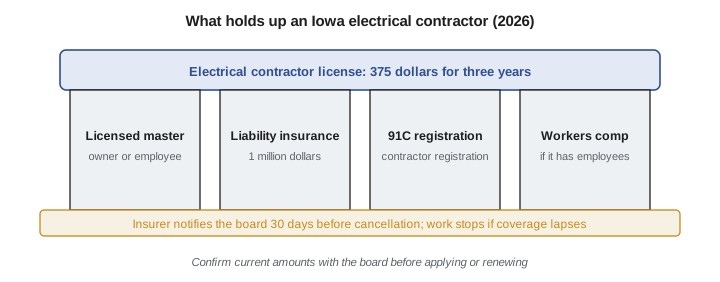
In Iowa a business that offers or performs electrical work for others must hold an electrical contractor license issued by the board. Section 103.9 sets the two conditions at the heart of that license. The contractor must be a licensed master electrician or employ one, and it must be registered as a contractor under chapter 91C. The board's rules in 481 IAC chapter 401 add the application details, the fee and the insurance requirement.
In 2026 the fee for an electrical contractor license was 375 dollars for a three-year license. The application identifies the business, its owners and its licensed master, and it is supported by proof of insurance and of 91C registration. Iowa also issues a residential electrical contractor license for businesses limited to residential work, with a residential master as its qualifier, and its scope is narrower. Boone Ridge holds the full electrical contractor license because it works on commercial and agricultural buildings as well as homes.
The licensed master in the contractor file
The contractor license records the master through whom the company qualifies. When Megan's license was issued, Linda updated the record to show her as a master employed by Boone Ridge, and when Dale moves to inactive status the company will continue to qualify through Megan alone. Some companies employ two masters so that the departure of one does not threaten the license, and Dale has encouraged Ben to start toward the master license for that reason.
If a contractor's only master leaves, dies or loses the license, the contractor no longer meets section 103.9. The board's rules and the contractor's license conditions explain what must be reported and how quickly a replacement must be found. A contractor in that position should contact the board at once rather than continue working and hope the gap goes unnoticed. Working as a contractor without a qualifying master is a violation of chapter 103.
Liability insurance
Rule 401.7 requires electrical contractors to carry general liability and completed operations liability insurance of at least 1 million dollars. The same requirement applies to licensees who are not employed by a contractor, such as a master working independently. Proof of the coverage is filed with the board. The policy must provide that the carrier will notify the board at least 30 days before the coverage is canceled or not renewed.
The rule has teeth. If coverage lapses, the contractor or licensee must stop electrical operations until new coverage is in place and proof is filed. Linda keeps the insurance renewal date in two calendars and asks the agent to send the new certificate to the board directly, then confirms that the board has received it.
Completed operations coverage deserves special mention. It covers claims for injury or damage that arise after a job is finished, such as a fire traced to a connection made months earlier. For an electrical contractor it is often the most important part of the policy, which is why the rule names it.
| Requirement | Rule or statute | Summary (2026) |
|---|---|---|
| Licensed master | Iowa Code 103.9 | Be or employ a Class A or Class B master |
| Contractor registration | Iowa Code chapter 91C | Register with the state; fee 50 dollars |
| Liability insurance | 481 IAC 401.7 | At least 1 million dollars, general and completed operations |
| Cancellation notice | 481 IAC 401.7 | Carrier notifies the board 30 days ahead |
| License fee and term | 481 IAC 401.3 | 375 dollars for three years |
Contractor registration under chapter 91C
Separate from the electrical license, Iowa requires most construction contractors to register with the state under chapter 91C. DIAL's contractor page states that registration is required for anyone earning at least 2,000 dollars a year in construction, that the fee is 50 dollars, and that registration is done through the state's online labor portal. Registration requires an Iowa unemployment insurance account number, even for a contractor with no employees, and a contractor with employees must show proof of workers' compensation coverage.
An electrical contractor needs both the electrical license and the 91C registration. They are issued through different systems and renewed on different schedules, which is a common source of lapses. Linda's calendar shows the electrical contractor license, the 91C registration, the liability policy and the workers' compensation policy as four separate dates.
Bonds
Iowa's electrical licensing law relies on insurance rather than a license bond, but contractors meet bonds in other ways. Chapter 91C contains bond provisions for some contractors, including contractors based outside Iowa, and DIAL's registration page describes them. Public owners in Iowa generally require performance and payment bonds on public improvement contracts, and many private owners and general contractors ask for them on larger jobs. A performance bond guarantees the contractor will finish the work, and a payment bond guarantees that subcontractors and suppliers will be paid.
For an exam candidate the distinction to keep clear is between the three things a contractor may be asked to show: the license, which proves the company is qualified; the insurance, which protects people harmed by the work; and the bond, which protects the owner or the people the contractor must pay.
Bonds are not insurance for the contractor. If a surety pays a claim on a bond, it will expect the contractor to repay it, which is why sureties look closely at a contractor's finances before issuing a bond. Boone Ridge has a bonding line with a surety for school and municipal work, and Megan learned that the surety asks each year for financial statements and a list of work in progress.
# A renewal calendar for the contractor file (dates invented for this course)
from datetime import date
items = {
    "electrical contractor license": date(2027, 9, 30),
    "91C contractor registration":   date(2027, 3, 15),
    "liability insurance policy":    date(2026, 11, 1),
    "workers' comp policy":          date(2027, 1, 1),
    "Megan's master license":        date(2029, 6, 1),
}
today = date(2026, 9, 1)
for name, due in sorted(items.items(), key=lambda kv: kv[1]):
    days = (due - today).days
    flag = "  <- start now" if days <= 90 else ""
print(f"{name:31} {due} {days:5} days{flag}")liability insurance policy 2026-11-01 61 days <- start now workers' comp policy 2027-01-01 122 days 91C contractor registration 2027-03-15 195 days electrical contractor license 2027-09-30 394 days Megan's master license 2029-06-01 1004 days
Workers' compensation
Iowa employers with employees must generally carry workers' compensation insurance or qualify as self-insured, and chapter 91C registration requires proof of coverage when a contractor has employees. Lesson 10 covers the injury-reporting duties. For the contractor file, the key points are that the policy must stay in force, that certificates must be current for 91C and for general contractors who ask for them, and that subcontractors without their own coverage can create liability for the company that hires them. Boone Ridge collects certificates from every subcontractor before work starts.
Out-of-state contractors
A contractor based in another state who wants to work in Iowa needs the same Iowa electrical contractor license and 91C registration, and its master needs an Iowa master license, which may come through reciprocity if the master's home state has an agreement with Iowa. Some chapter 91C provisions apply only to out-of-state contractors, including bond provisions described on DIAL's page. Megan sometimes bids against Minnesota and Nebraska contractors on larger agricultural projects, and she has learned to ask whether they are licensed in Iowa before assuming they are.
Starting a contractor from scratch
Boone Ridge has held its license for decades, but Megan wanted to understand how a new company would start, because Caleb had already asked her what it would take to run his own business one day. The order matters. The business entity comes first, usually a limited liability company or corporation formed with the Iowa Secretary of State, along with a federal tax number. Next come the Iowa unemployment insurance account and, if there will be employees, a workers' compensation policy. With those in hand the business registers under chapter 91C. Then it buys liability insurance that meets 401.7 and applies to the board for the electrical contractor license, naming its licensed master.
Only when the board issues the contractor license may the business offer electrical work. Advertising, bidding or signing contracts for electrical work before that point is contracting without a license. A new owner who is not yet a master needs a licensed master as an employee from the first day, not just a promise of one.
Contracts, advertising and the license number
Customers and general contractors increasingly ask for license and registration numbers before signing. Boone Ridge prints both on its proposals and invoices and lists them on its website, along with a statement that work is performed under permit and inspected where the law requires. It also attaches a current insurance certificate to every commercial proposal. These habits answer the most common questions before they are asked, and they make it easy for an owner to check the company in the public lookups.
A written contract is the contractor's best protection when something goes wrong. It should describe the scope, the price and payment terms, the code edition and permits, who is responsible for changes, and the lien rights the contractor intends to preserve. Lesson 9 explains why Iowa's lien registry makes the written contract and the job dates especially important.
What a lapse costs
A lapsed license, registration or policy is more than an administrative problem. A contractor working without a valid license is in violation of chapter 103 and may face civil penalties. A contractor without insurance must stop work under 401.7. A contractor without 91C registration may face penalties under that chapter and may find that public owners refuse its bids. And a lapse can complicate a mechanics' lien or a contract claim, because owners and their lawyers look for any reason to avoid payment. Lesson 9 covers liens.
Megan made one more change after taking over. She asked Linda to add a monthly line to the office checklist: open the board's license lookup and the 91C lookup and confirm that Boone Ridge's records are current. It takes two minutes, and it is the cheapest insurance the company buys.
Worked problem
Can Boone Ridge keep working?
Boone Ridge's liability policy renews on November 1. The agent sends the renewal certificate to Linda on October 28 but forgets to send it to the board, and the old policy ends on November 1. On November 3 the board's records show no current insurance. Is Boone Ridge in compliance, and what should Megan do?
Show solution
- Rule 401.7 requires at least 1 million dollars of coverage and proof filed with the board.
- The coverage itself continued, because the renewal was issued before the old policy ended.
- The board's records do not show it, so the company must file proof immediately.
- Megan should have Linda send the certificate to the board that day, confirm receipt and make sure the agent sends future certificates directly.
Answer: The coverage is in force, but proof must be filed with the board at once; if coverage had truly lapsed, work would have to stop until it was restored.
Common mistakes
MistakeAssuming the electrical license covers state contractor registration.
InsteadThe electrical contractor license and 91C registration are separate and renew separately.
MistakeLetting a liability policy lapse briefly between carriers.
InsteadUnder 401.7 operations must stop while coverage is lapsed.
MistakeHiring a subcontractor without checking its workers' compensation.
InsteadCollect certificates before work starts; uninsured subcontractors create risk for the hiring contractor.
MistakeContinuing to work after the only master leaves.
InsteadContact the board at once; the contractor must be or employ a licensed master.
Summary and key terms
- An Iowa electrical contractor must be or employ a licensed master and be registered under chapter 91C.
- The contractor license cost 375 dollars for three years in 2026.
- Rule 401.7 requires at least 1 million dollars of general and completed operations liability insurance, with 30 days' notice to the board before cancellation.
- If coverage lapses, electrical operations must stop until it is restored.
- Bonds come from 91C provisions for some contractors and from owners on public and larger projects.
- Electrical contractor license
- The board license that allows a business to offer and perform electrical work.
- Chapter 91C registration
- Iowa's general construction contractor registration.
- Completed operations
- Insurance coverage for claims arising after work is finished.
- Performance bond
- A surety bond guaranteeing the contractor will complete the work.
- Payment bond
- A surety bond guaranteeing payment to subcontractors and suppliers.
Practice problems
Work each problem on paper first, then reveal the answer to check.
What minimum liability insurance does 401.7 require for an Iowa electrical contractor?
Show answer
1 million dollars of general and completed operations liability coverage.
At what annual construction income does chapter 91C registration become required, according to DIAL?
Show answer
2,000 dollars a year.
What must a contractor do if its liability coverage lapses?
Show answer
Stop electrical operations until coverage is restored and proof is filed.
Lesson quiz · 5 questions
Score 60% or more to complete this lesson.
Create a free account to save your progress, take quizzes and earn a certificate.