
MELU-215 · Lesson 2 of 12 · 18 min
Eligibility for the Master Electrician License
▶ Video coming soon A video version of this lesson is on the way.
Megan's first job after saying yes to Dale was to find out whether she could even sit the master exam yet. She had heard three different answers on job sites: that you needed eight years in the trade, that you needed a year as a journeyman, and that the state would accept any master license from another state. Linda Ochoa printed the licensing chapter of the board's rules, 481 IAC chapter 401, and the two of them went through it one evening in the Boone Ridge office. By the end of the evening Megan knew which story was right, which was half right and which was wrong.
The usual route: one year as a licensed journeyman
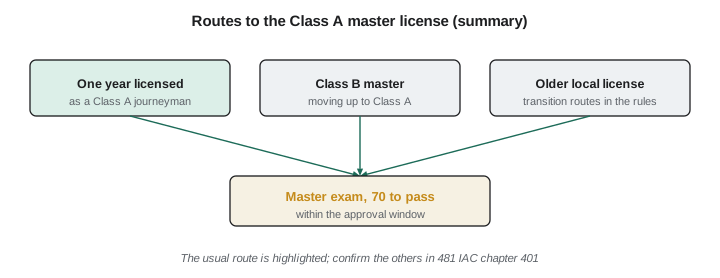
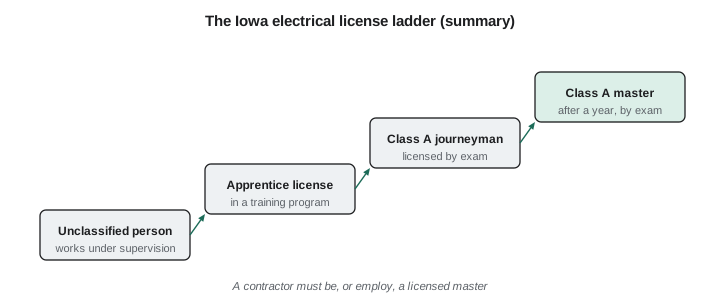
For most candidates, the route to the Class A master license runs through the Class A journeyman license. The rules require at least one year of experience as a licensed Class A journeyman electrician before the master license is issued, together with a passing score on the master exam. In other words, the experience the board counts for the master license is experience gained while already holding a journeyman license, not the years spent as an apprentice. A candidate who earned a journeyman license in May of one year will usually reach the one-year mark in May of the next.
Megan passed the journeyman exam and received her license in April 2025. Linda put the date in the office calendar with a reminder for April 2026. Megan could apply to the board and prepare for the exam before that date, but she needed the year of licensed experience before the master license could be issued, and she wanted to apply in a way that left nothing for the board's staff to question.
The rules also place the exam inside a time window. Under chapter 401 the passing master exam result must fall within a set period around the application, 24 months in the current rule, and the board's authorization to test has its own limit, described in lesson 3. The practical advice is simple: do not pass the exam and then wait a year or two before applying for the license, and do not apply for authorization until you are ready to study and test.
Other routes in the rules
Chapter 401 also contains routes for people whose history began before statewide licensing. When Iowa moved to state licenses in 2008, some electricians already held master licenses issued by cities. The rules provide a path for a person who held a master license from a political subdivision before statewide licensing began, combined with experience as a journeyman, and they describe how a Class B master can qualify for a Class A license by passing the Class A master exam. These routes matter mostly to electricians who were in the trade before 2008, and candidates who think they fit should read the exact wording of the rule and ask the board before relying on it.
Rumors about an eight-year experience route usually come from the journeyman rules rather than the master rules. Those rules allow an applicant to qualify for the journeyman exam with a large number of documented hours outside a formal apprenticeship, and the hours figure in the rule is 16,000 hours, which is about eight years of full-time work. That route leads to a journeyman license first. It does not let a candidate skip straight to the master license.
How the journeyman routes feed the master route
Because the master route rests on the journeyman license, a master candidate should understand how journeymen qualify. The rules list several routes, summarized here:
- Completing an apprenticeship program registered with the U.S. Department of Labor, which is the route Megan took.
- Documenting 16,000 hours of electrical experience and completing continuing education hours set in the rule, for those who learned outside a registered program.
- Holding a residential electrician license and adding further commercial experience, measured in hours in the rule.
- Completing an approved postsecondary electrical program and adding hours of experience.
- Holding a license from another jurisdiction that the rules recognize, with additional education and hours.
Each route ends with the journeyman exam. A year after that license is issued, the journeyman can qualify for the master license by passing the master exam. Boone Ridge's apprentice, Caleb Moore, is on the first route, and Megan has started explaining to him how his hours now will shape his options in five years.
| Route | What the rules require (summary) | Who typically uses it |
|---|---|---|
| Licensed journeyman | At least one year as a licensed Class A journeyman, plus the master exam | Most candidates |
| Class B master | Hold a Class B master license and pass the Class A master exam | Electricians first licensed in the Class B category |
| Earlier local master license | A master license from a political subdivision held before statewide licensing, plus journeyman experience | Electricians licensed by cities before 2008 |
| Reciprocity | A license from a state with a reciprocal agreement, plus the conditions in the agreement | Electricians moving to Iowa |
Reciprocity
Iowa does not accept every out-of-state license. The board grants licenses by reciprocity only to applicants licensed in jurisdictions with which Iowa has a reciprocal agreement, and only on the terms of that agreement. As summarized in chapter 401, the applicant must have held the other license for at least a year and must have qualified for it through an apprenticeship or a large number of documented hours comparable to Iowa's requirement, and the other state's exam must be comparable. The list of states with agreements changes, so an applicant should ask the board for the current list. A master from a state without an agreement takes the Iowa route like anyone else, starting with the journeyman license if necessary.
Iowa has also adopted general laws that make it easier for some people licensed in other states, and for military members and spouses, to obtain an Iowa license. Those laws come with their own conditions, and the board's staff can say whether one applies. Chapter 401 also tolls certain deadlines for licensees on active military duty.
What the board looks at
Eligibility comes down to documents. For the usual route, the key facts are the date the journeyman license was issued and whether it has stayed active. The board can check its own records for an Iowa journeyman license. For other routes, the applicant may need to show earlier licenses, transcripts or records of hours. If an application is incomplete, the board's staff will ask for more information, and an application that does not meet the rule will be denied.
An applicant who is not sure whether unusual experience counts can ask the board for a determination before applying. The rules provide a petition for an eligibility determination, with a fee of 25 dollars in the current rule. This can be worth the fee for someone with out-of-state or military experience, because it settles the question before the applicant spends time and money preparing for an exam.
Chapter 401 also allows certain fees to be waived for applicants whose household income is at or below twice the federal poverty guideline. Applicants who think they qualify should ask for the waiver form when they apply.
Keeping the journeyman license active
The one-year requirement assumes the journeyman license has stayed in good standing. A license that lapsed because a renewal was missed, or one that was under discipline, can raise questions about whether the year counts. Megan's journeyman license runs on a three-year term with its own continuing education requirement, described in lesson 11, and she checked that her hours were up to date before applying. Linda also made sure the name and address on the license matched the application, because small mismatches are a common reason for a staff request for more information. A candidate who changed employers during the year should keep pay records or a letter from each employer in case the board asks how the experience was gained.
Retake limits
Iowa limits repeated attempts at an exam. Under chapter 401, a candidate who fails an exam twice must wait six months and complete 12 hours of continuing education before trying a third time. The same wait and education apply again after a fourth failure, and after six failures the candidate must petition the board for permission to keep testing. These limits are one reason to treat the first attempt as a real attempt rather than a practice run.
# Retake limits as summarized from 481 IAC chapter 401 (study aid; confirm the rule)
def before_next_attempt(failures):
    if failures in (2, 4):
        return "wait six months and complete 12 hours of continuing education"
    if failures >= 6:
        return "petition the board before testing again"
    return "may schedule again (no same-day retest)"

for n in range(0, 7):
print(n, "failures:", before_next_attempt(n))0 failures: may schedule again (no same-day retest) 1 failures: may schedule again (no same-day retest) 2 failures: wait six months and complete 12 hours of continuing education 3 failures: may schedule again (no same-day retest) 4 failures: wait six months and complete 12 hours of continuing education 5 failures: may schedule again (no same-day retest) 6 failures: petition the board before testing again
The inactive master license
Chapter 401 includes an inactive master license for a master who is not currently doing electrical work, for example someone who has moved into management or retired. The inactive license keeps the person's status without the obligations of an active license, and it carries a lower fee. An inactive master may not do electrical work or qualify a contractor until the license is reactivated under the rules. Dale plans to move to inactive status once Megan is in place and he no longer works on jobs, which will keep his license available if he ever needs it.
Planning Megan's timeline
Linda drew Megan's plan on the whiteboard. Megan's journeyman license was issued in April 2025, so her year of licensed experience would be complete in April 2026. She would apply to the board in February 2026, with time for the board's staff to review the application, and expected her authorization letter in March. She would study through the spring and test in May, after the one-year mark, so that the master license could be issued as soon as she passed. If anything went wrong, the six-month authorization window would still leave room for a second attempt in the summer.
Worked problem
Is Megan eligible?
Megan's Class A journeyman license was issued on April 14, 2025, and has stayed active. She plans to apply for the master exam in February 2026 and test in May 2026. Does she meet the experience requirement for the Class A master license, and when?
Show solution
- The usual route requires one year of experience as a licensed Class A journeyman.
- Her journeyman license was issued April 14, 2025, so one year of licensed experience is complete on April 14, 2026.
- She can apply before that date, but the board must be satisfied that she has the year before the master license is issued.
- Testing in May 2026 places the exam after the one-year mark.
Answer: Yes, once she has one year as a licensed journeyman, from April 14, 2026. Testing in May 2026 fits the rule.
Common mistakes
MistakeCounting apprenticeship years toward the master's one year of experience.
InsteadThe one year must be experience as a licensed Class A journeyman.
MistakeExpecting any out-of-state master license to transfer.
InsteadIowa grants reciprocity only with states that have an agreement, on that agreement's terms.
MistakeAssuming the 16,000-hour route leads to a master license.
InsteadIt is a route to the journeyman exam; the master license still requires a year as a licensed journeyman.
MistakeTreating a first attempt as a practice run.
InsteadAfter two failures the rules require a six-month wait and 12 hours of continuing education.
Summary and key terms
- The usual route to the Class A master license is one year as a licensed Class A journeyman plus a passing master exam score.
- Other routes in chapter 401 serve Class B masters and electricians licensed by cities before 2008.
- Reciprocity is limited to states with an agreement with Iowa, on that agreement's terms.
- A petition for an eligibility determination can settle unusual cases before testing.
- After two failures a candidate must wait six months and complete 12 hours of continuing education before testing again.
- Class A master
- Iowa's standard master electrician license, valid statewide and able to qualify a contractor.
- Class B license
- A narrower license category from the transition to statewide licensing.
- Reciprocity
- Licensing based on a license from another state that has an agreement with Iowa.
- Eligibility determination
- A board decision, on petition, about whether an applicant's experience qualifies.
- Inactive master
- A master license held without doing electrical work or qualifying a contractor.
Practice problems
Work each problem on paper first, then reveal the answer to check.
How long must a candidate hold a Class A journeyman license before qualifying for the master license on the usual route?
Show answer
At least one year.
What must a candidate do after failing the master exam twice?
Show answer
Wait six months and complete 12 hours of continuing education before testing again.
Does Iowa accept a master license from any other state?
Show answer
No. Only states with a reciprocal agreement, on the agreement's terms.
Lesson quiz · 5 questions
Score 60% or more to complete this lesson.
Create a free account to save your progress, take quizzes and earn a certificate.